All articles - Developmental Biology
-
 Thanks to modern methods of studying cell biology, deepening the understanding of blood stem cells and connective tissue, knowledge of their origin and differentiation has been significantly enriched. However, despite this, they require systematization and understanding, taking into account theoretical provisions on histogenetic series, or cellular differons, and the development of modern criteria for differon [1, 3, 6].
 -
 The effects of natural and mineral feeds on egg production of queen beeThis article explores the effects of natural and mineral feedson egg production and weight of queen bee. As natural feed for the control group, 50% sugar syrup was used. For the first experimental group, 50% sugar syrup + germinated wheat syrup, and for the second group 50% syrup multimaks mineral supplement
Scientific research results in pandemic conditions (COVID-19) -
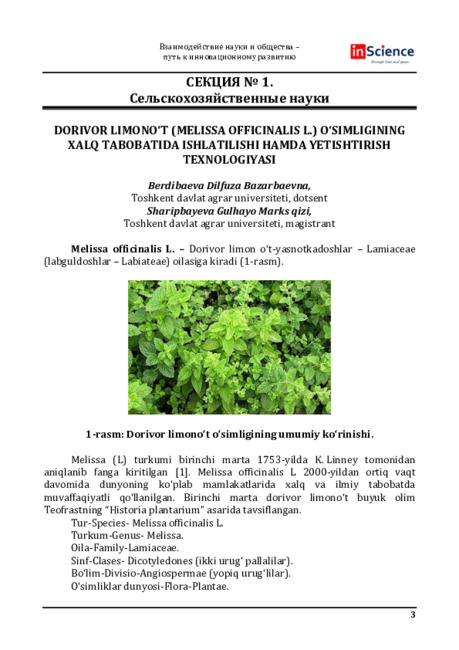 Dorivor limonoʻt (melissa officinalis l.) oʻsimligining xalq tabobatida ishlatilishi hamda yetishtirish texnologiyasi
Interaction of science and society - the way to innovative developmentMelissa (L) turkumi birinchi marta 1753-yilda K. Linney tomonidan aniqlanib fanga kiritilgan [1]. Melissa officinalis L 2000-yildan ortiq vaqt davomida dunyoning koʻplab mamlakatlarida xalq va ilmiy tabobatda muvaffaqiyatli qoʻllanilgan. Birinchi marta dorivor limonoʻt buyuk olim Teofrastning “Historia plantarium” asarida tavsiflangan.
-
Andiz (Inula) – qoqidoshlar oilasiga mansub ko‘p yillik o‘tlar turkumi haqida keltirilgan. O’zbekistonda va dunyoda dorivor o’simliklarni biologik faol moddalar tarkibini o’rganishga ham katta e’tibor berilmoqda, chunki inson tanasidagi gormonlar, vitaminlar, aminokislotalar, fermentlar bilan bog’liq bo’lgan optimal miqdori va nisbati fiziologik jarayonlarning normal o’tishini ta’minlaydi va ularning yetishmasligi inson tanasida turli xil patologik jarayonlarning rivojlanishiga sabab bo’lishi mumkin
-
 Genetic basis of intra- and interspecies hybridization in applied cotton breeding
Catalog of abstractsTopicality and demand of the subject of dissertation. Various techniques of hybridization arc used in crop breeding, including cotton to produce a wide variability in agronomical valuable traits and develop new forms.
Regardless of its implementation hybridization process leads heredity decoding which allow the new plastic genotypes formation with an ability to change and adapt to the new conditions. Hybridization and selection arc considered as a main synthetic method of new varieties development and a success in this largely depends on the choice of crosses method and genotypes of initial forms. Therefore, there is given a special attention for studying the genetic basis and improving of hybridization methods. However, based on the most widely used of hybridization methods arc not always possible to develop varieties having high parameters of composite agronomical traits. Many developed varieties as a result of breeding methods arc genetically become homogeneous, which leads to a reduction of genetic variation and increasing of risk of cpiphytoty outbreaks and decreasing of total productivity (Boroycvich, 1981). Therefore, it is necessary to increase the genetic variability of crops’ agronomic traits by involving of original forms, as well as wild relatives of crops with genetic resistance to various stress factors, diseases and pests.
In increase cotton production through the creation of early maturing, high-yielding having good fiber yield and quality, resistant to various diseases, pests and stress factors, as well as with low level or toxic gossypol in cotton seeds still remain as critical problem in cotton production.
To overcome these problems there need to improving of genetic basis for assessment of existing donors and through the use of various hybridization methods to create new enriched genotypes, promoting positive recombination of polygene in hybrid’ organism for use in applied cotton breeding. Based on the above stated, the study of the genetic aspects of various methods of remote composite intraspecific and interspecific hybridization, based on the comparative evaluation of the effectiveness in order to isolate valuable recombinants and transgressive forms having new genetic variability of traits arc important both scientific and practical point of view.
The dissertation meets the objectives as set out in the Lows of Uzbekistan «On Seed Production» of December by 21, 2007 and «On Breeding achievements» by August 21, 2002 directed to developing and introduction of high-yielding cotton varieties, with a good yield and fiber quality, tolerance to various factors, as well as improving seed production.
Purpose of researches is comparative study of effectiveness of the various methods of intraspecific composite, convergent and inter-specific (3 to 5 species) hybridization revealing the nature of inheritance, form shaping and transgressive variation of traits, total and (+)-gossypol in creation of genetically enriched breeding material and for using in the applied cotton breeding.
Scientific novelty of the dissertation research is follows:
in the system of topcrosscs there used genetic evaluation for combining ability of main agronomic traits cotton varieties with different origins for further using in intraspecific composite and convergent hybridizations;
there established principally dominant inheritance and overdominance type of inheritance (with deviation toward the initial forms with the high agronomic traits) in F| at composite intra-and interspecific hybridization which genetically distinct accessions from the local and foreign selection and wide transgressive variability in F2-F3, facilitating to efficient selection of valuable recombinants;
first identified the inheritance nature and variability of total and (+)-gossypol in the cotton hybrids’ generative parts, developed by involving of American accessions with high (+)- gossypol and local varieties, as well as their correlation with some agronomical valuable traits;
first there held comparative study of economic traits at the different forms of amphidiploid G.thurheri x G.raimondii K-58 (hirsutum type) and K-59 (type harhadense) for free reproduction and after crossing the cultural forms of G.hirsutum L. species, it was established a wide range of variation of agronomic traits at mutant form of K-59 and composite hybrids, derived from it’s participation as compared to K-58 amphidiploid and it’s composite hybrids. It was found out those two types (type G.hirsutum K-58 and type G.harhadense K-59) of amphidiploid G.thurheri x G.raimondii at the free reproduction exhibits similarities with the both cultural tctraploid species; G.hirsutum L. and G.harhadense L., respectively. When they crossed with the cultivated G.hirsutum L. species these amphidiploid forms also behave as natural tctraploids;
it is revealed that, at the composite hybrids produced with the participation of the both forms of amphidiploid (K-58 and K-59) G.thurheri Tod. x G.raimondii Ulhr., as a result of transgressive variation, there is a disturbance of negative correlations between such traits as yield and fiber length, fineness and boll numbers conducive to positive recombinants emergence and increase donor opportunities of amphidiploids;
by comparative study of different methods of remote intra-and interspecific hybridization revealed the genetic nature of inheritance nature and variation degree of the main agronomic traits in composite hybrids, as well as their effectiveness in allocating recombinants having a new genetic variability of traits;
it is revealed that the possibility of breaking some negatively correlated traits by different methods of composite intra-and interspecific hybridization and selection of recombinants combining early maturity and high productivity, high fiber output with its quality and 1000 seed weight, etc.;
it is confirmed that the effectiveness of used methods such as a composite intraspecific and interspecific crosses, to increase positive transgressive variation and segregation genetically enriched recombinants having new combination of high levels of positive parameters of agronomic traits that were recommended and used to develop valuable initial material and new cotton varieties;
the obtained theoretical data on inheritance nature, hcritability and agronomic traits morphogenesis, levels of total and (+)-gossypol and their correlation with other agronomical valuable traits at developed hybrids could be successfully used in the field of fundamental research, and created unique hybrids, forms, progenies, lines and varieties could be used in applied cotton breeding.
Conclusion
1. There obtained and identified on comparative study base of intraspecific composed and converged hybrids with participation of six registered medium staple cotton cultivars in topcross system and high effects of GCA on the following traits:
«50%-cmcrgcncy-50 % flowering» Yulduz (-0.71); Tashkent-6 (-0.39) and in S-9070 (-0.38); “50% cmcrgcncy-50% maturing” S-9070 (-1.43), and in
Tashkent- 6 (-0.91); one boll weight S-6532 (+ 0.11); 1000 seeds weight S-9070 (+0.51); on productivity Tashkent-6 (+5,28), S-4911 (+4,04) and S-9070 (+2 24); fiber output S-6532 (+1,29); fiber length S-4911 (+0,70) and S-6532 (+0,48); fiber strength S-6532 (+1,57) and S-4911 (+0,91); micronairc S-6532 (+0,24) and Ak-Darya-6 (+0.24). These donors of high valuable traits were used by us for improving of the recurrent varieties by composite and convcrcgcnt hybridization. It was found that involvement of the varieties with a high GCA in convergent hybridization allows improving of the recurrent varieties and developing of a new initial material for cotton breeding:
inheritance nature and variability degree of agronomic traits at intraspecific composite and convergent cotton hybrids revealed the relative efficiency of the studied hybridization techniques during elaboration of new initial material with enriched genotypes of agronomic traits, and recommended to use in geneticselection process;
convergent hybrids F i dominated by early maturity, in terms of productivity and fiber output occurcd overall effect of overdominance, and F2-F3 appeared as positive transgressive forms;
significant effect of the genotype of the parental forms involved in hybridization on the inheritance nature of fiber quality (length, micronairc, strength) had convergent hybrids Fj, as well as their level of recombination in F2-F3 indicating the need for breeding of recombinants on these traits in early generations, taking into account genotype of initial forms;
the inheritance of the wilt tolcrancccs bccamcs not only depending on the pathogen load in soil fungus infections, but also depends on the used hybridization methods. Thus, most high resistance, i.c. negative superdominance on wilt tolerance observed in convergent hybrids F, and F2;
the direction and strength of correlation between the studied traits in intraspecific composite and convergent hybrids varied in depending on crosses type and from genotype of recurrent varieties. At present ease, the greatest number of recombinants with positive combination of high indicator traits which determining fiber quality, as well as its output, length, observed with with composite, particularly with convergent hybridization.
2. For the first time, on the basis of studies on determination the percentage of (+)- gossypol in seeds of genetically different cultivars of Uzbek cotton selection and analysis of variability, inheritance degree of total and (+)-gossypol in the environmentally and genetically remote hybrids and their correlations with economically valuable traits was proved:
the cultivars S-6524, S-6530 and S-6532 which were elaborated involving subspccic of G.ssp.punctatum had the highest level of (+)- gossypol and the «Turon» cultivar which was developed by composite hybridization has a low indicator of the current trait and relatively high level of total gossypol in seeds;
It was determined intermediate inheritance level of (+)- gossypol in the petals and seeds in F| hybrids and wide positive and negative transgressive variability in Ғ2-Ғ3. It was proved that the efficiency of plant selection with high (+)- gossypol in seeds since F2, that confirmed with segregation of constant progenies and lines on trait basis in F4 hybrids;
as a result of research the cross-correlation total and ( +)- gossypol and some agranomically valuable traits was found that between the ( +)- gossypol in the petals and seed exists a weak correlation. The data on correlations of studied traits showed an independent genetic control of (+)-gossypol in the generative organs and independent inheritance of them at cco- geographically and genetically remote hybridization.
3. For the first time, based on comparative study of agronomic traits of amphidiploid G.thurheri Tod. x G.raimondii Ulbr. two forms (hirsitum type -K-58 and harhadense type -K-59) and hybrids derived from G.hirsutum L. varieties revealed:
both studied forms of hirsutum type and harhadense type of amphidiploid G.thurheri Tod. x G.raimondii Ulbr., being functional diploids provided wide combinative variability in the progeny from the free reproduction and crossing with the cultivars of tetrapioid G.hirsutum L., and showed their similarity to G.hirsutum L. and G.harhadense L. tctraploid species, respectively;
as a result of the research a group of unique composite hybrids (F\G.thurherii Tod. x G.raimondii Ulbr.) x G.hirsutum L. confirmed unlimited transgressive variation as the basis of a new form revealing, new gene pool developing for use in applied cotton breeding. Herewith, at bud mutant K-59 observed emergence of phenotypes with higher variability for most agronomic traits compared to K-58;
it was found out that in composite hybrids which obtained by crossing of studied forms of G. thurberi Tod. x G. raimondii Ulbr. amphidiploids (2n=52) and with G.hirsutum L. cultivars were observed relatively rapid improvement on productivity and its components in comparison with freely propagated amphidiploids offspring. Herewith, composite hybrids involving K-58 on boll number in all generations was slower comparied to hybrids derived from K-59;
composite hybrids F, obtained involving two cultivars of cultivated forms on fiber output and length were observed deviation toward the parent with the best expression of the trait. It was revealed that the fiber output and length of the studied composite hybrids susceptible to less variability compared in terms productivity and its components. Relatively high variation was manifested on fiber output in F2, and on fiber length in F2-F3. In freely multiplying offspring of K-59 and its hybrids with varieties in F3 was observed the derivations of more long staple plants compared with hybrids, developed involving K- 58;
free propagating amphidiploids’ offsprings and composite hybrids selected by using of cultural forms showed the least wilt susceptibility compared with the control. Wilt resistance of barbadense type K-59 progenies from the free breeding was higher as compared than offspring of K-58, and higher in composite hybrids F2-F4, obtained involving K-59.
4. Under the general principle of correlation relationships among the studied hybrids were found that composite hybrids F2 amphidiploids’ G.thurberi Tod x G.raimondii Ulbr., both types (K-58 and K-59) with a G.hirsutum L. type Acala sj-5 cultivar showed mainly low positive and negative correlation coefficient values, which in most eases were none significant. In hybrid combination of K-58 x Andijan-60 fiber output and length correlated positively;
5. Based on comparative study of inheritance and variation of agronomic traits in developed 4 genomic [(G.thurberi Tod. X G.raimondii Ulbr.) X G.arhoreum L.] x G.hirsutum L., 5 - genome [(F|K-28 x S-6524 ) x G.harhadense L. hybrids and their backcross hybrids were proved:
the possibility of broad transgress variation and creation genetically enriched recombinants on unique traits;
efficiency of backcrosscs among the composite interspecific earlier generation hybrids for rapid improvement and stabilization of eultuvated forms of cotton;
wide transgress variability presence in 4 and 5 species composite hybrids and their backcross hybrids on productivity and its components starting with F|. In particular, it was confirmed the effectiveness of five species hybridization to increase the boll numbers per plant, boll weight and weight of 1000 seeds at 4 and 5 species and backcrosscs hybridization.
by obtaining recombinants having fiber output 43,1-45,0%, fiber length - 40 mm and above, micronairc of fiber 3.9-4.5 and wilt tolerance it was confirmed the effectiveness of introgressive and transgressive breeding at composite 4-5 species hybridization and their backcross hybrids.
6. As a result of studies of correlations in composite 4-5 species and backcrosscs hybridization of F2 hybrids it was revealed the effectiveness of used methods in interruption of such negatively correlated traits as «fiber output» and «fiber length» from medium positive (r=+0,39) up to high positive (r=+0,62), «fiber length» and «micronairc» -medium positive (r=+0,55), as well as «fiber length» and «fiber strength» -medium positive (r =+0,56 and r=+0.50).
7. Based on intraspecific composite and convergent, eco-geographically and genetically remote and 3-4-5 species and backcrosscs hybridizations were developed the following new breeding progenies, lines and varieties of upland cotton:
by composite and convergent hybridization way-L-7966, L-214/05; CC-896/05; CC-896/28; CC-991/05; CC-991/09; KC-1/05; КС-1/08; КС-1/18; KC-1/35; KC-1/51; KC-1/77, S-231-233/07, L-234-235/07, L-236-237/07, L-242-243/07, L-244-245/07, L-482-483/07, L-484-485/07, L-666-667/07, L-397-398/07, L-802-803/07, L-814-815/07, L-230/05;
cco- geographically and genetically distant hybridization - cultivar S-7300, S-7301, the progenies S-5344, S-5361. HPG-1;
composite 3 - specific hybridization -cultivar «Sulton», «Jarkurgan», S-7276, S-7277, as well as a number of lines;
8. Using the remote intra-and interspecific hybridization it was elaborated unique introgression hybrids, genetically enriched cotton recombinants, progenies, lines, and varieties «Sulton», «Jarkurgan», S-7276, S-7277, S-7300, S-7301 having positive combination of high agronomic traits. Cultivar «Sulton» was included in the State register from 2011 and for the period from 2008 up to 2014 it was sown on the area of over than 275,5 thousand hectares.
9. The following rcccomcndations were given for practize and future studies:
use of method convergent hybridization, allowing improving of agronomic valuable traits of recurrent parent and registered medium staple cotton cultivars and receiving a positive transgressive variability;
as an initial source in convergent crosses use cotton varieties with high General combination ability (GCA) on the following: on early maturity- Tashkent-6 and S-9070; boll weight - S-6532; weight of 1000 seeds S- 9070; on productivity -Tashkent-6, S-4911 and S-9070; fiber output -S-6532; fiber length - S-4911 and S-6532; fiber strength - S-6532 and S-4911; and for micronairc - S-6532 and Ak-Darya-6.
for use as an initial source in cotton genetics and breeding research such new cotton selection progenies as well as the lines: KS-1/05; K.S-1/08; K.S-1/18; KS-1/35; KS-1/51; and KS-1/77, L-7966, L-214/05, S-214/05, SS-896/05; SS-896/28; SS-991/05 and SS-991/09 with early maturity, productivity, wilt tolerance, fiber output and quality.
to use in cotton genetics and breeding researches both USA accessions BC3S,-47-8-l-17, BC3S|-l-3-6-15 with 95% of (+)-gossypol level in seeds and lines HPG-1 and others with 90% of (+)-gossypol level, as donors on this trait. Since 2012, developed and studied in the competitive variety testing of Institute the following lines: L-404-05 and L-6970 with high (+)- gossypol level were recommended for testing on ground control of the State Inspection Commission for Agriculture crops variety testing.
widespread use of various forms of synthetic tetrapioids G.thurheri Tod. x G.raimondii Ulbr., 4-5 species composite hybrids [(G. thurheri Tod. x G. raimondii Ulbr.) x G.arhoreum L.] x G.hirsutum L. and [(F t K- 28 x C-6524 ) x G.harhadense L., as well as their backcrosscs for achievement the broad transgress variation, elaboration genetically enriched recombinants on economically valuable traits and their use in practical cotton breeding;
to extend the areas in of early maturing commercialised cotton cultivar «Sulton» and perspective one «Jarkurgan» as well broad testing of such as new varieties S-7277, S-7300 and S-7301 in the republic. -
 In the flora of Jizzakh region, the bioecological characteristics of astragalus L. Species.This article provides information about species belonging to the Astragalus L. family distributed in Jizzakh region.
Новый Узбекистан: наука, образование и инновации -
Subject of research: the lakes of wetland Sudochje, Vest Karatcrcn, Muynak and Sarbass, the Aydaro-Amasaj system lakes, the lakes of Khorezm oblast, the lake Sarakamish in Fergana.
Purpose of work: to learn the present-day characteristics of zooplankton into plain lakes, those have transform drainage due to economical activity.
Methods of research: to include laboratory and field tools of hydrobiology analyses of zooplankton; physicochemical methods tj learn of water living conditions.
The results obtained and their novelty: has been carried out the inventory data of zooplankton species into lakes of Uzbekistan that includes a literary and native data; has been observed a seasonal and long-term succession and the quantitative dynamic of zooplankton into lakes of different depth, salinity; has been study the index of biodiversity, index of biomass distribution and other structural characteristics of zooplankton community.
Practical value: zooplankton data examined with fauna and biocenology perspective could be use for the prediction a species structure and quantity of zooplankton; to appear opportunity to modification of dominant zooplankton species for the community for improvement of food base into water bodies for fisheries importance.
Degree of embed and economic effectively: obtained results were used by development (substantiation) projects studied of potential productivity of reservoirs.
Field of application: practical and sanitary hydrobiology, ecological monitoring. -
 Milk productivity and some biological peculiarities of black-particolored breeds of cows of different genotypes”
Catalog of abstractsSubjects of research: Black-particolored cow breeds of different genotypes and milking technology by lactation phases.
Purpose of work: Development of technology of milking improvement by lactation phases, display of genetic potential of milk productivity of black-particolored breeds of cows of different Israeli Holstein genotypes and definition of biological peculiarities of their environmental adaptability.
Methods of research: zootechnical, technological and biological methods.
The results obtained and their novelty: The genetic potential of milk productivity of black-particolored breeds of cows of different genotypes of Israeli Holstein breed is found out. The milking level increased by 43-66 percent. For the first time their exterior peculiarities, the technology of milking improvement by lactation phases, environmental adaptability and their relation to productivity were studied.
Practical value: Receiving of different genotype animals by crossing of black-particolored breed of cows with Israeli Holstein breed, identifying of their productivity genetic potential at optimum conditions of their housing and feeding.
Forming of high-productive cattle-stock, environmentally adapted, tolerant to hot climate and gaining of milk productivity of 3900-4600 kg.
Degree of embed and economic efficiency: Results arc introduced in cattle stocks in farms Soliikh, Azizjan and Murat of Kibray District of Tashkent Region. The profit of 345,6-572,9 Thousand Sums was earned from each cow, profitability rate made 36.4-41.1%.
Field of application: Cattle-breeding farms specialized in dairy production in suburbs of Tashkent city. -
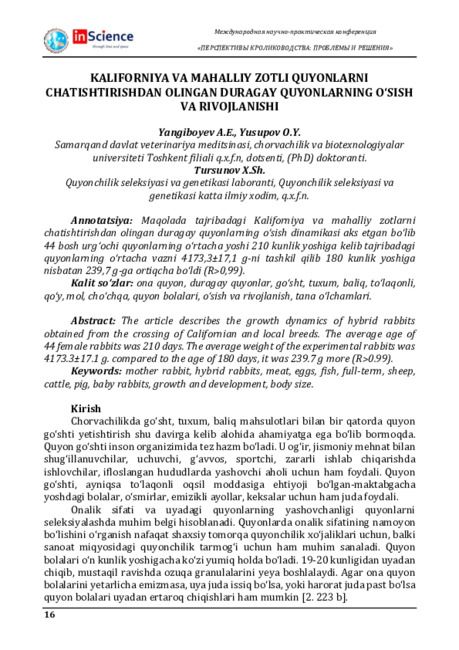 Growth and development of hybrid rabbits from crossing california and local rabbitsThe article describes the growth dynamics of hybrid rabbits obtained from the crossing of Californian and local breeds. The average age of 44 female rabbits was 210 days. The average weight of the experimental rabbits was 4173.3±17.1 g. compared to the age of 180 days, it was 239.7g more (R>0.99).
Перспективы кролиководства: проблемы и решения -
 Adaptive features of vegetative organs species of the genus Climacoptera Botsch. (Chenopodiaceae) in connection with halophytic
Catalog of abstractsTopicality and relevance of the theme of the dissertation. Today soil salinization on a world scale is one of the global problems that cause great damage to the sectors of economy. «Currently, nearly 10% of the land in the world consists of saline soils that have a negative impact on 75 countries, located in arid zones»1.
In the years of independence, large-scale reforms have been carried out in the agricultural sector of our country with a special focus on native reclamation of land and improvement of soil fertility. On the basis of the realized policy measures certain results were reached in this area, including the use of effective methods of fighting against soil salinization, introduction of water-saving technology, the definition of resistant species of plants and development of new kinds for saline soils, as well as improving their efficiency in phytomcliorative events.
In the world, definition of halophytic plants sustainable on saline soils and their use for reclamation of saline lands, including the definition of halomorphic and xeromorphic traits in species of Climacortera Botsch. family of Chenopodiaceae Vent., prevailing among halophytic plants are of great importance, which makes it possible to understand the resistance of plants to salinity and adaptive features of halophytes. One of the current problems is determining the adaptive features of vegetative organs to the salinity on the basis of morphological and anatomical traits of species Climacoprtera and introducing them into practice. Determination of morphological and anatomical adaptive features of vegetative organs of Climacoprtera species to salinity and their use in practice arc as follows: clarification of the origin, taxonomy and ecology of Climacoprtera species, studying the structural features and development of vegetative organs under the influence of drought and salinity using morphological and anatomical methods, evaluation of specificity and functionality of adaptive anatomical features, definition of sustainable indicators of species on the basis of genotypic and phenotypic characteristics, reasoning of halotolcrance and haloresistance, determination of the economic value of the plant, proving the possibility of halophytes using for rehabilitation of saline and marginal lands.
The present dissertation research to a certain extent serves for the fulfilment of the tasks stipulated in the Presidential Decree No. PD-3932 of the Republic of Uzbekistan «About measures to fundamentally improve the system of land reclamation» of 29 October 2007, the Resolution No.PR-1958 «About measures to rationally use the water resources and improve the ameliorative state of irrigated lands in the years 2013-2017» of 19 April 2013, as well as other normative and legal documents adopted in this area.
The aim of the research is determining the adaptive features of morphogenesis, ontogenesis and the anatomical structure of vegetative organs of Climacoptera Botsch. (Chenopodiaceae) species in connection with halophytic.
Scientific novelty of the research is as follows:
for the first time, we identified species-specific characteristics in ontogenesis and morphogenesis of species of the genus Climacoptera due to the different conditions of habitat;
we identified different types of mesophyll in assimilating organs, a combination of xero- and halomorphic signs in connection with environment, as well as the reaction of a leaf in the altered habitat;
we characterized the formation of the structure of species of the genus Climacoptera axial organs and determined the direction of structure development: in the stem - from the primary beam to abnormal policambial, radically - from diarchy to secondary thickening;
we proved the structural significance of primary and secondary protection in the cortex of the central cylinder in different environmental conditions;
we determined the presence of alkaloids in aboveground mass and nutritional value of species of the genus Climacoptera-,
we revealed the general direction of the adaptatiogenesis of species of the genus Climacoptera: rosette growth form, mesobasitonic and basitonic branching, succulence of leaf with a kranz-structurc, policambiality of stem and root;
we determined the prevalence of halomorphic signs of species growing in Mirzachul on soils with sulphate-chloride type of salinity, xcromorphic signs - the species growing in Ustyurt with chloride-sulphatc type of salinization;
we recommended the use of species of the genus Climacoptera in phytomclioration of degraded pastures on the basis of halomorphic and xcromorphic signs, as well as their feeding qualities.
CONCLUSIONS
On the basis of the carried research on the theme of the doctoral dissertation «Adaptive features of vegetative organs of species of the genus Climacoptera Botsch. (Chenopodiaceae) in connection with halophytic» the following conclusions are presented:
1. It was determined that in the latent period of ontogenesis, the fruit of Climacoptera species are protected by the sclerificd perianth in varying degrees; the pericarp and spermoderm arc reduced, the embryo is coiled with green cotyledons and polynomial buds. Seedling rosette, compact habitus and the length of all the stages of ontogeny reflects the adaptation of species to the current arid conditions.
2. In assimilating organs of Climacoptera species, different types of mesophyll were identified: dorsiventral type in cotyledons, Climacoptera-\ypc and krantz-ventral-dorsal type in the leaf. Leaf adaptation to arid conditions is ensured by a high degree of succulence and the presence of kranz-cells with C4-typc of photosynthesis.
3. The difference of the structural features of the leaf of Climacoptera species from Salsola genus due to discontinuity of chlorenchyma layer, 3 conductive beams in the central plane, and remoteness of peripheral beams from kranz-plates was confirmed.
4. It was found that the primary stem bark combines parenchyma and collenchyma in different volumes due to habitat conditions: the predominance of sclcrification of cortex in species growing in Ustyurt, parenchymatous - in species growing in Mirzachul and Kyzylkum.
5. A relationship was established between the anatomical structure of stem and moisture keeping ability in arid climate in Climacoptera species, which is evidenced by the primary sheaf structure of stem and secondary abnormal policambial sclcrcnchymatous beam-type thickening.
6. The increase of the conductive ability and protection of Climacoptera species root from drying in arid conditions arc due to a spiral root system, homozygosis, diarch primary xylem, poly cambial secondary thickening, early phellogcn laying, spiral beam-type thickening, greater parcnchimatization and less scelirification (C. ferganica, C. affinis).
7. Low content of alkaloids in various aboveground mass was found, and the nutritional value of Climacoptera species was determined.
8. The main direction of the adaptive process of Climacoptera species arc: rosette growth form, mesobasitonic and basitonic branching, succulence of kranz-structurc leaf, policambial stem and root, sclcrification and parcnchimatisation of perianth.
9. In relation to halomorphic and xcromorphic signs of vegetative organs, structural and adaptive groups of species were identified: halomorphic, xcromorphic and halo-xcromorphic reflecting the environment and belonging to different types of habitat.
10. On the basis of halomorphic and xcromorphic signs and taking into account the content of biochemical fodder indicators of aboveground mass, the perspective species of Climacoptera arc recommended for use in phytomclioration of degraded pastures. -
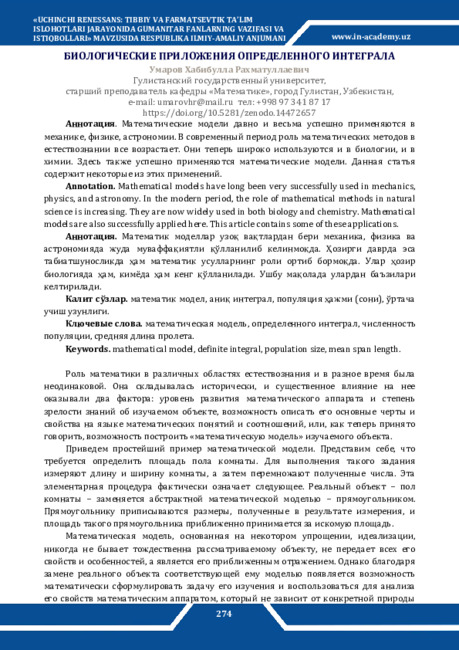 БИОЛОГИЧЕСКИЕ ПРИЛОЖЕНИЯ ОПРЕДЕЛЕННОГО ИНТЕГРАЛАMathematical models have long been very successfully used in mechanics, physics, and astronomy. In the modern period, the role of mathematical methods in natural science is increasing. They are now widely used in both biology and chemistry. Mathematical models are also successfully applied here. This article contains some of these applications
Pedagogy and psychology in the modern world: theoretical and practical research -
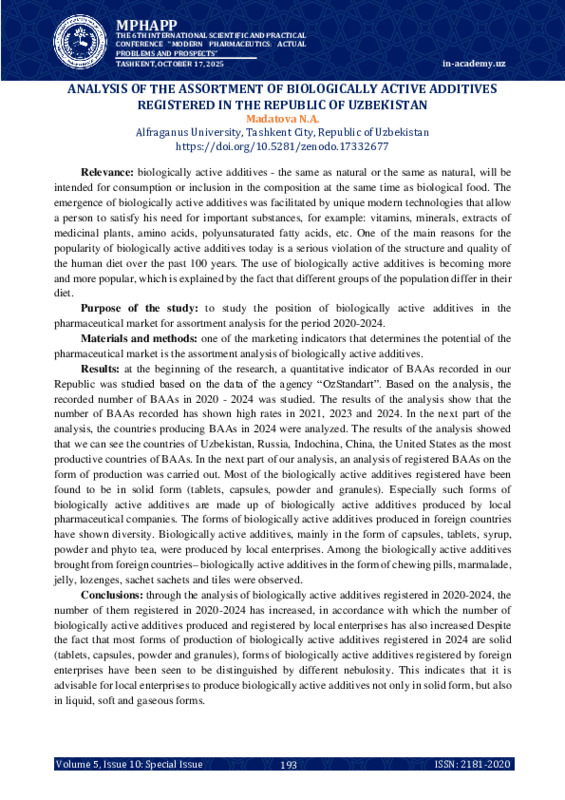 ANALYSIS OF THE ASSORTMENT OF BIOLOGICALLY ACTIVE ADDITIVES REGISTERED IN THE REPUBLIC OF UZBEKISTANBiologically active additives - the same as natural or the same as natural, will be intended for consumption or inclusion in the composition at the same time as biological food.
Eurasian Journal of Academic Research
