All articles - Legal Medicine
-
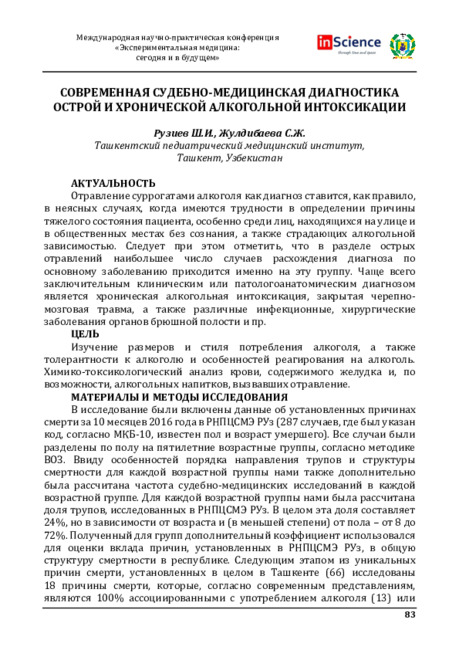 Современная судебно-медицинская диагностика острой и хронической алкогольной интоксикации
Экспериментальная медицина: сегодня и в будущемОтравление суррогатами алкоголя как диагноз ставится, как правило, в неясных случаях, когда имеются трудности в определении причины тяжелого состояния пациента, особенно среди лиц, находящихся на улице и в общественных местах без сознания, а также страдающих алкогольной зависимостью. Следует при этом отметить, что в разделе острых отравлений наибольшее число случаев расхождения диагноза по основному заболеванию приходится именно на эту группу. Чаще всего заключительным клиническим или патологоанатомическим диагнозом является хроническая алкогольная интоксикация, закрытая черепномозговая травма, а также различные инфекционные, хирургические заболевания органов брюшной полости и пр.
-
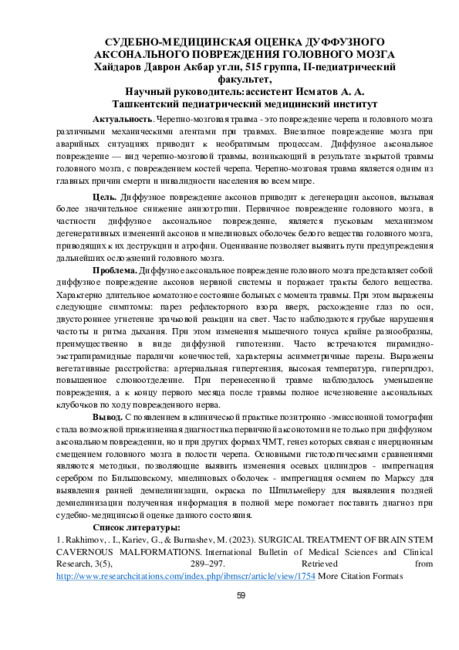 Судебно-медицинская оценка дуффузного аксонального повреждения головного мозга
Современная медицина глазами молодых ученыхЧерепно-мозговая травма - это повреждение черепа и головного мозга различными механическими агентами при травмах. Внезапное повреждение мозга при аварийных ситуациях приводит к необратимым процессам. Диффузное аксональное повреждение — вид черепно-мозговой травмы, возникающий в результате закрытой травмы головного мозга, с повреждением костей черепа. Черепно-мозговая травма является одним из главных причин смерти и инвалидности населения во всем мире.
-
 Современные критерии оценки острой кровопотери в судебно- медицинской практике
Scientific works of gifted youth and medicine of the XXI centuryПо оценкам Всемирной организации здравоохранения в Европе ежегодно происходит около 80 миллионов несчастных случаев, при этом от травматических повреждений с кровопотерей погибает около 1,5 миллионов человек. По оценкам Всемирной организации здравоохранения в Европе ежегодно происходит около 80 миллионов несчастных случаев, при этом от травматических повреждений с кровопотерей погибает около 1,5 миллионов человек.
-
 Патоморфологические критерии острого отравления суррогатами спирта в судебно-медицинской практике
Scientific works of gifted youth and medicine of the XXI centuryПо данным статистической отчётности, смертельные отравления алкоголем и его суррогатами составляют более 55% всех отравлений. На долю смертельных отравлений суррогатами алкоголя приходится около 3-5%. Резко возросло количество отравлений органическими растворителями и техническими жидкостями, принимаемыми внутрь в качестве суррогатов алкоголя. По данным статистической отчётности, смертельные отравления алкоголем и его суррогатами составляют более 55% всех отравлений. На долю смертельных отравлений суррогатами алкоголя приходится около 3-5%. Резко возросло количество отравлений органическими растворителями и техническими жидкостями, принимаемыми внутрь в качестве суррогатов алкоголя.
-
 Forensic medical criteria for determining the birth of a child
Topical issues of fundamental medicine: today and in the futureThe establishment of the gestational age is one of the most important issues to be resolved in the study of fetal and newborn corpses. In forensic medical expertise and autopsy practice for diagnosis gestational age usually uses a set of fctomctric indicators, including weight and length, a number of linear parameters of the head, trunk and limbs, and the mass of organs.
-
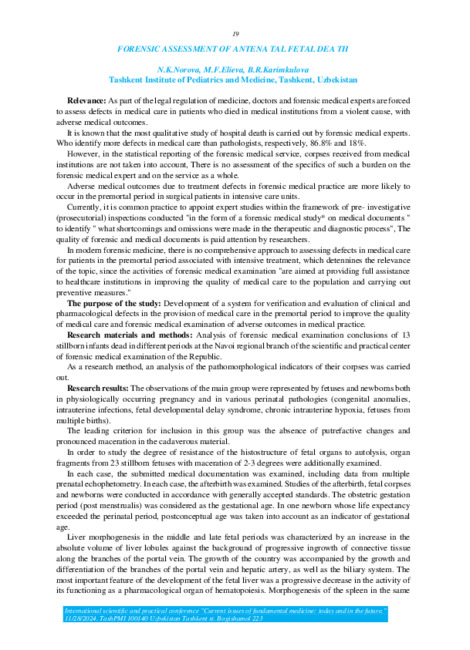 Forensic assessment of antena tal fetal death
Topical issues of fundamental medicine: today and in the futureAs part of the legal regulation of medicine, doctors and forensic medical experts arc forced to assess defects in medical care in patients who died in medical institutions from a violent cause, with adverse medical outcomes.
-
 Forensic medical assessment of medical care in obstetric practiceIn forensic medical practice, solving the problem of defining the concept of medical error is necessary to distinguish offenses from the so-called "permissible professional errors in medical activity." It is quite understandable that most manufacturers of medical services attribute medical errors to purely medical concepts, and therefore they say that it is impossible to bring medical workers to criminal responsibility for professional mistakes. At the same time, for many years in the works of forensic doctors and lawyers, the concept of "medical error" has been so contradictory that it did not contribute to an objective study of this phenomenon.
Topical issues of fundamental medicine: today and in the future -
 Шахси номаълум мурдаларни суд тиббиётига оид текширишнинг жида тлариШахси номаълум мурдаларни ва топилган склет суяк колдикларидан ёшини аниклаш суд-тиббиётда ва экспертиза масалаларида уз ах,амиятини саклаб колмокда, чунки куролли тукнашувлар, терактлар, табиий офатлар, техноген офатлар, жиноий котилликлар сони юкори даражада колмокда. Х,озирги вактда ташки параметрларни бах,олашнинг макроскопик ва морфологик усуллари етарли даражада аникликка эга эмас. Инсоннинг биологик ёшини аникрок аниклаш учун суд тиббиётида кулланиладиган усулларни купайтириш ва янги тадкикот усулларини янада ривожлантириш долзарблигини курсатади. Айни пайтда шахе айнанлигини аниклаш буйича туш суягини суд тиббий экспертизасини такомиллаштиришни урганиш нафакат суд тиббиёти, балки тиббиётнинг бошка сох,алари мутахассислари учун мух,им муаммоли масалаларидан бири х,исобланади. Баъзи усуллар бироз катта, бошкалари эса ёшни аниклашда бироз кичикрок хатоликларга эгадир. Бу эса инсоннинг биологик ёшини аникрок аниклаш учун суд тиббиётида кулланиладиган усулларни купайтириш ва янги тадкикот усулларини янада ривожлантириш долзарблигини курсатади. Айни пайтда шахе айнанлигини аниклаш буйича туш суягини суд тиббий экспертизасини такомиллаштиришни уРганиш нафакат суд тиббиёти, балки тиббиётнинг бошка сохалари мутахассислари учун мухим муаммоли масалаларидан бири хисобланади.
Topical issues of fundamental medicine: today and in the future -
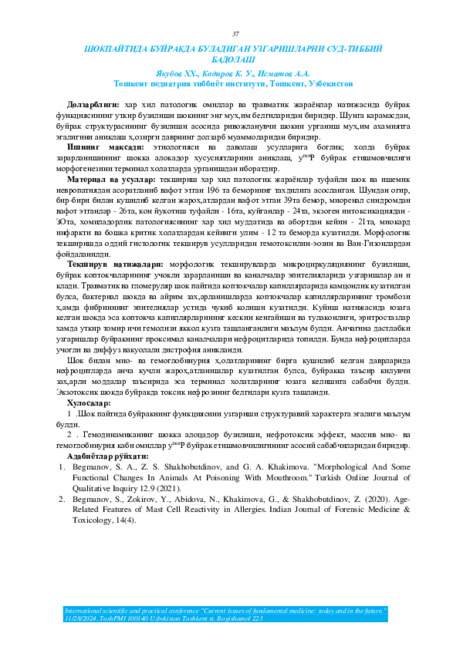 Шокпайтида буйракда буладиган узгаришларни суд-тиббий бадолашХар хил патологик омиллар ва травматик жараёнлар натижасида буйрак функциясининг уткир бузилиши шокнинг энг мух,им белгиларидан биридир. Шунга карамасдан, буйрак структурасининг бузилиши асосида ривожланувчи шокни урганиш мух,им ахамиятга эгалигини аниклаш х,озирги даврнинг долзарб муаммоларидан биридир.
Topical issues of fundamental medicine: today and in the future -
 Forensic medical assessment of injuries of abdominal cavity and retroperitoneal space
Catalog of abstractsTopicality and relevance of the dissertation theme. Today, there is an increase of injury rate in the world as a result of the intensification of using modem transport vehicles, the development of various kinds of sports, as well as injuries in everyday life and at work, and deaths from mechanical injuries ranked the third place among all deaths. In Europe, more than 150,000 people die each year as a result of trauma, such as traffic accidents, falls from a height, etc. Mechanical abdominal injuries occur in 2-5% of cases.
From the first days of independence in our country in order to improve the quality of care systematic work on the implementation of effective health system models is conducted, as well as the targeted use of modem methods of diagnosis. In particular, the use of computed tomography and ultrasound diagnostics has improved the early diagnosis of abdominal blunt injuries. As a result, the life expectancy for men is from 67 to 73.5 and for women is up to 75.8 years.1
In world forensic practice, the problem to increase the effectiveness of expert evaluation of abdominal cavity and retroperitoneal space injuries is associated with the need to develop such scientific targets as: to elaborate scientific bases of definition the severity of abdominal injuries and to determine the tactics of treatment in living individuals, to study the parenchymal (liver, spleen and kidney) abdominal injury mechanisms, interpretation of injury assessment considering mechano-genesis, injury relationship from influencing factors, the development of modem clinical and instrumental methods of injury investigation, the elaboration of mechanisms to identify morphological parameters of abdominal and retroperitoneal space injuries with lethal outcomes, substantiation of revealed morphological signs with parenchymal organ blunt injuries.
To a certain degree, this dissertation is the decision of the tasks provided for in the Law of the Republic of Uzbekistan «Law on the Judicial Review», in the Resolution of the Cabinet of Ministers №-1652 dated November 28, 2011 «On measures for further deepening of reforming the healthcare system» as well as in other legal instruments adopted in this area.
The aim of research work is to substantiate the criteria for legal diagnosis based on the study of clinical and instrumental and morphological features of the injuries of abdominal cavity and retroperitoneal space with blunt abdominal trauma.
The scientific novelty of the research is as follows:
first developed forensic criteria for liver, spleen and kidney injuries, allowing much probability to establish the type of traumatic exposure, the mechanism and circumstances of getting injured;
developed expert criteria to evaluate subcapsular bleedings of parenchymal organs, depending on the location and volume in living individuals;
substantiated expert criteria for severity assessment (light, moderate, severe) injuries with blunt injuries of the abdominal cavity and retroperitoneal space;
improved mechanisms for forensic evaluation, improvement of the quality of forensic examination in blunt trauma of liver, spleen and kidneys;
worked out practical recommendations to improve the reliability of results of visual, morphological, clinical and instrumental methods of research at forensic examination in cases of liver, spleen and kidney injuries by blunt objects.
Conclusion
On the basis of studies on the doctoral dissertation on the theme "Forensic medical assessment of the injuries of the organs of abdominal cavity and retroperitoneal space" the following conclusions are presented:
1. Injuries of the organs of abdominal cavity and retroperitoneal space in the studied period of 2004-2015 y. accounted for 5.1 ± 0.2% of all injuries. Half of these cases (2.5%) are blunt abdominal trauma, of which 60% are injuries of the abdominal wall, 34.1% - injuries of parenchymal organs. Most of the injured-males (63%) aged 16-0 years. In the structure of types of traumas, predominate household (51.9%) and transportation (47.6%) injuries.
2. 90.9% of injuries are characterized by isolated and 9.1% - associated injuries. In the living individuals, severe bodily injuries are 11.8%, in lethal outcomes-97.7%. In blunt abdominal traumas the most frequent injuries of parenchymal organs are kidney injury (19.4%); liver injuries account for 7.9%, spleen - 6.7%.
3. The leading causes of injury are road traffic accidents (37.9-52.2%), fightings or beatings (12.6-28.7%), falls from height (12.6-19.1%). The severity of the injuries and their outcome depends on the cause and nature of the strength of acting blow, the site of its application, the surface of exposed area.
4. Liver injuries in the form of single subcapsular hemorrhages and ruptures the capsules and the liver parenchyma in the site of the direct blow are inherent to the action of blunt object with a limited surface, whereas in the action of unlimited surface multiple ruptures with elements of crushing are observed. In falling from a height subcapsular hemorrhages, ruptures of parenchyma and ligaments, as well as the separation from the body of the ligamentous apparatus are recorded most often. In compression of the body with blunt objects, distinguishing feature is the presence of central ruptures and crushing of the liver parenchyma.
5. Injuries of the spleen in blow with a blunt object limited in surface expressed in subcapsular hemorrhages, ruptures of the capsule and the parenchyma of the linear and star-shaped form in the area of the gate. Subcapsular hemorrhages and ruptures of the parenchyma of the spleen on the diaphragmatic surface are observed in blow in the area of the left side surface of the lower thorax and abdomen. Spleen injuries in the action of a blunt object with unlimited surface distinguished with multiplicity and localization both on diaphragmatic and visceral organ surfaces. Fragmentation, organ crushing and rupture of the vessel pedicle are characteristic for the compression of the body, whereas rupture of ligaments and parenchyma and organ destruction are most frequently observed in the fall from a height.
6. Kidneys injuries in the form of subcapsular hemorrhage, the ruptures of capsule and parenchyma, coming out from gate on a back surface of the kidneys observed in blow with a blunt object with limited surface in the lumbar area, whereas localization of ruptures on the front surface are observed in blow in hypochondrium. Multiple ruptures of the parenchyma on the back surface with the transition to the front, partial and complete avulsion, organ crushing are observed in the action of a blunt object with unlimited surface. Subcapsular hemorrhages and ruptures of the parenchyma in the gate, penetrate deeply into the organ tissue with massive hemorrhages in the retroperitoneal and perirenal tissue are observed in renal compression, while in a fall from height are observed focal subcapsular hemorrhages and ruptures in the gate area, penetrating deep into the organ with partial avulsion in the renal pedicle.
7. Medical criteria of qualifying features of injuries in traumas of the abdominal cavity and retroperitoneal space are: crushing, avulsion and rupture through capsule of parenchymal abdominal organs unambiguously interpreted as serious injuries and require no further definition of life-threatening conditions; subcapsular hematoma in most cases are regarded as grievous bodily harm in cases of rupture of the capsule; subcapsular hematoma without violating the integrity of the capsule with rupture formation and subcapsular hematoma which not jeopardize the injured’s life are evaluated by the injury outcome.
8. Liver injuries are most commonly observed in lethal outcome (79.7%), while kidney injuries most frequently occur in living individuals (56.9%). More pronounced injuries of parenchymal organs, in the form of crushing and avulsion are found only in injured with a lethal outcome.
9. injuries of organs of the abdominal cavity and retroperitoneal space in injured with lethal outcome most often occur in the automobile trauma and injury after falling from a height, while the beatings often recorded in living individuals; the main factor for adverse outcome are associated injuries of organs of abdominal cavity and retroperitoneal space with the chest and head area, which are accompanied by multiple bilateral rib fractures, ruptures of the lung tissue, fractures of the skull with hemorrhages under the membrane and the brain substance; it is characteristic that liver injuries are most often observed in people with a lethal outcome, while kidney injuries most frequently occur in living individuals. More pronounced spleen injuries, as well as other parenchymal organs, in the form of crushing and avulsion are found only in injured with a lethal outcome. -
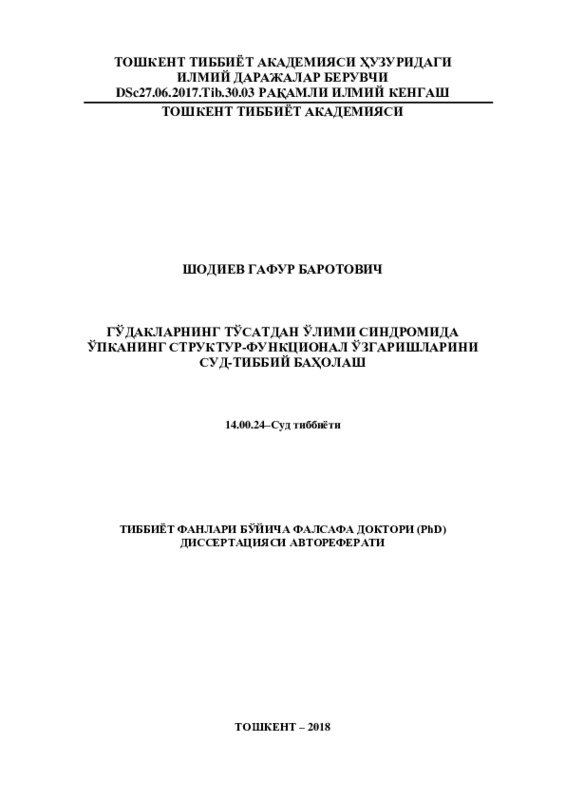 Forensic medical evaluation of structural and functional changes of the lungs at sudden infant death syndrome (SIDS)
Catalog of abstractsThe aim of the research work is to determine a comprehensive study of the structural and functional features of the lungs in SIDS to identify their place and significance in the structure of causes of death.
The scientific novelty of the research is as follows:
it was found that more than half (58%) of those with SIDS had an absolute and relative number of type II alveolar cells reduced by more than 30% compared to the group of infants who died of violent death (mechanical asphyxia, craniocerebral and bum injuries), and about 15% - with the SSM group. This suggests the structural-functional immaturity of the surfactant system of the lungs;
it is shown that in infants who die from SIDS, there is a violation of the functional state of the surfactant, which manifests itself in the form of a decrease in its surface-active biophysical indices. The parameters of surfactant stability in SIDS were, on average, reduced by a factor of 1.7-2.7 compared with the group of infants who died of violent death;
immunohistochemistry revealed that in most infants (more than 60% of cases) with SIDS, the expression of the surfactant protein of type В decreases, indicating qualitative changes in pulmonary surfactant;
it is shown that disturbances in the surfactant lung system arc one of the risk factors that creates a kind of unfavorable background. Against this background, under certain conditions (abnormal position of the child during sleep, lack of oxygen in the room and other risk factors), it is possible to develop a negative reflex effect that promotes prolonged apnea with a sudden fatal outcome;
It was established that the complex structural and functional analysis of the lung tissue allows verifying the diagnosis in SIDS and significantly reduces the risk of diagnostic errors in the form of hypo- or over diagnostics of SIDS.
