All articles - Zoology
-
 This article provides information on the use of coccidostatic drugs used in rabbit farms for the treatment and prevention of rabbits infected with eymerosis.
 -
 This article provides information about one of the most common parasitic diseases among rabbits, Eymeriosis, the relevant recommendations for the spread, diagnosis, treatment and prevention of the disease, in particular, Koxitoks, one of the highly effective anti-Eymeriosis drugs that are widely used today. , Toltrox, Intracox oral, Vazuril is recommended.
 -
 In this article, information is provided about the invasion (protazoic) disease eimeriosis, which causes great economic damage to rabbit farms, the effectiveness of local Toltrox, one of the most effective anti-eimeria drugs, has been tested, and recommendations for use are given.
 -
 this article provides information on the spread of eimeria, one of the most common diseases in rabbit farms, and the use of some anti-eimeria drugs that are widely used in the treatment of the disease.
 -
 This article describes the diagnosis of Eimeria, a parasitic disease that often disturbs rabbit farms and private households and causes economic damage, as well as methods of early detection and accurate diagnosis.
 -
 In this article, information on the epizootology of Eimeria, an invasive disease of rabbits, is presented, the course of clinical symptoms and the origin of the disease are briefly explained.
 -
 This article provides detailed information on the biological indicators of rabbits, their care, feeding technologies, and provides important information necessary for rabbit farmers and those interested in production and practice.
 -
 In this article, the history and systematic status of the study of paramphistomatoses is described based on literature data
 -
 This article provides a review and analysis of the literature on the prevalence of major helminthiasis in chickens (prostagonimosis, ascariasis, heteracidosis, etc.), the extent and intensity of invasion among chickens.
 -
 This article provides information on the prevalence, epizootology, biology, effective treatment, and cost-effective control of avian prostogonism.
 -
 This article contains information about helminthoses in poultry (chickens) and their distribution in some districts of the Navoi and Bukhara regions, which are considered the south-western regions of our country. The researches were carried out in the irrigated districts of these regions with natural water bodies, and fecal samples were taken from chickens raised in the direction of eggs, in households and poultry farms, and examined by fyulleborn and serial washing methods. Another important aspect of our research in these regions is that helminthological studies have not been conducted on poultry (chickens) in these regions for many years, and the helminth fauna of poultry (chickens) in these regions has not been studied. In the article, the distribution of helminthosis of chickens (prostogonimosis, ascariasis, heterokidosis, capillariosis, etc.), the extent and intensity of infestation among chickens is also presented in the literature. As a result of the conducted research, the optimal periods of deworming and prevention have also been determined.
 -
 This article presents information about the spread of helminthiasis in households and poultry farms in some districts of the regions of the Central geographical climate region of our Republic, as well as information on their treatment.
 -
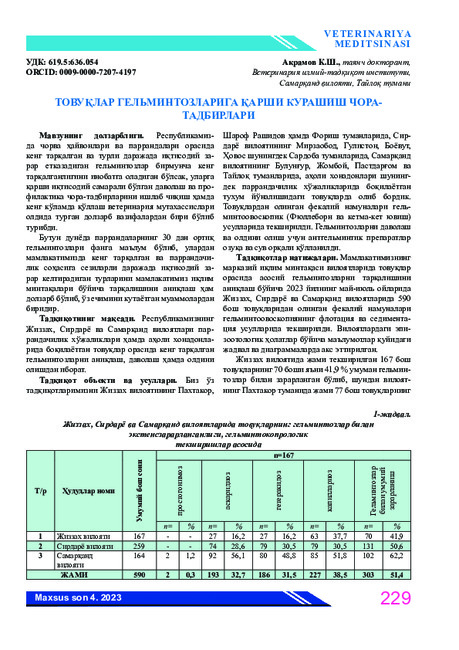 This article presents information about the spread of helminthiasis in households and poultry farms in some districts of the regions of the Central geographical climate region of our Republic, as well as information on their treatment.
 -
 This article provides information on the complex of strict measures to combat, that is, treatment and prevention of helminthiasis - namtodoses (ascariasis, heterokidosis, capillariosis, syngamosis) common among chickens. These measures are developed based on the results of scientific research and serve as a program for veterinary professionals.
 -

Актуальность работы. Зааминский государственный заповедник, расположенный на западных отрогах Туркестанского хребта в верховьях реки Сангзар, представляет собой богатейший во флористическом и фитоценотическом отношениях район Узбекистана. Этот заповедник, созданный в 1926 году, является уникальным но количеству редких исчезающих видов растений произрастающих на этой небольшой территории. Арчовые леса, но своей полнотности и богатству видами многолетних трав и кустарников, не имеют аналогов в нашей республике. С этой территории было описано не менее 20 видов растений, что сопоставимо с известнейшей флорой Чимгана. Список сосудистых растений, составленный и опубликованный М.Г. Поповым, Н.В. Андросовым в 1937 году, долгое время являлся, чуть ли нс единственной флористической информацией по всему западному Памироалаю. Во второй половине 20 века были проведены широкомасштабные флористические исследования нс только в этом регионе, но и но всей территории Узбекистана. В частности, были опубликованы списки флор Чаткальского, Нуратинского и Сурханского заповедников. Таким образом, изученная нами флора, более богатая по количеству видов растений, будет хорошим подспорьем для создания электронной базы данных современной флоры Узбекистана.
Цель исследования: составление современного конспекта флоры Зааминского государственного заповедника на основании собственных полевых исследований, анализа литературы и изучения гербарных материалов.
Научная новизна. Составлен современный конспект флоры Зааминского государственного заповедника, состоящий из 1192 видов сосудистых растений. Растительный покров слагается из 5 основных флороценотипов. Исследуемая территория относится к Кухистанскому округу Горносреднеазиатской провинции. На территории заповедника описаны 2 новых для науки вида (Astragalus russanovii, Allium levichevii).
Научная и практическая значимость результатов исследования. В основу диссертационной работы положены материалы, собранные лично автором в 2005-2011 гг. на территории заповедника. Составлен конспект флоры и создана электронная база данных флоры Зааминского государственного заповедника. В 4 издании Красной Книги Республики Узбекистан (2009) автором обработан очерк 1 вида - Astragalus helolipovii. Выявлен 21 вид растений, включенных в 4 издании Красной Книги Республики Узбекистан (2009).
Реализация результатов. В результате проведенных исследований 1 вид включен в 4 издание Красной Книги Республики Узбекистан. Практические рекомендации но диссертации в виде конспекта флоры сосудистых растений Зааминского государственного заповедника были переданы в заповедник (акт № 011, от 14.10.2011). Разработанная электронная база данных передана для использования в качестве учебного пособия на кафедру биологии и методики ее преподавания Джизакского государственного педагогического института (акт № 4, от 13.10.2011).
Апробация работы. Основные результаты работы доложены на конференции молодых ученых, посвященной 1000-летию Академии Маъмуна (Ташкент, 2006), региональной научно-практической конференции «Зарафшон воҳаси флораси ва ўсимликлари қоплами ўрганиш истиқболлари» (Ташкент, 2007), республиканской научно-практической конференции «География гаълими ва услубининг долзарб муаммолари» (Коканд, 2008),республиканском научно-практическом семинаре «Достижения и перспективы развития в области биоразнообразии и биотехнологий в Узбекистане» (Ташкент, 2009).
Материалы диссертации обсуждены на расширенном заседании лаборатории геоботаники, флора и растительных ресурсов, экологии растений (2011), а также научном семинаре при Спецсовете НПЦ «Ботаника» АН РУз (2011).
Опубликованность результатов. По теме диссертации опубликованы 3 журнальных статьи, 1 видовой очерк в 4 издании Красной Книги Республики Узбекистан (2009) и 4 тезисов.
Структура и объём диссертации. Диссертация состоит из введения, 5 глав, выводов, рекомендаций и приложения. Диссертация изложена на 79 страницах компьютерного текста и иллюстрирована 14 таблицами, 24 рисунками и 1 приложением. Список литературы содержит 113 наименований. -
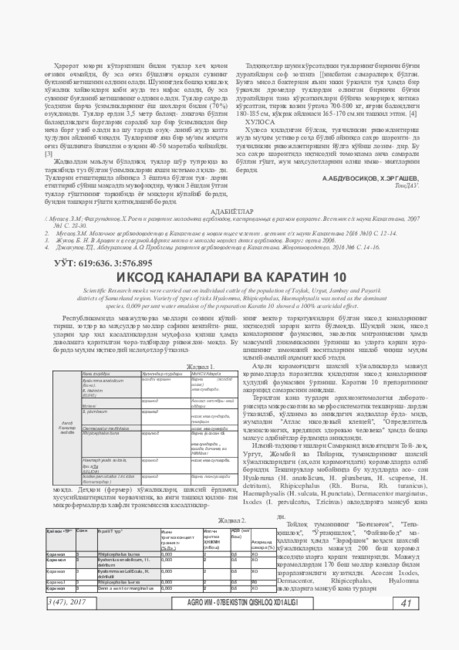 This article provides information on the organization of Iksod mites and quarantine 10 measures that cause great economic damage to livestock.
 -
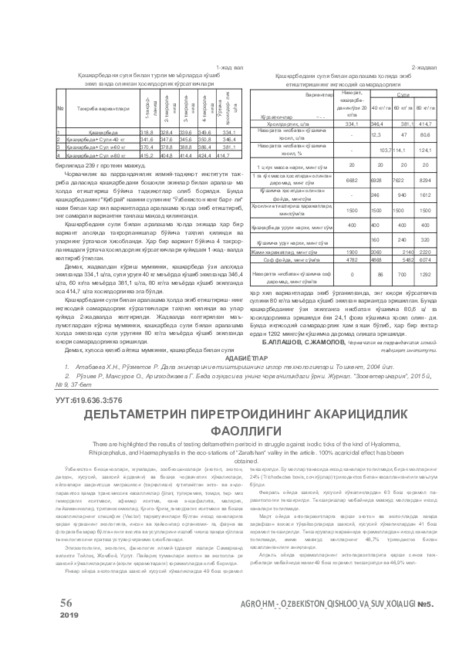 In this paper, the acaricidal activity of the pyrethroid deltamethrin used against animal ectoparasites has been determined and the results reported.
 -
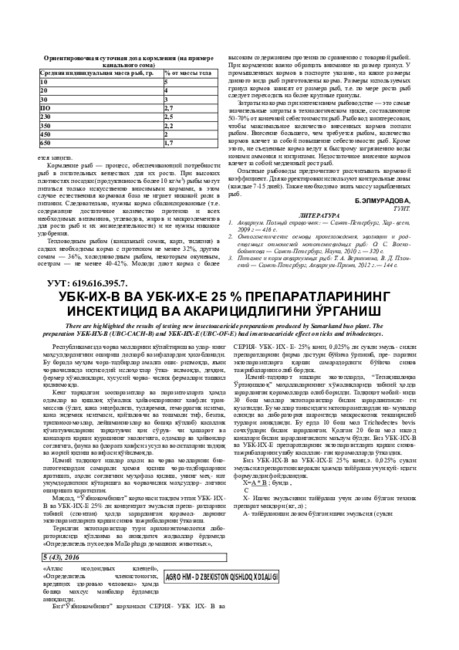 This article describes the results of studying the insecticidal and acaricidal properties of UBK-IX-V and UBK-IXE 25% preparations.
 -
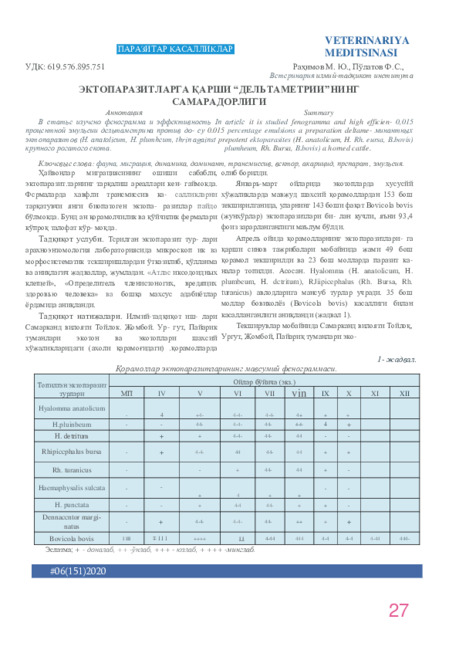 This article reports on the efficacy of deltamethrin against ectoparasites in farm animals.
 -
 This article presents reliable data on the endemic migration of ixod mites, which cause great economic damage to livestock.
 -
 The productivity of Golshtin, black – variegated breeds and their crossbreeds under conditions of South zone of Uzbekistan
Catalog of abstractsThe object of inquiries: pure- bred and crossbred heifers and calves of Golshtin and black - variegated breeds.
The aim of the work: the study of the growth and development, meat and milk productivity and also some biological peculiarities of Goldstein, black -variegated breeds and their crossbreeds under a sharp-continental conditions of South zone of Uzbekistan.
Methods of inquiries: zootechnical, biological and economical
Obtained results and their novelty: for the first time in the researches there was revealed the genetic potential of pure - breed Goldstein, black-variegated cattle? their crossbreds according to milk and meat productivity under conditions of hot climate. Purebred young cavs of Goldstein breed exceeded their analogues of black- variegated and crossbred ones on yield of milk during the first 90 days of lactation, correspondingly 175,5 and 100,5 kg. Crossbred calves while slaughtering at the age of 18 and 21 months gave to 16,6 and 5,1; 21,1 and 7,9 kg more of fresh killed meat, than of their age of IV and V groups correspondingly.
Practical significance: increasing the production of meat and milk under conditions of hot climate of Surkhandarya valley, pure-bred rearing of Golshtin and black-variegated breeds and their crossing between each other has a great practical significance.
The degree of inculcation and economic effectiveness: The results of researches where inculcated into the herds of cattle on a farm “Chjrvador” of Kumkurgan district of Surkhandarya region. As a result of inculcation in average from one cow of Golshtin breed and from realization of one bull-calf (at the age of 18 and 21 month) there was obtained 181,0-252,8; 366,4-447,4 and 446,8-549,5 thousand sums of pure income, and the norm of profitableness comprised accordingly 46,7-64,1; 38,4-46,6 and 36,6-44.7%
The sphere of usage: all the categories of cattle-breeding farms, where there arc reared Golshtin and black- variegated breeds of cattle. -
 Ladybirds (Coleoptera, Coccinellidae) in Bukhara oasis fauna, ecology and industrial importance
Catalog of abstractsSubjects of research: Coccinellidae of biocenoses and agroecosystems of Bukhara oasis, sucking pests of plants.
Purpose of work: the main purpose is the study of the fauna, ecology and industrial importance of Coccinellidae in Bukhara oasis.
Methods of research: entomological and ecological methods of studies are used in the work.
The results obtained and their novelty: forty-one Coccinellidae spp. of 2 subfamilies, 9 tribes, of which 33 are common and 8 are rare, and 14 have first been recorded under conditions of Bukhara oasis. It was for the first time established that Coccinella septempunctata feeds on 93 aphid species of 5 families of the suborder Aphidinae. Besides, trophic links of Adonia variegata and Chilocorus bipustulatus have been established. The confinement of Coccinellidae species to habitats, as well as to different types of wintering grounds, has been established. Causes of large-scale death of Coccinellidae from the effect of anthropogenic factors have been revealed and methods of protection and improvement of their effectiveness against the pests of agricultural crops suggested.
Practical value: conservation of Coccinellidae biodiversity and increase in the numbers of their species in agroecosystems enables the decrease in the numbers of pests of agricultural crops.
Degree of embed and economic effectivity: the results of this study on the revealing of the role of local Coccinellidae species in Bukhara oasis, their protection and involvement in pest control yield a significant economic effect.
Field of application: environmental protection, education, scientific studies. -

Subjects of research: The group of karakul sheep fed in a various energetic caloric.
The aim and function of investigation: In the condition of new economical trends to work out the effective technological system relying on gaining weight of male lambs separated from ewes in the same year, keeping them, intensifying system of feeding in order to decrease the capacity of lambs in meadows and as a result of which relating on getting products.
The methods of investigation: zoo-tcchnical and biological
Achieved results and their novelty: The high level of rapid growth and fleshiness of karakul lambs is specified with clearly outlines that beginning from 2-2,5 months to feed them with extra food based on a high energetic ration. The weight of 4-4,5 monthly lambs reach 30,5±0,26 kg. The lactation of experimental ewes is higher than the controlled ewes of the I group for 22,6 %, the II group for 23,2 %. Making up 13,3 kg of experimental group lambs’ body (I group) and 14,8 kg (II group) and 47,3 and 47,9 % getting meat, 2,25 and 2,73 % of fat collection shows the highness of meat industry than usual demands and the high efficiency of gaining weight of young karakul lambs. According to the diet-II the morphological constituents of the body’s of the II group extra fed group lambs showed that the inter-balance between the amount of flesh and bones (fleshiness coefficient) should be 0,29 units comparing to the I group lambs, 1,08 units comparing to the controlled group-mates. Beginning supplementary feeding from the 2 period of ewes’ pregnancies will increase the living function of lambs, if there was not noticed any sheer losses, this indicator would make 2,5 - 3 % in animals kept in farm circumstances, comparing to the experimental group-mates ewes’ high birth of this group was lessened for 6,4 % .
Practical value: The practical value of the investigation was seen in the priority in the field of karakul sheep breeding to increase rapidly the male lambs which don’t satisfy the requirements of sheep market, to get a rational use from the energy of young organism, embedding little labour; pecuniary-technical means and finance to work out the technological system of increasing the productivity as well as profitability and efficiency of the system.
Application degree and economical efficiency: The result of investigation is utilized in karakul sheep breeding plant: “Karnab ota” of Pakhtachi region of Samarkand. The net profit received from one lamb of the II group makes 27151,8 sums while the lambs of the I and controlled group makes 19167,1; 10282,6 sums, profitability level constitutes correspondingly 54,1,42,1; and 25, 01 percents.
Utilizing sphere: All types of estate forms concerning with karakul sheep breeding. -
Subject of the inquiry: silkworm, mulberry leaves, a larva, silk gland, a cocoon, silk.
Aim of the inquiry: revealing the dependence between silk glands activity on the basis of feeding and temperature influence and biological indicators, productivity, a rating, and also technological features of a cocoon and its use at selection-hereditary works, especially at creation of new breeds and hybrids of silkworms.
Method of inquiry: agro technical and biological.
The results received and their novelty: influence of feeding and temperature on silk glands activity of a silkworm is scientifically proved. For the first time dependence between activity and indicators of silk glands and biological indicators, productivity, a rating and technological features of a cocoon and use of this communication at selection-hereditary works is scientifically proved, especially at creation of new breeds and hybrids of silkworms..
Practical value: it has been revealed that nonnormalized feeding and sharp change of temperatures in worm-house negatively affects the silk glands activity that leads to decrease in biological indicators, productivity, a rating and technological features of a cocoon.
Degree of embed and economic effectivity: at creation of new breeds and hybrids of a silkworm an especially great value is given to interrelation between silk glands activity and productivity of cocoon (biological indicators, productivity, a rating and technological features of a cocoon). As a result, at normalized silkworm feeding by high-quality leaves of a mulberry and at worms growing at moderate temperatures, from each box of a silkworm it is possible to receive the additional income for the sum of 249600 sums.
Sphere of use: silkworm breeding branch of agriculture, silkworm breeding stations and scientific research institutes. -
 Productive and interior peculiarities of sur karakul sheep of different etological types
Catalog of abstractsObjects of investigation: pure bred karakul sheep and lambs of sur colouring of different etological types and age groups.
Purpose of work: investigation of productive and interior peculiarities of sur karakul sheep of different etological types in the conditions of pasture maintenance.
Methods of research: zootcchnical, ctolodical, biological, statistical.
The results obtained and their novelty: For the first in the conditions of pasture maintenance the resemblance and distinctions of productive and interior peculiarities of sur karakul sheep of different etological types were investigated and revealed. The superiority of sheep and its generation of first etological types according to the use and digestibility of pasture fodder, productive, interior peculiarities, indexes of growth and development has been scientifically well -grounded et was investigated that sheep of given type have the superiority in comparison with sheep of 23 types according food activity on 5, 7 - 12, 0%, fertility in 5-10%, daily milk productive on 40-115g. wool productivity on 8,7-16,4%; they had better saturation of blood with erythrocytes, hemoglobin, total protein - that indicates about better proceeding in their organisms of oxidizing -deoxidizing processes.
Practical value: The use of etological differentiation of karakul sheep in the selection word promotes for the better use of pasture fodder and effective digestion of nutritive substances, increasing meat, wool and milk productivity and level of profitabless on 7,4 - 8,5%.
Degree of embed and economical efficiency: The results of investigation can be successfully applicatcd in all karakul husbandry. At present, they arc successfully introduced in the karakul husbandry “Istiklol” (the former by F. Khodjaev) in Navoi region and provides the additional profit from 1 sheep about 1476, 2-22301, 7 sum.
Field of application: The karakul sheep branch of agriculture in the Republic Uzbekistan.
