All articles - Substance Abuse
-
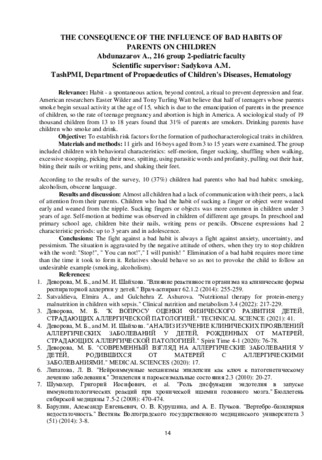 The consequence of the influence of bad habits of parents on children
Prospects for the development of medicineHabit - a spontaneous action, beyond control, a ritual to prevent depression and fear.
American researchers Easter Wilder and Tony Turling Watt believe that half of teenagers whose parents smoke begin sexual activity at the age of 15, which is due to the emancipation of parents in the presence of children, so the rate of teenage pregnancy and abortion is high in America. A sociological study of 19 thousand children from 13 to 18 years found that 31% of parents are smokers. Drinking parents have children who smoke and drink. -
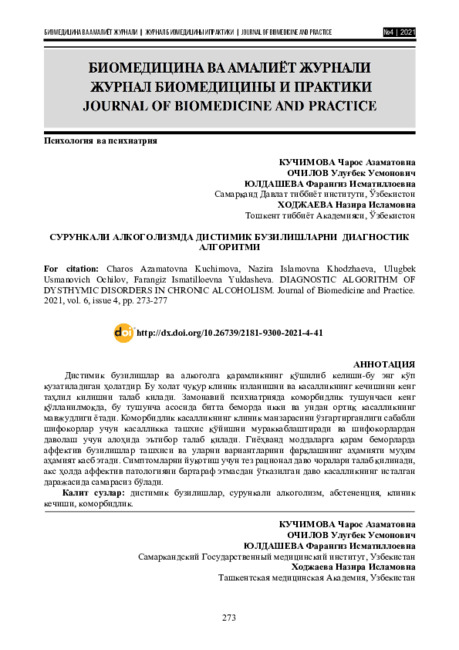 Diagnostic algorithm of dysthymic disorders in chronic alcoholism
Journal of Biomedicine and PracticeDysthymic disorders and a hangover of dependence on alkagol-this is the most observed condition. This condition requires in-depth clinical research and extensive analysis of the course of the disease. In modern psychiatry, the concept of comorbidity is widely used, on the basis of this concept lies the presence of two or more diseases in one patient. Since comorbidity prolongs the clinical picture of the disease, it complicates the diagnosis of the disease for doctors and requires special attention from doctors for treatment. Affektiv in drug-dependent patients, the importance of diagnosing disorders and distinguishing their variants is important. Rapid rational treatment measures arc required to relieve symptoms, otherwise affektiv treatment without eliminating pathology will be ineffective at any level of the disease.
-
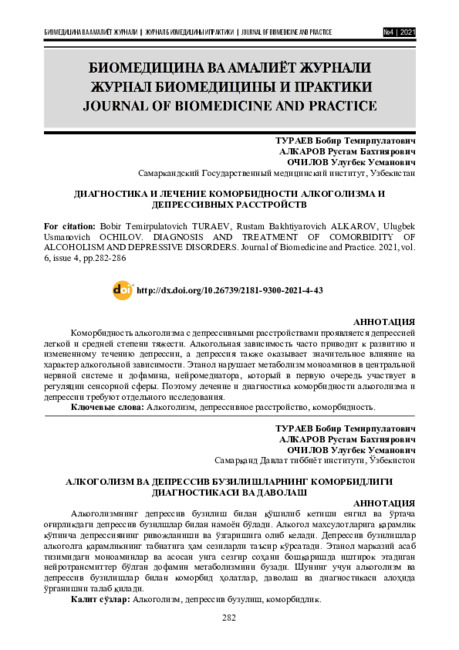 Diagnosis and treatment of comorbidity of alcoholism and depressive disorders
Journal of Biomedicine and PracticeThe combination of alcoholism with depressive disorder is manifested by mild to moderate depressive disorder. Addiction to alcohol often leads to the development and reversal of depression. Depressive disorders also have a significant impact on the nature of alcohol dependence. Ethanol disrupts the metabolism of dopamine, a monoamine in the central nervous system and a neurotransmitter that is mainly involved in controlling the sensitive area. Therefore, the treatment and diagnosis of comarbitis cases with alcoholism and depressive disorders require separate study.
-
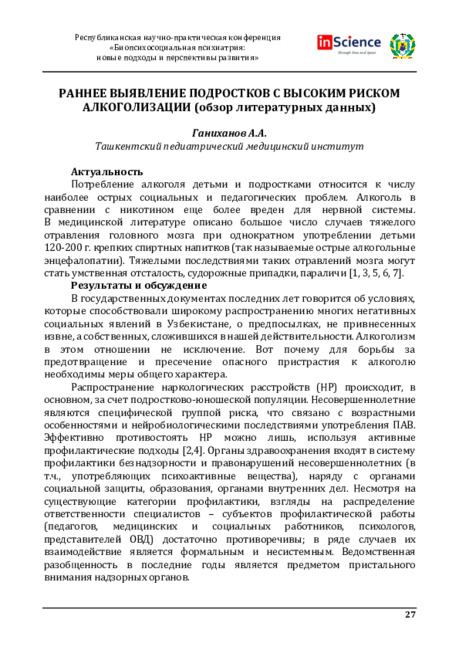 Раннее выявление подростков с высоким риском алкоголизации (обзор литературных данных)
Биопсихосоциальная психиатрия: новые подходы и перспективы развитияПотребление алкоголя детьми и подростками относится к числу наиболее острых социальных и педагогических проблем. Алкоголь в сравнении с никотином еще более вреден для нервной системы. В медицинской литературе описано большое число случаев тяжелого отравления головного мозга при однократном употреблении детьми 120-200 г. крепких спиртных напитков (так называемые острые алкогольные энцефалопатии). Тяжелыми последствиями таких отравлений мозга могут стать умственная отсталость, судорожные припадки, параличи [1,3, 5,6, 7].
-
 Новое в подходах реабилитации алкоголизма: раннее выявление подростков с высоким риском алкоголизацииПотребление алкоголя детьми и подростками относится к числу наиболее острых социальных и педагогических проблем. Алкоголь в сравнении с никотином еще более вреден для нервной системы. В медицинской литературе описано большое число случаев тяжелого отравления головного мозга при однократном употреблении детьми 120—200 г крепких спиртных напитков (так называемые острые алкогольные энцефалопатии)[11,16,21,28,30]. Тяжелыми последствиями гаких отравлений мозга могут стать умственная отсталость, судорожные припадки, папаличи.
Pediatrics -
 Gender peculiarities of mechanisms of formation, progression and course of opium addiction, and development of rehabilitation measures
Catalog of abstractsThe urgency and relevance of the theme of dissertation. According to United Nations Office on Drugs and Crime, there arc 15.6 million opiatedependent persons worldwide, 11.1 million heroin-dependent ones among them27. Today, wide spread of substance abuse and disorders governing by the dependence is one of the most urgent and relevant problems in the society.
In our country social relations in the sphere of drug trafficking, psychopharmaccuticals and precursors arc regulated by law, which aims at opposing their illegal trafficking, promoting health care and national security. The Republic of Uzbekistan Law on “Drugs of abuse and psychopharmaceuticals” guarantees health care promotion for drug and inhalant addicts including examination, counseling, diagnosis, treatment and medical-social rehabilitation.
It should be noted that studis on pathogenetic mechanisms of opium addiction, clinical peculiarities with gender interrelations taken into account, and development of the diffcrcnctiatcd approach to rehabilitation of opium addicts arc set at value in the international studies on the subject. In that context, study on clinical picture of both withdrawal syndrome and post-withdrawal period, comparative clinical-dynamic characterization of morbid attraction for drug in male and female opium addicts, determination of gender peculiarities of opium addiction, assessment of findings of opium addicts’ brain computer tomography and character of ncurocognitive disorders in opium addicts, study on somatic disorders in male and female opium addicts, as well as development of the differentiated approaches to medical-rehabilitation measures with clinical-dynamic peculiarities of the disorder taken into account is the urgent and relevant task. Accordingly, it is the proof for the relevance of the theme.
Objective. The work was initiated to study peculiarities of progression, clinical picture and course of opium addiction with gender differences taken into account and to develop differentiated methods for opium addicts’ rehabilitation.
Scientific novelty of the research work is as follows:
prolonged duration of opiate abuse (more than 5 years) both in men and women was proved to be characterized with formation of morpho-structural changes in the brain;
insignificant signs of the atrophy in some parts of brain cortex and the marked atrophic changes in the brain with widened subarachnoid space and lateral ventricular of the brain as well as presence of regions with lower white and grey matter density, deepened fissures and gyri, and reduction in density of white and grey matter were established. The morphological changes arc accompanied with worsening of cognitive functions which relatively preserved in patients with abuse duration under 5 years;
the course of opium addiction in women for the first time was proved to be characterized more frequently with high progressiveness mediated by some factors, such as starting abuse from heroin with the highest narcogenic potential and initial intravenous way of administration;
gender peculiarities of opium withdrawal syndrome in the form of predominance of affective variant in women and the mixed one in men were determined; no significant gender differences during the post-withdrawal period in clinical variant of morbid attraction for drug were found;
the findings from the study arc the evidence for the fact that combination of viral hepatitis C and HIV both in men and women affect clinical manifestations of opium addiction; incidence of HIV and VHC has no close correlation with sex and abuse duration.
Conclusion
1. Biological and social factors preceding addiction play a significant role in mechanisms of opium addiction formation. Inherited burden of addictions is typical of women. Prior to the drugs, most patients have used alcohol as a euphorizing substance, more than half of male examinees used hashish. Significantly greater number of women started using the opiates from heroin, which has the highest addicting potential among opiates. Significantly greater number of women started using heroin intravenously, while men started using opiates per orally. Significantly greater number of women used the drug for the first time in a company of drug-dependent friends of her drug-dependent cohabitant or husband.
2. Conditions of a person’s upbringing, processes of his/her socialization and a system motives incentivizing to the activity based upon a set of his/her needs arising in his/her disease dynamics arc important for formation of psychological-behavioral peculiarities of an individual. Personal deviations in premorbidity,person’s asocial orientation in particular, are the determinants in formation of the “addicted person”. Hysterical features were registered significantly more frequently in women, impulsive (excitable) ones occurred in men more often. Prior to opium addiction’s formation asocial tendencies were registered in significantly greater number of women. Significantly greater number of women was brought up in onc-parcnt families, more frequent conflicts in the family associated with characterological peculiarities of parents were observed in women, too. Prior to the addiction’s formation, more than half of women were nowhere employed, while almost all men worked in various spheres.
3. On the basis of examination of peculiarities in formation, clinical picture, and dynamics of symptoms as well as pronounced mcdical-social consequences of the diseases presence of definite gender differences in terms of formation of addiction and psychopathological symptoms, and severity has been observed. As the results of clinical-statistical analysis demonstrate, all these were determined by various tempo of opium addiction course. Highly progressive type of course is typical of women. Correlation between the type of course and sex was found.
4. The affective variant of opium withdrawal syndrome was seen more typical of women. In post-withdrawal period cmotionally-labile type of morbid attraction for drug was registered more frequently both in women and men. Within this period some reduction of the affective disorders can be seen in women. The degree of pronouncement of the affective disorders during post-withdrawal period starts prevailing in the group of the men examined.
5. As the brain computer tomography findings demonstrated upon opium addiction morpho-structural changes in the brain form to range from insignificant brain atrophy to widened subarachnoid space and lateral ventricular of the brain as well as presence of regions with lower white and grey matter density. These changes were less pronounced in patients with the disease duration less than 5 years than in those with the opiate use duration more than 5 years.
6. Significant (p=0,02) differences in the cognitive sphere between patients with the disease duration less than 5 years and those with the disease duration ranging from 6 to < 10 year were found. When comparing parameters in patients with longer disease duration we could see reduction in number of correctly performed intellectual tasks within definite period of time.
7. Among patients with the verified VHC three variants of opium postwithdrawal syndrome were equally registered. In the male patients with VHC+HIV the mixed OAS was observed more typical, while all variants of OAS were registered in the female ones. The mixed OAS was registered more frequently in the male patients having no somatic pathology. Among women having no somatic pathology affective type of OAS was more typical.
8. Highly pronounced morbid attraction for drugs could be seen during the whole period of hospitalization in patients with the verified VHC and HIV. Before the discharge in this category of men and women the moderate attraction preserved but was not observed in patients with the verified VHC and those without somatic pathology.
9. There arc additional risk factors determining involvement of women in addiction, to name, younger age (under 20-25 years), European nationality, employment in the consumer services, disharmonic bringing up in the family and conflict relationships with the siblings, conflict relationships in their own family, cohabiting with drug-dependent partner (husband/cohabitant), difficulties in overcoming life crises and social adaptation. In this connection the differentiated medical-rehabilitation measures with clinical-dynamic peculiarities of the disease and gender differences taken into account were developed. -
 Роль алкоголя в динамике насильственной смерти
Topical issues of fundamental medicine: today and in the futureВ статье проанализированы данные насильственной смерти от роли алкоголя за последние 5 лет в Самаркандской области. По сравнению с 2018 годом в 2023 году эти показатели возросли более чем в 2 раза. Среди всех отравлений более половины случаев составляют отравления алкоголем, которые возросли более чем в 4 раза.
-
 Clinical features of alcoholism and addiction in patients with deviant behavior
Catalog of abstractsThe urgency and relevance of the theme of dissertation. According to the United Nations Office on Drugs and Crime1, the number of drug addicts is increasing year by year. In particular, if in 2006-2007 the number of drug addicts was 200 million, in 2013-2014, the number reached 246 million people. Annually alcoholism and its consequences cause death of approximately 2, 5 million people. Also, in some cases strong forms of it may cause such negative consequences as working capacity loss, conflicts with people around, and committing crimes. Therefore, nowadays the issue of deviant behavior is a serious social problem worldwide.
Since obtaining independence, Republic of Uzbekistan has achieved positive changes in the organization of up-to-date drug abuse services such as effective examination of patients with alcoholism and drug addiction, consultation, diagnosis and medical and social rehabilitation in the framework of large scale reforms.
Currently the whole world is paying special attention to exploration of interrelation of formation and development of alcoholism and opiate addiction with negative influence of deviant behavior in premorbid, effective ways of treatment and prevention measures. Due to this theoretical foundation of personal biological peculiar properties of patients with alcoholism and drug addiction, defining the importance of social-psychological factors of deviant behavior and deviant personality formation, comparative classification of clinical-dynamic features of pathological attraction and ncurovisual state of the brain of patients with alcoholism and opiate addiction with and without deviant behavior.
The dissertation research particularly addresses the tasks outlined in the government program “The year of a healthy child” signed by the President of the Republic of Uzbekistan, № PP-2133 on 19th of February in 2014 year, the decree of the President of the Republic of Uzbekistan "On efforts of further deepening the reform of the Healthcare system", № PP-1652, 28th of November 201 land the decree of the State commission of the Republic of Uzbekistan of the controlling of drugs “The program of complex methods against the drug violation and criminal turnover in 2011-2015 years”, No: 11/11 since 8th of August, 2011.
The aim of research work is examining clinical-psychopathological features of alcoholism and opium addiction in patients with deviant behavior in premorbid with consideration of personal-biological, social-psychological factors and improving trcatmcnt-and-rchabilitation and preventive measures.
The scientific novelty of the research work is as follows:
interference of existence of perinatal pathology in the anamnesis, prevailing of emotionally unstable and impulsive personality types, hereditary drug abuse inclination and mental illnesses major role in the formation of deviant behavior in patients with premorbid alcoholism and opiate addiction have been proved;
high progressive progress of addiction in patients with alcoholism and drug addiction with deviant behavior in premorbid, which in turn is associated with factors such as early onset of drug abuse, the rapid formation of dependence, severe course of abstinent syndrome;
it was established that at most of alcoholics and drug addicts with deviant behavior in a premorbid the reference high-progreduated course of dependence explained by the early beginning of the use drugs, high speed of formation and the heavy course of an abstinence syndrome.
the prevalence of behavioral and affective components of the pathological craving in patients with deviant behavior in premorbid has been justified;
morphological and structural changes in the brain, which vary from slight signs of an atrophy to expansion of subcortical space and furrows of bark of frontal lobes, as a result of high gradient progress of dependence in patients with deviant behavior have been identified;
the necessity of introducing cognitive-behavioral therapy to improve the social adaptation of patients with alcoholism and drug addiction with deviant behavior in premorbid has been pathogcnetically justified.
CONCLUSION
On the basis of the research on a doctoral thesis on “Role of the apoptosis factors for realization ofprotectivc-barricr function of the stomach mucosa and the intestine at the salmonella infection and chronic hepatitis” provided the following conclusions:
1. The particularity of deviant behavior in the premorbid of alcohol and opioid dependence is the prevalence of aggressive and delinquent behaviors, and what is more in the premorbid of alcohol dependent patients occurs more aggressive behavior and in opioid dependent patients more delinquent behavior. Both forms of behavior is characteristic mainly for explosive and unstable type of persons, whereas suicidal deviant behavior for hystcroid type personalities.
2. Among patients with alcohol and opioid dependence with deviant behavior in premorbide prevails psychopathic personality or accentual personalities with explosive and unstable types. Among patients without deviant behavior in the premorbid personality prevails psychasthenic and conformal type.
3. The formation of deviant behavior in patients with alcohol and opioid dependence have been developed due to the social and psychological factors including, to be brought up in incomplete families or families with low cultural level and material prosperity, upbringing defects likcless caring for children, cruelty and violence, getting involved with antisocial or criminal groups.
4. Clinical features ofalcohol and opioid dependence with deviant behavior in premorbide is early onset of psycho-active drug abuse, high progress of formation of abstinentsyndrome, the severity of abstinence, a highly progressive course of the disease with the rapid development of personality degradation and negative medical and social consequences.
5. In the same duration of the disease in patients with the presence of deviant behavior in the premorbid is morphostructural changes of the brain, ranging from minor atrophicstillto the expanding of subcortical space and sulci of the cortex of the frontal lobes, in patients without deviant behavior in premorbide - only the expansion of perivascular spaces, and problems with blood circulation in the veins.
6. Improving the treatment and rehabilitation measures of persons with deviant behavior in premorbide requires cognitive-behavioral psychotherapy methods for correcting deviations of personality and behavior.
7. When the developing of preventive measures for persons with deviant behavior must be considered the personality traits, social and psychological factors and clinical-dynamic features of the main disease with the definition of the form and direction of the work of performer. -
 Clinical and pathogenetic aspects and optimization of therapeutic tactics in heroin addiction (clinical-experimental study)
Catalog of abstractsTopicality and relevance of the theme of the dissertation. According to the UN Office on Drugs and Crime, in 2014 the total number of people in the world who used drugs was 247 million people aged 15 to 64 years, of these, about 10-13% arc the group suffering from drug addiction '. In addition, the number of opiate (opium, morphine and heroin) users totalled about 17 million people throughout the world, of these, 12 million arc injection narcotic users. The injection drug intake significantly contributes to the epidemic of viral hepatitis В and C in all parts of the world. According to the data of “The UN World Drug Report for 2016”, 1.6 million people who use injected drugs are infected with the human immunodeficiency virus, 6 million arc living with hepatitis C.
During the years of independence, as a result of systematic measures in the organization of drug treatment services in line with modem requirements, there were achieved positive changes in our country in rendering narcological medical assistance for the prevention and diagnosis of drug addiction, treatment and medical and social rehabilitation of drug addicts. According to the National Information and Analytical Centre for Drug Control of the Republic of Uzbekistan, the ratio of primary morbidity of drug abuse decreased 1.6 times in 2015.
At the global level, much attention is paid to the study of the role of personality-biological, social, psychological, clinical and psychopathological features, as well as a variety of pathophysiological and biochemical processes based on experimental studies in the pathogenesis and progression of opioid dependence with comorbid medical conditions for further optimization of rehabilitation measures. In this, the study of the features of comorbid somatic pathology in heroin addiction, in-depth studies of pathobiochcmical changes and optimization of treatment strategies to reduce the recurrence of the disease and to achieve sustainable remission is relevant and significant.
This dissertation research to a certain extent serves for the implementation of the tasks set out in the in the Government Program “The year of a healthy child” approved by Decree PD-2133 of the President of the Republic of Uzbekistan of 19 February 2014, the Decree PD-1652 of the President of the Republic of Uzbekistan “On measures to further deepen the reform of the health system” of 28 February 2011, the Resolution No.11/11 of the State Commission of the Republic of Uzbekistan on Drug Control “On the program of comprehensive measures to counter drug abuse and drug trafficking for 2011-2015” of 8 August 2011, the Resolution No. 01-14/47-17 “On the program of measures to counter drug abuse and drug trafficking for 2016-2020” of 17 June 2016, as well as in other legal normative and legal acts adopted in this area.
The aim of the research is determining the clinical, psychopathological and pathochemical aspects of opioid dependence with subsequent optimization of therapeutic approaches.
The scientific novelty of the research is as follows:
the relationship between premorbid social deviance, genetic predisposition to drug dependency and socio-psychological factors that contribute to the occurrence of comorbid somatic diseases (chronic viral hepatitis В and C) in individuals dependent on opioids has been proved;
features of the opium withdrawal clinical symptoms and craving for the drug, taking into account the comorbid somatic pathology (chronic viral hepatitis В and C) have been disclosed;
the effect of concomitant liver disease (chronic viral hepatitis В and C) on the intensity of systemic oxidative stress and significant reduction of antioxidant system in the blood of the patients with opioid dependence have been proved;
on the model of acute and chronic drug addiction, we defined the key link of pathogenesis characterized by prolonged increased generation of active oxygen forms in the subccllular fractions of liver and heart tissues on a background of the depletion of endogenous antioxidant defense and accumulation of protein degradation products - middle molecular peptides in the experiment;
based on the results of the experimental study, we pathogcnetically substantiated the necessity of the early inclusion of antioxidants in complex therapeutic measures in heroin addiction and the need for their depot in the liver in the treatment of drug addiction.
Conclusion
On the basis of the conducted studies on a doctoral dissertation “Clinical and pathogenetic aspects and optimization of therapeutic tactics in case of heroin addiction (clinical-experimental study)” the following conclusions are presented:
1. The most important socio-psychological factors that contribute to the emergence of comorbid somatic pathology of the liver (chronic viral hepatitis В and C) in patients who arc dependent on opioids arc: the early stages of the first trial of psychoactive substances (10,3%), early onset of systemic narcotization with a primary parenteral method of drug administration (31.5%), multiple drug use in the immediate vicinity (45.1%).
2. Comorbid somatic pathology of the liver (chronic viral hepatitis В and C) helps to increase the length and severity of the clinic of opium withdrawal syndrome due to the prevalence of psychopathological, algic, dissomnic disorders (34.6% versus 16.3% in the group of patients without comorbid pathology).
3. The distribution of the frequency of the pathological attraction to drugs revealed that the severe degree of the pathological attraction to drugs is characteristic of 36.9% of dependents on opioids with comorbid somatic pathology (chronic viral hepatitis В and C) and 8.6% of dependents on opioids without comorbid pathology, proving the contribution of the factor of comorbidity on the severity of the disease.
4. The study of personality characteristics revealed that drug users with chronic viral hepatitis В and C represent the individuals with severe difficulties in social adaptation, anxiety and depressive background of mood, which were often associated with the state of their physical health. The opioid dependents with comorbid disorders found external locus of control and arc characterized by personal immaturity, emotional and volitional characteristics, cognitive functions by detecting a correlation with the disease duration.
5. Comorbid pathology of the liver in opioid dependence contributes to significantly greater systemic oxidative stress and reduction of the antioxidant blood system. The intensity of the generation of reactive oxygen species in the blood of opioid-dependent people increases with the duration of narcotization and related liver disease, manifesting an increase of malondialdehyde, middle molecules of peptide and inhibition of catalase activity in relation to the control. The correlation analysis revealed a positive correlation with the duration of withdrawal symptoms in opioid-dependent people with comorbid pathology with increased values of middle molecules peptide (r=0.56) and negatively correlated with the activity of catalase (r=-0.66).
6. One of the molecular mechanisms of the pathogenesis of opioiddependent people is a pronounced oxidative stress, which manifests itself by prolonged increased generation of reactive oxygen species in the subccllular fractions of liver and heart tissues on the background of the depletion of endogenous antioxidant defense and accumulation of protein degradation products - middle molecules peptides. We established the trigger role of reactive oxygen species in the degradation of macromolecules of proteins in heart tissues, which indicates the development of prolonged endotoxemia and myocardial dysfunction even after the compensation of the oxidative stress, making it difficult for abstinence.
7. The optimized therapy including antioxidants - alpha-tocopherol acetate has a significant effect on the indicators of oxidative stress and antioxidant blood system of opioid- dependent people due to a lower level of malondialdehyde, catalase activity recovery to the control level. We substantiated the necessity of the early inclusion of antioxidants in complex therapeutic measures that can improve the therapy effectiveness, significantly reducing the duration of the opium withdrawal syndrome and the severity of craving for the drug.
