All articles - Music
-
 Maktabgacha ta’lim tashkilotlarida musiqa tinglash faoliyatida zamonaviy texnalogiyalar qo‘llash
Современные тенденции инновационного развития науки и образования в глобальном миреMaktabgacha ta’lim tashkilotlarida musiqa tinglash faoliyatida zamonaviy texnalogiyalar qo‘llash
-
 O‘zbek xalq musiqa ijodida ustoz-shogird an’analari
Современные тенденции инновационного развития науки и образования в глобальном миреMazkur maqolada o‘qitishning milliy, ustoz-shogird uslubini, yangi zamonaviy uslublarini yaratishda ta’lim texnologiyalarining muhim o‘rni va vazifalari qiziqarli ma’lumotlar asosida yoritildi. O‘zbek xalq musiqa ijodi fanidan yaratilgan ushbu maqolada zamon talablari asosida yangi pedagogik texnologiyalardan foydalangan holda, o‘quv reja asosida ma’ruza va amaliy tarzda o‘tkazilishi rejalashtirilgan mashg‘ulotlarda o‘zbek xalq musiqa ijodining hududlarga xos murakkab ijro uslublari, mohir ijrochilar, cholg‘u sozlari, katta ashula, dostonchilik, xalfachilik, folklor va baxshichilikka oid ma’lumotlarkeltirilgan.
-
 The problem of a competency-based approach to teaching the Russian language in Uzbek-teaching schools
in LibraryThe article is devoted to the formulation and concretization of the problem of the formation of a competency-based approach to teaching the Russian language in schools with the Uzbek language of instruction. The article compares the traditional approach, which is focused on instilling knowledge, skills in the Russian language, and the competence-based approach, which is aimed at developing the appropriate competencies in the Russian language among students. The combination in practice of two different strategies for teaching Russian as a non-native language occurs due to a widespread misconception among Russian language teachers, according to which competencies are identified with the sum of knowledge, skills and abilities. At the same time, the following distinction is proposed: competencies are knowledge in action, the ability to consciously apply skills and abilities in solving specific communication problems. Based on the results of the study, the need for a radical change in the pedagogical thinking of teachers of Russian as a non-native language working in the schools of Uzbekistan is stated.
-
Mazkur maqolada Abu Nasr Forobiyning serqirra ilmiy merosi, xususan, musiqa san’atiga doir pedagogik qarashlari tahlil qilingan. Mutafakkirning “Katta musiqa kitobi” risolasida musiqa fenomeni, uning maqsadlari, musiqa san’atining nazariy va amaliy qirralari atroflicha bayon etilgan.
-
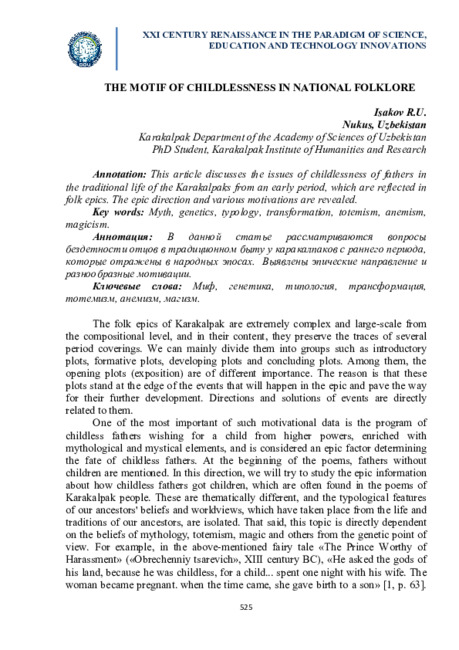 The motif of childlessness in national folklore
Renaissance in the paradigm of innovation in education and technology in the XXI centuryThis article discusses the issues of childlessness of fathers in the traditional life of the Karakalpaks from an early period, which are reflected in folk epics. The epic direction and various motivations are revealed.
-
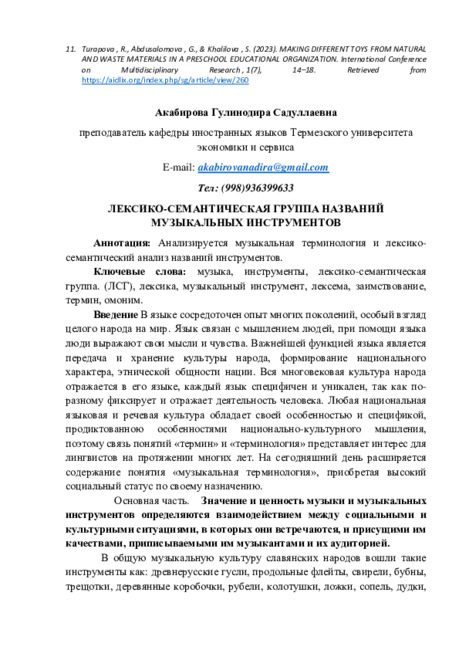 Lexico-semantic group of names of musical instruments
Traditions and innovations in language research and teachingАнализируется музыкальная терминология и лексико-семантический анализ названий инструментов.
-

Subjects of research: Artistic representation of the season cycle in the art of musical composition in a broad historical (from the end of the 18th to the early 21st century) and geographical range. Pieces selected for the analysis include classical specimens of world musical culture of the past and works by modern (Uzbek and foreign) composers, most of which are studied in this perspective for the first time.
Purpose of work: Using the art of composition as example, to demonstrate various interpretations of “the seasons” theme in its historical evolution, to identify its different renditions in the works of contemporary Uzbekistan composers and to prove their connection with national artistic traditions.
Methods of research: The object of research determined the application of his-torico-typological, comparative (synchronic and diachronic) and holistic methods of research.
The results obtained and their novelty: This is the first attempt to trace the historical evolution of various interpretations of the seasons theme in the musical art. The results of the study and some theoretical theses of the dissertation can contribute to the construction of scientific theory of artistic content as a complex evolving system reflecting stages in the development of creative thinking.
Practical value: is in broadening the knowledge about the art of composers representing different national schools of composition, who developed the seasons theme, and in contributing to the enrichment of musicology with studies of new contemporary music pieces.
Degree of embed and economic effectiveness: The dissertation materials have been used in the lecture course titled “History of World Music” taught at the department of music history and criticism of the State Conservatory of Uzbekistan.
Field of application: The key theses of the study could be used in academic work and pedagogical practice, in lectures on the history of world music and musical styles, and the history of Uzbek music, as well as in cultural studies. The outputs allow enhancing the standards and effectiveness of education activities performed by lecturers-musicologists. -
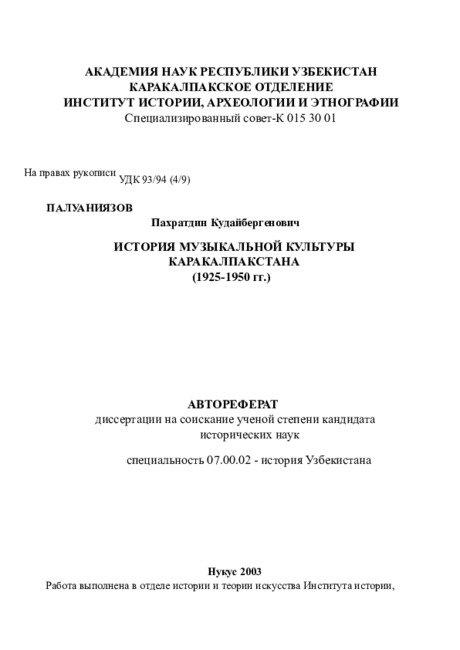
The introduction shows the actuality of the research and goals tasks, methodological and theoretical bases. Also it includes archive and literature sources, scientific and practical importance of the work.
The first chapter entitled «Musical culture of Karakalpakstan in 1925-1941 years» states the main moment of musical art. In the musical life there were themes; land water problem, collectivization, industrialization, company «Topilis» (struggle). The musical repertoire of theatrical troupe «Tan nuri» which existed in the state theatre in 1927-1941 years is analyzed.
In the dissertation the historical importance of gramophone record of Karakalpak melody recorded in Moscow in 1936 years is pointed out.
There also mentions that S. Majitov, K. Avezov, the cultural workers, were repressed in the thirties.
The second chapter entitled «Musical culture or Karakalpakstan in 1941-1950 years» describes in decade of musical life of Karakalpakstan. The war time atmosphere, epoch colour were described in the works of musical culture. The creative portraits of G. I. Komponeytsa, A. Kondorshtilov, B. Shaffrannikov, Zh. Shamuratov and there are created as well.
In conclusion results of research and inferences are given. A practical recommendation is offered according to the historical experience and study of the History of Musical Culture of the people of Karakalpakstan in 1925-1950.
Басыуга рухсат етилген уакты 03.01.03 МПФ."Баспа" Заказ №001 Тир. 100 экз -
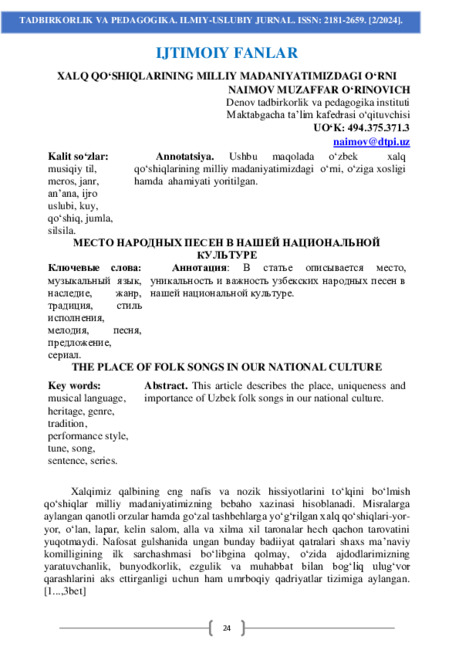
This article describes the place, uniqueness and importance of Uzbek folk songs in our national culture.
-
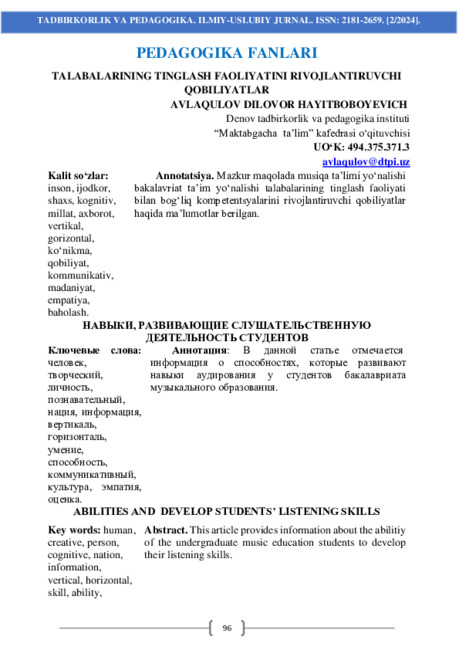
This article provides information about the abilitiy of the undergraduate music education students to develop their listening skills.
-
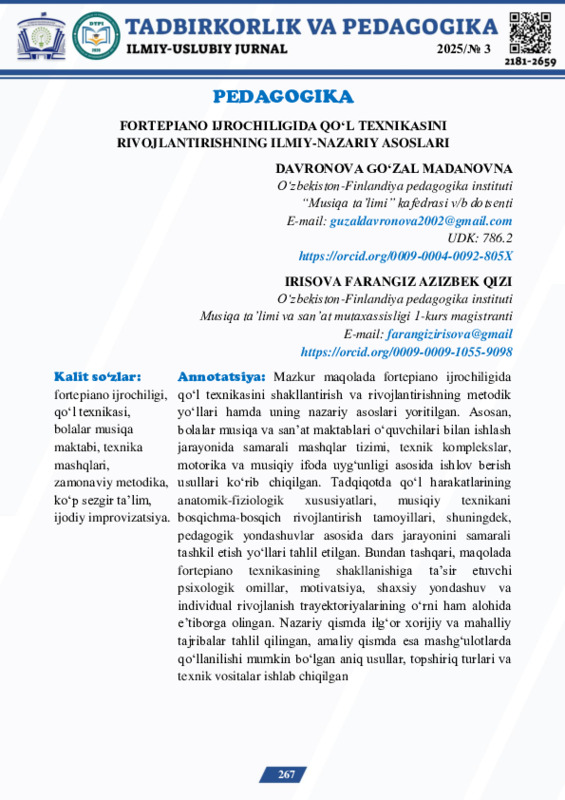 SCIENTIFIC AND THEORETICAL FOUNDATIONS FOR DEVELOPING HAND TECHNIQUE IN PIANO PERFORMANCE
Entrepreneurship and PedagogyThis article highlights the methodological approaches to the formation and development of hand technique in piano performance and its theoretical foundations. Mainly, in the process of working with students of children’s music and art schools, a system of effective exercises, technical complexes, methods of processing based on the combination of motor skills and musical expression are considered. The study analyzes the anatomical and physiological features of hand movements, the principles of the phased development of musical technique, as well as ways to effectively organize the lesson process based on pedagogical approaches. In addition, the article pays special attention to the role of psychological factors influencing the formation of piano technique, motivation, personal approach, and individual development trajectories. In the theoretical part, advanced foreign and domestic experience is analyzed, and in the practical part, specific methods, types of tasks, and technical means that can be used in classes are developed.
-
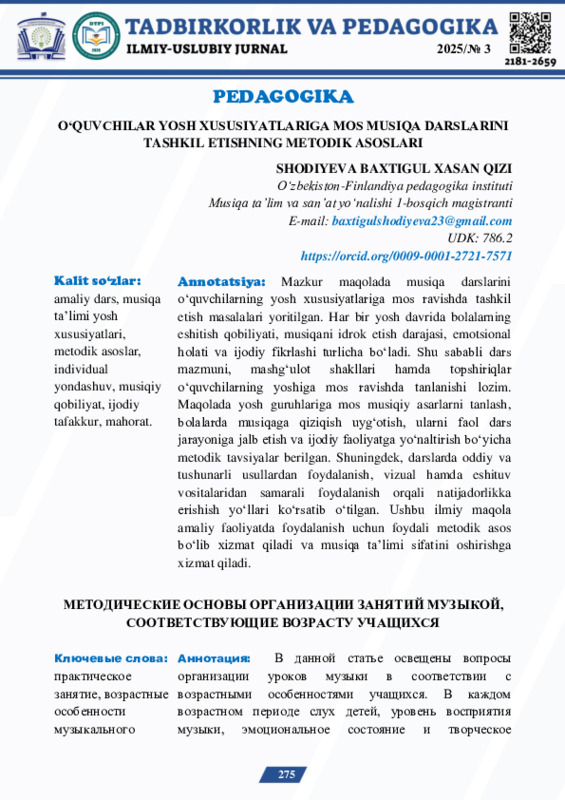 METHODOLOGICAL BASIS FOR ORGANIZING MUSIC LESSONS APPROPRIATE TO THE AGE OF PUPILS
Entrepreneurship and PedagogyThis article highlights the issues of organizing music lessons in accordance with the age characteristics of students. In each age period, children’s hearing ability, the level of musical perception, emotional state, and creative thinking are different. Therefore, the content of the lesson, the forms of classes, and the assignments should be selected in accordance with the age of the students. The article provides methodological recommendations for selecting musical works suitable for age groups, awakening children’s interest in music, involving them in the active learning process, and guiding them towards creative activity. Also, ways to achieve effectiveness through the use of simple and understandable methods in lessons, the effective use of visual and auditory aids are indicated. This scientific article serves as a useful methodological basis for use in practical activities and serves to improve the quality of music education.
