




215
Adabiyotlar
1. Bobayev I.D., Xujamshukurov N.A., Abdullayev X.O., Ramazanov N.Sh. Biotexnologik
sharoitda yetishtirilgan Chlorella vulgaris sp
2
tarkibidagi yashil pigmenti tarkibi va mikdori / “Kimyo,
neft-gazni qayta ishlash hamda oziq-ovqat sanoatlari innovatsion texnologiyalarini dolzarb
muammolari” Resp. ilmiy-texn. anjumani maqolalar to‘plami. Toshkent. 2015. – B. 191-192.
2. Сафаров И.В., Абдуллаев Х.О., Юнусходжаева С.С., Хужамшукуров Н.А., Комилова
Ш.А. Жирнокислотный состав липидов водорослей в зависимости от фазы роста культуры.
Республиканский межвузовский сборник “Актуальные вопросы в области технических и
социально-экономических наук”. Ч. I. Ташкент, 2015. –С. 249-251.
3. Bobaev I.D., Alimova M.T., Ramazanov N.S. 3 rd International Symposium on Edible Plant
Resources and the Bioactive Ingredients. study of the immuno-stimulating action of phytoecdysteroids.
Urumqi – China. July 28 -August 1. – 2012. – P. 28.
4. Dominik, V.Z. Vladimir, W.H. Schwarz, Applied Microbiology and Biotechnology. 2007. Vol.
77, p. 23-35.
TECHNOLOGY OF MEDICINAL DRINK PREPARATION FROM THE SAFRAN PLANT
Assistant X.N.Niyozov., prof. I.D. Bobayev, dots. V.Z. Nurmuxamedova., F. Norqulova
b
Tashkent Institute of Chemical Technology, Department of Biotechnology
e-mail: xasan.niyozov@mail.ru tel: +99897-771-16-88
Plant saffron in July-August. Light, sandy soil is the best soil for growing saffron. Before
planting saffron, the land is thoroughly plowed and fertilized. The saffron plant is planted at a depth
of 10-12 cm. It is recommended to plant this plant in rows. The distance between rows is 15-20 cm,
and the distance between plants is 10-15 cm. After the saffron plant is planted, watering several
times will give good results. They should be cleaned of weeds and soften the ground between the
rows. In this way, many saffron plants are grown and prepared [1, 2].
The technology of preparation of medicinal tincture from ready-grown saffron plant is
described in the following order.
Choosing a technological scheme and justifying it
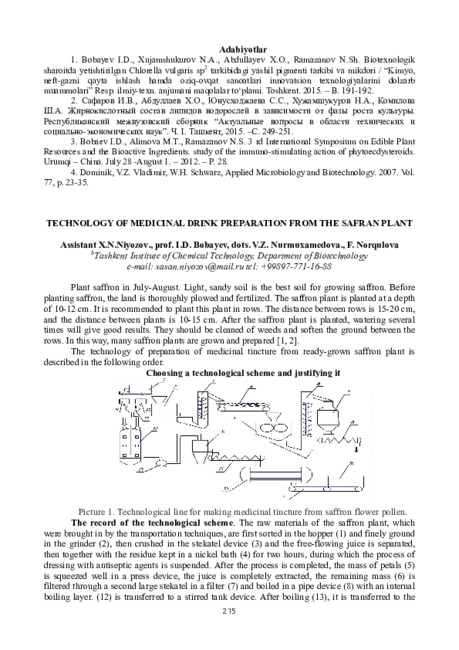
Picture 1. Technological line for making medicinal tincture from saffron flower pollen.
The record of the technological scheme
. The raw materials of the saffron plant, which
were brought in by the transportation techniques, are first sorted in the hopper (1) and finely ground
in the grinder (2), then crushed in the stekatel device (3) and the free-flowing juice is separated,
then together with the residue kept in a nickel bath (4) for two hours, during which the process of
dressing with antiseptic agents is suspended. After the process is completed, the mass of petals (5)
is squeezed well in a press device, the juice is completely extracted, the remaining mass (6) is
filtered through a second large stekatel in a filter (7) and boiled in a pipe device (8) with an internal
boiling layer. (12) is transferred to a stirred tank device. After boiling (13), it is transferred to the

216
evaporator for concentration (14) through the pump, and the evaporated mass (15) is delivered to
the cooling system through the pipe device (16) in the pipe, the finished product that has passed
through the cooling system (17) for packing (18) delivered and packed by means of a tape device.
The effect of saffron tincture on the human div is used as a sedative and pain reliever in
gastrointestinal diseases. In folk medicine, saffron is also used as a means of strengthening the div
when it is weakened, it calms the nervous system, and it is used as a remedy against many other
diseases.
References
1. Tukhtaev B.E., Safarov A.S., Eshonkulov B.I. Introduction and features of medicinal
plants growing on saline soils of the Bukhara region. "Materials of the Republican Scientific and
Practical Conference Plant Introduction: Problems and Prospects" Khiva, 2003, pp. 96-98.
2. Declaration of Certain Isolated or Synthetic Indigestible Carbohydrates as Dietary Fiber
Nutrition and Supplement Facts Label: Guidance for Industry"(PDF). US Food and Drug
Administration. 14 June 2018. Retrieved 15 June 2018 .
SHOLI QOLDIQ MAHSULOTLARI TARKIBIDAN BIOLOGIK FAOL
MODDALARNI AJRATIB OLISH
mag. Xabibullayeva S.T., prof. Bobaev I.D., dots. Normatov A.M., ass. Yusupov N.O’.
Toshkent kimyo-texnologiya instituti, Biotexnologiya kafedrasi,
+998 99 843 14 04
Sholini tozalashda maydalangan donidan glyukoza olish va uni biotexnologik yo‘l bilan
ferentatsiyalab O‘zbekistonda kamyob mahsulotni turini ko‘paytirish dolzar muammolardan biri
hisoblanadi.
Glyukoza oziq-ovqat va farmatsevtika sanoatining eng muhim mahsuloti bo‘lib, strategik
mahsulotlar qatoriga kiradi. Jaxonda bo‘lgan ehtiyoj tibbiyot sanoati uchun yiliga 7 ming tonna,
oziq-ovqat sanoati uchun esa yiliga 50 ming tonna import hisobidan ta’minlanadi.
Farmatsevtika sanoatida [1, 2] glyukoza ineksiya va infuzion eritmalar, tabletkalar
tayyorlash, sorbitol, askorbin kislota va veterinariya preparatlarini ishlab chiqarish uchun ishlatiladi.
Glyukozani katta qon yo‘qotish, yurak etishmovchiligi, zarba va tananing boshqa og‘ir sharoitlari
uchun eritmalar shaklida ishlatish juda muhimdir.
Oziq-ovqat sanoatida glyukoza diyetali va klinik ovqatlanishda, qandolat mahsulotlari ishlab
chiqarishda, konserva sanoatida, ichimliklar, muzqaymoq ishlab chiqarishda va sport ovqatlanishida
qo‘llaniladi [3].
Kristalli glyukoza kraxmalning kislota yoki fermentlar bilan gidrolizlanishi natijasida
olingan siroplardan ishlab chiqariladi [4].
Sholini tozalashda maydalangan donidan glyukoza ishlab chiqarish samaradorligi kraxmal
gidrolizining optimal usullariga va glyukoza kristallanishining tegishli texnologik sxemasiga
bog‘liq bo‘ladi. Kraxmal gidrolizining progressiv usullari kislota-fermentativ va qo‘sh fermentativ
fermentlarni qo‘llash bilan bog‘liq. Ularning eng foydali usuli olingan yakuniy mahsulotlarning
rejalashtirilgan assortimentiga qarab tanlanadi. Kraxmalni suyultirish va qandlash bosqichlarida
fermentlarni qo‘llash bilan ikki tomonlama fermentativ gidroliz 98% gacha glyukoza ekvivalenti
yuqori bo‘lgan siroplarni olish imkonini beradi, qimmatroq va undan foydalanish eng ko‘p hollarda
oqlanadi. siroplardan kristalli glyukozani to‘liq ajratib olish va bir nechta turdagi mahsulotlarni
olish. Oziq-ovqat gidratlangan glyukoza va shinni ishlab chiqarish uchun kraxmalning kislotali-
fermentativ gidrolizi ancha tejamkor bo‘lib, unda siroplar glyukoza ekvivalenti 95% ga yetadi.
Hozirgi vaqtda harorat va kristallanish sharoitlariga qarab, glyukoza sanoat miqyosida
olinadi, jumladan, namlik miqdori 1,0% dan kam bo‘lgan alfa shaklidagi suvsiz glyukoza, namlik
miqdori 1,0% dan kam bo‘lgan beta shaklidagi suvsiz glyukoza, gidrat shaklidagi glyukoza namligi
