➤
Kategoriyalar
Jurnallar
Konferensiyalar
Avtoreferat katalogi
Dissertatsiya katalogi
Монографиялар каталоги
Darslik katalogi
Kelgusi konferentsiyalar
Tashkilotlar
Mualliflar
Blog
Biz haqimizda
Materiallarni yuborish
Ommaviy Oferta
Шахсий Маълумотларни Қайта Ишлаш Сиёсати
Ochiq kirish bayonoti
Ommaviy litsenziya
Mualliflik huquqi
Kontaktlar
Kirish
Asosiy sahifaga o'tish
/
Arxivlar
/
№ 1 (2025)
№ 1 (2025)
Jurnal:
Zamonaviy tilshunoslik va ta’limda chet tillarini o’qitishda innovaciyallar
doi
https://doi.org/10.47689/ZTTCTOI-vol1-iss1-2025
Nashr qilingan:
04/09/2025
Ulashish
Maqolalar
Dominant and endangered languages: the future of world languages
Human communication and cultural identity depend heavily on languages. Due to historical, economic, and technological circumstances, some languages become more dominant worldwide, while others are in danger of being extinct. This essay examines the factors that contribute to linguistic dominance and endangerment, emphasizing the effects of media, education, and globalization. It also talks about the significance of preserving linguistic diversity and initiatives to save endangered languages.
Ruhshona Numonova
236-238
78
21
Batafsil o'qish
The voice of Karakalpak poets: a bridge between tradition and modernity
The Karakalpak people, a Turkic-speaking ethnic group in Central Asia, have a rich literary tradition deeply rooted in their history, culture, and connection to nature. Karakalpak poetry, an essential part of their identity, reflects the community's struggles, aspirations, and spiritual journey. From ancient oral epics to contemporary compositions, Karakalpak poets have preserved and transformed their heritage while addressing modern challenges. This article delves into the evolution of Karakalpak poetry, its cultural significance, and the enduring legacy of its poets.
Shakhnoza Nurillayeva, Elza Erimbetova
238-240
71
20
Batafsil o'qish
The nolinguistic study of Uzbek proverbs (based on the names of outerwear and their parts)
The ethnolinguistic features of vocabulary units pertaining to the names of clothing and their components that appear in Uzbek proverbs are examined in this study. The study supports the strong relationship between these lexical units and the people's way of life, historical and cultural memory, and national mentality. The proverbs' metaphorical and symbolic meanings are revealed through a semantic and functional analysis conducted during the investigation. Furthermore, the significance of clothing names in socio-cultural situations and their involvement in oral tradition are identified. Based on a variety of historical sources, anthropological research, and folklore materials, the study investigates the origins of clothing-related perceptions that are reflected in proverbs. By offering fresh theoretical perspectives, the research's conclusions advance Uzbek linguistics and ethnolinguistics.
Marjona O’razova , Rustam Mahsumov
240-242
91
21
Batafsil o'qish
Methods and techniques for developing english oral speech at national groups of lyceums
This article explores various modern approaches and techniques that contribute to the effective improvement of communication skills and practicing in national groups of lyceums. It highlights the integration of traditional and modern technologies in language teaching, emphasizing their impact on fluency, accuracy, and confidence-building among learners.
Saodat Polatova, Abish Musayev
243-245
232
19
Batafsil o'qish
Specific features of proverbs reflected national mentality
This article will explore the unique characteristics of proverbs found in both English and Karakalpak literature. This article will conduct a thorough analysis of some proverbs that have been transcribed by English writers, as well as some other proverbs found in Karakalpak folk literature. Every proverb holds some kind of literary, cultural, or educational meaning; every example will be examined in detail, and a description of the moral message of these proverbs will be investigated. Several proverbs written by English writers, including IV. Shakespeare, G. Chaucer, J. Mil ton, and A. Pope, will be examined in detail. In addition to this, some appropriate examples of Karakalpak folk proverbs will be presented and investigated deeply in order to provide the understandable meanings of them.
Orazali Karjavbayev, A Toleubayeva
245-248
89
20
Batafsil o'qish
The peculiarities of word formation in English and Uzbek
This article explores the peculiarities of word formation in English and Uzbek, two languages from distinct linguistic families. The study highlights major word formation processes such as affixation, compounding, blending, reduplication, and borrowing, using examples from literature. By comparing these methods, the research provides insights into the similarities and differences between English and Uzbek, aiding linguists, translators, and language learners in understanding the dynamic nature of vocabulary development.
Shohinur Koldosheva, Abish Musayev
248-250
146
13
Batafsil o'qish
Arab va O‘zbek tillaridagi kelishiklarning qiyosiy tahlili
Maqolada arab va о 'zbek tillarida kelishiklar va ularning о 'zaro о ‘xshash hamda farqli xususiyatlari, ularga xos jihatlar misollar yordamida tahlil qilingan. Arab till flektiv til bo jganligi sabahli ко 'p jihatdan о ‘zbek tilidan farq qiladi. Xususan, kelishiklar va ularning vazifalari, turli ma ’no ifodalashi jihatdan ikki til xususiyatlari qiyoslangan.
Risolat Ravshanova, N Ahmedova
250-253
97
20
Batafsil o'qish
Arab va O‘zbek tillarida rang-tus leksemalarining lingvomadaniy tadqiqi
Maqolada arab va о 'zbek tillarida rang-tus leksemalari Hngvomadaniy jihatdan tahlil qilingan. Ranglarning til va madaniyatdagi ahamiyati, ularning semantik xususiyatlari, shuningdek, bu ranglarning madaniy vafalsafiy ma ’nolari о ‘rganilgan. Arab va о 'zbek tillaridagi asosiy rang nomlari, ularning konnotatsiyalari va madaniy ahamiyati tahlil qilinadi. Ranglar va ularning ramziy ma ’nolarini о ‘rganish orqali har ikki xalqning madaniy merosi va dunyoqarashi tavsif qilindi. Arab va o'zbek tillarida rang bildiruvchi leksemalar o'rtasidagi o'xshashliklar va farqlar atroflicha aniqlandi.
Risolat Ravshanova, N Ahmedova
253-258
84
14
Batafsil o'qish
The advantages of multilingualism in learning additional languages
This study explores how multilingualism positively influences the process of learning new languages. It examines cognitive benefits such as enhanced memory, problem-solving skills, and language transfer effects. The paper also investigates linguistic advantages, including metalinguistic awareness and cross-linguistic similarities. Additionally, psychological and social factors contributing to language acquisition are analyzed. The findings suggest that multilingual individuals have a greater capacity to acquire additional languages efficiently compared to monolingual learners.
Madina Sabirbayeva
259-260
77
21
Batafsil o'qish
Ethnolinguistic study of Uzbek proverbs (based on the names of footwear and their parts)
This article presents an ethnolinguistic study of Uzbek proverbs related to footwear and its parts. The research analyzes the semantic properties of such proverbs, their symbolic meanings, and ethnographic aspects. A comparative study with other Turkic languages highlights cultural similarities and differences. The findings indicate that proverbs related to footwear reflect social status, labor practices, and everyday life in Uzbek culture.
Sevinchxon Sa’dullayeva , Rustam Mahsumov
265-268
72
13
Batafsil o'qish
Cognitive approaches in modern linguistics and their application in education
Cognitive linguistics, which emerged as a response io structuralist and generative approaches, places a strong emphasis on the relationship between language, thought, and human experience. This field views language not as an autonomous structure governed solely by formal rules but as a dynamic and integral part of human cognition. In modern linguistic studies, cognitive approaches have gained significant attention due to their ability to explain how language reflects and shapes human conceptualization of the world. These approaches emphasize meaning construction, mental representations, and embodied experience, making them particularly relevant for language teaching and learning. The application of cognitive linguistic principles in education fosters a more intuitive and meaningful understanding of linguistic structures, promoting deeper engagement among students. This article explores various cognitive approaches within modern linguistics, including conceptual metaphor theory, image schema theory, frame semantics, and construction grammar, while also examining their practical implications for language education. By integrating cognitive perspectives into teaching methodologies, educators can enhance students ’ comprehension, retention, and application of new linguistic concepts in real-world contexts.
Maryam Safarova, Gulhayo Xayitova
261-263
91
25
Batafsil o'qish
How english drives the creation of new words worldwide
This article investigates the pivotal role of the English language in the creation and dissemination of neologisms across the globe. English, as a dominant international language in areas such as science, technology, business, media, and entertainment, has become a key driver in the formation of new words and expressions. The paper delves into how English, through its widespread use, acts as a source of innovation in vocabulary, influencing both global communication and the evolution of local languages.The study highlights the ways in which English neologisms are adopted, adapted, and integrated into various linguistic and cultural contexts. It examines the impact of technological advancements, such as the internet and social media, in accelerating the spread of English-derived terms worldwide. Additionally, the article explores the phenomenon of code-switching and borrowing, where non-English speaking societies embrace English words, often modifying them to suit local phonetic and syntactic patterns.Furthermore, the article considers the sociocultural and economic factors that facilitate the widespread adoption of English neologisms, such as globalization, transnational corporations, and the global reach of English-language media. Through this exploration, the paper demonstrates the powerful influence of English in shaping modern languages, as well as its role in creating a shared lexicon that transcends national borders and fosters global connectivity. Ultimately, this analysis underscores how English serves not only as a language of communication but also as a tool for linguistic and cultural exchange, driving the creation of new words and expressions that reflect the dynamic, ever-changing nature of global societies.
Dilshoda Saidova, E’zoza Xazratkulova
263-265
243
35
Batafsil o'qish
Сравнительный анализ традиционной и современной грамматической парадигмы
В данной статье рассматривается сравнительный ан ап из традиционной и современной грамматической парадигмы немецкого языка. В работе освещаются ключевые принципы традиционной грамматики, основанные на строгих морфологических и синтаксических правилах, а также современные подходы, отражающие влияние когнитивной лингвистики, функциональной грамматики и цифровой коммуникации. Особое внимание уделяется изменениям в трактовке грамматических категорий, гибкости норм и их адаптации к современным языковым реалиям. В результате анализа выявлены основные различия между традиционными и современными подходами, а также перспективы развития грамматической парадигмы немецкого языка.
Aygul Seytbayeva, Marina Tajigaliyeva
268-272
92
16
Batafsil o'qish
On the grammatical compensation in the translation of national color in the works of I. Yusupov
This article is devoted by making thorough use of the lexical richness of the Karakalpak language, it would not be an exaggeration to say that I. Yusupov played a crucial role in shaping the literary language of Karakalpak, which holds special significance for the entire Karakalpak culture. In this regard, both his poetry and prose works are of particular importance.
D Shabatova, F Atashova
272-275
107
25
Batafsil o'qish
Ethnolinguistic study of uzbek proverbs (an emphasis on hat terminology)
This study examines the ethnolinguistic features of lexical units related to the names of headgear found in Uzbek proverbs. The study confirms the strong connection of these lexical units with the lifestyle, historical and cultural memory, and national thinking of the people. During the analysis, the metaphorical and symbolic meanings of proverbs are revealed semantically and functionally. In addition, the significance of the names of headgear in the socio-cultural context and their participation in oral tradition are determined. The origin of the views on headgear reflected in proverbs is studied on the basis of various historical sources, anthropological studies, and folklore materials. The results of the study provide new theoretical perspectives for Uzbek linguistics and ethnolinguistics.
Zarina Shermamatova, Rustam Mahsumov
275-277
86
9
Batafsil o'qish
Парадигмы современной лингвистики в глобализированном мире и их влияние на развитие русского языка и литературы
В данной работе рассматриваются ключевые парадигмы современной лингвистики в условиях глобализированного мира и их влияние на развитие русского языка и литературы. Анализируются процессы заимствования, изменения синтаксических и стилистических норм, а также трансформация литературного дискурса под воздействием глобальных факторов. Особое внимание уделяется когнитивнодискурсивному анализу, позволяющему выявить закономерности языковых изменений и их последствия для национальной языковой идентичности.
Viktoriya Sulaymanova, Farxod Rafiev
277-280
115
12
Batafsil o'qish
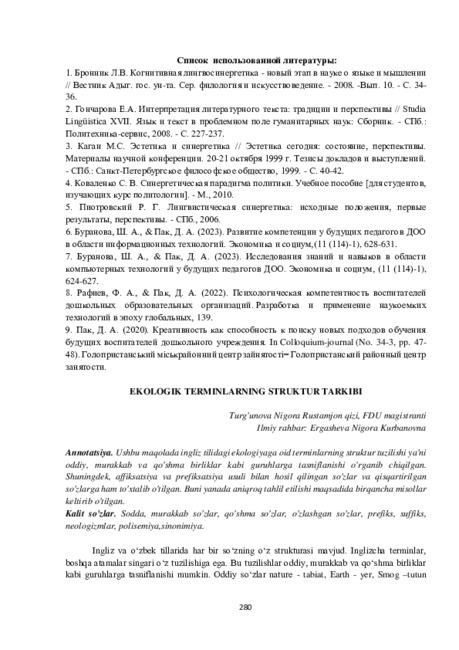
Ekologik terminlarning struktur tarkibi
Ushbu maqolada ingliz tilidagi ekologiyaga oid terminlarning struktur tuzilishi ya'ni oddiy, murakkab va qo'shma birliklar kabi guruhlarga tasniflanishi o'rganib chiqilgan. Shuningdek, affiksatsiya va prefiksatsiya usuli bilan hosil qilingan so'zlar va qisqartirilgan so'zlarga ham to'xtalib o'tilgan. Buniyanada aniqroq tahliletilishi maqsadida birqancha misollar keltirib o'tilgan.
Nigora Turg'unova
280-283
78
15
Batafsil o'qish
Понятие изоморфизма в лингвистической типологии
Изоморфизм в лингвистической типологии относится к систематическому соответствию между лингвистическими структурами в разных языках или внутри одного языка. Эта концепция играет решающую роль в понимании того, как языки представляют схожие когнитивные и коммуникативные процессы, несмотря на различия в поверхностных формах. Рассматривая концепцию изоморфизма в более широком контексте лингвистической типологии, эта статья исследует ее последствия для классификации языков, структурных универсалий и когнитивных механизмов, лежащих в основе формирования языка. [1].
G Urazniyazova
283-285
70
32
Batafsil o'qish
Лингвистические и когнитивные особенности английских предлогов
Предлоги — это небольшие, но важные элементы предложения, которые связывают существительные, местоимения и фразы с другими словами в предложении. Они указывают на связь между объектом предлога и другим элементом в предложении, обычно предоставляя информацию о местоположении, времени, направлении или принадлежности.
G Urazniyazova, G Konisov
285-287
84
13
Batafsil o'qish
Neologisms in modern english: the impact of social media and digital culture
This paper provides an extensive overview of how social media and digital culture have contributed to the emergence and rapid diffusion of neologisms in Modern English. By examining a broad range of examples — including like, unf riend, hashtag, binge — watch, doomscrolling, finsta, and more - this study highlights the complexity of linguistic innovation online. It further explores how these terms both reflect and reshape cultural values, user interactions, and the continually evolving relationship between technology and language in our globalized world.
Aziza Uzakova
287-289
114
24
Batafsil o'qish
To‘lepbergen qaipbergenov qissalarida badiiy obrazlar yaratilishi
Maqolada qoraqalpoq adabiyotining yorqin namoyandasi To'lepbergen Qaipbergenovning badiiy taraqqiyot у о ‘li atroflicha ко 'rib chiqiladi. Qoraqalpoq adabiyotidagi qissa janrining ilk na'munalari bulgan “Rahmat, muallitn”, “Sovuq bir tomchi ”, “Uyqusiz tunlar ” qissalarida obraz yaratish jarayoni talqin qilinadi.
Xurliman Xabibullaeva
290-291
77
24
Batafsil o'qish
Til birliklariga kognitiv yondashuv
Ushbu maqola til birliklariga kognitiv yondashuv va lining mohiyatini aniqla.shga oiddir. Maqolada tavsifiy metoddan foydalanilgan. Maqolada til birliklari alohida tasnif qilinib, ularning kognitiv vazifasi ochib berilgan. Maqola oxirida xulosa mavjud.
Zahro Xoliqova
291-293
77
12
Batafsil o'qish
Zamonaviy tilshunoslik va ta'limda innovatsiyalar
Ushbu maqola taqdimotda zamonaviy tilshunoslikning so'nggi yo'nalishlari (masalan, hisoblash Ungvistikasi, korpus Ungvistikasi, sotsiolingvistika) va ularning la ’limdagi qo 'llanilishi haqida umumiy ma ’lumot berilgan. Unda til о ‘rganishning innovatsion usullari (masalan, sun 'iy intellektga asoslangan dasturlar, interfaol platformalar, virtual va to ‘Idirilgan reallik texnologiyalari) hamda O'zbekistonda til ta’limini rivojlantirishda qo'llaniladigan zamonaviy yondashuvlar tahlil qilingan. Asarda tilshunoslikning amaliy maqsadlari (masalan, nutqni avtomatik tahlil qilish, til o'qitish metodikasini takomillashtirish) va ularning ta’lim samaradorligini oshirishdagi ahamiyati haqida ham so ‘z boradi.
Bahriddin Yodgorov, Nilufar Yuldoshova
294-295
112
21
Batafsil o'qish
The impact of social media on language simplification
Social media has had a significant impact on modern communication, leading to a significant simplification of language. Platforms such as Twitter, Instagram, Facehook and TikTok encourage abbreviations, resulting in the widespread use of abbreviations, acronyms, emoticons and informal expressions. This change affects vocabulary, grammar and writing styles, especially among younger generations. This study examines the reasons for the simplification of language, such as character limits, rapid interactions and increased use of visual communication. It also examines the impact on formal writing, academic language and linguistic diversity. Although social media makes communication more accessible and effective, there are concerns about the decline of complex language structures and formal writing skills. The article discusses the benefits and challenges of this linguistic shift, analyzing whether it is a temporary trend or represents a long-term change in language evolution.
Maftuna Yusupova, Sayyora Abdullayeva
295-298
79
33
Batafsil o'qish
Globаlizаtsiyаlаshgаn zаmonаviy tilshunoslik pаrаdigmаlаri
Ushbu maqolada globalizatsiya jarayonining zamonaviy tilshunoslikparadigmalari shakllanishiga ta'siri tahlil qilinadi. Xalqaro kommunikatsiya, ko'plik tillarining o'zaro ta'siri, sun'iy intellekt asosida tilshunoslik va kompyuter Ungvistikasi imkoniyatlari kabilarglobalizatsiya sharoitida tahlil qilinadi.
Fаrаngiz Zikrillаyevа, Mushtаriy Dustmurodovа, Niginа Normаmаtovа, Mohinur Sаydulloyevа, Moxigul Abdiraximova
298-300
86
24
Batafsil o'qish
<<
<
1
2
3
4
5
>
>>
© Copyright 2025 in Science All Rights Reserved | Developed by
in Science
| Site create by
in Designer