
Acumen:
International Journal of
Multidisciplinary Research
Volume 1, Issue 1
36
Acumen: International Journal of Multidisciplinary Research
SELECTION OF ADSORBENTS WITH HIGH EFFICIENCY IN DRYING
GASES AND STUDY OF THEIR PHYSICO-CHEMICAL PROPERTIES
Nematov Khusan Ibodullayevich
PhD, Karshi engineering-economics institute
ВЫБОР АДСОРБЕНТОВ С ВЫСОКОЙ ЭФФЕКТИВНОСТЬЮ
ПРИ СУШКЕ ГАЗОВ И ИЗУЧЕНИЕ ИХ ФИЗИКО-ХИМИЧЕСКИХ
СВОЙСТВ
Нематов Хусан Ибодуллаевич
к.т.н. Каршинский инженерно-экономический институт
ABSTRACT
: Currently, it is considered important to select adsorbents with
high efficiency in drying gases. For this purpose, the following works are being carried
out: physical and chemical parameters of NaA (3Å) synthetic zeolite, physical and
chemical properties of 3 types of KA (3Å) zeolite were reviewed. and other information
is given in the article.
KAYS WORD:
Absorption drying, adsorption drying, condensation, membrane
method, synthetic zeolite, corrosion resistance.
АННОТАЦИЯ:
В настоящее время считается важным подбор
адсорбентов с высокой эффективностью осушки газов. С этой целью проводятся
следующие работы: рассмотрены физико-химические параметры синтетического
цеолита NaA (3Å), физико-химические свойства 3-х типов цеолита KA (3Å). и
другая информация приведена в статье.
KAYS WORD:
Абсорбционная сушка, адсорбционная сушка,
конденсация, мембранный метод, синтетический цеолит, коррозионная
стойкость.
Water vapor in gas can be separated by physical methods (adsorption,
absorption, membrane, condensation) and chemical methods (using CaCl
2
) and their
hybrid combination methods. Today, oil and gas processing industries use the following
traditional and modern gas drying methods [1]:
• Absorption drying;
• Adsorption drying;

Acumen:
International Journal of
Multidisciplinary Research
Volume 1, Issue 1
37
Acumen: International Journal of Multidisciplinary Research
• Condensation. Spray cooling of hydrate inhibitors;
• Membrane method. Using elastomers and glassy polymers.
• Chemical method. Using hygroscopic salts. Metal chlorides are usually used.
Absorption and adsorption methods are widely used in the world.
Absorption drying of gases (Glycolic drying)
Drying gases using glycols is one of the most common methods, allowing gases
to be dried sufficiently for transmission or use as fuel.
Basic requirements for industrial consumers
In the absorption process, ethylene glycol, diethylene glycol and triethylene
glycol are mainly used as absorbers. In desorption cycle drying processes and repeated
application of the absorbent, almost no absorbent is consumed. Therefore, any
substance capable of separating the absorbent from the extracted component can be
used as an absorbent. However, in order to choose an absorber in the industry, a number
of the following requirements should be taken into account [2-3]:
• The absorbent must have a high absorption capacity relative to the component
to be extracted from the gas. The use of an absorbent with a low absorption capacity
leads to an increase in circulation of the circulating solution and an increase in the cost
of desorption.
• Absorbent should be easily regenerated during desorption. For this, the
component pressure in the absorbing solution must be high at the desorption
temperature.
• The selectivity of the absorbing solution should be high, that is, it should absorb
the desired component well and not absorb other substances in the gas.
• The absorption and desorption temperatures of the absorber should not have
high vapor pressure. Otherwise, the quantitative loss of this absorbent may increase.
• Absorbent should be chemically stable in working conditions, should not
change its age and structure. Chemical reactions should not occur between the gas and
the absorbent.
• The absorber must be cheap and have a large resource.
• The absorbent should not have a corrosive effect on the equipment of the
absorption process.
• The mass transfer coefficient must be sufficiently high.
It served as a basis for choosing effective adsorbents for natural gas drying. In
our study, various adsorbents were selected in order to improve the gas purification
process at Shurtanneftgaz LLC.

Acumen:
International Journal of
Multidisciplinary Research
Volume 1, Issue 1
38
Acumen: International Journal of Multidisciplinary Research
Today, NaA synthetic zeolite with a pore size of 3 Å is used for natural gas
drying at Shurtanneftgaz LLC (Fig. 1). Physico-chemical parameters of this adsorbent
are presented in table 1.
1 – table
Physico-chemical parameters of NaA (3Å) synthetic zeolite
№
Indicator name
Demand for
TSh
Analysis results
1
Granular appearance
Cylindrical
Cylindrical
2
Adsorbent size, mm
2,8±3,
2,8
3
Cumulative
density,
g/cm
3
,
calculated relative to absolute dry
matter
0.65 is not less
0,94
4
Amount of zeolite phase crystals, %
Not less than
80.0
81,5
5
Moisture absorption capacity, mg/g
Not less than
160.0
205,0
6
Anti-aging strength, %
Not less than
92.0
92,0
7
Mass fraction of water resistance, %
Not less than
96.0
96,0
The composition of NaA zeolite is determined to be Na
2
O*Al
2
O
3
*SiO
2
.
Zeolites of this type are widely used in gas drying, deep cleaning of liquids and gases.
The main disadvantage of this type of zeolites is their water resistance and resistance
to high pressures compared to new generation zeolites.
1 – picture. Overview of NaA (3Å) synthetic zeolite
Taking into account the above, we have selected new generation adsorbents for
gas drying processes.

Acumen:
International Journal of
Multidisciplinary Research
Volume 1, Issue 1
39
Acumen: International Journal of Multidisciplinary Research
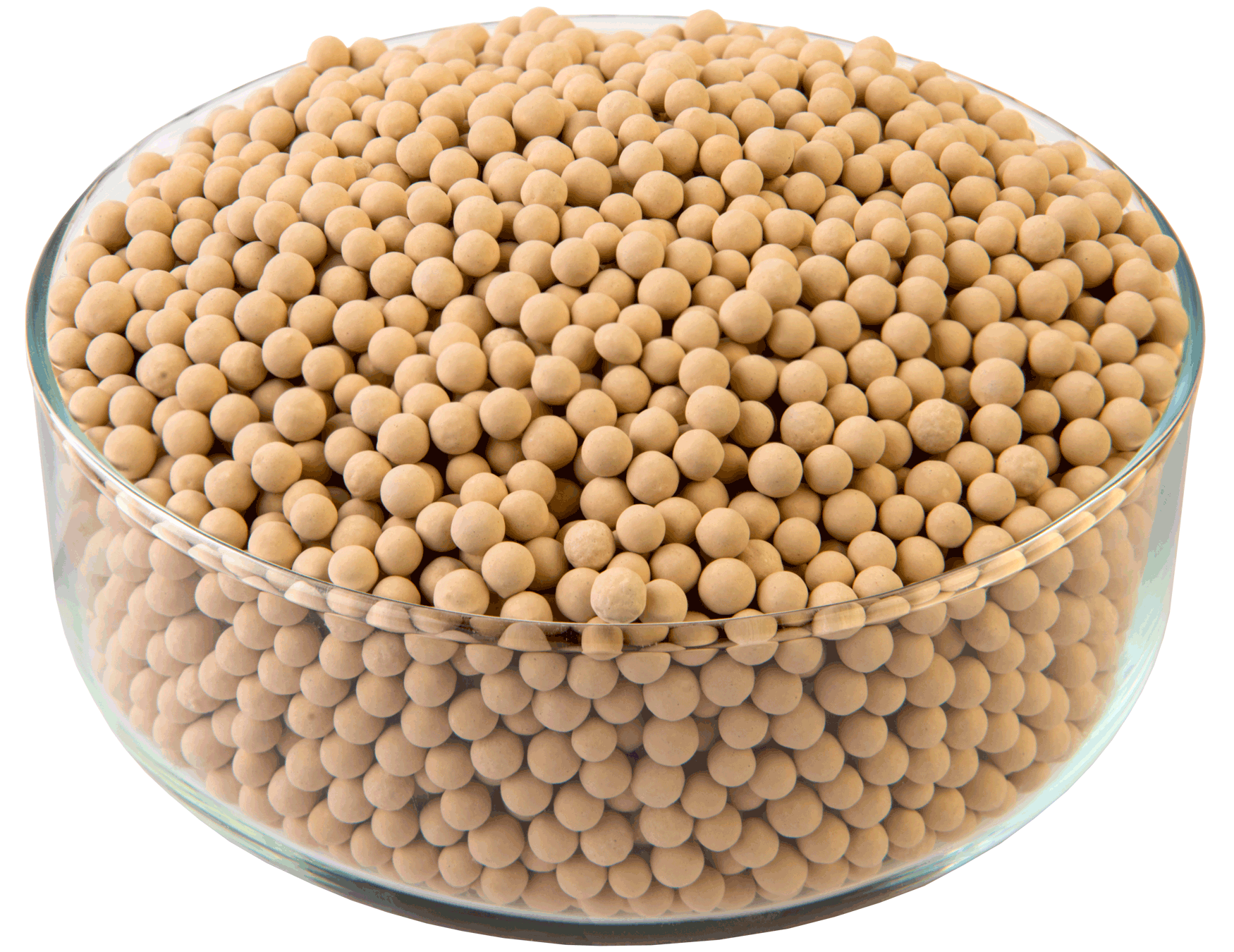
For the first time in our research, we examined the physicochemical properties
of 3 types of KA (3Å) zeolite, which has been widely used in recent years. The obtained
results are presented in Table 2.
2 - table
Physico-chemical parameters of KA (3Å) zeolites
№ Indicator name
Spherical
1,6-2,5
Spherical
3-5
Spherical
1
Granule size, mm
1,6-2,5
3-5
1,6
2
The moisture content of gas
drying in static conditions,
mg/g, is not low
210
210
205
3
The moisture content of gas
drying in static conditions,
mg/cm
3
, is not low
2,0
2,0
2,0
4
Bulk density, g/cm
3
0,70
0,68
0,6
5
The amount of moisture in
zeolite, % is not much
1,0
1,0
1,0
6
Mass fraction of total loss, %
0,1
0,1
0,1
7
Moisture absorption capacity,
mg/g
230
220
215
8
Anti-aging strength, %
95,0
95,0
94,0
9
Mass fraction of water
resistance, %
99,0
99,0
99,0
2 – picture. General view of spherical KA (3Å) zeolite
The comparative analysis of the analysis results of KA (3Å) zeolites shows that
spherical zeolite 1.6-2.5 mm in size showed higher results compared to others and NaA
zeolite. Among these indicators, we can see that the main requirements for adsorbents

Acumen:
International Journal of
Multidisciplinary Research
Volume 1, Issue 1
40
Acumen: International Journal of Multidisciplinary Research
for gas drying are high, such as moisture absorption capacity, resistance to corrosion,
and water tolerance mass fraction.
In conclusion, the physico-chemical parameters of adsorbents NaA (3Å) and KA
(3Å) zeolites selected as a result of the research were studied. Their parameters such
as moisture absorption capacity, corrosion resistance, water tolerance mass fraction
were studied and used in natural gas drying at Shurtanneftgaz LLC.
LIST OF REFERENCES USED
1.
ТУ
2161-023-21742510-2008.
Адсорбент
силикагелевый
модифицированный РС-АССМ-М. Ярославль: ООО «Торговый дом «Реал Сорб»,
2008. - 15 с.
2.
Серпионова E.H. Промышленная адсорбция газов и паров . М.:
Высшая школа, 1971.-413 с.
3.
Денисевич Е.В. Очистка и осушка природного газа силикагелями /
Е.В. Денисевич, JI.B. Моргун, С.А. Молчанов, Б.П. Золотовский // Газовая
промышленность. 2001. - № 6. - С. 23-26.
4.
Rakhimov, G., Kuybokarov, O., &Karshiyev, M. (2024). Research of the
catalytic properties of a catalyst selected for the production of high-molecular weight
liquid synthetic hydrocarbons from synthesis gas. In
E3S WebofConferences
(Vol. 498,
p. 01008). EDP Sciences.
5.
Rakhimov, G. B. (2023). DEVELOPMENT OF ANTI-DETONATION
ADDITIVE.
Экономика и социум
, (12 (115)-1), 604-607.
6.
Rakhimov, G. (2023). INCREASING REGENERATION EFFICIENCY
BY RECYCLING ALKANOLAMINES.
Sanoatda raqamli texnologiyalar
/Цифровые технологии в промышленности
,
1
(2), 158-163.
7.
Murtazaev, F. I., &Raximov, G. B. (2023). Synthesis of sorbents used in the
separation of halogens.
Sanoatda raqamli texnologiyalar
,
1
(01).