
All articles
Zullisonayn poets of the Babur period
Zakaria Yusuf is an Arabic source scholar and terminologist
Zacharia Tamer's stylistic skills: composition and symbolic language features (based on the story "Randa")
This article is devoted to the study of the special literary style of one of the prominent representatives of modern Syrian literature – the writer Zakaria Tamer. It analyzes the author’s story “Randa”, which clearly shows the compositional skills of Z. Tamer and the symbolic language used in the story. Although the “Randa”, created in the form of a “story inside a story”, resembles a fairy tale for children, in fact it is an extensive literary work of a talented writer that addresses important topics of society with simple sentences. Using the image of a little girl named Randa, the author creates a universal image of a woman and skillfully uses symbols to show her role in society, especially the fate of an Arab woman through thin lines.
Yemen Crisis: Internal and External Factors
The following article considers the origins, external and internal factors of the modern crisis in Yemen. It is particularly noted that one of the reasons that Yemen has always been the arena for a clash of interests of the powers due to its strategic position on the sea route connecting Europe with the Indian ocean. It describes in detail how, along with the external threat, North and South Yemen in the second half of the XXth century was torn by internal contradictions. It is noted that after the integration of Yemen in 1990, opposition intensified its activities against the conditions of unification, which led to a new civil war. The article has a strong focus on the fact that in Yemen in the end of twentieth century political factor has been supplemented by religious factor, i.e., the confrontation escalated between the northerners Shia zaidis and the South Sunni. Attention is drawn to the fact that the spread of Wahhabism in Yemen as an ideological and political force, the creation of "al-Qaeda of the Arabian Peninsula" has further aggravated the explosive situation in the country. The analysis of the process of transformation of the theological movement of the Houthis-zaidis into a military-political force, which managed in the Wake of the "Arab spring" and in Alliance with the supporters of former President Ali Abdullah Saleh, not only to seize power in Sana'a in January 2015, but also to expand its position up to Aden. The particular emphasis has been placed on the fact that since March 2015 the conflict in Yemen has acquired an international character, when the Saudi coalition (Saudi Arabia, Bahrain, Jordan, Kuwait, Morocco, Qatar, Sudan and UAE, Egypt) sided with the President in the exile of Abd Rabbo Mansur Hadi and forced the Houthis to retreat from Aden and Bab El-Mandeb Strait by force of arms. It is noted what changes have occurred in the US policy towards the support of the Saudi coalition in recent years. The role of Iran in Yemen and the nature of its relations with the Houthis cause disputes between researchers. Based on the analysis of recent events, it is concluded that the military actions of the Saudi coalition can lead to the elimination of Yemen as a state. The ongoing armed conflict and the futility of attempts at a political solution make the possibility of a peaceful settlement in Yemen problematical.
Works of Russian military orientalists as an important source in the study of the history of Central Asia
This article reveals the role of the Russian military Oriental studies in the study of the history of Central Asia in the period of expansion of the Russian Empire, is the analysis of the factors which had fundamental importance in the development of military-Oriental research, the contribution to the establishment of the military of Oriental studies of the Russian military engineer A. G. Serebrennikov, the author of a military geographical and topographical sketches, and compiler of an extensive body of archival documents of the "Turkestan region. The collection of materials for the history of his conquests, 1839–1876.", revealed the little-known pages of life and activities.
Works of great Turkish scholars who wrote about Arabic proverbs and proverbs
At the beginning of the eleventh century, with the formation of the largest centralized state of Turkic peoples, tribes in Central Asia - the Karakhanid dynasty, the prestige of the ancient Turkic language grew, and a number of scholars and poets developed in the process of raising it to a high literary level. These are the works of Mahmud Kashgari, Yusuf Khos Hajib, Ahmad Yugnaki, Ahmad Yassawi and Suleiman Bogirgani, who created their works in the 11th and 12th centuries. The works of these authors came not only from the 11th and 12th centuries, but through manuscripts rewritten from the 13th century. Consequently, the history of modern Turkish manuscripts in Arabic dates back to the 13th century. Learning Arabic proverbs began in the 8th century. Like many scholars such as Sahar Ibn Dhabi, the Arab poet Ubaid Jurdzhumiy (8th century) and the Persian scholar Abu Fadl Maidani, Mahmoud Zamahshari wrote his book Al-Mustaksa Min-l-Amsali. In addition to verses from different eras, he quotes from the book of Kalil and Dimna. This article presents the works of great Turkic scholars about Arabic proverbs and parables and historians, Orientalists - Hermann Wamberi, A.Yu. Yakubovsky, S.P. Tolstov, E., who studied the culture, enlightenment and national heritage of the peoples of Central Asia. The hard work of E. Bertels, V.V. Bartold, E. Berezikov and others was recognized.

Works of Ali Safi Hiravi available in Tashkent manuscript funds and new findings from the author's pen
Today, when our national and spiritual values have been restored and the study of the masterpieces of our ancient manuscript heritage is given serious importance at the level of public policy, we have a deeper understanding of our ancient cultural heritage and national history, rooted in the distant past. One of the master of words who made a great contribution to the development of world culture and science with his work was Fahruddin Ali Safi bin Husein Waiz Kashifi (d. 939/1539). His work is notable for covering various areas of secular and religious sciences. The works of Fakhruddin Ali Safi reflect the ideas of raising a person with high qualities through the scientific heritage of our ancestors, the advancement of young people to healthy thinking and pure morality through the foundations of our culture and religion. This article provides information on two recently discovered new works of prose and one poem (gazelle) by Mavlian Fakhruddin Ali Safi Hirawi. On the basis of the recently discovered this gazelle by Ali Safi, the rubai and poems in "Rashakhat", the researcher came to the firm conclusion that this artist could have had "Devon" (Collection of Gazelles). In his article, the researcher also examines in detail the manuscripts of Ali Safi's works in the Tashkent manuscript collections. The section of the article "New finds in the work of Ali Safi" is unique in that it examines two more new manuscripts of previously unknown works of Ali Safi and a gazelle. According to the author of the article, one of these manuscripts is the work of Ali Safi "Sharh-i Masnavi", the only manuscript of which is kept in the main fund of the Academy of Sciences of Uzbekistan. According to the author of the article, one of these manuscripts is the work of Ali Safi "Sharh-i Masnavi", the only manuscript of which is kept in the main fund of the Academy of Sciences of Uzbekistan. The second manuscript is "Tukhfa-i muluk", the only manuscript of which is kept in the main collection of the Academy of Sciences of the Republic of Uzbekistan. It is noteworthy that both of these manuscripts, written in Persian, are now being studied separately and in detail by the researcher. The second manuscript is "Tukhfa-i muluk", the only manuscript of which is kept in the main collection of the Academy of Sciences of the Republic of Uzbekistan. It is noteworthy that both of these manuscripts, written in Persian, are now being studied separately and in detail by the researcher. According to article FA RU No. 1023 inv. On the margins of pages 140a-140b "Majmu'a-i bayoz", which is kept under number According to the researcher, this gazelle was taken from Devon Ali Safi. So, our researcher is faced with an important task - to find the "Devon" of the poet.
Word formation on the basis of adopted Persian verb semi-affixes from Alisher Navoi's epic "Hayrat ul-Abror"
Word builder of homonymy in Chinese language processes
The issue of deputy is the importantoret issue not only with the determination of the limits of the word, but also the most complex issues of practical lexicography. The Chinese language-making processes are generally able to fill out the surgeon. In addition to the words of words, add, affixation, conversion and reduction process is included. It should be noted that the reasons for the sources of Omonia and the emergence of Oman are the main and essential source of the Omania, as the phonetic structure and phonetic
processes. This article is reflected in this article.
Ways to evaluate the effectiveness of Japan's national innovation system
The article provides an analysis of the concept of a national innovation system (NIS), scientific and theoretical views and approaches to it. In addition, by using the DEA model, the efficiency of the Japanese NIS was evaluated, as well as a comparative analysis was conducted with several developed countries, on the basis of which proposals for innovative development of the economy of Uzbekistan were developed. There are several software types of our selected model (DEA-Solver-Pro, Frontier Analyst, OnFront, Warwick DEA, EffiVision, KonSi DEA Analysis, etc.), and our analysis is presented in Excel program. For analysis, we used materials from international organizations such as the World Bank, OECD, the World Intellectual Property Organization, all research, and others.
Ways to convey the latest terms in the field of communication in modern Arabic
This article touches upon the most pressing issues in the field of modern Arabic terminology, namely, the ways in which the Arabic language is conveyed the latest terms used to denote modern technological advances in the field of communication. Arab countries, like many other developing states, are only consumers of the latest advances in science and technology that are emerging in more developed regions of the world. It is these “fruits” of technological progress that contribute to the formation of new, previously non-existent objects, phenomena and “transformations”. The latter not only enrich the "world of electronics", but also contribute to the expansion of the linguistic vocabulary of the "carrier" language, and then the languages of "consumers". Thus, the article analyzes and describes the most commonly used methods of transmitting the Arabic "speech" of the above-described newest names of gadgets that did not previously exist among the Arabs. It is well known that any language strives to preserve its identity and avoid direct foreign borrowings. The Arabic language in this context is no exception. In this regard, the author highlights the numerous attempts of the Arabic language to avoid direct borrowings by adapting their own lexical units. Sometimes, due to the lack of suitable semantic lexemes, the Arabic language is forced to use more "gentle ways" of transferring new foreign names, ie. by using methods such as "tracing paper" and "half-calf". On the other hand, despite attempts to avoid direct foreign borrowings, under the influence of the "fashion" for the English language, the facts of the "entry" of Western terms into the language of the Arab people are comprehensively observed, undergoing only transliteration necessary for this language.
Views on word formation in the history of Arabic linguistics
This article describes the views of famous Arab linguists living in the early medieval times on the word and its making. It also describes the distinctive and general aspects of the views expressed. In the Arabic language the meanings of words “kalima”, “lafz”, “qavl” have been analyzed.
Views on natural sciences in the works of Ahmed Donish
In the second half of the XIX - early XX centuriesThousands of scientific studies, works, and works on the natural sciences were created in Central Asia. These works are currently in preservation in the collections of manuscripts and libraries of Uzbekistan. In particular, the rich scientific and spiritual heritage of the famous thinker Ahmad Danish has its place among the sources of the manuscript fund of the Institute of Oriental Studies named after Abu RayhanBiruni of the Academy of Sciences of the Republic of Uzbekistan. The article indicates the registration numbers of his works and essays. The analysis of the views of Ahmad Donish on science, in the works. The author of the article pays great attention to the study of his works and works, where a place is given to the description of natural phenomena.The article also presents the scientific thoughts of Ahmad Donish about nature, about the origin and structure of the Earth, about the existence and movement of the planets, about the eclipses of the Sun and the Moon. In the works devoted to the natural sciences, he presents natural phenomena, based on scientific arguments. In covering the topic of a scientific article, the author used such scientific methods as historicity, analysis of phenomena in a particular historical context and explanation. It should be noted that Central Asia in the second half of the XIX - early XX centuries. became the object of active research of Russian and foreign researchers. As a result, hundreds of new studies have emerged. This justifies the level of the highest development of the science of geography in the second end of the XIX - beginning of the XX centuries. Innovations in the field of natural sciences directly influenced the work of the enlighteners of Central Asia. In view of the developing educational movement at the end of the
Verbs expressing the sense of sight in English and Uzbek proverbs
This article deals with the problem of proverbs “seeing” in English and Uzbek. By means of analyzing the psycholinguistic aspect of this problem the author makes an attempt of explaining the role of “seeing” in the process how people get information about the outer world using the organs of perception and the brain. The author analyses the problem of the “linguistic map of the world”, “national picture of the world” in order to find answers to the problems analysed.
Variations of stereotypical units used in Old Turkic inscriptions in later works
This article is devoted to the stereotypical units of Old Turkic texts. The transformation of the stereotypical units to the next period is particularly illuminated in the article.
Variants of simple verbs in Persian (in the example of the verb تنساوخ [خاستان])
Uzbekistan-Turkey relations
This article is devoted to the analysis of socio-economic and political ties between Uzbekistan and Turkey during the years of independence, mutual interests of the two states, the main directions of foreign policy, factors of increasing mutual interests of the two sides. The author discusses the speeches of Sh.M.Mirziyoyev at the Ankara summit, as well as the Uzbekistan-Turkey business forum on April 30, 2018 in Tashkent. In addition, it is stated that the Uzbek people watch Turkish films and TV series with love.
Uzbekistan-China: cooperation in the field of higher education
The article deals with relations between China and Republic of Uzbekistan in high education sphere within the project “One belt – one road”.
Uzbekistan under the New Leadership and the Cooperation of Republic of Korea
Recently, Republic of Korea and Republic of Uzbekistan have been buoyed up by expectations for new leadership. Under the new governments and new policies, the relationship between the two countries has entered a new phase. The new Korean government led by Moon Jae-in sees the new domestic and foreign policy initiatives led by the Mirziyoyev government as highly encouraging and shows great interest in establishing mutually beneficial partnership with the new government in Uzbekistan.
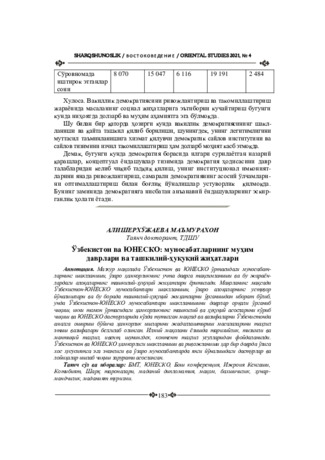
Uzbekistan and UNESCO: important periods and organizational and legal aspects of relations
This article describes the formation of relations between Uzbekistan and UNESCO, the division of cooperation into three periods and the organizational and legal aspects of relations in these processes. The purpose of the article is to study the formation of Uzbekistan-UNESCO relations, priorities and organizational and legal aspects of the relationship, as well as to analyze the issues of accelerating cooperation in the
implementation of tasks in Uzbekistan. Historical, systematic and logical analysis, event, as well as content analysis methods were used in writing the scientific article. The formation and development of cooperation between Uzbekistan and UNESCO is unique in each period and is based on the need to develop new programs and projects in the relationship.
Uzbekistan and Japan: common foundations of the development of strategic partnership relations
The following issues are analyzed in this scientific article:the significance and historical role of establishing diplomatic relations between the Republic of Uz-bekistan and Japan. The huge role of ratification of the strategic partnership agreement between two countries is also shown. The peculiar specifics of the political system of Japan, including the nature, structure and basic functions of the parliament and the procedure for holding parliamentary elections, the place and role of the emperor’s institution in the political system, as well as the cabinet of ministers, are examined. The article considers the basis of the principle of forming the Cabinet of ministers, its role in the process of reforming the political system of society, the features of the political system, in particular the formation of a multi-party system, the reasons for success as a dominant party - the Liberal Democratic Party of the country, the role of the LDP in the process of modernization of the Japanese political system, the role of the Cabinet of ministersin the political system of society, the activities of the Japanese government led by Sh.Abe in the process of updating political system, the government’s program for the development of the country's economy, as well as the specifics of the practical implementation of this program, the activities of the parliament and the cabinet to amend the Constitution of the country, in particular, on articles 1, 4, 7, 9, 41 of the Constitution. Particular attention is paid to the processes of amending Article 9 of the Constitution, which deals with the issue of legal updating of the status of the Japanese armed forces, and on the basis of these changes will complete the "idea of creating" a normal Japanese army. The cabinet’s aspirations to expand the powers of the government by improving the legal norms of the Constitution, in particular by adding a special chapter 9 to the main law, are also considered.
Uzbek-Japanese relations in ancient and medieval times
In this article given uzbek-japanese cultural and social-economical relations ancient and middle ages. It also analyzes data from articles of Japanese scholars –Sh.Kuwayama and M. Inabaabout ethnical history of Tokharistan and adjacent areas in early middle ages.
Uyghur written list "Kutadgu bilig": source study and textological contours
There are three manuscripts of “Kutadku bilig”. One of them was written in Uighur script and others in Arabic one. Uighur copy of manuscript was copied in 1439 in Herat. This copy of the work wasn’t so much analyzed because of its script. But there are many achievements of this copy. By supposition this text was copied from old one. It can give us much information about this work.
Use of common Arabic words in Persian and Uzbek languages
It is known from history that the Persian language is derived from the ancient languages, which did not retain its linguistic peculiarities. Temporary and historical circumstances have shown the rise of the lexicon of other languages under the influence of Persian words, as well as the Arabic language. The lexicon of the Uzbek language does not apply to exclusion. The ancient Persian-Tajik language was used in parallel with the languages of the Maverannahr region, in parts, in Uzbek. As a result, many words from the Persian and Arabic languages are used in the lexical composition of the Uzbek language, that is, they are used as common words. On the other hand, not all commonly used words are used for meaning and meaning. In the Uzbek language there is such an ancient Arabic word, that their semantic border has another meaning in the Persian language, and in the Uzbek language - a complete other meaning. Interestingly, what this word-term, used in both languages, refers to the word actively spoken in both languages. In addition, the methods of education of one-word words in comparative languages must correspond to the international standard. In the result, such a conclusion becomes the exact etymological basis and the basic meaning of the productive common words Persian and Uzbek languages. For example, in the Uzbek language, such words exist, such as' muhtoriяtʼ, 'maimurяtʼ,' maimurʼ, 'muқobilʼ,' каakam ',' tasrifʼ, 'insonparvarlikʼ,' dorulfunusʼ, х дастурʼ, 'инқиботʼ и многие სხვაе, basically which is related to Arabic borrowing, but does not fully reflect their meaning from the Arabic language. To give common words являются общеупоребительными словами, которые на сегодняшний день были предложены всесто русско-международного слова-термина The semantic and functional study of such a word serves the development of lexicology of the Uzbek language. The reason why, in 1989, when the Uzbek language was given the status of "state language", a task was set to pursue its prestige. Accordingly, the whole article я яvlяet я conducted the structural-semantic analysis of the Persian common-use words-terms, used daily in the Uzbek language.
Usage patterns of the Chinese verb lái [lái] and its Uzbek equivalents
Description of the semantics of the verb is a complicated process since the semantics of the verb is closely related to its distribution. In view of the foregoing, verbs are classified by the expression of directional movement and the presence or absence of subject/object, if there is one, by its quantity. In the Chinese language, there are verbs of motion that, besides movement, also express direction. These verbs can act as an independent verbal predicate or an appositive adjunct known as directive additional parts, a modifier or directional morpheme in a sentence. Verbs 来 [lái] “to come” and 去 [qù] “to go” are basic verbs of the direction of movement. Compound verb of the direction of movement is also formed by adding these verbs. If the action of the verb is getting closer to the speaker, 来 is used. If the action is moving away from the speaker, 去 is used. 来 [lái] “to come” is one of the basic verbs of the direction of movement. 来 [lái] is a polysemous word and it can act as notional or auxiliary verb in a sentence, as well as in the function of a syntactic word. The specificity of the semantics of the verb 来 [lái] lies in the fact that in addition to the orientation or direction of movement, it indicates the narrative clause, what information the speaker wants to emphasize. In this article, the verb properties of 来 [lái] are studied and ways to actualize their meanings in the Uzbek language are identified. The models 来 [lái] in the functions of the main and auxiliary verbs have been studied, as well as in the function of a syntactic word based on materials of the book by Lu Shusyan “现代汉语八百词吕 叔湘” (“800 words of modern Chinese”). The similarities and differences between the semantics of the verbs 来[lái] in Chinese and kelmoq in Uzbek are described.

