All articles

Treatment of theileriosis in cattle with a new drug
Theoretical background of the endemic icteroghemoglobinuria of the karakul sheep

The technology of lamb growing and increasing of its resourses in karakul
Subjects of research: The group of karakul sheep fed in a various energetic caloric.
The aim and function of investigation: In the condition of new economical trends to work out the effective technological system relying on gaining weight of male lambs separated from ewes in the same year, keeping them, intensifying system of feeding in order to decrease the capacity of lambs in meadows and as a result of which relating on getting products.
The methods of investigation: zoo-tcchnical and biological
Achieved results and their novelty: The high level of rapid growth and fleshiness of karakul lambs is specified with clearly outlines that beginning from 2-2,5 months to feed them with extra food based on a high energetic ration. The weight of 4-4,5 monthly lambs reach 30,5±0,26 kg. The lactation of experimental ewes is higher than the controlled ewes of the I group for 22,6 %, the II group for 23,2 %. Making up 13,3 kg of experimental group lambs’ body (I group) and 14,8 kg (II group) and 47,3 and 47,9 % getting meat, 2,25 and 2,73 % of fat collection shows the highness of meat industry than usual demands and the high efficiency of gaining weight of young karakul lambs. According to the diet-II the morphological constituents of the body’s of the II group extra fed group lambs showed that the inter-balance between the amount of flesh and bones (fleshiness coefficient) should be 0,29 units comparing to the I group lambs, 1,08 units comparing to the controlled group-mates. Beginning supplementary feeding from the 2 period of ewes’ pregnancies will increase the living function of lambs, if there was not noticed any sheer losses, this indicator would make 2,5 - 3 % in animals kept in farm circumstances, comparing to the experimental group-mates ewes’ high birth of this group was lessened for 6,4 % .
Practical value: The practical value of the investigation was seen in the priority in the field of karakul sheep breeding to increase rapidly the male lambs which don’t satisfy the requirements of sheep market, to get a rational use from the energy of young organism, embedding little labour; pecuniary-technical means and finance to work out the technological system of increasing the productivity as well as profitability and efficiency of the system.
Application degree and economical efficiency: The result of investigation is utilized in karakul sheep breeding plant: “Karnab ota” of Pakhtachi region of Samarkand. The net profit received from one lamb of the II group makes 27151,8 sums while the lambs of the I and controlled group makes 19167,1; 10282,6 sums, profitability level constitutes correspondingly 54,1,42,1; and 25, 01 percents.
Utilizing sphere: All types of estate forms concerning with karakul sheep breeding.

The role of mineral-vitamin and protein feeds in increasing efficiency in rabbit farming
In this article, the rapid development of the rabbit breeding industry, the improvement of breeding and selection, and the cultivation of high-quality meat, ecologically clean and biologically safe meat and other products, using single-celled blue green algae, and the use of coarse plant meal to grow low-cost grain feed are discussed.

The productivity of Golshtin, black – variegated breeds and their crossbreeds under conditions of South zone of Uzbekistan
Subject of research: pure- bred and crossbred heifers and calves of Golshtin and black - variegated breeds.
Purpose of the work: the study of the growth and development, meat and milk productivity and also some biological peculiarities of Goldstein, black -variegated breeds and their crossbreeds under a sharp-continental conditions of South zone of Uzbekistan.
Methods of research: zootechnical, biological and economical
Obtained results and their novelty: for the first time in the researches there was revealed the genetic potential of pure - breed Goldstein, black-variegated cattle? their crossbreds according to milk and meat productivity under conditions of hot climate.
The resuits obtained and theier novelty: Purebred young cavs of Goldstein breed exceeded their analogues of black- variegated and crossbred ones on yield of milk during the first 90 days of lactation, correspondingly 175,5 and 100,5 kg. Crossbred calves while slaughtering at the age of 18 and 21 months gave to 16,6 and 5,1; 21,1 and 7,9 kg more of fresh killed meat, than of their age of IV and V groups correspondingly.
Practical value: increasing the production of meat and milk under conditions of hot climate of Surkhandarya valley, pure-bred rearing of Golshtin and black-variegated breeds and their crossing between each other has a great practical significance.
Degree of embed and economic effectiveness: The results of researches where inculcated into the herds of cattle on a farm “Chjrvador” of Kumkurgan district of Surkhandarya region. As a result of inculcation in average from one cow of Golshtin breed and from realization of one bull-calf (at the age of 18 and 21 month) there was obtained 181,0-252,8; 366,4-447,4 and 446,8-549,5 thousand sums of pure income, and the norm of profitableness comprised accordingly 46,7-64,1; 38,4-46,6 and 36,6-44.7%
Field of application: all the categories of cattle-breeding farms, where there arc reared Golshtin and black- variegated breeds of cattle.
The productivity of Golshtin, black – variegated breeds and their crossbreeds under conditions of South zone of Uzbekistan
The object of inquiries: pure- bred and crossbred heifers and calves of Golshtin and black - variegated breeds.
The aim of the work: the study of the growth and development, meat and milk productivity and also some biological peculiarities of Goldstein, black -variegated breeds and their crossbreeds under a sharp-continental conditions of South zone of Uzbekistan.
Methods of inquiries: zootechnical, biological and economical
Obtained results and their novelty: for the first time in the researches there was revealed the genetic potential of pure - breed Goldstein, black-variegated cattle? their crossbreds according to milk and meat productivity under conditions of hot climate. Purebred young cavs of Goldstein breed exceeded their analogues of black- variegated and crossbred ones on yield of milk during the first 90 days of lactation, correspondingly 175,5 and 100,5 kg. Crossbred calves while slaughtering at the age of 18 and 21 months gave to 16,6 and 5,1; 21,1 and 7,9 kg more of fresh killed meat, than of their age of IV and V groups correspondingly.
Practical significance: increasing the production of meat and milk under conditions of hot climate of Surkhandarya valley, pure-bred rearing of Golshtin and black-variegated breeds and their crossing between each other has a great practical significance.
The degree of inculcation and economic effectiveness: The results of researches where inculcated into the herds of cattle on a farm “Chjrvador” of Kumkurgan district of Surkhandarya region. As a result of inculcation in average from one cow of Golshtin breed and from realization of one bull-calf (at the age of 18 and 21 month) there was obtained 181,0-252,8; 366,4-447,4 and 446,8-549,5 thousand sums of pure income, and the norm of profitableness comprised accordingly 46,7-64,1; 38,4-46,6 and 36,6-44.7%
The sphere of usage: all the categories of cattle-breeding farms, where there arc reared Golshtin and black- variegated breeds of cattle.
The parasites of fish in the Khorezm pond industry and measures of struggle against them
Subjects of research: fish parasites of the Khorezm pond industry.
Purpose of work: The Complex study of epizztic condition of spreading of pathogenic organism invasive diseases of valuable and less valuable fish in the oecologcal system of Khorezm pond farming and Working out some measures of combating against it, taking into consideration local oecological conditions.
Method of research: full parasitological, field and laboratory methods.
The results achieved and their novelty: The complex study of the parasitological state of fish in the Khorezm pond industry has been carried out for the first time and 68 species new for the farming have been revealed. The degree of infection of all the species of fish by parasites was distinguished, there were defined the conformities of change of fish parasite fauna from ecological factors (stream, turbidity, chemical structure of water, season of the year, food structure and fish feeding), the change of qualitative and quantitative structure of carp parasite fauna.
Practical value: The results of the study of pathogene value of fish parasites entering the ponds with the plants, prove the necessity of the regular parasitological control of fish at all the stages of its breeding.
Degree of embed and economic effectivity: practical recommendations for the preventive measures in the struggle against the pathogenes of the invasional fish deseases are introduced into the fish ponds of the Khorezm region and its economical profit is 3680000 sums (Acts of use in the production on May 6, 2003, and May 3, 2005).
Field of application: At the higher educational establishments, at the lectures and laboratory lessand, at the fish industries of the Republic.

The improvement of tretment and prophylaxis of teylerios of cattle on the base of local preparations
Objects of the inquiries: Th.annulata, cattle sick with teylcrious, diggcrent chemical preparations, samples of blood of animals, criomatcral.
The aim of the work: To elaborate highly effective means and ways of treatment and prophylaxis of teylerios of cattle on the base of local raw materials, and also to elaborate the method of crioconscrvation of agents of teylerios -Th. annulata.
Method of inquiry: cpizootological, clinical, parasitological, hacmotologicaL
Obtained results and their novelty: The were ascertained optimum dozes and studied treating -prophylactic properties of diamidin, uzbikarb, polyamidin-p at teylerios of cattle and inculcated into veterinary practice.
There is elaborated the teylerios -Th. annulata and established the term of pathogenous properties of teylerios (Patent for invention 1AP 04088.)
Practical significance: As a result of application of diamidin, uzbikarb, polyamidin-p in stock-breeding farms will be healthier from teylerios. The elaborated method of crioconscrvation of agents of teylerios -Th. annulata is used for creation of collection of stamms, at conducting exprimcntal tests and at production of biological preparations.
The degree of inculation and economical effectiveness:
The results of researches arc the base for treatment and prophylaxis of teylerios of cattle. There was elaborated and confirmed by state Administration Board of Veterinary of the Republic of Uzbekistan.
“ The directions on the of the application of polyamidin-p against piroplasmidoses of cattle”( the 5 th of Jine, 2010). As a results of the systematic usage of polyamidin-p every 10 days during period from march till September there was obtained 271 sums of economical effectiveness from 1 sum spent.
The sphere of application: veterinary.
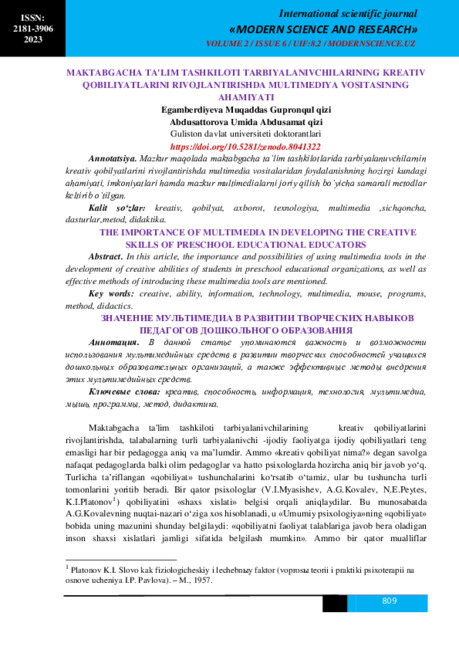
THE IMPORTANCE OF MULTIMEDIA IN DEVELOPING THE CREATIVE SKILLS OF PRESCHOOL EDUCATIONAL EDUCATORS

The importance of assessing the nutritional value of feed when feeding horses and their digestive system features
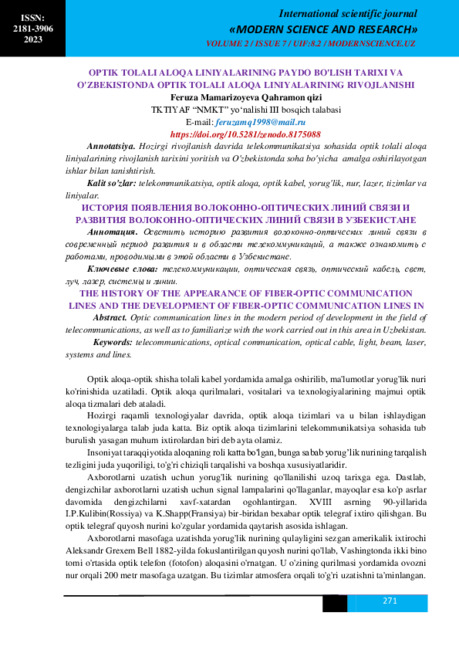
THE HISTORY OF THE APPEARANCE OF FIBER-OPTIC COMMUNICATION LINES AND THE DEVELOPMENT OF FIBER-OPTIC COMMUNICATION LINES IN

The fauna, distribution and ecology of filariata of the birds and mammals in Uzbekistan
The urgency and relevance of the theme of the dissertation.Filariata form a large and widely distributed group of parasitic nematodes that cause a series of very dangerous diseases in humans and animals, which arc called “filariases”. “According to the World Health Organisation (WHO), about 120 million people around the world living in the subtropical and tropical zones arc infected with filariases, with about 40 million being disabled persons, whose disability was caused by lymphatic filariases and lymphatic tumours”1.
Filariata cause a number of parasitic diseases in wild and domestic animals, such as parafilariasis, onchocercosis, setariosis, stephanofilariasis and dipctaloncmosis, and thus cause huge economic damage to cattle breeding and processing industries. This is why it is highly important to identify parasitic nematodes causing filariases, diagnose infected animals and develop preventive measures.
The necessity to develop filariases prevention methods for animals on the basis of the parasitic nematodes’ general biologic life cycles determine the huge practical importance of Filariata for health protection and veterinary science.
To modernize the taxonomy of the suborder Filariata on the basis of the contemporary characteristics of subspecies taxons, which remain debatable so far, is scientifically important for the theoretical parasitology.
Filariata parasitise vertebrates and cause highly dangerous diseases in them, which in the end impede the development of the main cattle breeding industries and their productivity. To develop methods to control filariases and to introduce them into the practical veterinary science arc among the topical tasks.
This thesis will help solve the tasks set in the decrees of the President of the Republic of Uzbekistan -PD-308 “On measures to stimulate the growth of livestock at private and state farms” issued on 23 March 2006 and PD-842 “On additional measures to stimulate the growth of livestock at private and state farms and to increase the amount of animal produce” issued on 21 April 2008, as well as in other normative legal acts concerning this area.
The aim of the research workis to identify the fauna, biology and life cycles of the most numerous species of parasites of birds and mammals - nematodes from the suborder Filariata, to modernize Filariata’s taxonomy and to prevent filariases in agricultural animals.
Scientific novelty of the research workis as follows:
the species diversity of Filariata of birds and animals was eastablishcd, with 53 species recorded in birds and 23 - in mammals;
46 of the 76 Filariata species were recorded for the first time for Uzbekistan, while the species Paronchocerca bumpae- for the Palacarctic;
the life cycles of predominating Filariata species (Aprocta cylindrica, Diplotriaena isabellina, Ornithofilaria falisensis, Onchocerca lienalis, Stephanofilaria stilesi and S. assamensis) were determined in the course of experiments;
the nucleotide sequence 5.8S+ITS-2+28S was determined to differentiate the species Setaria equina and Setaria labiatopapillosa;
changes were made in the taxonomy of the Filariata supcrspccics on the basis of a comparative analysis of Filariata’s morphology, biology and ecology, taking into account the belonging of certain groups of the nematodes to specific vertebrate hosts;
changes were made to the size and limits of the families Splcndidofilariidac, Diplotriacnidac and Oswaldofilariidae, in which Filariata parasitizing amphibians and reptiles were isolated into a separate group;
The separated species were included in the new families Icosiellidac and Oswaldofilariidae, which form the supcrfamilyOswaldofilarioidca supcrfam.nov;
Measures were developed to prevent filariases in agricultural animals.
CONCLUSION
The following conclusions were made from the results of the research carried out as part of the doctoral thesis “The faunam distribution and ecology of Filariata of birds and animals in Uzbekistan”.
1. 53 Filariata species were recorded in various ecological groups of birds. These species belong to 4 families and 22 genera; 46 of the 53 species were for the first time recorded in Uzbekistan, and 1 species (Paranchocerca bumpae) - for the first time in the Palacarctic.
2. 23 Filariata species belonging to 5 families and 9 genera were recorded in mammals; it was established that most of the species parasitise even-toed and oddtoed mammals.
3. The birds and mammals of the biogeocoenoses of Uzbekistan arc infected with 76 Filariata species, which comprises 13.0 % of the total of the world Filariata fauna.
4. It was established that Filariata recorded in birds and mammals can only parasitise in organs not connected with the external environment.
5. By their biological characteristics Filariata arc referred to heteroxenous forms; the class Insccta (Acrididae, Simuliidac, Culicidac, Muscidae) were identified as their intermediate hosts, and 14 bird orders and 7 mammal orders as their definitive hosts.
6. The life cycles of nematodes Aprocta cylindrica Linstow, 1833, Diplotriaena isabellina Koroliowa, 1926, Omithofilaria fallisensis Anderson, 1954, Onchocerca lienalis (Stiles, 1892), Stephanofilaria assamensis Pande, 1936, S.stilesi Chitwood, 1934 were established in the course of experiments.
7. A comparative analysis of fragments of nuclcotdc sequences 5.8S+ITS-2+28S was made to differentiate the species with similar morphlogics-Se/arm equina (Abildgaard, 1789) and Setaria labiatopapillosa (Alessandrini, 1848), and thus differences in the diagnoses of these nematodes were established.
8. Diagnostic characteristics were determined to differentiate Filariata in all the stages of their development (adult and larval stages and microfilariae).
9. Considerable changes were made in Filariata’s superspecies taxonomy. New size and limits were established for the families Splcndidofilariidac, Diplotriacnidac, Oswaldofilariidae and Lcmdanidac, and new taxons were suggested.
10. The composition of Filariata was justified. The suborder consists of 4 supcrfamilies(Filarioidca, Aproctoidea, Diplotriacnoidca and Oswaldofilarioidca), each of which is divided into groups of familiesincluding parasites specific to certain classes of vertebrates. The taxonomy of nematodes of the suborder Filariata was modernized.
11. It was established that filariases (parafilariasis, onchocercosis, setariasis, stephanofiariasis, dipctaloncmosis and dirofilariasis) was a common disease for animals at different types of farms; the infection rate depended on the season and geography. The extensiveness of the infection ranged between 4.8% and 75.7%.
12. Ivcrmcktin solution (1%), a broad-spectrum medicine, is recommended to cure animals infected with filariases; also, filariases prevention methods were developed.
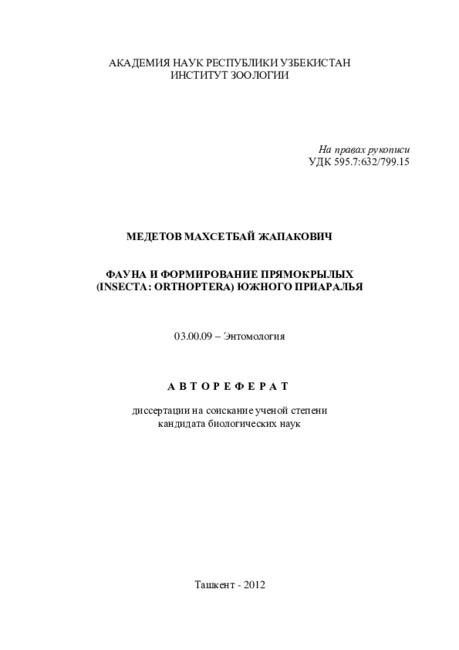
The fauna and formation ob Orthopterans (Insecta: Orthoptera) in Southern Aral Sea region
Subjects of the research: orthopterans of natural and anthropogenic landscapes in southcmAral Sea region.
Purpose of work: the study of fauna, ecology, landscape distributions of orthopterans in southern Aral Sea region and development of environmentally friendly methods of pest control.
Methods of research: entomological, ecological, plant protection and statistical methods.
The results achieved and their novelty: the dissertation studies the fauna of orthopterans in southern Aral Sea region. Seventy-five species of 50 genera and 7 families were revealed.
One species of locusts was for the first time revealed for the fauna of Central Asia, one subspecies for the fauna of Uzbekistan, as well as four genera and 17 species and subspecies for the fauna of the southern Aral Sea region. The distribution of orthopterans through landscapes and agroccosystcms was studied. Besides, the effect of the microbiological preparation “Green guard sc premium” on the Locusta migratoria L. and Calliptamus italicus italicus L.locusts was studied and the biological effect was identified.
Practical value:thc obtained results of the study of distribution of orthopterans throughout landscapes arc of ecological and economic importance in the improvement of control measures taken against pests.
Degree of embed and economic effectivity: the results of the study of orthoptcran species composition and their distribution throughout agroecosystems arc used for the improvement of control measures of pest species. The microbiological preparation “Green guard sc premium” is recommended for inclusion into the "List of pesticides and agrochemicals allowed for application in agriculture" of the State Chemistry Commission of the Republic of Uzbekistan.
Field of application: ecology, environmental protection, education, scientific studies and agriculture.

The advantage of conducting molecular-genetic research in Bushuev cattle
The article provides information on the introduction of modern methods of molecular genetics in preserving the gene pool ofBushuevsky cattle and early forecasting of their productivity, the advantages of using this method. In addition, as a result of research by other scientists, it has been proven that the factor of full feeding is important in the development of the genetic potential of animals.
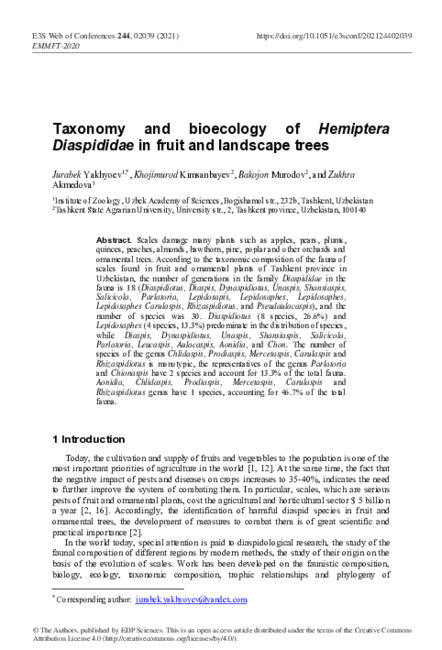
Taxonomy and bioecology of Hemiptera Diaspididae in fruit and landscape trees

Tajriba guruhidagi sigirlarning o‘sish va rivojlanish ko‘rsatkichlari
Study of insecticidal and acaricidal properties of UBK-IX-V and UBK-IXE 25% preparations

Slaughter yield of experimental hybrid rabbits

Sigirlar laktatsyasining kechish xususiyatlari
Selection works in rabbit breeding

Seed quality indicators of hybrid rabbits
Review of literature data on chemotherapy and chemoprophylaxis of eimeriosis in rabbits
Rabbit color genetics

Quyon bolalarining o‘sish va rivojlanish dinamikasiga «probiokorm» universal ozuqabop qo‘shimchasining ta’siri