Vol. 4 No. 06 (2024)
Articles
PROBLEMS OF TRANSLATION IN THE STORY OF ABDULLA QAHHOR
In this article, the problems of that period reflected in the translation of Abdulla Qahhor's story "The Patient" and the significance of the story today are discussed. The characteristics of the heroes of the story are discussed. Today's and the setting of the story are compared with differences and similarities.
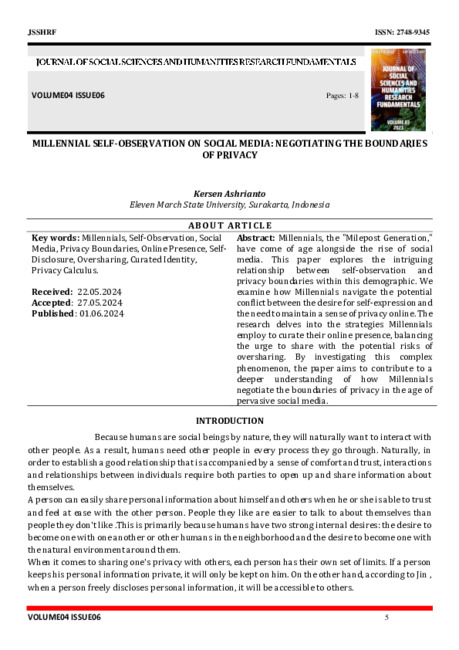
MILLENNIAL SELF-OBSERVATION ON SOCIAL MEDIA: NEGOTIATING THE BOUNDARIES OF PRIVACY
Millennials, the "Milepost Generation," have come of age alongside the rise of social media. This paper explores the intriguing relationship between self-observation and privacy boundaries within this demographic. We examine how Millennials navigate the potential conflict between the desire for self-expression and the need to maintain a sense of privacy online. The research delves into the strategies Millennials employ to curate their online presence, balancing the urge to share with the potential risks of oversharing. By investigating this complex phenomenon, the paper aims to contribute to a deeper understanding of how Millennials negotiate the boundaries of privacy in the age of pervasive social media.

FROM THE HISTORY OF THE ACTIVITY OF THE SECURITY DEPARTMENT IN THE FERGANA REGION AT THE BEGINNING OF THE 20TH CENTURY
The article describes the history of the establishment of the Security Department in Turkestan, the activities of the Security Department in Fergana region, the processes of working with filers and wanted persons.

ANALYSIS OF ARABIC LINGUISTIC TERMS: A DETAILED EXAMINATION OF TERMS RELATING TO PARTS OF A SENTENCE
Arabic, one of the oldest and most beautiful languages in the world, is known for its rich linguistic heritage and complex grammatical structure. In this article, we will delve into the analysis of Arabic linguistic terms, focusing specifically on terms related to the parts of a sentence. By exploring the intricacies of Arabic grammar, we aim to provide a comprehensive understanding of how sentences are constructed in this fascinating language.

GENDER INCLUSIVE COMMUNICATION IN CUSTOMS AUTHORITIES OF THE REPUBLIC UZBEKISTAN
This article is dedicated to the problem of gender neutralization of the language of business communication. It also gives examples of gender-inclusive vocabulary. Various options for the application of this vocabulary in the language of business communication are analyzed based on the rules and guidelines issued by the European Parliament, the United Nations, as well as the governments of Great Britain and Canada.
PROTOCOL FOR A SYSTEMATIC REVIEW OF SELF-COMFORTING BEHAVIOURS ACROSS THEORETICAL FRAMEWORKS: EXAMINING PATTERNS, MECHANISMS, AND SOCIO-CULTURAL INFLUENCES OVER 50 YEARS
Background and Rationale: Self-comforting behaviors are a spectrum of conscious and unconscious actions employed by individuals to regulate emotions, manage stress, and maintain a sense of security. These behaviors manifest physically, cognitively, and socially, and are prevalent from infancy through adulthood. Despite their adaptive functions, excessive or maladaptive self-comforting behaviors can contribute to psychological distress. Understanding these behaviors through various theoretical frameworks is crucial for developing effective interventions and promoting mental health.
Objectives: This systematic review aims to:
- Synthesize evidence on self-comforting behaviors across different theoretical frameworks.
- Examine patterns and mechanisms underlying self-comforting behaviors.
- Explore socio-cultural influences on the conceptualization and practice of self-comforting behaviors over the past 50 years.
Methods: The review will integrate findings from attachment theory, stress and coping theories, developmental psychology, clinical psychology, psychodynamic theory, and cognitive-behavioral theory. Examining studies within these frameworks allows the review to identify common themes and patterns, constructing a comprehensive understanding of self-comforting behaviors.
Results: Preliminary findings suggest that self-comforting behaviors serve crucial roles in emotional regulation and stress management. However, their maladaptive use can signal underlying psychological issues. The review will highlight the interplay of biological, psychological, and environmental factors influencing these behaviors and their evolution across the lifespan.
Conclusion: A holistic approach, considering multiple theoretical perspectives, is essential for understanding self-comforting behaviors. This comprehensive understanding will inform the development of effective interventions to support individuals in managing stress and enhancing emotional well-being.

