
All articles

SELECTION OF THE PRESCRIPTION OF A MEDICAL AND COSMETIC CREAM WITH ANTI-INFLAMMATORY EFFECT
Research on the level of anxiety in patients with psoriasis
Relationship inflammatory activity, and kidney disease in systemic lupus erythematosus

Qoraqalpogʻistonda gimenolepidoz invaziyasi tarqalishi: epidemiologik baholash va profilaktika yoʻnalishlari
Problems selection of modern drugs in the treatment of systemic lupus erythematosus
Problems of hygiene in field farming
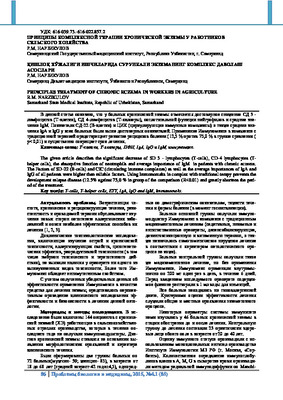
Principles treatment of chronic eczema in workers in agriculture
helper cells), the absorptive function of neutrophils and average importance of IgM in patients with chronic eczema.
The Factors of SD-22 (B-cells) and CIC (circulating immune complexes) as well as the average importances of IgA and
IgG of all patients were higher than reliable factors. Using Immunomaks in complex with traditional terapy prevents the development relapse disease (12.5% against 75,0 % in group of the comparison (R<0.01) and greatly shortens the peri-od of the treatment

Principles of treatment and prevention of skin diseases in dogs with herbal medicines
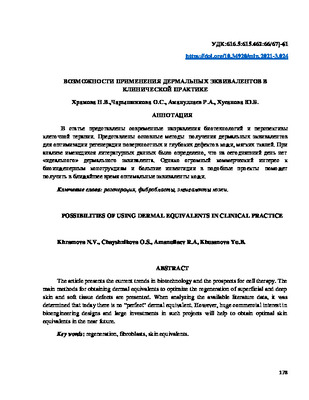
POSSIBILITIES OF USING DERMAL EQUIVALENTS IN CLINICAL PRACTICE
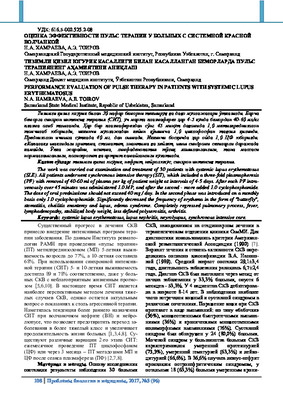
Performance evaluation of pulse therapy in patients with systemic lupus erythematosus

OVERVIEW OF THE KAZAKHSTAN MARKET FOR PERFUMERY AND COSMETIC PRODUCTS
preferences and the potential for localising the production of cosmetic products.
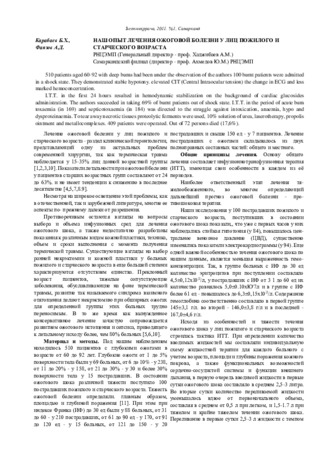
Our experience in the treatment of burn disease in the elderly and senile
510 patients aged 60-92 with deep bums had been under the observation of the authors 100 burnt patients were admitted
in a shock state. They demonstrated stable hypotony. elevated CIT (Central Intraocular tension) the change in ECG and less
marked hemoconcertration.
I.T.T. in the first 24 hours resulted in hemodynamic stabilization on the background of cardiac glucosides
administration. The authors succeeded in taking 69% of burnt patients out of shock state. I.T.T. in the period of acute bum toxaemia (in 169) and septicotoxaemia (in 184) was directed to the struggle against intoxication, anaemia, hypo and dysproteinaemia. To tear away necrotic tissues proteolytic ferments were used, 10% solution of urea, laserotherapy, propolis ointment and metallocomplexes. 409 patients were operated. Out of 72 persons died (17,6%)
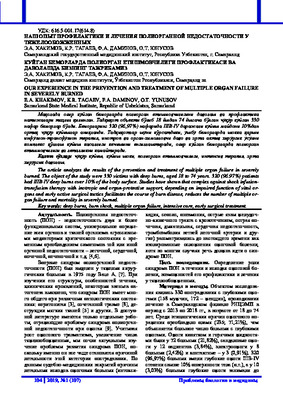
Our experience in the prevention and treatment of multiple organ failure in severely burned
burned. The object of the study were 330 victims with deep burns, aged 18 to 74 years. 320 (96.97%) patients
had IIIB-IV deep burns over 10% of the body surface. Studies have shown that complex against shock infusion-
transfusion therapy with inotropic and organ-protective support, depending on impaired function of vital or-
gans and early active surgical tactics facilitates the course of burn disease, reduces the number of multiple or-
gan failure and mortality in severely burned
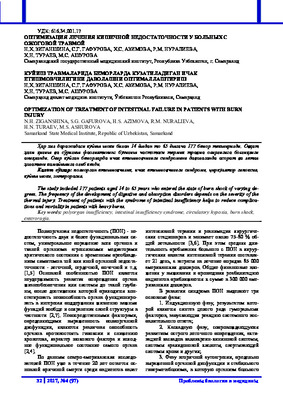
Optimization of treatment of intestinal failure in patients with burn injury
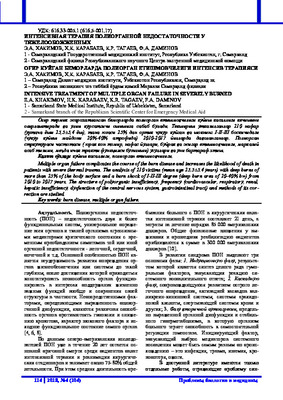
Ntensive treatment of multiple organ failure in severely burned
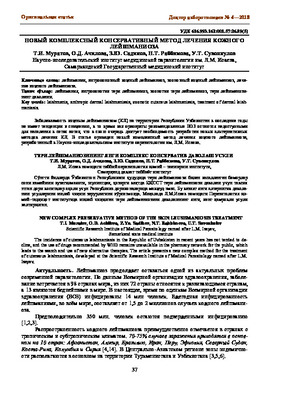
New complex preservative method of the skin leushmaniosis treatment
New approach in the treatment of cutaneous leishmaniasis
rapid relief of inflammation in the outbreak and scar formation in a shorter time.
Morphology of subcutaneous homografts of skin
Morphology of skin and human kriofraktograficheskim electron methods
Morphological features of wound burn healing in the experiment
Thermal burn is a severe form of injury, causing structural and functional disorders in numerous body systems. Because of the complexity of the process and the involvement of several body systems, it is impossible
to analyze this state by in vitro experiments. Over the past two decades, a number of experimental burn models
have been developed. The review examines the healing of wounds in animals with burn injury, the advantages
and disadvantages of these models for rational use. The paper considers three main types of animals used for
modeling burn wounds.
Modern methods of dermatoglyphics and iridodiagnostics in forensic medicine in identifying and assessing suidcidal tendencies
Modeling processes of distribution of cutaneous leishmaniasis in uzbekistan
Methods and means of local conservative treatment burnt
Mechanism of scar skin disease
Mathematical modeling and forecasting morbidity of cutaneous leishmaniasis in uzbekistan
sults of predictive risk maps distributed in geographic space of great importance in the management of the control of leishmaniasis

