
All articles
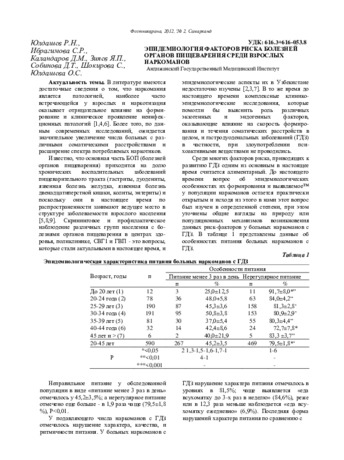
Эпидемиология факторов риска болезней органов пищеварения среди взрослых наркоманов
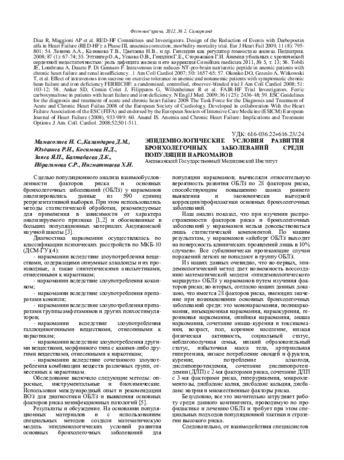
Эпидемиологические условия развития бронхолегочных заболеваний среди популяции наркоманов
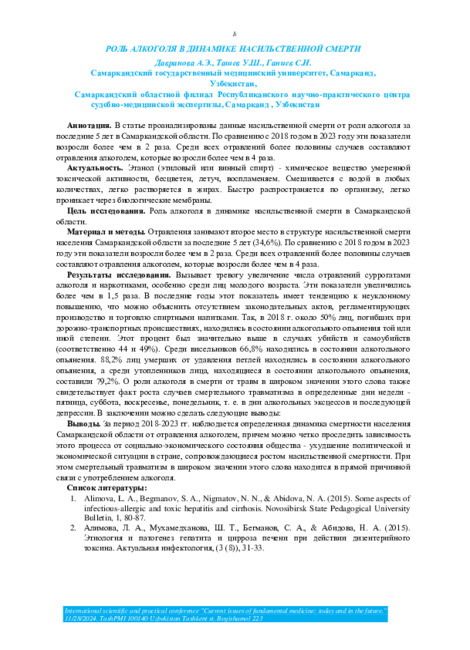
Роль алкоголя в динамике насильственной смерти
В статье проанализированы данные насильственной смерти от роли алкоголя за последние 5 лет в Самаркандской области. По сравнению с 2018 годом в 2023 году эти показатели возросли более чем в 2 раза. Среди всех отравлений более половины случаев составляют отравления алкоголем, которые возросли более чем в 4 раза.
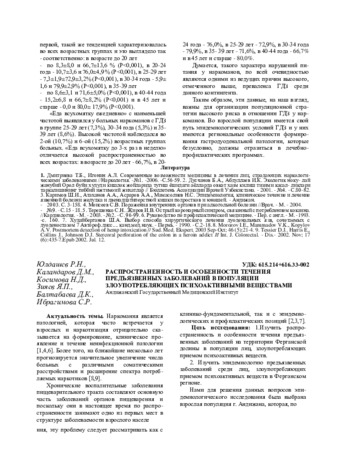
Распространенность и особенности течения предъязвенных заболеваний в популяции злоупотребляющих психоактивными веществами
прогнозируется значительное увеличение числа больных с различными соматическими расстройствами и расширение спектра потребляемых наркотиков
Распространенность железодефицитных состояний среди наркоманов
наркоманах такие сведения практически отсутствуют
Раннее выявление подростков с высоким риском алкоголизации (обзор литературных данных)
Потребление алкоголя детьми и подростками относится к числу наиболее острых социальных и педагогических проблем. Алкоголь в сравнении с никотином еще более вреден для нервной системы. В медицинской литературе описано большое число случаев тяжелого отравления головного мозга при однократном употреблении детьми 120-200 г. крепких спиртных напитков (так называемые острые алкогольные энцефалопатии). Тяжелыми последствиями таких отравлений мозга могут стать умственная отсталость, судорожные припадки, параличи [1,3, 5,6, 7].
Применение препарата миртел в комплексной терапии больных, страдающих хроническим алкоголизмом
Проблема эмоционального компонента хронического алкоголизма - депрессия, проявляющаяся в виде подавленности, тоскливости, бездеятельности и безразличия к окружающему. В некоторых случаях эмоциональный компонент выражается преимущественно тревогой или дисфорическими проявлениями с угрюмостью, недовольством, внутренним дискомфортом, взрывчатостью и агрессивностью, что приводит к социальной дезадаптации.
Поражения головного мозга человека при интоксикациях и отравлениях наркотиками (обзор литературы)
Новое в подходах реабилитации алкоголизма: раннее выявление подростков с высоким риском алкоголизации
Наш опыт лечения острых алкогольных отравлений
пользе алкоголя
Нарушение дифференцированного внимания у больных героиновой наркоманией
Аффективные расстройства, как отягощающий фактор в терапии алкогольной зависимости
В данной статье описывается отягощающее влияния аффективных расстройств, в частности депрессивных нарушений на течение алкогольной зависимости, их влияние на частоту рецидивов во время проводимой терапии алкоголизма, формирование суицидального поведения у больных с сочетанным течением алкогольной зависимости и аффективных нарушений в сравнительном аспекте с больными алкогольной зависимостью не отягощенной аффективными расстройствами. В статье описывается тот факт, что лечение проводимое без психофармакотерапии не только зачастую не излечивает больного, но также приводит к стойкому отказу больных от лечения. Не совсем определены методики психотерапии депрессивных нарушений у больных алкогольной зависимостью. Также необходим определенный алгоритм контроля качества проводимой психотерапии пациентов с алкогольной зависимостью. Психотерапевтическое воздействие должно быть направлено, в первую очередь, на обеспечение стабильно функционирующих изменений, а не только симптоматические улучшения.
Toximetric assessment of the risk of death in acute poisonings
The consequence of the influence of bad habits of parents on children
Habit - a spontaneous action, beyond control, a ritual to prevent depression and fear.
American researchers Easter Wilder and Tony Turling Watt believe that half of teenagers whose parents smoke begin sexual activity at the age of 15, which is due to the emancipation of parents in the presence of children, so the rate of teenage pregnancy and abortion is high in America. A sociological study of 19 thousand children from 13 to 18 years found that 31% of parents are smokers. Drinking parents have children who smoke and drink.
Suicidal intentions in persons with alcoholic dependence syndrome during depressive disorders
STUDY OF CLINICAL-PSYCHOLOGICAL DEPRESSIVE DISORDERS FEATURES OF PATIENTS WITH ALCOHOLISM
Results of eeg and psychoneurotic testing in patients with alcoholic encehalopathy
Quantitative assessment risk factors of rapid development of alcoholism
Influence of alcohol influence on the peculiarities of the curve of brain-brain trauma
Influence of alcohol exploitation on the peculiarities оf the current craniocerebral injury
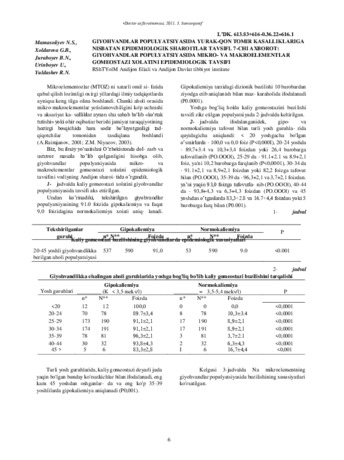
Giyohvandlar populyatsiyasida yurak-qon tomir kasalliklariga nisbatan epidemiologik sharo1 tlar tavsifi. 7-chi axborot: giyohvandlar populyatsiyasida mikro- va makroelementlar gomeostazi xolatini epidemiologik tavsifi
Mikroelementozlar (MTOZ) ni xatarli omil si- fatida
qabul qilish lozimligi oxirgi yillardagi ilmiy tadqiqotlarda
ayniqsa keng tilga olina boshlandi. Chunki aholi orasida
mikro-makroelementlar yetislunovchiligini ko'p uchrashi
va aksariyat ka- salliklar aynan shu sabab bo'lib «ko'rtak
tutishi» yoki ohir oqibatiar berishi jamiyat taraqqiyotining
hozirgi bosqichida ham sodir bo’layotganligi tadqiqotchilar tomonidan tasdiqlana boshlandi (A.Raimjanov, 2001; Z.M. Niyazov, 2003)
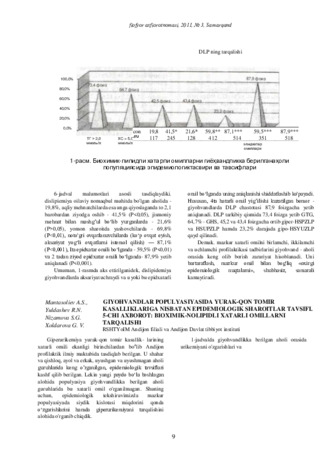
Giyohvandlar populyasiyasida yurak-qon tomir kasalliklariga nisbatan epidemiologik sharoitlar tavsifi. 5-chi axborot: bioximik-nolipidli xatarli omillarni tarqalish1
Giperurikemiya yurak-qon tomir kasallik- larining
xatarli omili ekanligi birinchilardan bo4
lib Andijon
profilaktik ilmiy maktabida tasdiqlab berilgan. U shahar
va qishloq, ayol va erkak, uyushgan va uyushmagan aholi
guruhlarida keng o’rganilgan, epidemiologik tavsiflari
kashf qilib berilgan. Lekin yangi paydo bo‘la boshlagan
alohida populyasiya giyohvandlikka berilgan aholi
guruhlarida bu xatarli omil o'rganilmagan. Shuning
uchun, epidemiologik tekshiruvimizda mazkur
populyasiyada siydik kislotasi miqdorini qonda
o‘zgarishlarini hamda giperurikemiyani tarqalishini
alohida o'rganib chiqdik
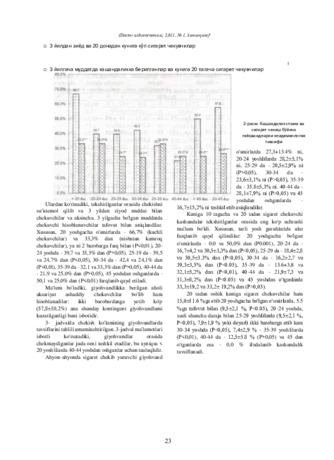
Giyohvandlar popdlyasiyasida ylrak-qon tom1 r kasalliklariga nisbatan epidemiologik sharoitlar tavsifi. Ii-axborot: populyasiya darajasida alkogol iste'mol qilishni epidemiologik tavsifi
Alkogolni salbiy ta'siri va kontiniumni kuchaytirishi
fanda yetarlicha isbotlangan yoki o'rganilgan. Lekin
giyohvandlar populyasiyasida bunday vazifani qo'yib
bajariigan tadqiqotlar juda kam, O'zbekistonning Farg'ona
vodiysida esa - yo'q darajada. Shu bois, giyohvandlikka
berilgan aholi guruhlarida alkogolni xatarli omil sifatida
epidemiologik tavsifi o'rganilib chiqildi va amaliyot
uchun ahamiyatli natijalar olindi
Gender peculiarities of mechanisms of formation, progression and course of opium addiction, and development of rehabilitation measures
The urgency and relevance of the theme of dissertation. According to United Nations Office on Drugs and Crime, there arc 15.6 million opiatedependent persons worldwide, 11.1 million heroin-dependent ones among them27. Today, wide spread of substance abuse and disorders governing by the dependence is one of the most urgent and relevant problems in the society.
In our country social relations in the sphere of drug trafficking, psychopharmaccuticals and precursors arc regulated by law, which aims at opposing their illegal trafficking, promoting health care and national security. The Republic of Uzbekistan Law on “Drugs of abuse and psychopharmaceuticals” guarantees health care promotion for drug and inhalant addicts including examination, counseling, diagnosis, treatment and medical-social rehabilitation.
It should be noted that studis on pathogenetic mechanisms of opium addiction, clinical peculiarities with gender interrelations taken into account, and development of the diffcrcnctiatcd approach to rehabilitation of opium addicts arc set at value in the international studies on the subject. In that context, study on clinical picture of both withdrawal syndrome and post-withdrawal period, comparative clinical-dynamic characterization of morbid attraction for drug in male and female opium addicts, determination of gender peculiarities of opium addiction, assessment of findings of opium addicts’ brain computer tomography and character of ncurocognitive disorders in opium addicts, study on somatic disorders in male and female opium addicts, as well as development of the differentiated approaches to medical-rehabilitation measures with clinical-dynamic peculiarities of the disorder taken into account is the urgent and relevant task. Accordingly, it is the proof for the relevance of the theme.
Objective. The work was initiated to study peculiarities of progression, clinical picture and course of opium addiction with gender differences taken into account and to develop differentiated methods for opium addicts’ rehabilitation.
Scientific novelty of the research work is as follows:
prolonged duration of opiate abuse (more than 5 years) both in men and women was proved to be characterized with formation of morpho-structural changes in the brain;
insignificant signs of the atrophy in some parts of brain cortex and the marked atrophic changes in the brain with widened subarachnoid space and lateral ventricular of the brain as well as presence of regions with lower white and grey matter density, deepened fissures and gyri, and reduction in density of white and grey matter were established. The morphological changes arc accompanied with worsening of cognitive functions which relatively preserved in patients with abuse duration under 5 years;
the course of opium addiction in women for the first time was proved to be characterized more frequently with high progressiveness mediated by some factors, such as starting abuse from heroin with the highest narcogenic potential and initial intravenous way of administration;
gender peculiarities of opium withdrawal syndrome in the form of predominance of affective variant in women and the mixed one in men were determined; no significant gender differences during the post-withdrawal period in clinical variant of morbid attraction for drug were found;
the findings from the study arc the evidence for the fact that combination of viral hepatitis C and HIV both in men and women affect clinical manifestations of opium addiction; incidence of HIV and VHC has no close correlation with sex and abuse duration.
Conclusion
1. Biological and social factors preceding addiction play a significant role in mechanisms of opium addiction formation. Inherited burden of addictions is typical of women. Prior to the drugs, most patients have used alcohol as a euphorizing substance, more than half of male examinees used hashish. Significantly greater number of women started using the opiates from heroin, which has the highest addicting potential among opiates. Significantly greater number of women started using heroin intravenously, while men started using opiates per orally. Significantly greater number of women used the drug for the first time in a company of drug-dependent friends of her drug-dependent cohabitant or husband.
2. Conditions of a person’s upbringing, processes of his/her socialization and a system motives incentivizing to the activity based upon a set of his/her needs arising in his/her disease dynamics arc important for formation of psychological-behavioral peculiarities of an individual. Personal deviations in premorbidity,person’s asocial orientation in particular, are the determinants in formation of the “addicted person”. Hysterical features were registered significantly more frequently in women, impulsive (excitable) ones occurred in men more often. Prior to opium addiction’s formation asocial tendencies were registered in significantly greater number of women. Significantly greater number of women was brought up in onc-parcnt families, more frequent conflicts in the family associated with characterological peculiarities of parents were observed in women, too. Prior to the addiction’s formation, more than half of women were nowhere employed, while almost all men worked in various spheres.
3. On the basis of examination of peculiarities in formation, clinical picture, and dynamics of symptoms as well as pronounced mcdical-social consequences of the diseases presence of definite gender differences in terms of formation of addiction and psychopathological symptoms, and severity has been observed. As the results of clinical-statistical analysis demonstrate, all these were determined by various tempo of opium addiction course. Highly progressive type of course is typical of women. Correlation between the type of course and sex was found.
4. The affective variant of opium withdrawal syndrome was seen more typical of women. In post-withdrawal period cmotionally-labile type of morbid attraction for drug was registered more frequently both in women and men. Within this period some reduction of the affective disorders can be seen in women. The degree of pronouncement of the affective disorders during post-withdrawal period starts prevailing in the group of the men examined.
5. As the brain computer tomography findings demonstrated upon opium addiction morpho-structural changes in the brain form to range from insignificant brain atrophy to widened subarachnoid space and lateral ventricular of the brain as well as presence of regions with lower white and grey matter density. These changes were less pronounced in patients with the disease duration less than 5 years than in those with the opiate use duration more than 5 years.
6. Significant (p=0,02) differences in the cognitive sphere between patients with the disease duration less than 5 years and those with the disease duration ranging from 6 to < 10 year were found. When comparing parameters in patients with longer disease duration we could see reduction in number of correctly performed intellectual tasks within definite period of time.
7. Among patients with the verified VHC three variants of opium postwithdrawal syndrome were equally registered. In the male patients with VHC+HIV the mixed OAS was observed more typical, while all variants of OAS were registered in the female ones. The mixed OAS was registered more frequently in the male patients having no somatic pathology. Among women having no somatic pathology affective type of OAS was more typical.
8. Highly pronounced morbid attraction for drugs could be seen during the whole period of hospitalization in patients with the verified VHC and HIV. Before the discharge in this category of men and women the moderate attraction preserved but was not observed in patients with the verified VHC and those without somatic pathology.
9. There arc additional risk factors determining involvement of women in addiction, to name, younger age (under 20-25 years), European nationality, employment in the consumer services, disharmonic bringing up in the family and conflict relationships with the siblings, conflict relationships in their own family, cohabiting with drug-dependent partner (husband/cohabitant), difficulties in overcoming life crises and social adaptation. In this connection the differentiated medical-rehabilitation measures with clinical-dynamic peculiarities of the disease and gender differences taken into account were developed.
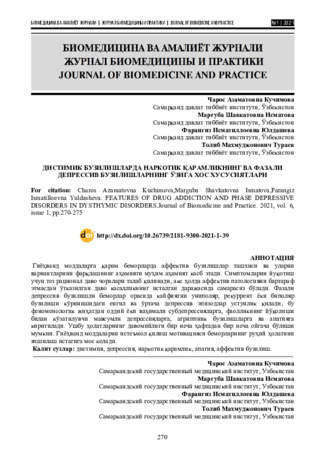
Features of drug addiction and phase depressive disorders in dysthymic disorders
Depressive disorders are of interest to most researchers because of their prevalence and the fact that they are considered high-level psychosocial disorders. In modern psychiatry, the clinic of the adynamic component of depressive disorders is still not fully studied. Adynamic depression often has a long, chronic course. Psychopathological analysis of adynamic depression, identification of various variants of its course, helps to choose therapeutic tactics. Among patients with phase depressive disorder, mild and moderate depressive episodes in the form of mood unipolar, recurrent or bipolar disorder predominate, which are phenomenologically normal or panic subdepressions, seasonal depressions observed with loss of activity, agrippnik disorders, and included in apathy. The duration of these cases can be from several weeks to several months. The motivation for the use of drugs is consistent with the desire to improve the mental state of patients.

