All articles

Algorithms and methods of regulation of the pumping stations operating modes
The relevance and demanding of the dissertation the theme. Today in the world the significance of pumping stations in the energy sector, land reclamation, pumping of petroleum products, as well as housing and communal services is continuously increasing. In these industries to ensure reliability, continuity, high energy efficiency and flexibility of pumping stations work, as well as performance under transient conditions is actual. In order to achieve all of the above mentioned parameters the certain progress has been made in other countries of the world where modem pumping equipment is constantly updated and improved. "In this regard, the use of a popular high-tech specialized basic and auxiliary power equipment of pumping stations, prolonging the life of the pipeline system by 1.5-2 times is necessary"1.
In the Republic of Uzbekistan, the large-scale activities on the effective organization of measures for the creation of energy-saving techniques and the control system of pumping stations operating modes arc carried out. In this regard, the notable progress has been made in developing effective methods, techniques and devices to reduce the influence of electromechanical and hydro-mcchanical transients on power equipment and pipelines of pumping stations. On the basis of controlled electric drive, the block diagrams and pumping units’ control algorithms are developed, frequency variable systems "asynchronous motor - pump" are designed, a combined management structure of asynchronous motor in turbo-machines are developed.
In the world, the questions of reliability and uninterrupted operation of pumping stations during transient conditions, the creation of new techniques and technologies of protection of the power equipment and pipelines of pumping stations against sudden transients are becoming particularly important. In this area, the implementation of targeted research in developing the control methods of the steady and transient modes of pumping stations operation, creation of the main power equipment and pipelines protection devices against water hammer, creating technical solutions and improving the reliability of the auxiliary power equipment for the removal of drainage and wastewater are the priority problems.
This dissertation research to a certain degree performs the tasks provided in the Law of the Republic of Uzbekistan "On the Rational Use of Energy" (1997), the Decree of the President of the Republic of Uzbekistan № PD-2343 on May 5, 2015 " On the program to reduce energy consumption measures, the introduction of energy saving technologies in the fields of economy and social sphere for 2015-2019", decree of the Cabinet of Ministers № 499 dated November 16, 1999 "On Measures for the Implementation of the Law of the Republic of Uzbekistan "On the safety of hydraulic structures" as well as in other regulatory documents adopted
The aim of the research is the creation of algorithms, methods, techniques and devices to reduce the negative influence of unsteady modes and sudden transients on the main and auxiliary power equipment and pipelines of pumping and hydroelectric stations.
Scientific novelty of the research consists in the following:
the algorithm of phased solving of electromechanical and hydro-mechanical transients at pumping stations, taking into account the duration of power equipment operation is developed;
the generalized mathematical model and software complex for calculation of "pipeline - pump - electric motor - electric grid" system elements, which allows to explore the power system transient processes during pumping stations transient modes are developed;
the new method of protecting of pumping stations pipelines against water hammer using the bypass device is substantiated;
the device of proportional control of the pump butterfly valve to improve the reliability of the pumping stations power equipment work is designed;
the method of simultaneous pumping of drainage and sewage water with different suction height by means of jet pump with the system of regulation is developed;
the regulated system of simultaneous removal of filtration, drainage and sewage water from buildings and adjacent territories of pumping and hydroelectric stations by means of jet pump to protect against flooding is developed.
CONCLUSION
On the basis of research on the doctoral dissertation on the theme: "Algorithms and methods of regulation of the pumping stations operating modes” the following conclusions arc presented:
1. Conducted systematic analysis of operation modes of pump stations showed that one of the main causes of accidents at the pumping stations is simultaneous electromechanical and hydro-mechanical transients, complicated by water hammer. In connection with this phenomenon the problem of development of methods and devices of the protection of the pumping stations main power equipment and pipelines against water hammer is becoming important.
2. A model of the system "pipeline - pump - electric motor - electric network", which allows investigating the power system transient modes at various emergency and operating conditions is developed: at changing the voltage on the buses, emergency shutdown of the synchronous motors, accidents associated with the pumps or pipelines, and so on. When an intermittent decrease in power of synchronous motor by 15% (0.85Pmot) unit stability is preserved, and the electromagnetic processes decay quickly and hydro-mechanical processes continue about 140s. By reducing power by 30% (0.7Pmot) unit enters the long-tern fluctuations. Power reduction by 50% leads to the violation of the motor stability and to the break of its synchronism.
3. Software system capable to calculate water hammer on pumping stations with piping diameters up to 4.2 meters is recommended, ft may greatly influence the selection of the main and auxiliary power equipment, the design and parameters of water conveyance structures. Certificates of official registration of programs for electronic computers number DGU 03124 and number DGU 03644 are taken out.
4. The use of bypass device at the pressure pipelines for reduction the amount of pressure increase at water hammer is recommended. When using the bypass device water hammer in pressure pipelines is considerably softer. When the pressure in one of the pipelines increases water escapes into the adjacent pipelines or when pressure decrease it causes water flow from adjacent pipelines. This reduces water hammer by an average of 40%, the pressure reduction duration reduces by more than 1.5 times.
5. The proportional device of butterfly valve control for the protection of the pumping stations against water hammer is recommended. The utility model Patent number FAP 01119 is taken out. Change of butterfly valve closing speed is occurring smoothly and proportionally to flow velocity in the pipeline. Technical characteristics of the programmable logic controller is programmed in such a way that when the liquid direct velocity changes in the pressure pipe to the reverse, i.e. at the moment of zero liquid velocity, fixed by a digital velocity sensor, butterfly valve is fully closed which eliminates the possibility of water hammer in the main equipment and pipelines during emergency electricity shut down at the pumping or hydroelectric station.
6. The method of simultaneous pumping of filtration, drainage and sewage water from buildings and adjacent territories of pumping and hydroelectric stations is recommended. It meets the requirements of reliability and safety of operation at the increase of water flow associated with duration of stations and pressure pipelines exploitation.
7. The result of calculating of parameters of the suction flows from the building and the adjacent territory of the pumping station became the algorithm of regulation of hydraulic float system. Analysis of the dependences showed that the maximum suction flow rate out of the pumping station territory is attained in the area of overlap of butterfly valve regulating float device at an angle of about 40°-45°.
8. The system of the simultaneous removal of the filtration, drainage and sewage water from buildings and adjacent territories of pumping and hydroelectric stations is designed and recommended. The utility model Patent number FAP 00592 is taken out. The device is designed to work in steady-state conditions and during emergency flooding.
9. The results of the dissertation arc implemented into practice at a number of pumping and hydroelectric stations. Performed complex experimental studies confirmed the adequacy of the developed methods and mathematical models. Maximum discrepancy between the theoretical and experimental values does not exceed 6%, which indicates the accuracy of the studies. Proven cost-effectiveness of the implementation of the results of the research is about 200 mln. sums per year.

AI in teaching english language
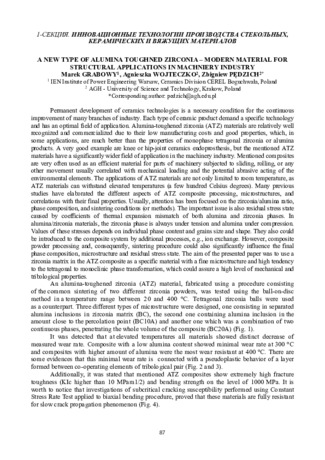
A new type of alumina toughned zirconia – modern material for structural applications in machniery industry
Permanent development of ceramics technologies is a necessary condition for the continuous improvement of many branches of industry. Each type of ceramic product demand a specific technology and has an optimal field of application.
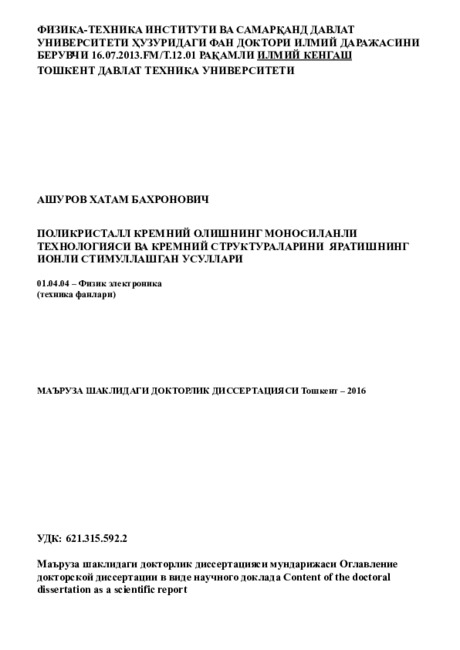
A monosilane technology of polysilicon production and ion-stimulated methods for creation of silicon structures
Topicality and relevance of the subject of dissertation as a scientific report. To meet the demand of electronic and solar PV productions, manufacturers produce a big part of 300MT silicon production by hydrogen reduction of chlorine compounds. Unfortunately, this technology is power consuming and not ecologysafe owing to toxic wastes of production. For this reason, alternative ecology-safe technologies of polysilicon production with low-energy consumption and low cost of production are in great demand.
Considering the growth of silicon demand in next 5 years3, it is neccesarry to apply a monosilane technology instead of treechlorsilane one in new plants. Since the monosilane technology is realized for lower temperatures and has high conversion of precursors, it is possible to spare up to 90% of energy in production of granulated polysilicon in boiling-layer reactors as compared to the traditional Siemens process. But today monosilane technology which is applied in industry aslo based on chlorsilane procceses and requers big CAPEX and still remains not ecology-safe, thats why this problem still needs a solution. A cardinal solution of this problem could be a monosilane technology based on direct reaction of metallurgical silicon and low alcohols. The presence of the induction period in the direct reaction of metallurgical silicon and low alcohols prevents the application of this technology in the industry. A big knowledge about the mechanism and conditions of heterogen catalysis reaction need to solve this problem. A direct reaction of metallurgical silicon and low alcohols and disproportionation of alcoxysilanes, mechanism of influence of catalysis, activation procces are not studied enough.
A number of works have been done to develop the using renewable energy resources in Uzbekistan. For example, starting the company on primary raw material of solar energy - metallurgical silicone, based on local quartzite. Compliance of the let-out metallurgical silicon to requirements of electronics and solar power requires its repartition through process of deep purification into polycrystalline silicon and this task waits for its decision. Proceeding from this, developing of low energy comsumping, ecology-safe technology of monosilane with less capital expenditure is actual in our Republic. Performance of target scientific researches, in particular, researches on Research on the development of non-chlorine monosilane technology of polycrystalline silicon production and creation of processing equipment for its high-quality implementation; development of ion-stimulated methods for creation of the silicon structures for formation of perspective structures of solar elements on the basis of silicon and application of these methods: for increase the level of alloying of silicon structures during their growth; for a relaxation of mechanical stress in heterostructures; for formation of midget and superdense nanoislands; for manifestation of thermovoltaic properties in silicon structures; and also the creating the intermediate layers between functional coating and substrate are an actual tasks. The dissertation is devoted to a certain extent the tasks specified in the Decree of the President of the Republic of Uzbekistan by UP-4512 of March 1, 2013 "About measures for further development of alternative energy sources" and in the Resolution of the President of the Republic of Uzbekistan PP-1442 "About priorities of development of a promydennost of the Republic of Uzbekistan in 2011-2015" of December 15, 2010 and also in other standard and legal documents accepted in this area.
The purpose of the research research is to develop a monosilane technology of polysilicon production and ion-stimulated methods for creation of silicon structures.
The scientific novelty of the research consists of the following results:
developed a technology of alkoxysilane synthesis on the basis of direct reaction of metallurgical silicon and alcohol. The technology is high selectivity relative to the main product (over 95%) and has a high degree of conversion (close to 100%);
excluded, for the first time, an induction period of the direct reaction of metallurgical silicon and ethyl alcohol, which allowed the technological process to run in a continuous mode;
proposed and realized a method of continuous activation of the reaction medium in alkoxysilane synthesis by way of removing the soluble impurities together with a solvent excess through a porous ceramic membrane;
developed a monosilane technology of polysilicon production with the use of alkoxysilanes.
the absence of aggressive precursors and reaction intermediate products in the synthesis process allows a high degree of monosilane purity for single stage distillation;
proposed a new method of catalyst preparation for catalytic disproportionation of triethoxysilane. Natrium ethylate prepared in a medium of tetraethoxysilane, as a result of interaction of metallic natrium and absolute ethyl alcohol, has high activity and is easily regenerated owing to which the process of monosilane synthesis can be performed at room temperature in continuous mode;
developed and created an experimental set-up for polysilicon production on the basis of the monosilane technology where the new technology was successfully tested and all the proposed technical solutions were realized;
proposed a method of separation and control of charged particle flows and an device for its realization, which allowed the ions generated under electron-beam evaporation to be used for control and management of the processes on the growth surface;
increasing doping level reached to 1019 cm'3 by ion-stimulated antimony atoms embed in the crystal lattice of the silicon during the growth;
proposed and realized a method of ion-stimulated relaxation of stresses in Si/Ge heterostructures during the growth;
it was found that the formation of germanium nanoislands on the silicon surface by ion-stimulated molecular beam epitaxy maximizing the density and narrowing of the size distribution function is achieved at 200eV an energy of ions;
it found that at temperatures above 500K. the thermovoltaic properties of thin film silicon p-n structures obtained by the ion-stimulated by vacuum deposition is manifested;
proposed a method of creation of intermediate layers with chemical affinity and gradient transition for adjustment of thermal barrier coatings by the ion-stimulated method.
CONCLUSION
On the basis of the research on a doctoral thesis on «А monosilane technology of polysilicon production and ion-stimulated metohods for creation of silicon structures» provided the following conclusions:
1. Developed a monosilane technology of polycrystalline silicon production, based on the alkoxysilanes synthesis by the direct reaction of metallurgical silicon and alcohol, and created an experimental process equipment for its implementation.
2. For the first time held a silicon milling process to the size from 30 to 100 microns in the liquid medium used subsequently as solvent in the alkoxysilanes synthesis, that protects the new surfaces of the silicon particles from exposure to oxygen and moisture, as a result excluded the induction period of the direct reaction of metallurgical silicon and alcohol, and excludes flow of side reactions under the influence of water.
3. A method for dosed supply of suspension, which is consisting of particles of metallurgical silicon, catalyst, solvent and the powder was proposed, whereby, the silicon consumed in the reaction process is compensated and provided a stable reaction;
4. A method is proposed for the activation of the reaction medium, where impurities entering the reaction medium composed of metallurgical silicon, entrained from the reactor with excess of solvent, whereby level of the solvent and the activity of the reaction medium remains constant, the excess solvent is continuously removed from the reactor through the ceramic membrane which is mounted in the walls of the reactor.
5. It has been found that the simultaneous use of technical solutions for milling silicon in a solvent, dosed supply of suspension into the reactor and removing excess solvent together with dissolved therein impurities provides maintains the constant amount of silicon, a catalyst and a solvent for the duration of the process of synthesis and realization of a fully continuous process of alkoxysilane synthesis.
6. A method is proposed for preparing sodium ethoxide in a shielding medium of tetraethoxysilane and the application of freshly prepared sodium ethylate as catalyst in the synthesis of monosilane provides increasing of the process productivity by reducing the contact time of the reactants in more than 5 times.
7. For the first was proposed the purification of monosilane in the absorber, where triethoxysilane cooled below 133K used as an absorbent and separated from triethoxysilane by the phase separation at a temperature of 193K in the separator which is established in the top of the absorber, whereby the deep purification of monosilane is provided in a short manufacturing cycle.
8. A method of separation and control the flow of charged particles and device for its implementation, which allowed the ions generated by electron-beam evaporation to control and management of the processes on the growth surface were proposed.
9. Increasing doping level reached to 1019 cm’3 by ion-stimulated antimony atoms embed in the crystal lattice of the silicon during the growth with delta doping;
10. Experimentally proved the possibility of purposeful management of the degree of stress relaxation in heterostructures during their formation in ion-enhanced molecular beam epitaxy.
11. It was established that the formation of germanium nanoislands on the silicon surface by ion-enhanced molecular beam epitaxy maximizing the density and narrowing of the size distribution function is achieved at 200eV of an ions energy.
12. It is found that at temperatures above 500К the thermovoltaic properties of thin film silicon p-n structures obtained by the ion-stimulated by vacuum deposition is manifested;
13. The creation of intermediate layers with a chemical affinity and gradient transition to adjust the thermal barrier coatings by ion-stimulated method was proposed.