
All articles
The structure of ophthalmopathology in infants based on the materials of the clinic of the tashkent pediatric medical institute
Actuality. Prevention of visual disability should begin in childhood. To plan high-tech specialized ophthalmic care for young patients, it is necessary to monitor the structure of ophthalmopathology in infants in leading domestic children's medical
institutions. Purpose of the study. The study of the structure of eye diseases in infants based on the materials of the department of ophthalmology of the clinic of the Tashkent Pediatric Medical Institute (TashPMI). Material and methods. A retrospective analysis of statistical coupons of case histories of 685 patients aged 0 to 1 years who were hospitalized in the ophthalmological department of the TashPMI clinic for 2018-2021 was carried out. Results and conclusion. The spectrum of nosological units revealed the
predominance of glaucoma (41.3%) and lens diseases (30.4%). At the same time, it was noted that eye injuries (10.5%), diseases of the eyelids, lacrimal ducts (phlegmon of the lacrimal sac) and orbit (9.2%), although they did not occupy a leading position, nevertheless represented severe acquired lesions that could be prevent. Age-related aspects of nosologies are due to the timing of clinical manifestations, diagnosis and treatment of pathologies, the anatomical and physiological characteristics of the child’s body,
and a decrease in parental control over children.
The structure of ophthalmopathology in infants based on the materials of the clinic of the Tashkent Pediatric Medical Institute
Prevention of visual disability should begin in childhood. To plan high-tech specialized ophthalmic care for young patients, it is necessary to monitor the structure of ophthalmopathology in infants in leading domestic children's medical institutions. Purpose of the study. The study of the structure of eye diseases in infants based on the materials of the department of ophthalmology of the clinic of the Tashkent Pediatric Medical Institute (TashPMI). Material and methods. A retrospective analysis of statistical coupons of case histories of 685 patients aged 0 to 1 years who were hospitalized in the ophthalmological department of the TashPMI clinic for 2018-2021 was carried out. Results and conclusion. The spectrum of nosological units revealed the predominance of glaucoma (41.3%) and lens diseases (30.4%). At the same time, it was noted that eye injuries (10.5%), diseases of the eyelids, lacrimal ducts (phlegmon of the lacrimal sac) and orbit (9.2%), although they did not occupy a leading position, nevertheless represented severe acquired lesions, which could have been prevented. Age-related aspects of nosologies are due to the timing of clinical manifestations, diagnosis and treatment of pathologies, the anatomical and physiological characteristics of the child's body, and a decrease in parental control over children.

The state of hemodynamics during the period of induction into anesthesia during surgical correction of congenital glaucoma in children
The most important stage of anesthetic management is the period of induction into anesthesia, which requires control and regulation of central hemodynamics and vegetative changes, which creates conditions for ensuring a smooth course of subsequent stages of anesthesia without increasing intraocular pressure during surgical correction of congenital glaucoma in children.
The role of eye biomechanical parameters in the development of congenital glaucoma in children
The objective of this review was to study biomechanical parameters of the eye in children with different stages of congenital glaucoma. 20 patients (40 eyes) aged from 1 month to 3 years with simple primary congenital not operated glaucoma were examined. 7 patients (14 eyes) entered in the 1st group (developed stage), 8 patients (16 eyes) — the 2nd group (passed stage), 5 patients (10 eyes) — the 3rd group (end stage) respectively. Research methods included visiometry, refractometry, ophthalmoscopy, definition of the optic disc excavation, ultrasound А-scan of the anterior posterior size of the eye, Filatov’s — Kalfa elastotonometry with weights 5g, 10g, 15g.
The analysis of the data shows that gradient of the elastotonometry graphs elevation registered in all groups, but the highest was in group of children with terminal stage. Thus the anteroposterior size of the eye and intraocular pressure increase corresponding to disease severity. Biomechanical parameters of the eye increase according to the stages of a congenital glaucoma first form. The decrease of sclera rigidity shows morphological changes of the eye tissue and severity of glaucoma process.
The role of eye biomechanical parameters in the development of congenital glaucoma in children
Tug'ma glaukoma bilan og'rigan bolalarda ko'zning biomexanik ko'rsatkichlari uning turli bosqichlari bilan o'rganildi. Oddiy birlamchi tug'ma operatsiyasiz glaukoma bilan og'rigan 1 oydan 3 yoshgacha bo'lgan 20 bemor (40 ko'z) tekshirildi. Ulardan 1-guruhga (ilg'or bosqich) mos ravishda 7 (14 ko'z), 2-chi (ilg'or bosqich) - 8 (16 ko'z), 3-chi (terminal bosqich) 5 bemor (10 ko'z) kiradi. Tadqiqot usullari orasida visometriya, refraktometriya, oftalmoskopiya, optik diskni qazib olishni aniqlash, ko'zning old-orqa o'lchamini ro'yxatga olish bilan A-skanerlash, 5 g og'irlikdagi elastotonometriya; janubiy; 15d, shuningdek, Filatov-Kalf usuli bilan. Olingan ma'lumotlarning tahlili shuni ko'rsatdiki, elastokrivning ko'tarilish gradienti barcha guruhlarda qayd etilgan, ammo eng yuqori ko'rsatkich terminal bosqichi bo'lgan bolalar guruhida bo'lgan, ko'zning anteroposterior hajmi esa mos ravishda kattalashgan. kasallikning og'irligi bilan. Ko'z ichi bosimining oshishi kasallikning og'irligiga mutanosib ravishda qayd etilgan. Konjenital glaukomaning oddiy shakli rivojlanishi bilan ko'zning biomexanik ko'rsatkichlari bosqichlarga ko'ra ortadi. Shu bilan birga, tolali membrananing qattiqligining pasayishi ko'zning to'qimalarida morfologik o'zgarishlarni va glaukoma jarayonining zo'ravonligini ko'rsatadi.
The role of central corneal thickness in the unterpretation of intraocular pressure readings in primary infantile glaucoma
Determine the indicators of intraocular pressure (IOP) tonometry, taking into account the parameters of the central thickness of the cornea (CTC) in children with congenital infantile glaucoma (CIG). Clinical studies were conducted in the eye department of the Tashkent Pediatric Medical Institute's clinic. A total of 14 patients (26 eyes) aged 3 to 10 years with a diagnosis of CG were examined. All patients underwent basic ophthalmologic examination prior to surgical and conservative treatment. In addition to basic methods, the axial length of the eyeball was determined, and the CTC was determined on an automatic non-contact tonometer - Reichert pachymeter (USA). An analysis of the data showed: IOP in 39% of cases was considered subnormal, after correction taking into account the CTC in 11% of cases, the IOP was high. This group (11% of cases) was composed of children with a “thin” cornea at the terminal stage of CIG and high myopia. The correct interpretation of IOP indicators will help in choosing an adequate treatment and monitoring the glaucoma process. The used indicator of the central nervous system has practical significance in the interpretation of tonometry according to Maklakov 5 gr.
The role of central corneal thickness in the unterpretation of intraocular pressure readings in primary infantile glaucoma
Determine the indicators of intraocular pressure (IOP) tonometry, taking into account the parameters of the central thickness of the cornea (CTC) in children with congenital infantile glaucoma (CIG). Clinical studies were conducted in the eye department of the Tashkent Pediatric Medical Institute`s clinic. A total of 14 patients (26 eyes) aged 3 to 10 years with a diagnosis of CG were examined. All patients underwent basic ophthalmologic examination prior to surgical and conservative treatment. In addition to basic methods, the axial length of the eyeball was determined, and the CTC was determined on an automatic non-contact tonometer - Reichert pachymeter (USA). An analysis of the data showed: IOP in 39% of cases was considered subnormal, after correction taking into account the CTC in 11% of cases, the IOP was high. This group (11% of cases) was composed of children with a “thin” cornea at the terminal stage of CIG and high myopia. The correct interpretation of IOP indicators will help in choosing an adequate treatment and monitoring the glaucoma process. The used indicator of the central nervous system has practical significance in the interpretation of tonometry according to Maklakov 5 gr.

The relationship between functional and anatomical-optical parameters of the eye in congenital glaucoma in children
Aim of research. To study the dynamics of the FBS of the eyes in children with congenital glaucoma by age. The studies were carried out in the clinic of TashPMI, on 132 eyes with congenital glaucoma. By age, patients were distributed according to the classification of E.S. Avetisova 2003. At the advanced stage of FBS, the eye exceeded the average statistical norm by 2.9 mm, 2.3 mm, 2.3 mm, at the advanced stage by 4.7 mm, 4.8 mm, 6.3 mm, and at the terminal stage by 7.5 mm, respectively, in each age group of eyes. An increase in the size of the anterior-posterior axis of the eye in congenital glaucoma depends not only on the violation of the hemo hydrodynamic processes of the eye with the accumulation of intraocular fluid, but also depends on the age-related dynamics of eye growth.
The prevalence of diabetic retinopathy according to the optic center of "A.A.Yusupov" The city of samarkand
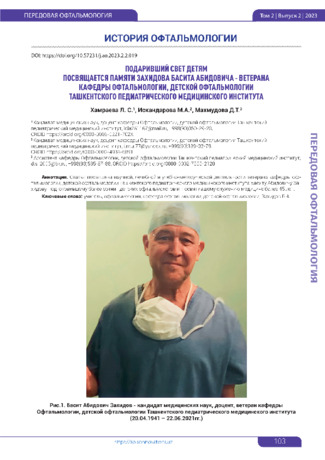
The one who gave light to children is dedicated to the memory of Zakhidov Basit Abidovich - a veteran of the Department of Ophthalmology, Pediatric Ophthalmology of the Tashkent Pediatric Medical Institute
The article is devoted to the scientific, medical and educational activities of the veteran of the Department of Ophthalmology, Pediatric Ophthalmology of the Tashkent Pediatric Medical Institute Basit Abidovich Zakhidov, who trained more than a hundred pediatric ophthalmologists and devoted more than 45 years to medicine.
The influence of ecology on the health of the eye
The evolution of treatment methods for cornea diseases
Inflammatory diseases of the cornea are one of the most common causes of blindness worldwide. In recent years, many modern methods of treating diseases of the cornea have appeared, including, in addition to traditional conservative methods, modern surgical methods, such as autoconjunctival plasty, amniotic membrane transplantation, therapeutic keratoplasty, corneal covering with a corneoscleral flap, microdiathermocoagulation, and corneal crosslinking. A promising direction in the treatment of corneal pathology is stem cell therapy and cell therapy.
The effectiveness of the operation of phacoemulsification with intra ocular lenses implantation with mature senile cataract
Visual acuity at delivery ranged from the correct projection of light to 0.01. By the degree of core density of 54.5% (12 eyes) - had grade 2, 36.4% (8 eyes) grade 3 and 9.1 % (2 eyes) - 4 degree very dense cataract are drilling core.
Discharge of patients from hospital acuity of 0.6-1.0 was observed in 45.4% cases (10 eyes), 0.4-0.5- in 31.8% cases (7 eyes). 0.2-0.3- in 22.7% cases (5 eyes). Poor eyesight in the postoperative comorbidity explained by the retina.

The effectiveness of the introductory period of anesthesia in ophthalmic operations in children
The most important stage of anesthetic management is the period of induction of anesthesia, which requires control and regulation of central hemodynamics and vegetative shifts, which create conditions for ensuring a smooth course of induction and subsequent stages of anesthesia during ophthalmic operations in children.
The effectiveness of laser photocoagulation at central serous chorioretinopathy
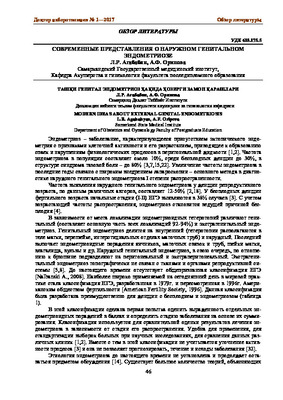
The effectiveness of combined treatment of viral conjunctivitis using ozone in the form of gas through glasses
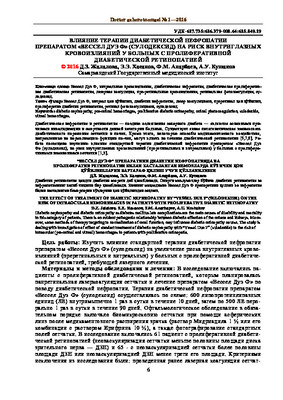
The effect of treatment of diabetic nephropathy by “vessel due f”(sulodexide) on the risk of intraocular hemorrhages in patients with proliferative diabetic retinopathy
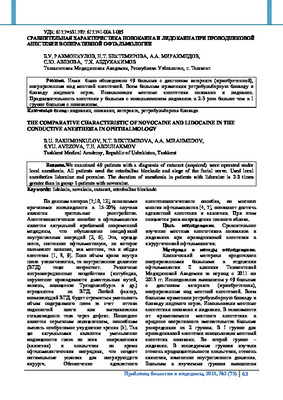
The comparative characteristic of novocaine and lidocaine in the conductive anesthesia in ophthalmology
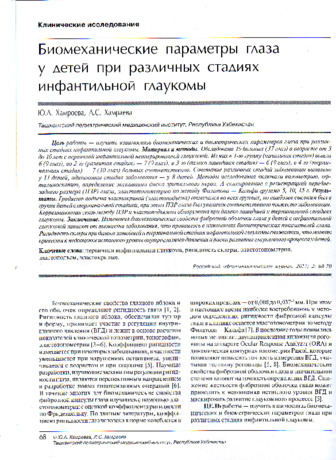
The biomechanical parameters of the eye in various stages of infantile glaucoma
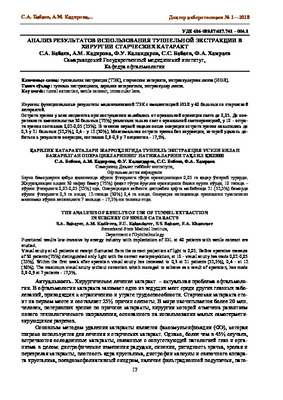
The analysis of results of use of tunnel extraction in surgery of senile cataracts
Visual acuity at all patients at receipt fluctuated from the correct projection of light to 0,05. Before operative measure of 30 patients (75%) distinguished only light with the correct svetoproyektion, at 10 - visual acuity has made 0,02-0,05 (25%). Within the first week after operation visual acuity has increased to 0,3 at 21 patients (52,5%), 0,4 - at 12 (30%). The maximum visual acuity without correction which managed to achieve as a result of operation, has made 0,8-0,9 at 7 patients - 17,5%.
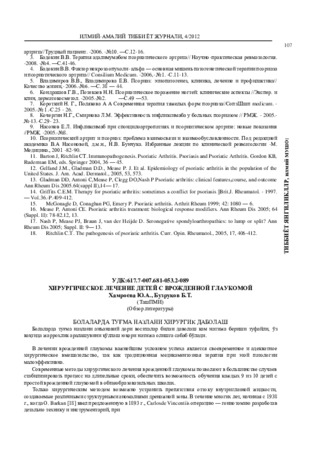
Surgical treatment of children with congenital glaucoma
In the treatment of congenital glaucoma, the most important condition for success is timely and adequate surgical intervention, since traditional drug therapy for this pathology is ineffective.
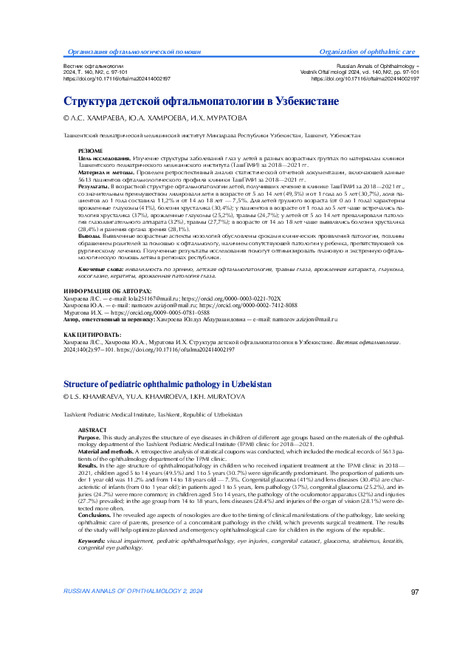
Structure of pediatric ophthalmic pathology in Uzbekistan
This study analyzes the structure of eye diseases in children of different age groups based on the materials of the ophthal-mology department of the Tashkent Pediatric Medical Institute (TPMI) clinic for 2018—2021.
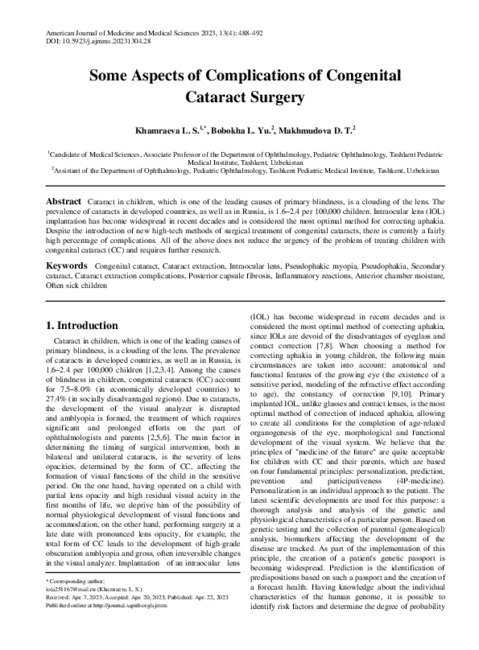
Some aspects of complications of congenital cataract surgery
Cataract in children, which is one of the leading causes of primary blindness, is a clouding of the lens. The prevalence of cataracts in developed countries, as well as in Russia, is 1.6–2.4 per 100,000 children. Intraocular lens (IOL) implantation has become widespread in recent decades and is considered the most optimal method for correcting aphakia. Despite the introduction of new high-tech methods of surgical treatment of congenital cataracts, there is currently a fairly high percentage of complications. All of the above does not reduce the urgency of the problem of treating children with congenital cataract (CC) and requires further research.
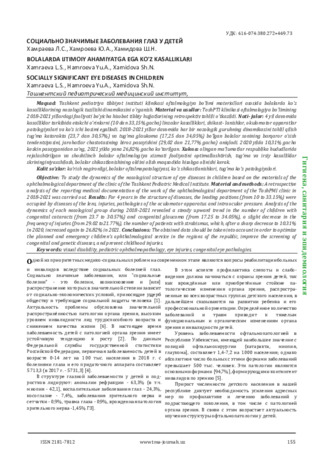
Socially significant eye diseases in children
Objective: To study the dynamics o f the nosological structure o f eye diseases in children based on the materials o f the ophthalmological department o f the clinic o f the Tashkent Pediatric Medical Institute. Material and methods: A
retrospective analysis o f the reporting medical documentation o f the work o f the ophthalmological department o f the
TashPMI clinic in 2018-2021 was carried out. Results: For 4 years in the structure o f diseases, the leading positions (from 10 to 33.15%) were occupied by diseases o f the lens, injuries, pathologies o f the oculomotor apparatus and intraocular pressure. Analysis o f the dynamics o f each nosological group during 2018-2021 revealed a steady upward trend in the number o f children with congenital cataracts (from 23.7 to 30.57%) and congenital glaucoma (from 17.25 to 34.05%), a slight decrease in thefrequency o f injuries (from 29.02 to 21.77%), the number ofpatients with strabismus, which, after a sharp decrease to 10.31% in 2020, increased again to 26.82% in 2021. Conclusions: The obtained data should be taken into account in order to optimize the planned and emergency children’s ophthalmological service in
the regions o f the republic, improve the screening o f congenital and genetic diseases, and prevent childhood injuries.


