
Journal of Social Sciences and Humanities Research Fundamentals
104
https://eipublication.com/index.php/jsshrf
TYPE
Original Research
PAGE NO.
104-109
DOI
OPEN ACCESS
SUBMITED
26 October 2024
ACCEPTED
30 December 2024
PUBLISHED
30 January 2025
VOLUME
Vol.05 Issue01 2025
COPYRIGHT
© 2025 Original content from this work may be used under the terms
of the creative commons attributes 4.0 License.
Dental bugel prostheses
Djumaev Asliddin Abdusamadovich
Clinic Resident of the Department of Orthopedic Dentistry Samarkand
State Medical University Samarkand, Uzbekistan
Islamova Nilufar Bustanovna
PhD, Assistant Department of Orthopedic Dentistry Samarkand State
Medical University Samarkand, Uzbekistan
Abstract:
Tooth loss is always an unpleasant fact, which
most often affects elderly people. But such problems
are everywhere, even among young people who lose
their teeth for various reasons: from injuries to chronic
systemic diseases. All of this significantly deteriorates
the quality of life and leads to serious consequences,
including impaired dictation and inability to chew food.
Prosthetics will help to save the position, which will
restore not only the aesthetics, but also the functional
state of the dentofacial system. If the installation of
non-removable bridges and implants is contraindicated
or inaccessible to the patient due to the high cost, the
dentists of the "May" clinic recommend considering
removable prostheses.
Keywords:
Tooth loss, consequences, including
impaired dictation and inability to chew food.
Introduction:
Types of removable dentures:
•
The removable models structurally represent
an imitation of the gums and teeth made of:

Journal of Social Sciences and Humanities Research Fundamentals
105
https://eipublication.com/index.php/jsshrf
Journal of Social Sciences and Humanities Research Fundamentals
•
made of soft inert plastic (most often acrylic) -
it is light, does not cause discomfort and does
not depress;
•
metal elements - this can be both a base and a
crown;
•
ceramic elements - used to imitate lost units.
With their help, you can distribute the chewing load
and the pressure it creates on the entire gum, not just
on the chewing area. This helps protect the mucous
membrane and alveolar processes from atrophy and
sedimentation.
There are two main types of such prostheses:
• Complete, used in the absence of all units from above
or below, allows you to immediately replace the entire
row;
• Partially removable, used in cases
where one or more
units remain in the patient's mouth.
When partial prosthetics are performed, the best, most
durable, and long-lasting option is a styrofoam
prosthesis.
What is a bogy prosthesis?
•
A Bugel prosthesis is a variation of a partially
removable prosthesis, which is based on an
arch that acts as a base and allows you to
evenly distribute the load. The word "bugel"
translates from German as "arc."
•
It is possible to use bugabock models only if the
own teeth are preserved on both sides of the
jaw. They serve as a support for the cartilage,
allowing for the even distribution of the
chewing load and ensuring the firm fixation of
the prosthetic product in the oral cavity.
•
New-generation dental prostheses should not
be associated with "grandmother's jaws,"
which are regularly dropped and put into
glasses with water at night. Most commonly,
arched models are made with an open nose,
which does not affect taste or reduce
sensitivity, they are thin and elegant, and they
can be removed once every few months for
additional care, such as professional cleaning.
•
The
advantages
of
bureaucracy
are
indisputable:

Journal of Social Sciences and Humanities Research Fundamentals
106
https://eipublication.com/index.php/jsshrf
Journal of Social Sciences and Humanities Research Fundamentals
•
compact sizes that ensure maximum comfort
during operation;
•
comfort when wearing - they do not rub, do not
interfere with communication, do not provoke
speech disorders;
•
a long period of uninterrupted work is 5-10
years, which allows you to live a full life;
•
high strength and reliability - patients may not
worry about the fact that the artificial jaw will
fall out of their mouth or break at the most
inopportune moment;
•
less load on the mucous membrane of the
gums - the tissues do not experience increased
loads, as the arc does not press on the gum;
•
strong fixation to the support units - with
proper installation, there will be no problems
with wearing the product.
Partial dentures can be worn not only by the elderly,
but also by people with toothless jaws. Often, young
people also use such products. For example, a model
without a nose is an excellent temporary option for
treatment and preparation for implantation, allowing
the patient to maintain self-confidence, comfort, and
dictation.
There are several drawbacks in the models, however,
doctors note:
•
a higher price compared to fully plastic ones,
but it is justified by increased reliability and
strength;
•
if the clamper type of attachment to the front
coroners is used - this destroys the aesthetics,
which does not please many patients;
•
the minimum necessary number of retained
support crowns - four on each side of the jaw,
and if they are less, it is impossible to guarantee
the possibility of prosthetic treatment and
comfortable operation.
Types of bogy prostheses:
There are several types of upper and lower braces. All
of them have their own characteristics, advantages and
disadvantages:
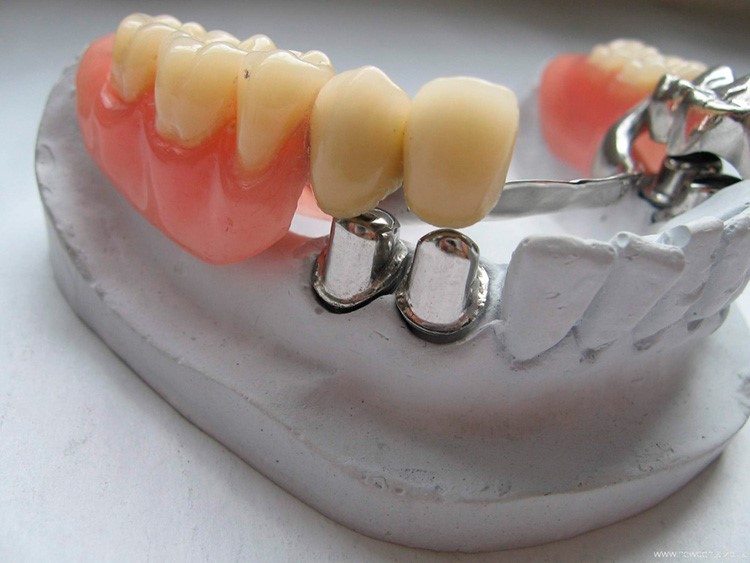
•
Partial removable tissue protects with
telescopic fixation. This is the most expensive
type of handbag. They are miniature and allow
you to achieve maximum aesthetics. A feature
of their fixation is the installation of a metal
crown in the form of a cap on the supporting
teeth, and a prosthesis is applied to them from
above according to the principle of a telescope;
•
On clambers. Clampers are special metal hooks
that extend the arc that lies at the base of the
structure and are attached to the base of the
support unit. Allows you to distribute the load
on your own crowns and partially remove it
from the soft tissues of the gums. The cost of
such a prosthesis is relatively low;
•
On lock fastenings (attachments) - is a double
construction connected to a lock. One part is
located on the prosthesis itself, and the other
is attached to the crowns located on the
supporting units. Prolonged clamping ensures
strength and reliability of the fastening;
•
Shining. Recommended for people with
periodontal diseases and atrophy. From the
arch, the outgrowths, as if "wrapping" the base
of each crown, create additional fixation and
prevent teeth from shaking and falling. These
models also create additional chewing load
protection for the thighs;
•
Quadrotti - plastic products with ceramic
crowns and light soft hooks for attachment to
support units. In essence, they are a type of
cluster model.
•
There is also a classification of wrist prostheses
depending on the material:
1. Metallic. The most popular and affordable.
Telescopic models can be made solely on a metallic
basis;
2. Metal-free. Expensive but sufficiently aesthetic
options, used only in cases of allergic reactions to metal
alloys;
Plastic. Their frame arch is made of acetal plastic,
which ensures a small weight of the product, so the
main advantage of this bugle system is lightness;
Metal-ceramic. Their "tooths" are made of ceramics
based on metal, which ensures both aesthetics and
strength, but in price they are more expensive than
metal and plastic.
Indications and contraindications:
Like any medical procedure, the use of bogy prosthetics
has both indications and contraindications. Bugle
systems are shown in the following situations:
•
End defects in the dental rows on one or both
sides of the jaw;
•
The absence of several consecutive teeth
within the dental row, including frontal ones;
•
Unable to install a bridge or implants;
•
Increased crown stiffness;
Preserving units and preventing their shake-up in
periodontitis or periodontitis.

Journal of Social Sciences and Humanities Research Fundamentals
107
https://eipublication.com/index.php/jsshrf
Journal of Social Sciences and Humanities Research Fundamentals
Among
contraindications,
the
following
are
distinguished:
• Oral mucosal inflammatory processes
- they must be
treated first, otherwise it will be impossible to perform
prosthetics;
• Severe atrophy of alveolar processes;
Insufficient tooth spaces for fixation - they are
necessary for reliable installation;
•
Deep bite - in case of such anomaly of the
dentofacial system, the bagel is not used;
•
There is no flexibility of the gum mucosa;
•
Too high fastening of the tongue;
•
Completely lack of own teeth, or their ability to
•
There is no flexibility of the gum mucosa;
•
Too high fastening of the tongue;
•
Complete absence of own teeth or their
number less than four;
•
Diabetes and other endocrine diseases - they
disrupt
metabolism
and
complicate
prosthetics;
•
Oncology;
•
Drug addiction;
•
Mental disorders;
•
Cardiovascular diseases.
It is also not recommended to make and wear a cuff
during pregnancy.
The process of manufacturing bogy prostheses:
All stages of manufacturing upper jaw models can be
divided into clinical (on admission to the dental clinic)
and laboratory (conducted in the dental laboratory):
1. The doctor collects the medical history, examines the
patient, and, if necessary, prescribes an additional
diagnosis. Our clinic has all the conditions and modern
equipment for this - you will not have to run to different
institutions and doctors;
Prints are taken and a plaster impression of the future
jaws is created, on the basis of which the dental
technician will make a prosthesis. This is called
"diagnostic model";
The remaining teeth in the mouth are smoothed and
crowns are installed on them. The "May" clinic operates
the "Anti-stress" program for patients who are afraid of
the sound of the drumstick and the dental chair. It
involves the use of nitric oxide, intravenous sedation,
or general anesthesia during all unpleasant dental
procedures.
The gypsum model is removed from the wax film, and
based on this data, the metal frame and plastic
elements of the buckle structure are cast;
At the doctor's appointment, there is residual
adjustment. It is important to achieve maximum
convenience - getting used to the budget model can
take several weeks. Adaptation involves immersing the
plastic layer under the jaw so that the chewed food
does not fall under the arch.
Bogy prosthesis care:
In contrast to frameless plastic prostheses, whose
service life is 2-3 years, buckles are designed for 5-10
years of use. And in order for the product to serve you
as long as possible, it needs full-fledged systematic
care:
• It is necessary to ensure thorough hygiene twice a day
using a medium-tough brush and a paste;
• After each meal, it is advisable to rinse the mouth with
a rinse;
• It is advisable to remove the structure at least once a
day and clean it additionally, although some items can
be worn for weeks or even months without removing;
• Do not clutch the product in your hand, clean it on a
soft surface, otherwise it may break;
Occasionally bring the prosthesis to the dental clinic for
professional cleaning;
• At least once a year (or even better
- once in half a
year) you should visit the treating doctor to check the
formation of super contacts (points of excessive bite
and uneven load on the remaining teeth and gums). It
is important to regularly monitor the preservation of
the correspondence of the oral mucosa and the
cartilage to prevent rubbing or atrophic processes. The
doctor will also remove the tooth deposits that are
beginning to form if necessary.
• At least once a year (or better half a year) you should
visit the doctor to check the formation of super
contacts (points of excessive bite and uneven load on
the remaining teeth and gums). It is important to
regularly
monitor
the
preservation
of
the
correspondence of the oral mucosa and the cartilage to
prevent rubbing or atrophic processes. The doctor will
also remove the tooth deposits that are beginning to
form if necessary.
Price of new-generation dental prostheses without
fangs:
It is impossible to immediately, without examination, to
name the cost of a wrist prosthesis.
It can vary greatly depending on the following factors:
• the number of teeth requiring prosthetics;
• the patient's preserved teeth;
• type of buckle structure and its fixation;

Journal of Social Sciences and Humanities Research Fundamentals
108
https://eipublication.com/index.php/jsshrf
Journal of Social Sciences and Humanities Research Fundamentals
• manufacturing materials;
• the qualification of the doctor and the reputation of
the clinic;
• dental technician prof
essionalism.
REFERENCES
Asrorovna, X. N., Baxriddinovich, T. A., Bustanovna, I.
N., Valijon O’g’li, D. S., & Qizi, T. K. F. (2021). Clinical
Application Of Dental Photography By A Dentist. The
American
Journal
of
Medical
Sciences
and
Pharmaceutical Research, 3(09), 10-13.
Ugli, A. A. A., & Bustanovna, I. N. (2024). STUDY OF THE
CONDITION OF PARODONT IN PERIODONTITIS IN FETAL
WOMEN.
European
International
Journal
of
Multidisciplinary Research and Management Studies,
4(05), 149-156.
Kizi, J. O. A., & Bustanovna, I. N. (2024).
FAMILIARIZATION WITH THE HYGIENIC ASSESSMENT
OF THE CONDITION OF THE ORAL MUCOSA IN
ORTHOPEDIC TREATMENT. European International
Journal of Multidisciplinary Research and Management
Studies, 4(05), 89-96.
Bustanovna, I. N. (2024). Determination of the
Effectiveness of Dental Measures for the Prevention of
Periodontal Dental Diseases in Workers of the
Production of Metal Structures. International Journal of
Scientific Trends, 3(5), 108-114.
Bustanovna, I. N. (2022). Assessment of clinical and
morphological changes in the oral organs and tissues in
post-menopause women. Thematics Journal of
Education, 7(3).
Bustanovna, I. N., & Berdiqulovich, N. A. (2022).
ПРОФИЛАКТИКА
И
ЛЕЧЕНИЯ
КAРИЕСA
У
ПОСТОЯННЫХ ЗУБОВ. JOURNAL OF BIOMEDICINE AND
PRACTICE, 7(1).
Bustanovna, I. N. (2024). PATHOGENESIS OF
PERIODONTAL DISEASE IN ELDERLY WOMEN. Лучшие
интеллектуальные исследования, 21(3), 25
-29.
Bustanovna, I. N. (2024). TO STUDY THE HYGIENIC
ASSESSMENT OF THE CONDITION OF THE ORAL
MUCOSA DURING ORTHOPED
IC TREATMENT. Лучшие
интеллектуальные исследования, 21(1), 9
-15.
Bustanovna, I. N. (2024). CLINICAL AND LABORATORY
CHANGES IN PERIODONTITIS. Journal of new century
innovations, 51(2), 58-65.
Bustanovna, I. N. (2024). Morphological Changes in Oral
Organs and Tissues in Women after Menopause and
their Analysis. International Journal of Scientific Trends,
3(3), 87-93.
Bustanovna, I. N. (2024). Hygienic Assessment of The
Condition of The Oral Mucosa After Orthopedic
Treatment. International Journal of Scientific Trends,
3(3), 56-61.
Bustanovna, P. I. N. (2024). Further Research the
Features of the Use of Metal-Ceramic Structures in
Anomalies of Development and Position of Teeth.
International Journal of Scientific Trends, 3(3), 67-71.
Bustanovna, I. N. (2024). The Effectiveness of the Use
of the Drug" Proroot MTA" in the Therapeutic and
Surgical Treatment of Periodontitis. International
Journal of Scientific Trends, 3(3), 72-75.
Bustanovna, P. I. N. (2024). Research of the Structure of
Somatic Pathology in Patients with Aphthous
Stomatitis. International Journal of Scientific Trends,
3(3), 51-55.
Bustanovna, I. N., & Abdusattor o’g, A. A. A. (2024).
Analysis of Errors and Complications in the Use of
Endocal Structures Used in Dentistry. International
Journal of Scientific Trends, 3(3), 82-86.
Bustanovna, I. N. (2024). Complications Arising in the
Oral Cavity after Polychemotherapy in Patients with
Hemablastoses. International Journal of Scientific
Trends, 3(3), 62-66.
Bustanovna, I. N., & Sharipovna, N. N. (2023). Research
cases in women after menopause clinical and
morphological changes in oral organs and their analysis.
Journal of biomedicine and practice, 8(3).
Bustonovna, I. N., & Sharipovna, N. N. (2023). Еssential
Factors Of Etiopathogenesis In The Development Of
Parodontal Diseases In Post-Menopasis Women.
Eurasian Medical Research Periodical, 20, 64-69.
Fakhriddin, C. H. A. K. K. A. N. O. V., Shokhruh, S. A. M.
A. D. O. V., & Nilufar, I. S. L. A. M. O. V. A. (2022).
ENDOKANAL PIN-KONSTRUKSIYALARNI ISHLATISHDA
ASORATLAR VA XATOLAR TAHLILI. JOURNAL OF
BIOMEDICINE AND PRACTICE, 7(1).
Очилов, Х. У., & Исламова, Н. Б. (2024). Особенности
артикуляции и окклюзии зубных рядов у пациентов
с
генерализованной
формой
повышенного
стирания.
SAMARALI
TA’LIM
VA
BARQAROR
INNOVATSIYALAR JURNALI, 2(4), 422-430.
Ortikova, N., & Rizaev, J. (2021, May). The Prevalence
And Reasons Of Stomatophobia In Children. In E-
Conference Globe (pp. 339-341).
Ortikova, N. (2023). ANALYSISOF ANESTHESIA
METHODS FOR DENTAL FEAR AND ANXIETY.
Центральноазиатский
журнал
академических
исследований, 1(1), 8
-12.
Ortikova, N. K. (2023). DENTAL ANXIETY AS A SPECIAL
PLACE IN SCIENTIFIC KNOWLEDGE. SCHOLAR, 1(29),
104-112.
Исламова,
Н.
Б.
(2024).
ПАРОДОНТ

Journal of Social Sciences and Humanities Research Fundamentals
109
https://eipublication.com/index.php/jsshrf
Journal of Social Sciences and Humanities Research Fundamentals
КАСАЛЛИКЛАРИДА
ОРГАНИЗМДАГИ
УМУМИЙ
ЎЗГАРИШЛАРНИ
ТАҲЛИЛИ
ВА
ДАВОЛАШ
САМАРАДОРЛИГИНИ
ТАКОМИЛЛАШТИРИШ.
ОБРАЗОВАНИЕ НАУКА И ИННОВАЦИОННЫЕ ИДЕИ В
МИРЕ, 43(7), 18
-22.
Islamova, N. B., & Chakkonov, F. K. (2021). Changes in
the tissues and organs of the mouth in endocrine
diseases. Current Issues in Dentistry, 320-326.
Исламова, Н. Б., & Исломов, Л. Б. (2021).
Особенности развития и течения заболеваний
полости рта при эндокринной патологии. ББК, 56,
76.
Исламова, Н. Б., & Назарова, Н. Ш. (2023).
СУРУНКАЛИ ТАРҚАЛГАН ПАРОДОНТИТ БИЛАН
КАСАЛЛАНГАН
ПОСТМЕНОПАУЗА
ДАВРИДАГИ
АЁЛЛАРНИНГ
ПАРОДОНТ
ТЎҚИМАСИНИНГ
ДАВОЛАШ САМАРАДОРЛИГИ ОШИРИШ. ЖУРНАЛ
СТОМАТОЛОГИИ
И
КРАНИОФАЦИАЛЬНЫХ
ИССЛЕДОВАНИЙ, 4(2).
Исламова, Н. Б. (2024). ПАРОДОНТИТ КАСАЛЛИГИДА
ОРГАНИЗМДАГИ УМУМИЙ ВА МАҲАЛЛИЙ ЎЗГАРГАН
КЎРСАТКИЧЛАРНИНГ
ТАҲЛИЛИ.
Журнал
гуманитарных и естественных наук, (8), 23
-27.
Islamova, N. B., & Sh, N. N. (2023, May). STUDY OF
CHANGES
IN
PERIODONTAL
DISEASES
IN
POSTMENOPAUSAL WOMEN. In Conferences (pp. 15-
17).
Исламова, Н. Б., & Назарова, Н. Ш. (2023, May).
Совершенствование
диагностики
и
лечения
хронического генерализованного пародонтита у
женщин в период постменопаузы. In Conferences
(pp. 13-15).
Islamova, N. B., & Nazarova, N. S. (2023). IMPROVING
THE DIAGNOSIS AND TREATMENT OF CHRONIC
GENERALIZED PERIODONTITIS IN POSTMENOPAUSAL
WOMEN. Conferences.
Исламова, Н. Б. (2023). Гемодинамика тканей
пародонта зубов по данным реопародонтографии.
Исламова, Н. Б., & Назарова, Н. Ш. (2023). МЕТОДЫ
ИССЛЕДОВАНИЯ ЗАБОЛЕВАНИЙ ПАРОДОНТА У
ЖЕНЩИН,
НАХОДЯЩИХСЯ
В
ПЕРИОДЕ
ПОСТМЕНОПАУЗЫ. In АКТУАЛЬНЫЕ ВОПРОСЫ
СТОМАТОЛОГИИ (pp. 334
-338).
Исламова, Н. Б. (2024). Complications Arising in the
Oral Cavity after Polychemotherapy in Patients with
Hemablastosis. International Journal of Scientific
Trends, 3(3), 76-81.
Islamova, N. B. (2022). CHANGES IN PERIODONTAL
TISSUES IN THE POSTMENOPAUSAL PERIOD. In
Стоматология
-
наука и практика, перспективы
развития (pp. 240
-241).
Назарова,
Н.,
&
Исломова,
Н.
(2022).
Этиопатогенетические
факторы
развития
заболеваний пародонта у женщин в периоде
постменопаузы. Профилактическая медицина и
здоровье, 1(1), 55
-63.
Иргашев, Ш. Х., & Исламова, Н. Б. (2021).
Применение и эффективность энтеросгеля при
лечении
генерализованного
пародонтита.
In
Актуальные вопросы стоматологии (pp. 305
-310).
Иргашев, Ш., Норбутаев, А., & Исламова, Н. (2020).
Эффективность
энтеросгеля
при
лечении
генерализованного пародонтита у ликвидаторов
последствий аварии на чернобыльской АЭС.
Общество и инновации, 1(1/S), 656
-663.
Исламова, Н. Б. (2016). Сравнительная оценка
противовоспалительных
цитокинов
крови
в
развитии
заболеваний полости рта при гипотиреозе.
Наука в современном мире: теория и практика, (1),
41-44.
Исламова, Н. Б., Шамсиев, Р. А., Шомуродова, Х. Р.,
&
Ахмедова,
Ф.
А.
(2014).
Состояние
кристаллообразующей
функции
слюны
при
различных патологиях. In Молодежь и медицинская
наука в XXI веке (pp. 470
-471).