

179
2
Tajriba-sinov guruhi
8 %
23 %
69 %
8-sinflar
25-30
19-24
18<
1
Nazorat guruhi
10 %
17 %
73 %
2
Tajriba sinov guruhi
11 %
16 %
73 %
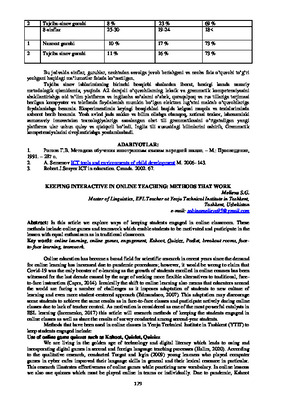
Bu jadvalda sinflar, guruhlar, nechtadan savolga javob berishgani va necha foiz o‘quvchi to‘g‘ri
yechgani haqidagi ma‘lumotlar foizda ko‘rsatilgan.
Tajriba sinov ishlarimizning birinchi bosqichi shulardan iborat, hozirgi kunda nazariy
metodologik qismidamiz, yaqinda A2 darajali o‘quvchilarning leksik va grammatik kompetensiyasini
shakllantirishga oid ta‘lim platforma va inglizcha so‘zlarni o‘zbek, qoraqalpoq va rus tillariga tarjimasi
berilgan kompyuter va telefonda foydalanish mumkin bo‘lgan elektron lug‘atni maktab o‘quvchilariga
foydalanishga beramiz. Eksperimentimiz keyingi bosqichlari haqida kelgusi maqola va tezislarimizda
axborot berib boramiz. Yosh avlod juda zukko va bilim olishga chanqoq, xotirasi tezkor, ishonamizki
zamonaviy innovatsion texnologiyalariga asoslangan chet tili grammatikasini o‘rtgatadigan yangi
platforma ular uchun qulay va qiziqarli bo‘ladi. Ingliz tili xususidagi bilimlarini oshirib, Grammatik
kompetensiyalarini rivojlantirishga yordamlashadi.
ADABIYOTLAR:
1.
Рогова Г.В. Методика обучения иностранным языкам в средней школе. – М.: Просвещение,
1991. – 287 с.
2.
ICT tools and environments of child development
3.
Robert.J.Sozyer ICT in education. Canada. 2002. 67.
KEEPING INTERACTIVE IN ONLINE TEACHING: METHODS THAT WORK
Melieva S.G.
Master of Linguistics, EFL Teacher at Yeoju Technical Institute in Tashkent,
Tashkent, Uzbekistan
Abstract:
In this article we explore ways of keeping students engaged in online classroom. These
methods include online games and teamwork which enable students to be motivated and participate in the
lesson with equal enthusiasm as in traditional classroom.
Key words
:
online learning, online games, engagement, Kahoot, Quizizz, Padlet, breakout rooms, face-
to-face learning, teamwork.
Online education has become a broad field for scientific research in recent years since the demand
for online learning has increased due to pandemic procedures; however, it would be wrong to claim that
Covid-19 was the only booster of e-learning as the growth of students enrolled in online courses has been
witnessed for the last decade caused by the urge of seeking more flexible alternatives to traditional, face-
to-face instruction (Capra, 2014). Ironically the shift to online learning also means that educators around
the world are facing a number of challenges as it imposes adaptation of students to new culture of
learning and even more student-centered approach (Edmundson, 2007). This adaptation may discourage
some students to achieve the same results as in face-to-face classes and participate actively during online
classes due to lack of teacher control. As motivation is considered as one of the most powerful catalysts in
ESL learning (Iaremenko, 2017) this article will research methods of keeping the students engaged in
online classes as well as share the results of survey conducted among second-year students.
Methods that have been used in online classes in Yeoju Technical Institute in Tashkent (YTIT) to
keep students engaged include:
Use of online game quizzes such as Kahoot, Quizlet, Quizizz
We are living in the golden age of technology and digital literacy which leads to using and
incorporating digital games in second and foreign language teaching processes (Halim, 2020). According
to the qualitative research, conducted Turgut and Irgin (2009) young learners who played computer
games in cyber cafes improved their language skills in general and their lexical resource in particular.
This research illustrates effectiveness of online games while practicing new vocabulary. In online lessons
we also use quizzes which must be played online in teams or individually. Due to pandemic, Kahoot

180
released a new function to show questions on the device of each participant. This made it possible to play
this game while Zoom lessons. Besides such websites as Quizizz and Quizlet are always effective tools
for learning grammar and vocabulary. They are interactive as students can practice teamwork,
competitive and engaging due to their colorful interface and background music.
Research
We decided to conduct quantitative research which involved 50 second-year students of mixed
levels and abilities. All participants were taking Business English course and for all of them it was not a
major subject. Most of students were not fluent in English and were unwilling to turn their microphones
on during online classes and speak on particular topic, although some students were quite active;
however, during online games the teacher was able to monitor students‘ progress in remembering words
as well as encourage passive students participate in class. Participants were provided with a questionnaire
containing a set of statements which were explained and translated by the researcher. Students had to tick
the answers and send the result to the researcher.
Findings
The results of the survey are given in the table below. According to the table, all students enjoy
learning with Kahoot and Quizizz, find these games interactive as they have a chance to see achievements
of their friends and think that the games increase their attention in doing activities. Moreover, majority
consider Kahoot and Quizizz a useful and interesting tool to improve their English.
Statement (question)
Strongly
Disagree
Disagree
Agree
Strongly Agree
I enjoy learning English
using games like
Kahoot and Quizizz
-
-
9
18%
41
82%
Learning English with
Kahoot and Quizizz
makes English class
more interesting
-
2
4%
12
24%
36
72%
I miss my friends so it
is nice to play a game
like Kahoot and Quizizz
with them
-
-
15
30%
35
70%
I think I can improve
my English playing
Kahoot and Quizizz
-
8
16%
20
40%
22
44%
Learning English
through Kahoot and
Quizizz increases my
attention in class
-
-
13
26%
37
74%
Use of Padlet as part of warm-up or collaborative activity
One of the main challenges EFL instructors face during the lessons is inability to control the
students in the class. By this we mean that many students turn their microphones off and tend to listen to
practical English lessons as a lecture. This might be tackled by making students involved through various
interactive apps like Padlet. Padlet (https://www.padlet.com) is a free web based application that provides
a ―wall‖ that allows the user to post words, pictures and even videos, which could be viewed by anyone
with the link or address to the specific wall. Students can comment on these ―walls‖, have discussions
unanimously or showing one‘s identity. From a brainstorming board to a live questions bank, there are
lots of ways to use Padlet. Thus, if the students are shy to turn on their microphones, they can comment
on colorful boards where a teacher can insert images, videos, audio files, links, or documents. Padlet is
also excellent ice-breaker as students find it more interesting to discuss questions on the ―wall‖ rather
than questions on shared PPT by a teacher since they feel more freedom to be creative and exchange ideas
with their peers. The application has also been used as an avenue for art appreciation online discussion
board, reflection, and enabled students to collaborate safely with an online community (Delacruz et al.,
2014).
Breakout rooms in Zoom
It is true that today educators have access to various types of tools to conduct classes online from
Skype to Microsoft Teams. In YIIT we tend to use Zoom as it seemed the most user-friendly for students.

181
Besides, certain functions of Zoom are significantly appealing to teachers to keep students engaged. One
of these features is the ability to divide students in groups with the assistance of breakout rooms. The idea
is to continue using all traditional classroom activities online. It might be discussion, collaborative writing
task, warm-up, project and any other type of activity which requires teamwork. For instance, a teacher
might assign a task ―From A to Z‖ which requires students to find one word for each letter of the alphabet
to a particular theme as an ice-breaker almost to any topic such as Travelling, Education, Business, etc.
The procedure of the task and instructions are explained during the main session and then a teacher
divides learners into teams. It can be done randomly by the program or an educator can assign each
student to a particular team. One of the benefits of such function is that it helps to manage time in the
most effective way as the host of the conference can end breakout rooms for all teams and require them to
return to the main session to share to results of the given assignment. It is also possible to monitor the
working process of each team by entering each group one by one and checking their progress, although an
obstacle might be that a teacher cannot control other teams simultaneously which can lead to switching to
L1 by the students. Nevertheless, it is an effective way to make students communicate and interact with
each other.
The implication of this study is that online tools such as Kahoot, Quizizz, Padlet and Zoom can
create an effective environment for interactive online lessons an encourage students to participate in the
class as enthusiastically as it would be in the traditional face-to-face lesson using modern methods and
approaches to teaching ESL.
REFERENCES:
1.
Capra T. (2014).
A Consideration of Online Learning.
Thought & Action, pp. 111-120
2.
Delacruz, E., Brock, D., Fuglestad, T., Ferrell, K., Huffer, J., & Melvin, S. (2014).
Teaching Art
in the Age of Social Media
:
http://www.elizabethdelacruz.com/uploads/5/4/3/6/5436943/delacruz_5techteachers.pdf
3.
Edmundson A, Ed. (2007).
Globalized E-Learning Cultural Challenges
. Information Science
Publishing
4.
Iaremenko N (2017)
Enhancing English Language Learners‘ Motivation through Online Games
.
Information Technologies and Learning Tools, pp.126-133
5.
Mohd Shakir Azfar Abdul Halim; Harwati Hashim; Melor Md Yunus (2020).
Pupils‘ Motivation
and Perceptions on ESL Lessons through Online Quiz-Games
. Journal of Education and e-Learning
Research, 7(3): 229-234
6.
Turgut, Y., & İrgin, P. (2009).
Young learners‘ language learning via computer games.
Procedia-
Social
and
Behavioral
Sciences,
1(1),
760-
764.
Available
at:
https://doi.org/10.1016/j.sbspro.2009.01.135
LINGUOCULTURAL APPROACH IN MODERN FOREIGN LANGUAGE EDUCATION
Serdalieva B.H.
Doctoral student, NukSPI named after Ajiniyaz, Nukus, Uzbekistan
Abstract
: The article highlights peculiar features and aspects of developing the linguocultural approach
in Foreign language teaching (Flt) to students of non-linguistic specialties of pedagogical universities in
the framework of the cognitive-linguocultural methodology which serves as the universal conceptual
basis for the theory of modern Foreign language education (Fle) and multilingual education in the
Republic of Karakalpakstan.
Key words
: intercultural communication; intercultural and professional communicative competence;
linguocultural studies; linguocultural approach.
Today, the linguoculturological approach to teaching foreign languages (hereinafter referred to as
FL) reflects the main trend in the field of foreign language education, mainly the shift of target accents,
the switching of interest from the formation of knowledge, abilities and skills to the development of a FL
as familiarization with a different culture, mastering new socio-cultural content.
Increasingly, in interpreting the models of a modern specialist, the emphasis is not only on
mastering a foreign language by a graduate, but also on developing the ability of such a specialist to
comprehend and accept cultural values that differ from his own. Therefore, along with linguistic
knowledge, the formation of speech skills and abilities, it is necessary to determine a set of cultural






