
DOI:
https://doi.org/10.71337/inlibrary.uz.science-research.139572Keywords:
nomoddiy aktivlar intellektual mulk buxgalteriya hisobi amortizatsiya IFRS moliyaviy hisobot.Abstract
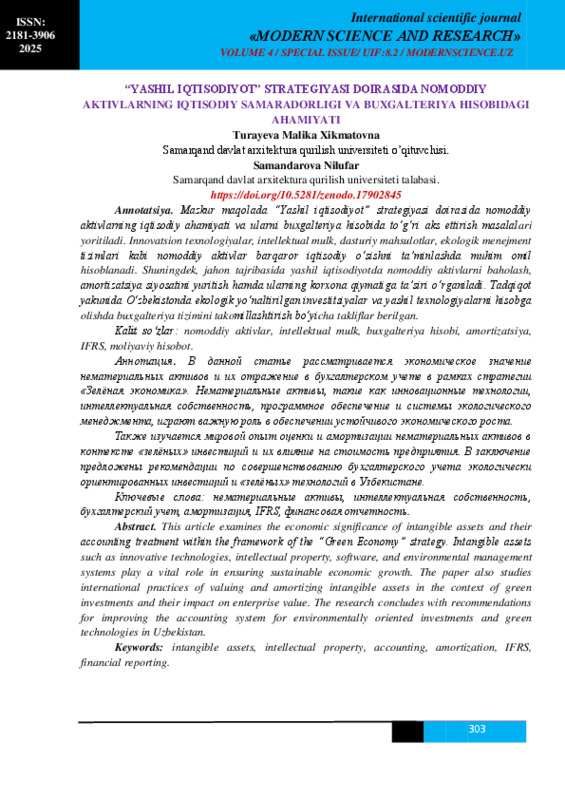
This article examines the economic significance of intangible assets and their accounting treatment within the framework of the “Green Economy” strategy. Intangible assets such as innovative technologies, intellectual property, software, and environmental management systems play a vital role in ensuring sustainable economic growth. The paper also studies international practices of valuing and amortizing intangible assets in the context of green investments and their impact on enterprise value. The research concludes with recommendations for improving the accounting system for environmentally oriented investments and green technologies in Uzbekistan.References
IFRS Foundation. (2022). International Financial Reporting Standards. London.
Sultonov, A. (2020). Buxgalteriya hisobi va moliyaviy hisobot. Toshkent: Iqtisodiyot nashriyoti.
Karimov, B. (2019). Nomoddiy aktivlar va moliyaviy boshqaruv. Toshkent: Ilmiy nashr.
O‘zbekiston Respublikasi Soliq qo‘mitasi. (2023). Buxgalteriya hisobi bo‘yicha tavsiyalar. Toshkent.
KPMG. (2021). Intangible Assets: Accounting and Reporting. London: KPMG Publications.
Tursunov, R., & Xolmurodov, F. (2019). Nomoddiy aktivlar va korporativ moliya boshqaruvi. Toshkent: Ilmiy nashr.
World Bank. (2021). Corporate Intangible Assets in Emerging Economies. Washington, D.C.
OECD. (2020). Accounting for Intangible Assets: Best Practices. Paris: OECD Publishing.
Muminov, E. (2021). Intellektual mulk va moliyaviy hisob. Toshkent: Ilmiy nashr.
Rasulov, J. (2022). Nomoddiy aktivlar va ularning raqamli iqtisodiyotdagi roli. Toshkent: Ilmiy axborot.






