
All articles

The development of technology for processing of Cr (VI) - containing industrial waste
The aim of research work The aim of the research work is to develop a technology for the complex processing of Cr(VI) - the containing industrial waste materials, using a untraditional environmentally safe, organic reducing word save dust.
Scientific novelty of the research work is as follows: the reduction properties of wood chips of chromium (VI) ions to chromium (III) in waste solutions, which open cellulose macromolecules arc formed as a result of chemical modifications, as well as an increase in the number of aldehyde group that is rarely found in the cellulose structure, contributes to the intensification of the reduction process;
the dependence of the yield of the product in the process of reduction of chromium (VI) ions to chromium (III) on the mass ratio of chromate ions, reducing agent and sulfuric acid, which is 1: 1: 1.6 ratio, is proved;
Optimal conditions for purification of the processed solution from calcium sulphate and iron (III) hydroxide arc established;
a west less technology for the complex processing of highly toxic spent chromate-containing solutions was developed, followed by the production of metal oxides.

The development getting food powder technology from byproduct of processed fruits and vegetable
Subjects of research: Secondary raw materials of processing of carrots.
Purpose of work: developing technology of drying and getting semi-finished products from byproduct of production of fruit and vegetable juices.
Methods of researches: Evaluating the quality of product received from byproduct raw material will be carried out with the modem physical, chemical, organoleptic, physico-chemical methods. Convective drying and arbitration assessment methods arc used.
The received results and their novelty:
- method of system analysis determined the optimal parameters of drying and grinding of recycled juice production;
- developed technology for producing semi-finished powder by processing recycled juice production in hypotonic solution and subsequent drying;
- developed technology of recycling of juice production, arranged production schedules and made technological scheme;
- compared mineral and vitamin compositions, nutritional value and organoleptic characteristics of the product and found the relationship between them.
Practical value:
- developed technology for producing semi-finished powder recycled production of fruit and vegetable juices;
- received a patent for a process of food powders;
- developed the recommendations for the use of the resulting powder in the canning industry and catering;
- research results which arc put in to practice approved by regulations.
Degree of embed and economic efficiency: A new technology applied into production at the plant «Nam-kon» in Kasansay district of Namangan region.
Capacity of the enterprise for manufacture of a food powder makes 100 t/ycar, expected economic benefit reaches 47805457cyw in a year.
Field of application: the Enterprises for processing of vegetables and fruit, a process industry and agriculture.
The application of hard withdrawals of soda plant as the active mineral additive of with the production of Portland cement
Subjects of research: the hard withdrawals of soda production, the slime of cleaning brine, slaked lime, lime, limestone, gypsum, Portland cement, concrete, calcium chloride, sodium chloride.
Purpose of work: Development of the chemical-engineering of the bases of obtaining and studying the construction- operational properties of multicomponent Portland cement with the use of hard wastes of soda production as the carbonatccontaining filler and the intensifiers of hardening.
Methods of research: chemical, rocntgcnographic, differential-thermal, electron-microscopic. Methods for physicomcchanical testing of cements, solutions and concretes in accordance with in force standards.
The results obtained and their novelty: Arc obtained high-strength and salt-tolerant cements, solutions and concretes on the basis of the local withdrawals (hard withdrawals of the Kungrad soda plant) of those improving their properties and decreasing prime cost.
It is established that the application of an additive of production waste of the soda ash before quantity 1-30% as the intensifier of hydration and hardening of Portland cement accelerates the process of the hydration of alit component to the 28- daily period respectively as far as 17-45%. Portland cement the containing hard withdrawals of soda production better noted that harden under normal conditions and with the warm moist working; the cement mortar (and concretes), which harden 28 days under normal conditions, before the natural conditions continue to harden with the speed of normal hardening and have sufficiently high strength. It is also established that the finely ground dispersed hard withdrawals arc capable of playing the role of the active microfiller of cement, which makes it possible to decrease its expenditure. The contact zone “concrete block - filler” before the presence of dispersed hard withdrawal has the higher values of microhardness, as a result of the adsorption of portlandite by hard withdrawals, interaction of hard withdrawal with carbonates of calcium and chloride calcium of aluminates and alumos-ferrite.
Practical value: Is for the first time before Uzbekistan established possibility before the large volumes of the utilization of the hard and liquid waste of soda production by their introduction beside the Portland cement as the finely ground mineral filler and the intensifier of hardening with obtaining of effective, cements, which exceed about the construction- operational indices both traditional, and sulfate resistent Portland cement.
Degree of embed and economic effectivity: The technologies proposed arc approved on an industrial scale with the development of multicomponent cement at the Angren cement combine. Is obtained the cement, which corresponds down the requirements of stamp M-500. The manufactured parties of cement arc used beyond Society with the limited responsibility “Bcton invest” in Almalyk city Tashkent region. The articles arc released: the plate of enclosure (ПО), chute is tray (JIK) and fundamental blocks (ФБС) 24.4.6, which correspond down the requirements of stamp M-300. The savings of cement comprises to 20% with the sufficiently good quality of concrete mixture and ferroconcrete constructions. The total volume of the prepared cement 100 T. economic effect with the production of the experimental-industrial party of Portland cement of M500 of Д20 with the hard withdrawals composes 4422469,8 sum. The expected economic effect with the volume 1 mln. t/yr of multicomponent cement will comprise more than 33 billion sum.
Field of application: AK. “Uzkurilishmatcriallari”.

Technology of Xylite obtaining from beer fraction by methods of simultaneous hydrolysis and hydrogenization
Subjects of the inquiry: beer fraction is a waste of the beer production in the ALR “Shymkcntpivo”, xylans of beer fraction, catalyzators having stability from acids.
Aim of the inquiry: development of methods of Xylite obtaining from beer fraction by methods of simultaneous hydrolysis and hydrogenization of beer fraction’s polysaccarides in the presence of promoted catalyzators on the basis of copper, cobalt and nickel.
Methods of inquiry: physical-chemical, IR-spcctroscopy, gas-liquid chromatography, electron microscopy.
The results achieved and their novelty: novelty of thesis is included in the development of scientifically-technical basis of efficient technology of Xylite obtaining from beer fraction by method of joint hydrolysis of polysaccarides and hydrogenization of formed Xylose. Chemical composition of Xylans of beer fraction have been established and it is proved that beer fraction can be perspective pentose-containing raw material for hydrolysis; the possibility of implementation of hydrolysis process of Xylans into autocatalitical “acidless” regime have been established the scientifically-technical basis of hydrolysis and hydrogenization of beer fractions’ polysaccharides in the devices of columned type of original construction have been developed; selection of efficient hydrogenization catalyzators that have stability from acids and admixtures of Xylose solutions have been implemented; the optimum conditions of autocatalytical hydrolysis process and hydrogenization of beer fraction’s polysaccharides have been determined by method of mathematical planning of the experiment.
Practical value: for the first time on the base of results of investigations the methods of synthesis and resource-and energy-saving technology of Xylite obtaining from beer fraction by way of simultaneous hydrolysis and hydrogenization have been developed which is approved in real experienced-industrial conditions. Realization in practice the results of given investigation decides the following important problems: the domestic production of Xylite with ability to competition on the principal new technology by way of development and inculcation of highly rated processes arc created; the waste of beer production -beer fraction arc rationally used that provides the improvement of the ecological situation in zone of beer production and provides the maximum profit at minimum of expenseses.
Degree of embed and economic effectivity: developed technology passed the experienced-industrial tests in research institute of chemical technology and industrial ecology (Shymkent), the obtained Xylite meets the demands of TX - 64-10-04-89 on the organoleptic and physical-chemical properties. At the averagt of production 2000 tone of crystalline xylite a year at the it’s sail on the minimum world price 10 000 dollars fors 1 tone the expected profit will be 4.359,4 dollars fors 1 tone of xylite.
Sphere of usage: hydrolytic industry, processiong of beer fractions’ wastes.

Technology of Xylite obtaining from beer fraction by methods of simultaneous hydrolysis and hydrogenization
Subjects of the inquiry: beer fraction is a waste of the beer production in the ALR “Shymkentpivo”, xylans of beer fraction, catalyzators having stability from acids.
Aim of the inquiry: development of methods of Xylite obtaining from beer fraction by methods of simultaneous hydrolysis and hydrogenization of beer fraction’s polysaccarides in the presence of promoted catalyzators on the basis of copper, cobalt and nickel.
Methods of inquiry: physical-chemical, IR-spectroscopy, gas-liquid chromatography, electron microscopy.
The results achieved and their novelty: novelty of thesis is included in the development of scientifically-technical basis of efficient technology of Xylite obtaining from beer fraction by method of joint hydrolysis of polysaccarides and hydrogenization of formed Xylose. Chemical composition of Xylans of beer fraction have been established and it is proved that beer fraction can be perspective pentose-containing raw material for hydrolysis; the possibility of implementation of hydrolysis process of Xylans into autocatalitical “acidless” regime have been established the scientifically-technical basis of hydrolysis and hydrogenization of beer fractions’ polysaccharides in the devices of columned type of original construction have been developed; selection of efficient hydrogenization catalyzators that have stability from acids and admixtures of Xylose solutions have been implemented; the optimum conditions of autocatalytical hydrolysis process and hydrogenization of beer fraction’s polysaccharides have been determined by method of mathematical planning of the experiment.
Practical value: for the first time on the base of results of investigations the methods of synthesis and resource-and energy-saving technology of Xylite obtaining from beer fraction by way of simultaneous hydrolysis and hydrogenization have been developed which is approved in real experienced-industrial conditions. Realization in practice the results of given investigation decides the following important problems: the domestic production of Xylite with ability to competition on the principal new technology by way of development and inculcation of highly rated processes are created; the waste of beer production -beer fraction are rationally used that provides the improvement of the ecological situation in zone of beer production and provides the maximum profit at minimum of expenseses.
Degree of embed and economic effectivity: developed technology passed the experienced-industrial tests in research institute of chemical technology and industrial ecology (Shymkent), the obtained Xylite meets the demands of TX - 64-10-04-89 on the organoleptic and physical-chemical properties. At the averagt of production 2000 tone of crystalline xylite a year at the it’s sail on the minimum world price 10 000 dollars fors 1 tone the expected profit will be 4.359,4 dollars fors 1 tone of xylite.
Sphere of usage: hydrolytic industry, processiong of beer fractions’ wastes.

Technology of the reception complex phosphoric-sulphur of the fertilizers, possessing insecticides by activity
Subjects of research: phosphorites of Central Kizylkum: ordinary phosphorite flour, low phosphorites, washed dried concoction, thermo concentrate, sulphur.
Purpose of work: the development to technologies and chemical base of the reception, complex phosphoric-sulfuric and nitrogen-phosphoric-sulfuric of the fertilizers, possessing insecticides by activity on base of the conversion phosphorites of Central Kizylkum sulphur, and under lowered rate by sulfuric and nitric acids.
Methods of research: chemical and X-ray graphical analysis.
The results achieved and their novelty: for the first time explored process to activations low phosphorites of Central Kizylkum presence of the sulphur, as well as is revealed role, rates of the sulphur and influence condition on transition not acquired forms of phosphorus in acquired. Designed technology of the reception phosphoric-sulfuric and nitrogen-phosphoric-sulfuric of the fertilizers by by decompositions phosphorites presence of the sulphur and lowered by rate by chamois and nitric acids, as well as explored physic-chemical and goods characteristic of the got products.
Practical value: on base result studies are for the first time received scientific given about creation intensive technological scheme of the reception complex phosphoric-sulfuric and nitrogen-phosphoric-sulfuric of the fertilizers possessing insecticides by activity by means of activation low phosphorites with sulphur, lowered rates by sulfuric and nitric acids.
Degree of embed and economic affectivity: agricultural chemistry test on cotton plant have shown efficiency phosphoric-sulfuric and nitrogen-phosphoric-sulfuric of the fertilizers before superphosphat prime cost 1 ton phosphoric-sulfuric of the fertilizers forms 20102,77 sum, prime cost 1 ton nitrogen-phosphoric-sulfuric of the fertilizers forms 153057,64 sum.
Sphere of usage: plants of State joint-stock company “O'zkimyosanoat”, the agriculture.

Technology of the receiving new oligomer antioxidants and inhibitor corrosions on the bases of local raw materials
Topicality and relevance of the theme of the dissertation. Nowadays, in the countries of the world with developed chemical and oil-chemical industry loss as a result of corrosions metal forms is distributed 20 percentage of annual production metal. Under large planning the expansion their production and modernizations production organization, appears the problem of the increase lifetime polymeric and metallic product1.
For independence years of our Republic toward development of production of different new products in chemical industry broadly covered actions on the protection of metal from corrosion in agricultures, home services and production spheres, in this direction, as follows, production qualitative inhibitors, which serves in determined degree to increase lifetime polymeric and metallic products have been implemented. It is possible to note the applicable and designed inhibitors at the process of the corrosion, as well as antioxidants for the protection of polymeric products.
These days, in the world the pyridinic, low-molecular and high-molecular amines and oxyamincs, fatty syntetic acids, high-molecular alcohols, the basis of the quinoline, imidazolines, derived thiourea, urotropin, phosphorus-containing compounds, as well as by-products production of syntetic rubber, coke-chemical and petrochemical products arc used as main raw materials for the production of inhibitors. For this purpose, in our country systematic scientific studies arc making on the creation of new types of inhibitor and antioxidants. In connection with increasing need to applicable inhibitor, it appears practicability of the creation of universal inhibitors based on advanced technology. During the solution of this task there is a need of development and obtaining inhibitors using local raw material resources as a source of raw materials in the synthesis of oligomer inhibitors having set of valuable and useful characteristic.
This dissertation research in determined degree serves for performing the tasks, provided in resolution of the President of the Republic Uzbekistan number 1442 on December 15, 2010 "About priority of the development of industry of the Republic of Uzbekistan" and number 1072 on March 12, 2009 "About the program of the measures on realization the major project on the modernization, technical and technological re-equipment of production", as well as in other normative legal documents accepted in this sphere.
The aim of the research is to develop technologies of obtaining nitrogen, phosphorus and sulphur-containing multifunctional oligomer antioxidants for polymeric material and inhibitor to corrosions for protection metal from corrosion.
The scientific novelty of the research is as follows:
the structure and physical and chemical properties of the synthesized organic chemical additives based on the oligomer of derivatives of gossypol, a polymethylcncdi(thio)amidophosphatcs, oligomer on the basic of epichlorohydrin with di(thio)amidophosphatcs and oligomer of dimethyl terephthalate with polyeth-ylcncpolyamine is defined;
it is defined influences of the received inhibiting additives on the basic of N-, S-and the P-containing oligomer on physical and chemical and mechanical properties of polymeric materials and metal products;
arc defined efficiency of the antioxidants synthesized the oligomer on the basis of gossypol with antioxidants of a class of the spatial complicated Phenolums and qualitative and quantitative differences arc installed in the mechanism of their action;
the inhibiting properties of the corrosion inhibitors developed the oligomer for protection of metals against the hydrochloric, hydrosulphuric and acid corrosion arc defined;
the technology of taking new oligomer antioxidants and inhibitors of corrosion and forecasting of the inhibiting properties of antioxidants is developed for polymers and inhibitors of corrosion at inhibition of corrosion of metals.
CONCLUSION
1. Methods of obtaining antioxidants on the basis of gossypol with epichlorohydrin and allyl compounds under different conditions and proportions of reagents.
2. Polyfunctional oligomer antioxidants and corrosion inhibitors containing N-, S-, P- have been recommended and oligomer derivatives of gossypol, polymcthilcncdi (thio)amidophosphate, oligomers obtained on the bases of epichlorohydrin with di(thio)amidophosphatc and oligomers obtained on the bases of dimcthyltcrcph-thalate with polyethylene polyamine.
3. By using IR-spcctroscopy, mass-chromatography, differential thermal analysis, etc. the structure and the inhibitory activity of the synthesized oligomers in the reactions of PE degradation has been studied. It has been reveallcd that the synthesized oligomers based on gossypol prevent thermo-oxidative aging of polymers and they have been recommended in exchange of «Irganox 1010» used in the industry on its efficiency.
4. Oxygen uptake kinetics and stable source of LDPE has been investigated at various pressures of molecular oxygen. It has been established that in addition to inhibiting the reactions of the polymer oxidation process, oligomer antioxidant leads to the deceleration of the process of degradation of the polymer composition.
5. As a result of oligomer antioxidants SKI-3 and SKMS-30 ARKM-15 based on gossypol representing antioxidant activity in rubber mixtures they have been recommended for use in exchange of antioxidant «Irganox 1010».
6. It has been shown that the introduction of mixtures of oligomeric stabilizers in the SKI-3 and SKMS-30 ARKM-15 rubbers leads to a significant increase in the thermal stability, and observed a synergistic effect is higher for 2.4-3 times than the sum of the individual effects of stabilizers.
7. When the inhibitory evolution of oligomer corrosion inhibitors was studied on the bases of conducted experiments, having exposed that their anticorrosion efficiency is 98-99%, the use of IC-4 and IC-5 inhibitors in the saline medium and IC-3 inhibitors in the acid medium has been recommended.
8. Process technology of oligomer antioxidants and corrosion inhibitors has been recommended.

Technology of the process of obtaining derivatives of morpholine
The aim of the research work
is development of methods of synthesis of new polyfunctional nitrogencontaining compounds - derivatives of morpholine, finding areas.
The object of the research work morpholine, epichlorohydrin, urea, acrylic and methacrylic acid.
Scientific noveltyof the researchwork
consists in the following:
it has been developed the technological process of obtaining new mono- and deexchanged derivatives of morpholine;
there have been suggested the method of obtaining unsaturated heterocyclic compounds on the bases of morpholine with akryl and methaakryl acids.
chlorohydrin has been synthsised on the bases of morpholine and epichlorohydrin and it has been created obtaining technology of унинг асосида petroltriazol, akryl methaakryl acids with morpholine new derivatives;
it has been investigated the spostaneous polymerization of epichlorohydrin with morpholine. Kinetic parameters of the process:the order of reaction on the initial reagents,activation energy of polymerization reaction.
spostaneous interaction of morpholine with epichlorohydrin has been investigated through quantum-chemical method and its molecular and energy diagrams have been recommended.
it has been created the technology of obtaining polyfunctional nitrogen containing compounds in the wide scale possessing morpholine ring with diffirent fragments by structure.
Implementationof the research results. According to the research results of the spontaneous polymerization of morpholine with epichlorohydrin:
developed by standard organizations ("based on Oligomer of epichlorohydrin ", Moree". Specifications (notice of the Ministry of health 14825224-04:2016 25 November 2016).
Processing leather goods with a solution of the oligomer on the basis of morpholine with epichlorohydrin allow you to get the leather semi-products with improved physical and mechanical, including hygiene and antibacterial properties.
The structure and volume of the thesis. The dissertation structure consists of the introduction, five chapters, the conclusion, the list of the used literature and appendixes. The dissertation volume consists of 120 pages.
Technology of reception the single phosphate fertilizers by the method of phosphate – acidic activation of the Central Kizilkum phosphorites
Subject of the inquiry: rock phosphated meal, the washing up concentrate, thermoconcentrate, mineralizated mass, dusty fraction of the Central Kyzilkum phosphorites, single phosphated fertilizers.
Aim of the inquiry: development of the technology of reception single phosphated fertilizers form above - mentioned viewes of the phosphated raw of Central Kyzilkum.
Method of inquiry: chemical and physico-chemical methods.
The results achieved and their novelty: for the first time the single high -concentrated phosphorated fertilizers with large content of assimilated and water -soluble forms P2O5 is produced from the poor high - carbonizated phosphated raw by the method of its phosphate - acidic activation and by acidic - thermal processing.
Practical value: the agriculture has received extremely needed the single -phosphated fertilizers for applying under autumn ploughing. The results of this work permit to involve into production of the phosphated fertilizers such the large - tonnaged waste of Kizilkum phosphorited combinate as mineralizated mass and dusty fraction.
Degree of embed and economic effectivity: the laboratory findings have test - operates on the large model plant. During 2010y have planning the industrial test at Almalyk Open Society “Ammophos - Maksam”. The carried out agrochemical testings showed high efficiency of the new fertilizers. The agricultural demand in single phosphated fertilizers for applying them under autumn ploughing only on cotton and cereal crops has constitutes 272 - 292 thousand tons P2O5 by year. Now only simple ammoniated superphosphate producing by Kokand plant in amount 22,9 thousand tons P2O5 by year, maybe used as single phosphated fertilizer under autumn polughing.
Sphere of usage: plants of State joint - stock company “Uzkimyosanoat”, agriculture.

Technology of production liquid carboammonium and nitrogen-calcium fertilizers on base of the secondary ores of nitrogenfertilizer manufactures
Subjects of research: expanders gas, calciumcontcnts slimes, nitrate ammonia, urea, carboammonium salts, liquid fertilizers, bottom rest of monocthanolamine, solution of copperammonium cleaning, phosphate of carboammonium.
Purpose of work: physicochemical justification and development of technology liquid carboammonium and nitrogcn-calsium fertilizers on base of the secondary ores of nitrogenfertilizer manufactures with establishment optimal technological parameters and research ways stabilization of carboammonium salts.
Methods of research: chemical, physicochemical, visual-polythcrmal, X-ray.
The results obtained and their novelty: established raw effect technological parameters to process obtaining liquid carboammonium and nitrogcn-calcium fertilizers, their contents and properties, detecting optimal technological parameters. Development their technology with using secondary ores of nitrogenfertilizer manufactures. Established conditions stabilization carboammonium salts.
Practical value: results of executable research become scientific base of for creating technology of liquid carboammonium and nitrogen-calcium fertilizers on base of the secondary ores - expanders gas, calciumcontents slimes, and also fertilizers with additives urea and ammonium saltpeter, bottom rest of monoethanolamine, solution of copperammonium cleaning, phosphate of carboammonium. Development ways stabilization carboammonium salts and select dispersants. .
Degree of embed and economic effectively: proposed technology has been tested on «farg’onaazot» model set, experimental batches of liquid carboammonium and nitrogcn-calcium fertilizers were produced. Development technical conditions, initial data to projection, technological regulation, recommendation to use. The economic effect of production of 1 ton of 100% N in dependence from grade of fertilizer, comparison with ammonium saltpeter, for 61.13-187.98 thousand sum, and rise crops of cotton-raw to 4-15%
Field of application: chemical industry, agriculture.

Technology of obtaining potassium and sodium chlorides from low-grade sylvinites of Tyubegatan and halite waste
The aim of the research work is improvement of technology of processing low-grade sylvinites of Tyubcgatan deposit to potassium chloride and working out of technology of processing halite waste of production to sodium chloride.
The scientific novelty of dissertational research consists in the following:
new data about structure and properties of sylvinitc ores of the Tyubcgatan deposit arc obtained and law of influence of fractional structure of orc and mineral contents of i.r. of sylvinite to processes hydromcchanical deslurrying is established;
revealed reasons of low efficiency of processes hydromcchanical dcslurrying of sylvinite ores of the Tyubcgatan deposit and working out technical decisions of increase of their efficiency;
processes of deslurrying and floatations of reception floatation potassium chloride from low-grade sylvinitc ores of the Tyubcgatan deposit arc improved and processes of filtration of concentrate of potassium chloride and halite waste arc intensified;
optimum technological parametres of processes is increase of an exit of sodium chloride and processing halite waste by leaching by the sated solutions of sodium chloride to technical sodium chloride and sodium chloride of food cleanliness arc established, conditions of flotation low-grade sylvinites arc revealed.
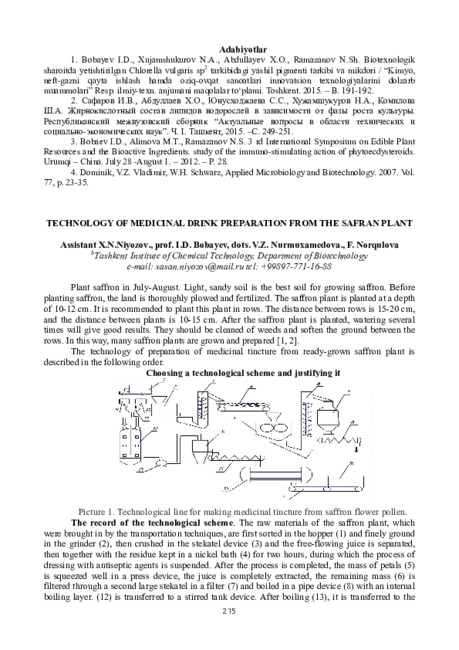
Technology of medicinal drink preparation from the safran plant
Plant saffron in July-August. Light, sandy soil is the best soil for growing saffron. Before planting saffron, the land is thoroughly plowed and fertilized. The saffron plant is planted at a depth of 10-12 cm. It is recommended to plant this plant in rows. The distance between rows is 15-20 cm, and the distance between plants is 10-15 cm. After the saffron plant is planted, watering several times will give good results. They should be cleaned of weeds and soften the ground between the rows. In this way, many saffron plants are grown and prepared [1, 2].

Technology of elixir with expectorant antiseptic property
Subjects of research: subjects of research are the medicinal plants: radix Althaeae, flores Chamomillae, flores Achilleae millefolium, herba equiseti, folia Juglantis rediae, folia Salviae, herba Taraxaci, aethanol and purified water.
Purpose of work: development of composition and technology of “Tonzilat” elixir. With expectorant, anti inflamatori, antiseptic action on the base of local raw materials. Conducting of its quality control, standardization, study of its stability and bioavailability.
Methods of research: spirituose extract was obtained by means of maceration-circulation method from medicinal plants; spirit consentration was determined by means Of method, density-by means of picnometer, pl l-by means of potentiometric method, refractometric parameter-by means of Abbe refractometer dry residue of elixir in accordance with XI edition of SPh USSR. Bioavailability of preparation was studied in “vivo” experiments. Identity and assay of elixir active substances was determined with CMS (Chromatomassspectrometry) THC, SPh methods; storage term of elixir was established with “native” method (in ordinary condition).
The results obtained and their novelty: Optimal composition and rational technology of “Tonzilat” elixir were developed on the base of conducted researches Bioavailability of “Tonzilat” elixir suggested was determined in “in vivo” experiments. Storage condititions and terms of “Tonzilat” elixir were established.
Practical value: Projects of laboratory regalement and TPP (TPA) for “Tonzilat” elixir were developed on the base of results of researches conducted
Degree of embed and economic efficiency: TPP (TPA) developed for “Tonzilat” medicinal elixir was introduced into projects of laboratory regalement. Technology of “Tonzilat” elixir successfully probed in LLC “Galenika”which gave an agreement for introduction of this preparation into industrial manufacture on its base.
Field of application: pharmaceutical industry, medicine.

TECHNOLOGICAL PROPERTIES OF RUBBER COMPOUNDS WHEN USING CARBON-CONTAINING MATERIALS AS FILLERS
Currently, the recycling of worn-out car tires is a serious problem. For example, world statistics on tire recycling showed the formation of more than 14.5 million tons of depreciated car tires per year. However, about 10% of used tires are recycled. Tire recycling by pyrolysis makes it possible to obtain fuels and lubricants, and the chamber residue represented by carbon often poses a threat to the environment as a pollutant. Therefore, the disposal of the resulting carbon black is a major problem. At the Navoi State University of Mining and Technology at the Department of Chemical Technology, the physico-mechanical properties of a carbon-saving material, which is a secondary raw material for the production of pyrolysis of worn tires, were analyzed, in turn, and the technological parameters of rubber mixtures based on SKI-3 and Nairit KR-50 rubbers were studied.

TEACHING THE TOPIC “OXIDATION-REDUCTION PROCESSES” IN NATURAL SCIENCES AT SCHOOL
Oxidation-reduction processes are phenomena that occur continuously in nature. As a result of these processes, organic substances are converted into inorganic ones. Energy exchange in living organisms, thermal phenomena in physics, and electrical processes in nature are also related to oxidation-reduction processes. The essence of these processes is that the oxidation state of the particles that make up the substance changes during chemical reactions. This topic is mainly studied in depth in chemistry. This article provides valuable information on teaching oxidation-reduction processes.

Synthesis, structure and using of monotype and mixed coordination compounds of calcium and magnesium sucsinate
The aim of the research work is concluded obtaining novel tupe of stimulants based on synthesis homogeneous and mixed ligand coordination compounds of calcium and magnesium sucsinate with organic ligands.
Scientific novelty of the research work is as follows:
there have been revealed the synthesis condition, structure and individuality of 61 homogeneous and mixed ligand coordination compounds of calcium and magnesium sucsinates;
there have been proved the coordination propecties of amide, acetic ligand fragments by adsorption of infrared spectroscopy and quantium chemical analysis, as well as it has been shown the structure of some types of compounds;
it was revealed that dependence of specificities of structure, property and composition of sucsinate groups in the compounds from nature of complex-former, organic ligand and coordination ability;
there have been revealed the factors determining particular coordination ability of amides, sucsinatic fragments;
there have been created the stimulants for acceleration of the growth and rising of agriculture crops;

Synthesis, structure and properties of complexes Ni (II) and Cu (II) on the basis of derivatives fluorinated β-diketones
The aim of research work is synthesis of fluorinated polydentant ligands and their complexes with ions of Ni(II) and Cu(II), and determination of structures and properties.
Scientific novelty of the research is as follows:
The new 27 organic ligands and 44 intercomplex compounds on their base were synthesized for the first time;
single crystals of 6 ligands and 4 complexes were grown, their molecular and crystal structures were determined;
method of synthesis of fluorinated P-diketones by Lil I was developed for the first time;
systematic data about regio-oriented reactions of fluorinated 1,3-diketones with acylhydrasines and structural factors for obtaining some individual regioisomers were determined;
it was determined that central ion of 3d-metals in chelat compounds and double deprotonated residues of ligands form five and six-membered metallocycles;
formation of a d-n-dative bound between d-electrons of nickel and cupper atoms with я-orbitals of a monodentant Py ligand was proved.
Synthesis, structure and biological activity of new derivatives of gossypol
The actuality and claiming of the theme of dissertation. Currently in the world selecting medical components from plants and getting a new medical components on their basis is 50-60%. Gossypol obtained from cotton can also be attributed to such medical drugs which efficiency of interferon inductors was shown at some viral diseases (ARVI, influenza, herpes virus infection, hepatitis and others).
Since the acquisition of independence of our republic large-scale activities on the creation of scientific research at a high level on the development of the creation of medicines on the basis of local raw materials and the supplying with quality drugs a pharmacy national market have been carried out and appropriate results have been achieved. It can be highlighted the drugs (mcgocin, ragocin, kagocel, gozalidon and etc.) obtained from gossypol derived from local raw materials against viral diseases.
Nowadays synthesizing new components of gossypol, identifying its biologic activity and creating drugs against diseases of immunity arc considered as the urgent tasks in the world. Moreover, preventing infectious pathology on the base of gossypol and synthesizing amino-compounds of alkaloids for producing drugs on carrying out research for producing therapeutic drugs, creating effective machinery in synthesizing herbal matters, identifying the construction, products and features of synthesized compounds with the help of modem physic-chemistry methods, decreased the poisonous effect with the help of modifying the gossypol with other various substances intensifying the activity against fungi and identifying the activity of gossypol products against dangerous swellings and others arc considered as the urgent tasks.
The research of this dissertation in a sense is devoted to fulfilling the tasks which were outlined in the decree of President of Uzbekistan Republic № 416 from 14.07.2006 «Objectives on supporting the manufacturers producing local medicine and medical equipment», and the decree № 1442 from 15.12.2010 «Prime ways on the development of manufacture of Uzbekistan Republic during 2011-2015 years», and in other documents concerning to this field.
The aim of research work is purposeful modification of gossypol molecules and its structural analogies, investigation of biological activity and determination of physic-chemical properties of synthesized compounds.
Scientific novelty of the research work is as follows:
formation of free radicals in cotton has been investigated and also more then 100 new azomcthinc derivatives of gossypol, 2-oxybcnzaldchyde, 2-oxynaphtaldchydc and pyrridoxalc and also compounds containing hydrazine like pharmakophiric group (derivatives of ephedrine, salsolinc, carbazol and diphcnylaminc) have been synthesized;
anti-virus activity of new derivatives of gossypol against virus stomatite (VVS) was shown and at this height antivirus active for thrcptophanc compounds was determined and also compounds possessing by high biological activity again bacterium's - E.coli, St.aureus, X.malvasearum, B.subtilis and some others has been determined;
supramolecular and metal- complexes (on the base of salts containing ions of metals Cu2+, Ni2+) of Schiff bases of gossypol have been obtained. On the base of investigation of UV-, IR-, PMR- and mass-spectrums of obtained compounds their structure was confirmed;
diaminogossypol was synthesized by two methods; on its base were obtained Schiff bases with aldehydes of different nature; with using of gaunt-chemical calculations, their molecular-dynamical constants and electronical structure were determined;
it proved greater intcrfcron-inducing activity of supramolecular complexes mcgosin and tagosin with MASGA relatively gossypol, mcgosin and tagosin;
HPLC method was developed to identify, and quantify the separation of content and mcgosin MASGA in mcgafcrone defined supramolecular complex composition and the degree mcgafcron crystallinity substances.
CONCLUSION
On the basis of conducted research for his doctoral thesis on «Synthesis, structure and biological activity of novel derivatives of gossypol» presented the following conclusions:
1. The studies synthesized new azomethine derivatives of gossypol, 2-hydroxybcnzaldehyde, 2-oksinaftaldcgida and pyridoxal, diaminogossipol and on its basis a new Schiff base, this will in the long term for drugs based on local raw materials.
2. Revealed that the composition of cotton, in various conditions free radicals arc formed, it is proved that the formation of free radicals occurs at temperatures above 30°C due to the decomposition of dissolved O2 in lipid complexes, in the future it will serve to improve the development of new drugs have representatives have fungicidal properties the importance of agriculture.
3. A systematic analysis of activity against bacteria and fungi (E.soli, St.aurcus, V.dahliae, F.ohusrorum, R.solani, X.malvascarum, S.cerevisiae, C.scotti, C. albicans and B. subtilis ) synthesized compounds, the results obtained will hereinafter important when developing new drugs having antibiotic properties.
4. Installed Activity supramolecular complexes mcgosin and tagosin with MASGA to peritoneal fluids number of macrophage cells, it gives the opportunity to create products with higher interferon inducers based mcgafcron.
5. Biological activity of some derivatives gossypol PASS calculated by the program, and the data obtained showed identical results with the experimental methods of performing various pre calculation using computer programs subsequently result in savings of expensive reagents.
6. With the help of special programs of computer package designed power growth dynamics of the formation of the synthesized complexes with the growing number of GA molecules, low probability of consolidation of clusters, it is predicted that, in real systems the number of GA associates can make n = 2-4.
7. The crystal structure was studied clathrates gossypols Schiff bases with o-toluidinc and p-xylidine, it was found that the reaction of 1,4-dioxanc with Schiff bases molecules occurs by hydrogen bonds, these data allow to obtain different clathrates using various solvents.
8. For the first time developed a method of identifying and separating mcgosinc and MASGA in mcgafcronc by HPLC. Quantitative data processed by statistical methods. The data in the future will serve to study the quantitative composition of supramolecular drugs.

Synthesis, investigation of physical-chemical properties and application fields of carboxylcontaining polymers
The aim of the study is a targeted synthesis of soluble and water-insoluble polymers having carboxyl groups in the structure, establishing their physicochemical, medical-biological properties and processes of interaction with low-molecular compounds, and the obtaining of an antiprotozoal preparation on their basis.
The scientific novelty of the research is as follows:
for the first time the complexes of PMAC and imidocarb-dipropionate of 3,3-bis (2-imidazolinyl-2) -carbanilide were synthesized;
for the first time, the possibility of a first-order phase transition of PMAC macromolecules in the form of polymer complexes in the interaction of highly concentrated solutions of PMAC and imidocarb was established;
the preservation of the chemical structure of the imidocarb by means of cooperative binding during its immobilization at PMAC has been demonstrated;
for the first time on the basis of polymeric complexes PMAC and imidocarb developed a little toxic and prolonged antiprotozoal dosage form;
for the first time, granular sorbents were obtained by modification of PVC amino-acetic, aminocaproic, o-, m-, p-aminobenzoic acids;
the effect of the steric effect of neighboring functional groups, besides the basicity of the amino group, on the modification of PVC by amino acids, has been proved;
the regression equations for the reactions of modifications of PVC with aminoacid and m-aminobenzoic acid have been calculated;
the strong influence of the solvent on the process of modification of PVC by amino acids and the amorphous structure of the obtained samples were established.
Synthesis, development of technology for obtaining of biologically active compounds on the basis of aromatic keto- and carboxylic acids
Topicality and demand of the subject of dissertation. As a result of consecutive realization of the program of priority development of the industry accepted in the Republic for 2011-2015 and branch programs on modernization, technical and technological updating of production in the structure of industry the processing sectors play more important role, manufacturing competitive productions with high additional costs.
Thus, the special attention is given to the problem of localization, creation and introduction of the new biologically active compounds used in various areas of the national economy that leads to an import substitution and saving of currency resources.
Along with increase in volume of manufacturing chemical products the important task of the further expansion of their assortment and improvement of quality has been put.
The main role in this aspect belongs to direct searches of new valuable substances, more effective methods and processes of synthesis and division of products, and the ways of radical improvement of existing manufactures.
There is a tendency to creation of the processes using cheaper local raw materials at the minimal expenses of the other reagents.
Development of new technology more and more is based on its scientific evidence, including knowledge of the mechanism and physical and chemical laws of the process. Greater reserves in increase of the production efficiency are available in the field of improvement of the operating enterprises with a choice of the best parameters of the process, modernization of technological schemes and the equipment, and qualified use of by-products and production wastes. In the conditions of an economic reform being carried out in our Republic the set of all these factors gets special importance for the further development of the organic synthesis industry.
Aromatic keto- and carboxylic acids represent special interest for the synthesis of potential medical products, plant growth stimulants, plasticizers, synthetic lubricant oils, dyes in the development of our industry due to the presence of highly reactive carbonyl (C=O) and carboxyl (COOH) groups in their structures.
According to the President of the Republic Uzbekistan Decrees N272 issued on January 31, 2006 «About measures on improvement of plans of agricultural plants protection and the system of measures on supplying with chemical preparations», N731 from November 19, 2007 «About the program of modernization, technical and technological reequipment of the pharmaceutical plants for the period till 2011», and N1442 from December 15, 2010 «About priorities of development of the industry of the Republic of Uzbekistan in 2011-2015» development to biological active compounds and their application into industry.
On the basis of carried out works on the synthesis of aromatic кето- and carboxylic acids the conditions of the synthesis of substances with various functional groups, having a wide spectrum of biological actions will be developed.
In this connection creation of scientific bases for obtaining of aromatic keto- and carboxylic acids by oxidation of aromatic hydrocarbons and the solution of the problems related to the synthesis of biologically active substances on their basis is the actual task representing both theoretical and practical value.
The substances with high plant growth stimulating effect that increase the productivity of plants and anti-inflammatory activity on living organisms with little harmful actions found as a result of researches carried out in last years on the synthesis of aromatic keto- and carboxylic acids shows the urgency of the chosen theme.
The collected data on the synthesis of new aromatic кето- and carboxylic acids, their derivatives, physico-chemical and biological properties, and also the results of implementation of new preparations into manufacture can be effectively used in this area of the research.
Purpose of research is development of theoretical and practical bases of synthesis of aromatic keto- and carboxylic acids by oxidation of alkylbenzenes and solving practical problems related to the synthesis, and application of biologically active substances on their basis.
Scientific novelty of disscrtational research consists in the following:
by oxidation of 1.3- and 1,4-diethylbenzenes and methylethylbenzenes with the solution of potassium permanganate was found the optimum conditions, allowing to obtain the maximum output of 1,3- and 1,4-benzenemono-ketodicarboxylic and also 1,3- and 1,4-benzenediketodicarboxylic acids, and from the obtained reaction mixture the indicated acids were isolated in individual state for the first time;
carbonyl group derivatives - phenylhydrazones, semicarbazones, thiosemicarbazones, quinoxalones, and disulfide derivatives as well as carboxyl group derivatives - ethers, salts (altogether 45 compounds) were synthesized on the basis of 1,3- and 1,4-benzenemonoketodicarboxylic, and 1,3- and 1,4-benzenediketodicarboxylic acids;
structural, stability and reactivity features of the synthesized compounds with their pharmacological and growth-stimulant activities were investigated;
for the first time, on the basis of 1,3- and 1,4-benzeneketodicarboxylic acids mixtures growth stimulant preparations of ketostim and ketostim-K. were synthesized;
etherification process of 2,4-dichlorobenzoic acid with 2-butynediol-l,4 and the condensation of obtained l,4-bis-(2,4-dichlorobenzoyloxy)-butyne-2 with phenylazide have been investigated. In etherification stage of 2,4-dichlorobenzoic acid with 2-butynediol-l,4 along with bis-ether (l,4-bis-(2,4-dichlorobenzoyloxy)-butyne-2) a mono-ether (2,4-dichlorobenzoyloxybutyne-2-ol-4) was also found to be formed. Separation and purification methods of obtained mono- and bis-ethers have been developed. l-phenyl-4,5-bis-(2,4-dichlorobenzoyloxymethyl)-1,2,3-triazol (dichlotazol preparation) was synthesized by condensation from the obtained bis-ether with phenylazide, and l-phenyl-4-(2,4-dichlorobenzoyloxy-methyl)-5-carbinol-l,2,3-triazol (monochlotazol preparation) from mono-ether, which showed high anti-inflammatory activity;
from them, a substance of a dichlotazol preparation and its medicinal form in 3% ointment was recommended for the treatment of an inflammation of genitals in medicine and the technologies of their obtaining were developed.
CONCLUSION
1. As a result of oxidation research of 1,3- and 1,4-diethylbenzenes and their mixture, 1,3- and 1,4-methylethylbenzenes, 1,2,3,5-and 1,2,4,5-tetraethylbenzenes by potassium permanganate solutions in an alkaline medium were revealed regularity of the process depending on temperature, concentration of an oxidizer, duration on a final yield of benzeneketocarboxylic acids.
2. It was found that oxidation of diethylbenzenes to benzenedicarboxylic acids goes through the formation of benzenediketodicarboxylic and benzenemonoketodicarboxylic acids. In case of oxidation of tetraethylbenzenes the mixture of benzenetetraketotetracarboxylic, benzenetriketotetracarboxylic, benzenediketotetracarboxylic, benzenemonoketotetracarboxylic and benzenetetracarboxylic acids are formed.
3. Methods of separation of the mixture of benzeneketodicarboxylic acids were developed and the individual isomers of 1,3- and 1,4-benzenemonoketodicarboxylic, 1,3- and 1,4-benzenediketodicarboxylic acids were isolated for the first time from the products of dialkilbenzenes oxidation. Physical and chemical properties of the isolated compounds have been determined.
4. Kinetics of decomposition of benzenediketodicarboxylic and benzenemonoketodicarboxylic acids in nitrogen and oxygen current has been investigated and on the basis of comparison of these reactions rate constants the scheme of behavior of oxidation reaction of diethylbenzenes has been proposed.
5. 45 derivatives of 1,3- and 1,4-benzenediketodicarboxylic and 1,3- and 1.4-benzenemonoketodicarboxylic acids have been synthesized for the first lime and their structures have been elucidated using the modem physical and chemical methods of investigations (1R-, NMR, mass-spectroscopy and X-ray analysis)
6. Among the synthesized compounds were found substances possessing anti-inflammatory, antimicrobial and growth stimulant properties and the interrelations of these activities with their structures have been specified.
7. Preparation of Ketostim, an effective growth stimulant of cotton, allowing to increase productivity of a raw-cotton by 10-15% was synthesized on the basis of the mixture of benzeneketodicarboxylic acids. Economic effect from the usage of Ketostim preparation in cotton-growing makes 150-250 thousand sums per hectare.
8. The technology for the production of Ketostim preparation has been developed and created an experimental-industrial installation in the experimental plant of UzCPRl and all the necessary reference documents have been made. Ketostim preparation has passed the State tests and by the Decision of the Presidium of the State Chemistry Committee of RUz it has been included into the list of licensed preparations for use as a biostimulant in presowing treatment of cotton seeds.
9. Optimum conditions for carrying out of the process of etherification of
2.4- dichlorobenzoic acid with 2-butynediol-l,4 depending on a ratio of the catalyst, solvent and duration of reaction have been found. It has been shown that
2.4- dichlorobenzoyloxybutyne-2-ol-4 has also been formed alongside with 1,4-bis-(2,4-dichlorobenzoyloxy)-butyne-2. The methods of isolation of l,4-bis-(2,4-dichlorobenzoyloxy)-butyne-2 from the mixture of ethers have been developed. The process of 1,3-dipolar cyclocombination of phenylazide with l,4-bis-(2,4-dichlorobenzoyloxy)-butyne-2 has been investigated and the optimum conditions of reaction behavior with the formation of l-phenyl-4,5-bis-(2,4-dichlorobenzoyloxymethyl)-l,2,3-triazol (dichlotazol), with an output of 85.5 % have been found and on the basis of the carried out investigations the experimental-industrial technological regulations have been compiled.
10. Drug forms of an anti-inflammatory dichlotazol preparation in the form of 3% ointment and tablets in 0.025 g have been developed and the experimental-industrial technological regulation and TPA for the production of ointment have been made. On the basis of the carried out clinical investigations the dichlotazol preparation in the form of 3% ointment was permitted by the Quality Control Bureau of Medicinal Drugs and Medical Techniques (QCBMD and MT) of the MH RUz for medical application as an anti-inflammatory drug for use in the gynecologic practice.

SYNTHESIS OF TRANSPARENT-COLORLESS GLASS AND THEIR DIFFERENTIAL THERMAL ANALYSIS (DTT)
The chemical composition of the PbO-SiO2 based glass resin was analyzed using physico-chemical and differential thermal analysis methods. Experimental work on researching physico-chemical properties and determining the possibilities of obtaining transparent glass based on them was carried out using traditional methods of physico-chemical and glass technology. It has been experimentally proven that 70%PbO+30%SiO2 and 80%PbO+20%SiO2 are the optimal compositions for obtaining transparent glasses based on the PbO-SiO2 system. Based on the obtained glass mixture of such optimal composition, it is possible to obtain transparent glass that can be fired at low temperatures, and it has been found that the glass with a PbO content of 70-80% has a high refractive index.

Synthesis of some derivatives of ferrocene carboxylic acid and their classification
The aim of the research work is to improve the synthesis of certain biologically active derivatives of ferrocenecarboxylic acid and classify them on the basis of the chemical composition of the preparation of acetylferrocene and ferrocenic acid.
The scientific novelty of the research work is as follows:
the method of obtaining acetylferrocene;
a new method for the production of ferrocenecarboxylic acid;
the formation of l'-(p-hydroxyphenyl) ferrocenecarboxylic acid in the diazotization reaction of ferrocenecarboxylic acid was first established;
new biologically active compounds based on ferrocenecarboxylic acid and water-soluble aromatic acids of ferrocene have been synthesized and a positive effect on the germination and energy of germination of cotton seeds has been established.

Synthesis of nitrogen-, phosphorus-, oxygen-containing ligands and their coordination compounds with some d-metals
The aim of research work is synthesis of nitrogen-, phosphorus-, oxygencontaining complex-forming polyfunctional polymer ligands, obtaining of complex compounds of some d-metals on their basis by sorption method and study the composition, structure and properties of the obtained compounds.
The scientific novelty is as follows:
for the first time synthesized new nitrogen-, oxygen-, phosphorus-containing complexing polyfunctional polymeric ligands - poly-2-oxo-l,3-di (hydrazinomethyl) -5-N-hydroxymethylaminocarbonyl-l,3,5-triazine (L1); poly-2-oxo-l,3-di (phosphonoxymethyl) -5-N-methylaminocarbonyl-l,3,5-triazine (L2); poly-di (3-aza-5,6-dioxohexyl) -dithiophosphate potassium (L3) and poly-di (3-azabutyl) -dithiophosphate potassium (L4);
the electronic structures of molecules of polydentate polymer ligands were calculated by semiempirical quantum-chemical methods AM-1, MNDO and PM3, their geometric parameters and energy characteristics were determined, and the most probable centers for localization of the coordination bond were identified based on charge control.
static exchange capacities of synthesized polymer ligands for Си (II), Zn (II), Cd (II) and Ag (I) ions were determined and a number of sorptivity of these metals with the resulting ligands was constructed;
16 new coordinated compounds Си (II), Zn (II), Cd (II), Ag (I) were first obtained chelate type with synthesized polymeric ligands; their composition and structure were determined using modern physicochemical methods of analysis;
determined constant stability and revealed the series of thermal stability of the obtained complex compounds, it is proved that the stability of complexes grows in the series L1—>L2—>L4->L3 and Zn (II)—>Cd (II)—>Cu (II)—>Ag (I) in accordance with the Pearson’s principle of «Hard and soft acids and bases».

Synthesis of isoquinoline alkaloids and their analogues based on some carbonic acids
The aim of research work to develop methods for the synthesis of new mono- and bis- molecular tetrahydroisoquinolines, as well as to determine the physicochemical properties.
The objects of the research work are homoveratrilamine, organic acids, selected substituted tetrahydroisoquinolines and their new derivatives, obtained using the developed methods.
The scientific novelty of the study is as follows:
new method has been developed for obtaining mono- and bis-derivatives of substituted 1,2,3,4-tetrahydroisoquinolines based on homoveratrilamine and a number of acids, including the targeted synthesis of new biologically active compounds:
the synthesis of 32 new derivatives based on the interaction of homoveratrilamine with a number of mono-basic acids (С7 0-С22Л, Cisi Л9 cis and trans fatty acids, 3-indolylacetic, glycolic acid, and o-, m-, p- pyridinic acids) had been done for the first time;
it was found the reaction with glycolic acid proceeds with the formation of an unusual tricyclic product, aziridine-borane;
it has been proved that the Mannich and Craig reactions of 6,7-dimethoxy-l-(lH-indol-3-yl) -1,2,3,4-tetrahydroisoquinoline with formalin yield one five-cyclic derivative;
the synthesis of the bis- isoquinoline derivative based on natural and anthropic acid was first carried out and new methods for the synthesis of the alkaloid co-rydaldin were found;
Implementation of the research results: On the basis of scientific results obtained on the synthesis of isoquinoline alkaloids and their analogues based on certain carboxylic acids:
the crystalline structure of the synthesized 2,3-dimethoxy-5,6,7,8,13,13a-hexahydro-6a,8-diazoindeno[2,l-b]phenanthrene and introduced into the International Cambridge Center for Structural Data (Cambridge Crystallographic Data Center reference No. 1412105 of January 11, 2017). Scientific results allow synthesizing new substances that are part isoquinoline classes;
crystalline structures of N, N' - (3,4-dimethoxy-P-phenylethyl) diamide oxalic acid and 6,7-dimethoxy-l,3,4,8b-tetrahydroazirin[2,la]isoquinoline-N-borane, on the basis of the condensation and cyclization reaction of glycolic acid and homoveratrilamine, are introduced into the Cambridge Crystallographic Data Center international reference No. 1014600 and 1014601 of 11 January 2017. Scientific results allow to synthesize purposefully new substances with different properties;
a methodology for the synthesis of isoquinoline alkaloids and their analogues in the JSC Kokand superphosphate plant (reference 03-231 of February 22, 2017). The developed method allows the synthesis of new compounds based on mono-and bis-molecular tetrahydroisoquinoline.
The structure and volume of the thesis. The structure of the dissertation consists of an introduction, three chapters, conclusion, a list of references and an appendix. The volume of the dissertation is 110 pages of computer text.

Synthesis of HighTemperature Superconducting Ceramics on the Basis of the System Bi2O3-PbO-SrO-CaOCuO with Utilize of Concentrated Solar Energy and Research of Properties
Inquiry of the Subject: Precursors Nominal Structures Bi, 7Pbo3Sr2Can.iCunOy (n = 2-5) on the Basis of the System Bi2O3-PbO-SrO-CaO-CuO. Superconducting Ceramics on the Base of the System Bi2O3-PbO-SrO-CaO-CuO.
Aim of the Inquiry: the purpose of the given work was research of the mechanism of formation and properties of high-temperature superconducting materials and ceramics on the basis of the system Bi2O3-PbO-SrO-CaO-CuO, synthesized under the influence of a sunlight. Interrelation revealing between reception conditions precursors, the mechanism of formation of superconducting phases, and critical properties of the high-temperature superconducting ceramics.
Method of Inquiry: the rentgenophases analysis, the electron-microscopic analysis, DTA, a method of hydrostatic weighing, micro hardness, temperature dependences of a magnetic susceptibility, the magnetic moment and electro resistance.
The Achieved Results and Their Novelty: for the first time it was synthesised with utilize of the concentrated solar energy superconducting connection gomologics of some Bii 7Pbo 3Sr2Can.iCunOy(n = 2-5) and were investigated their mechanism of formation. And it is established that Increase of speed of interphase reactions turned out to be connected with a metastable initial condition. It is introduced corrective amendments in a structure of the private system Bi2O3-PbO-SrO-CaO-CuO, connected with incongruent character of formation of the phases 2234 and 2245. For the first time they were revealed steady (more than 7 years) new superconducting phases from the Hardware in an interval 110-150 K. It is established that the reason of their formation turned out to be formation of periodic defects in CuO2-planes in a direction [110].
Practical Value: can be used for synthesis of superconducting phases with the set temperatures of superconducting transition in an interval 95-150 К at Bij jPbojS^Can. iCunOy (n = 2-5). The developed method of reception of superconducting ceramics on the base of connections Bii ^Pbo sSbCan-iCunOy (n = 2-5) with Tc= 110-150 К can be the basis for creation of new technologies of reception of materials with special electric properties. The developed method is the contribution to development of power saving up technologies.
Degree of Application and Economical Efficiency: the gotten results are plugged in a database on inorganic connections “The American Mineralogist crystal structure database”.
Sphere of Usage: electronics, power.

