

18
Volume 5, Issue 10: Special Issue
(EJAR)
ISSN: 2181-2020
MPHAPP
THE 6TH INTERNATIONAL SCIENTIFIC AND PRACTICAL
CONFERENCE
“
MODERN PHARMACEUTICS: ACTUAL
PROBLEMS AND PROSPECTS
”
TASHKENT, OCTOBER 17, 2025
in-academy.uz
MATHEMATICAL MODELING OF THE SPREAD OF THE EPIDEMIC
Ochilova A.Yo.
Tashkent Pharmaceutical Institute, Tashkent city, Republic of Uzbekistan
https://doi.org/10.5281/zenodo.17310525
Relevance:
studying the spread limit of the epidemic through the Kermak-McKendrick model
and studying the mathematical expression of the breeding trend.
The purpose of the study:
to study the limits of the spread of the epidemic based on the
Kermak-McKendrick model.
Methods and techniques:
mathematical analysis and modeling methods were used in the
research process. In describing the epidemiological process, the Kermack-McKendrick model was
taken as a basis. The population was divided into three groups - the healthy, infected and those who
recovered from the disease (isolated) - and their processes of mutual transition were expressed using
equations
Results:
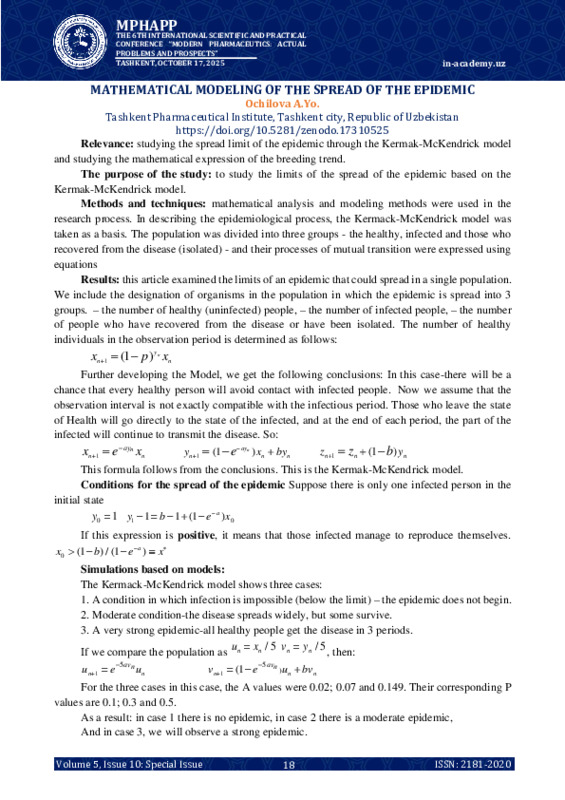
this article examined the limits of an epidemic that could spread in a single population.
We include the designation of organisms in the population in which the epidemic is spread into 3
groups. – the number of healthy (uninfected) people, – the number of infected people, – the number
of people who have recovered from the disease or have been isolated. The number of healthy
individuals in the observation period is determined as follows:
1
(1
)
n
n
n
y
x
p
x
+
= −
Further developing the Model, we get the following conclusions: In this case-there will be a
chance that every healthy person will avoid contact with infected people. Now we assume that the
observation interval is not exactly compatible with the infectious period. Those who leave the state
of Health will go directly to the state of the infected, and at the end of each period, the part of the
infected will continue to transmit the disease. So:
1
n
n
n
ay
x
e
x
+
−
=
1
(1
)
n
n
ay
n
n
y
x
by
e
−
+
+
= −
1
(1
)
n
n
n
z
y
z
b
+
+
=
−
This formula follows from the conclusions. This is the Kermak-McKendrick model.
Conditions for the spread of the epidemic
Suppose there is only one infected person in the
initial state
0
1
y
=
1
0
1
1 (1
)
a
y
b
e
x
−
− = − + −
If this expression is
positive
, it means that those infected manage to reproduce themselves.
0
(1
) / (1
)
a
x
b
e
x
−
−
−
Simulations based on models:
The Kermack-McKendrick model shows three cases:
1. A condition in which infection is impossible (below the limit) – the epidemic does not begin.
2. Moderate condition-the disease spreads widely, but some survive.
3. A very strong epidemic-all healthy people get the disease in 3 periods.
If we compare the population as
/ 5
n
n
u
x
=
/ 5
n
n
v
y
=
, then:
1
5
n
n
avn
u
e
u
+
−
=
1
5
)
(1
n
n
n
avn
v
e
u
bv
+
−
= −
+
For the three cases in this case, the A values were 0.02; 0.07 and 0.149. Their corresponding P
values are 0.1; 0.3 and 0.5.
As a result: in case 1 there is no epidemic, in case 2 there is a moderate epidemic,
And in case 3, we will observe a strong epidemic.

19
Volume 5, Issue 10: Special Issue
(EJAR)
ISSN: 2181-2020
MPHAPP
THE 6TH INTERNATIONAL SCIENTIFIC AND PRACTICAL
CONFERENCE
“
MODERN PHARMACEUTICS: ACTUAL
PROBLEMS AND PROSPECTS
”
TASHKENT, OCTOBER 17, 2025
in-academy.uz
Conclusions:
mathematical models are important in the study of epidemics. Through them, it
is possible to predict the spread of the disease, develop effective measures against it. The kermack-
McKendrick model is a basic model widely used in the analysis of the dynamics of infectious
diseases.






