All articles
The state of absorption of new terms in the Persian language into the literary language
The article investigates the new terms of “Academy of Persian Language and Literature” and an analysis of their appling in transport terminology. Conclusion had been given doublets of transport terms in Persian language and their using form in the terminology.
The spiritual grounds of the democratic direction
Uzbekistan celebrated 15 years of joining to the Shanhai Cooperation Organization in 2016 year. The summit was held in Tashkent at this year. On account of these historical and political facts this article will highlight some Chinese political culture.
The skill of creating a plot in Rahnavard zaryob stories
The significance of the historical and cultural heritage of the era of Amir Temur and the Temurids in the history of the Republic of Uzbekistan and world history
The article considers the possibilities of systems analysis in the solution of problems of increasing integrity system named “The importance of historical and cultural heritage of the epoch of Amir Temur and Temurids in the history of Uzbekistan and world history”. The working model is chosen for the systematic analysis
The Shanghai Cooperation Organization is the main factor in Pakistan's regional policy
The article discusses the participation of the Islamic Republic of Pakistan in the Shanghai Cooperation Organization (SCO) and the influence of the organization as the main factor of regional cooperation in today's context. Today Pakistan considers membership in the SCO as a cornerstone of its regional policy. Participation in the Shanghai organization allows Islamabad to strengthen its international position, facilitate the realization of geostrategic and geo-economic potential, develop relations with the Russian Federation, People's Republic of China, Central Asian countries, strengthen its positions in the field of regional security, and also “restrain” its traditional opponent – India. The effectiveness of the Shanghai organization in a new format is studied. The expansion of the SCO through the accession of Pakistan and India has turned the organization into one of the main instruments of multilateral cooperation. It began to be perceived as the Asian counterpart of the G7 group, which could become a new center of power of global importance. Pakistan and India have changed the balance of power within the organization, and the contradictions between Islamabad and Delhi, as well as between Delhi and Beijing, may reduce the effectiveness of the Shanghai organization in a new format. Finally, the article discusses promising areas of cooperation between Pakistan and the member states of the Shanghai Cooperation Organization. Islamabad is counting on strengthening cooperation with the countries of the Shanghai organization, enhancing the effectiveness of a regional approach to the problems of terrorism and extremism, making its contribution to regional development, security and stability, and informing about its point of view on regional issues. Islamabad is counting also on more active involvement of the Shanghai organization in resolving the problem in Afghanistan with the participation of Russia, China and the states of Central Asia. In economic terms, for Pakistan the Shanghai Organization is the main platform for promoting its interests in the energy and transport and communications sectors. Among its most important goals in the Shanghai Cooperation Organization, Islamabad considers gaining access to the energy resources of Central Asian countries for consumption and transit, as well as providing the Shanghai Organization with its territory for access to the World Ocean, the Middle East, and South and Southeast Asia.
The Secularization Process: History and Interpretation
In the modern world, the principles of secular society dominate, on the one hand, and on the other, the process of the initial revival of religious consciousness, one of the ancient sources of popular culture. That is why religion has become a social institution on the agenda of many issues related to the role and status of modern society. Issues such as secularism, which implies the free, independent and independent activity of the spheres of public life. In this sense, this article is devoted to the analysis of this complex and controversial social process and its relevance. In the article, the term “secularization” occurs in terms of history and logic: the linguistic meaning of a word, its comparative and critical analysis of its definitions by various authors. At the same time, the objective and subjective factors behind the secularization process were uncovered. Specific examples of the sociocultural life of the West and the East are studied in detail and the content of the term "secularization" is defined. Particular attention is paid to the analysis of the views of modern philosophers on this issue, the analysis of theoretical views proposed by various academic schools. General and specific aspects of the description and approach are highlighted, the author’s own views on them are described and definitions of the concept of “secularization” are developed. Based on recent studies, general theoretical conclusions are given. As it is known, the secularization paradigms in the modern world are gradually changing. In this sense, secularization is not a feature of all societies. It should be noted that in the process of change, religious issues are at the center of public debate and, in some cases, at the center of controversy. However, secularization remains the core of the modern world, although religion is likely to occupy a huge space. Based on the above analysis, we can say that the processes of secularization are not based on a specific standard in different societies, and in each society there is a certain limit. Based on historical analysis, modern definition and description, secularization is a complex social process associated with the role of religion in society, and can be replaced by changing the order of religious traditions based on rational principles based on the principle of secularism.
The secret of Amir Temur's ring
The science of hadith and the activity of scholars in Shosh in the Middle Ages
This article reveals new informations about such muhaddithes of Shash oasis as Imam Abdullah ibn Avana Shashi, Abu Sa’id Isa ibn Selim Shashi, Abu Muhammad Ja’far ibn Shu’ayb Shashi, Abu Is’hak Ibrahim ibn Huzeym Shashi, Abu Ali Hasan ibn Sahib ibn Hamid hafiz Shashi and e.t.c.
The role of Walid Ikhlasi in Syrian literature
The role of the PRC in the stability of socio-political processes in the states of Central Asia
This article is devoted to some features of the foreign policy of the People’s Republic of China on ensuring the stability of social and political processes in the states of Central Asia and promoting economic prosperity of the region. In particular, the essence of the Belt and Road Initiative, aimed at the consistent development of constructive, good-neighborly relations between China and the Central Asian states, as well as raising them to a new level by increasing the region’s potential, is revealed.
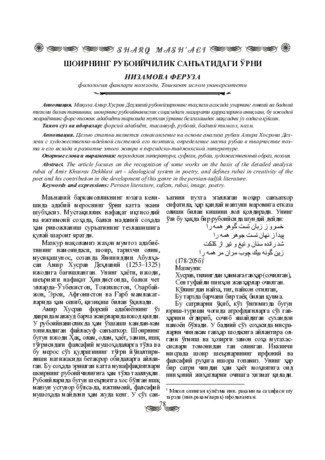
The role of the poet in the art of writing
The role of the affix "zú zú" in the formation of modern Chinese neologisms
The article is devoted to the study of the method of word formation in modern Chinese using the «族zú» affix. It is known that the lexical stock of a language is constantly replenished due to the internal capabilities of the language and extracted from a foreign language. Of course, Chinese is no exception. Which method is the most effective for a language, depends on a number of features of the language. In Chinese, affixing is the second most productive after word addition. Like the vocabulary of a language, its morphemic units are constantly replenished. In addition to the trend observed in world linguistics, the affix method is becoming more and more active in word formation in the Chinese language, therefore the number of affix units in the language is also increasing. One of the affixes that plays an important role in the construction of modern Chinese neologisms is 族 zú, which participates in the construction of a number of new words in the Chinese language. Most of these words refer to a noun and serve to denote a social group that has a specific character. Words formed with the participation of 族 zú are more involved in the formation of words that are applied to a specific group of people in accordance with their social status or role in social life. But, in our opinion, 族 zú is not a full affix unit, but a semi-affix. Therefore, when words are formed with the participation of, zú, it does not completely lose its original meaning, the meaning of a group or community. Like the vocabulary of a language, its morphemic units are constantly replenished. In addition to the trend observed in world linguistics, the method of affixation in the Chinese language is becoming more and more active in word formation, therefore the number of affix units present in the language is also increasing.
The role of technopolises in the development of innovative activities in Japan
This article analyzes the strategy of Japan to develop an innovative economy in the country by creating technopolises. Object of the article - Japanese technopolises The subject of the article is the experience of Japan in the development and organization of a technopolis in the development of an innovative economy. The aim of the article is to study the system of organization of Japan’s technopolis, create conditions for scientific research and industrial application of the results of scientific research by technopolis clusters.
Scientific results of the article:
- The role of Japan in global innovation indicators and the nature of innovation policy are shown;
- substantiates the essence of the Japanese strategic program "Technopolis-90";
- The activity of Japanese technopolises is explained on the example of the technopolis Tsukuba.
The role of Tashkent in foreign trade relations in the second half of the 19th century (as an example of archival documents)
This article is devoted to highlighting the place of the city of Tashkent in foreign trade relations in the second half of the 19th century based on materials from the archive. For this purpose, information about the importance of internal and external trade of the city of Tashkent is analyzed, the list of goods sent to domestic and foreign trade, the cost of goods, the number of goods, duties levied on these goods using the example of documents stored in the National Archives of Uzbekistan. It is known that the city of Tashkent has become one of the special links in the active trade center of the Great Silk Road since ancient times. Tashkent was a special city leading caravan trade besides with the regions of cattle-breeding nomads of Eurasia, intensively conducted trade and economic relations with the khanates of Central Asia, as well as with close and distant foreign countries, including China, the European and Siberian parts of Russia, East Turkestan, Semirechye. Craftsmen who lived in specialized makhallas, depending on their occupation for the production of certain goods, played an important role in the trade relations of the city of Tashkent. Therefore, the Tashkent residents, depending on their occupation, were called mahallas with the same names. For example, "pichakchi" - knife makers, "misgarlik" - copper casting, "sagban" - psari, "ukchi" - arrows, "konchi" - tanners, "degrizon" - boiler makers, "egarchi" - saddle makers, etc. .d. During the period under review, the bulk of Tashkent residents lived in country estates. For example, residents of the Sebzor mahalla lived in Yunusabad, Khasanbai, Kokterak, residents of the Shaikhantakhur mahalla lived in Kokche, as well as in the direction of Salar-Karasu, Beshagach residents lived in the Chopanata-Kani-Dombirabad quarters, etc. and were engaged in gardening and brought the essential fruits to foreign trade. Rabats located around the city of Tashkent played a special role in carrying out the order of foreign trade operations, in solving the problems that arose in the collection of duties and heraj. Merchants from other countries stopped in caravanserais and their goods were stored in them, and wholesale trade was also carried out here. This is considered as proof that foreign trade played a special place in the economic life of the city of Tashkent. The article analyzes information about the number of caravans, the value of goods exported abroad, their quantity, transportation of goods, information about customs duties.
The role of similes in creating a linguistic landscape of the world
In this paper paper it is carried out comparative researches on one of the units of the Ethnolinguistics – comparison (as a method of analogy drawing in literature) etalons (standarts) which reflects itself national thought of peoples’, thier world outlook and mentality.
The Role of Saudi Women Writers in the Development of the Novel Genre
The article discusses the development of female creativity in the Saudi literature and provides an overview of the works of the most famous Saudi women writers nowadays. The central place in the works of Saudi writers takes the problem of the “women’s issues”, which is common for general Arabic literature as a whole at the stage of its formation, but which has its own peculiarities in Saudi literature, related to the preservation of the predominant role of men in matters of family and marriage.
The role of religious scholars in the domestic and foreign policy of the Islamic Republic of Iran
The paper investigates the role of Islam in the social and political life of Iran after Islamic revolution and over the monarchy. The Islam influenced in the political and ideological spheres, when Shia clergy came to power. Where was at the head Imam Khumeyni worked contrary to former regime in the home and foreign policy. This is forced the some countries to revise the foreign policy about of IRI.
The role of pre-Islamic beliefs in the formation of the local form of Islam in Central Asia
The article is devoted to the local form of Islam in Central Asia, which formed as a result of a symbiosis of pre-Islamic religious teachings and orthodox Islam. There are considered the penetration and syncretism of Islam in the region. There are also forms of shamanistic and Tengri’s vestiges which were shown in detail after it’s surviving in the form of folk rituals and rituals are.
The role of Mulla Ghavvasi and Mulla Wajahi's poetry in Dakhini literature
The article is about the creativity of poets who lived in Golkonda in the 17th century during the reign of the Kutubshah dynasty, such as Mulla Gavasi and about his book Sharkhi Margub al-Kulub and Shahadat al-hakika, Mulla Vajahi, about his masnavi "Irshadnama”.
The role of moral values in Mahmoud Zamakhshari's spiritual heritage
This article analyzes ethical views of the great scientist, thinker Mahmud Zamakhshari through studying various stories, narratives, advices and symbols in his works. The article investigates his approach on the major ethical concept in the medieval era – theory of internal and the external beauty. His philosophical views, in particular his views of moral of human being are examined.
The role of Mirza Yusuf Khan ibn E'tisami ul-Mulk in Iranian literature
This article considers information about the scientific heritage of Mirza Yusufkhan ibn Etisomi, a contemporary representative of modern Iranian Literature and culture. Author’s difficult scientific activity as an interpreter, a writer, a publisher and also his unique works for the people of Iran and society have been described in the article.
The role of mass media in the development of the Arabic literary language
This article gives some insight into the role of the media – the press of time and television in the development and popularization of the Arabic literary language. In addition to using the Arabic literary language as the language of international communication, the language of fiction, the Arabic literary language is used as the language of instruction in administrative and administrative documents of schools and educational institutions, social and political, educational and in scientific literature. The fact that the Arab countries are so numerous also suggests that each Arab country has its own regional literary language.
The role of Manchurian sources in the study of the history of the Kokan Khanate
This article deals with the use of manuscripts in the study of the history of the Kokand Khanate, which has its place in the history of the Uzbek statehood. More than 180,000 Manchu language documents stored in the First Social Sciences Archive of the People's Republic of China contain important information about the relationship of the Kokand Khanate with the Roman Empire. Studying this issue is a great importance for the history of Uzbekistan.
The role of Ismailism and its sects in the history of Shiism
The article is devoted to the role of the history of Ismailism and its movements. The article discusses some historical data on the emergence of Ismaili as one of the trends of Shiism, especially its dogma and the role its sects in the history of Muslim countries.