
All articles
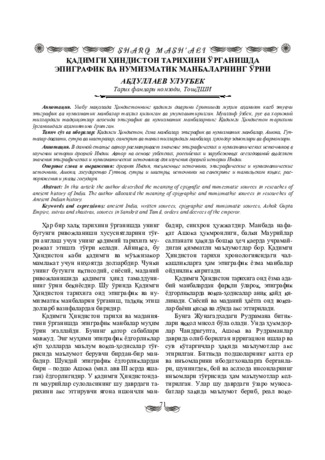
The role of epigraphic and numismatic sources in the study of ancient Indian history

The role of Arab research centers in the political life of the state
The purpose of this article is to study the research centers operating in the Arab states and analyze the extent of their involvement in the development of strategic concepts in public life. The study of cooperation between research centers and political offices of the state gives an opportunity to clarify the development degree of science and democratic traditions, and political pluralism in Arab states. Methodically, two criteria were chosen for evaluating the activities of Arab research centers: first, the state's investment in science, and second, their democratic indexes. In both criteria, the Arabian international rankings are based on reports from competent rating agencies and research centers. In order to analyze the activities of research centers, firstly, their development stages, secondly, factors that affected the activities of the centers, and thirdly, the role and importance of the centers in strategic decision-making related to domestic policy, economy, international cooperation and regional security were investigated. The study revealed that the current tensions and increasing crises in the region do not allow the centers to overestimate their effectiveness.
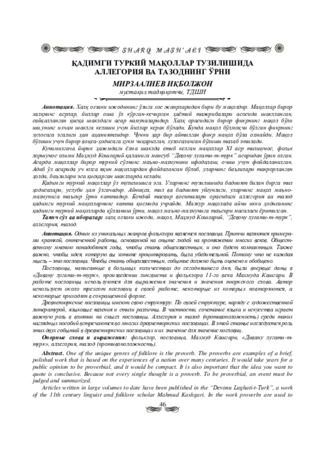
The role of allegory and contrast in the structure of ancient Turkish proverbs
One of the unique genres of folklore is the proverb. The proverbs are examples of a brief, polished work that is based on the experiences of a nation over many centuries. It would take years for a public opinion to be proverbial, and it would be compact. It is also important that the idea you want to quote is conclusive. Because not every single thought is a proverb. To be proverbial, an event must be judged and summarized. Articles written in large volumes to date have been published in the “Devonu Lughati-t-Turk”, a work of the 11th century linguist and folklore scholar Mahmud Kashgari. In the work proverbs are used to express the meaning and meaning of a Turkic word. The author uses about three hundred proverbs in his work, some of which are repeated and some come in abbreviated form. Ancient Turkic proverbs have their own structure. In their structure, along with fiction, language phenomena and style are different. Especially, the combination of language and art plays an important role in influencing the meaning of the article. The allegory and confusion among such visual aids is found in many of the ancient Turkic proverbs. This article explores the role of these two events in ancient Turkic proverbs and their impact on the meaning of the article.
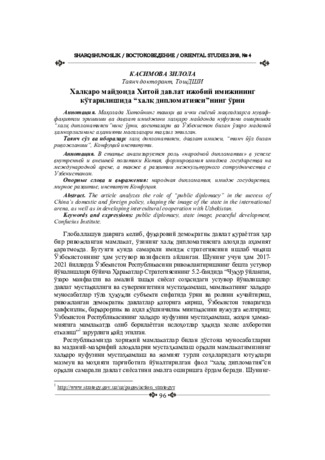
The role of "people's diplomacy" in raising the positive image of the Chinese state in the international arena
The article analyzes the role of “public diplomacy” in the success of China’s domestic and foreign policy, shaping the image of the state in the international arena, as well as in developing intercultural cooperation with Uzbekistan.
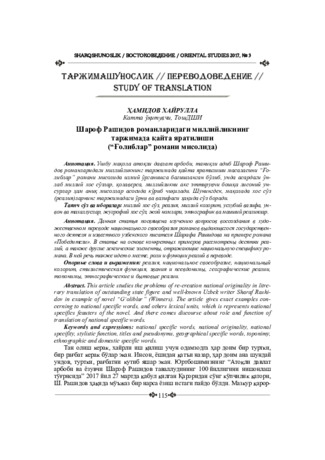
The re-creation of nationality in the novels of Sharof Rashidov in translation (in the example of the novel "The Winners")
This article studies the problems of re-creation national originality in litrerary translation of outstanding state figure and well-known Uzbek writer Sharaf Rashidov in example of novel “G‘oliblar” (Winners). The article gives exact examples concerning to national specific words, and others lexical units, which is represents national specifics feauters of the novel. And there comes discourse about role and function of translation of national specific words.
The re-creation of conceptual metaphors in literary translation
This article is devoted to the study of the specific peculiarities of the French translation of conceptual metaphors in the Uzbek language on the basis of French translations of the works of E. A’zam. In order to reveal the peculiarities of the French translation of conceptual metaphors in the Uzbek language, three samples of E.A’zam's works and their translations by Sh.Minovarov were investigated. The analyzed metaphors were selected according to their originality, expression in translation, and level of influence on the content of the text. The classifications included to the content of orientational, structural, and ontological metaphors were expanded based on sources related to the semantic types of metaphors.
The question of the historiography of the administrative management of the Somonides era
The article deals with the use of Persian traditions in the Samanid rule of the city, as well as historical conformity of the administration of Samanid period.
The question of self-realization in the Upanishads
One of the main issues raised in the article on Upanishads is the relation-ship of "I" to the nature and the universality of existence in general. Philosophical concepts are interpreted as rationalism as a process of self-awareness from the senses to the examples of ideas. It was analyzed that the rationalization of Upanishad was later a basis for the development of Indian thought, which in turn influenced Islamic philosophy.

The problem of word choice in literary translation (in the example of the Turkish translation of the novel "World Affairs")
Currently, a number of scientific studies are underway to translate the masterpieces of Uzbek literature into foreign languages and samples of foreign literature into the Uzbek language, and to the scientific study of translated works. Within the framework of this topic, the study of the problem of the choice of words in literary translation is of current importance. When it comes to translations made between the Uzbek and Turkish languages belonging to the same language family, which are spoken by peoples who have a common culture, common customs and traditions, the situation often changes. It should also be recognized that the translation between these two languages has not only its advantages, but also a kind of complexity. The scientific problem posed in this article will be considered on the example of Turkish translations of the work of the famous Uzbek writer Utkur Khashimov. When choosing the topic of this study, it is taken into account that currently there are not enough scientific works devoted to urgent issues of literary translation from Uzbek into Turkish, and much remains to be done at the behest of the time. Particular attention is paid to the importance of studying the problem of word choice and stable phrases in literary translation, the role and place of bilingual dictionaries in the translation process, and the problems of transmitting “false equivalents”. The article also attempts to elucidate serious questions about the fact that a word in a literary translation from Uzbek into Turkish and the context is a means of literary interpretation of the text, and translators often encounter problems when translating the title of works. Despite the fact that the Uzbek and Turkish languages, which form the basis of this study, belong to the same language family, that most lexical and phraseological units are fundamentally different in their etymology in these languages, it requires a special approach from translators. The conclusions made during the research are confirmed by the theoretical conclusions of famous translation scholars.
The problem of the genesis of aesthetic categories and the nature of art in the philosophy of Al-Farabi and Ibn Sina
The article deals with al-Farabi's contribution, Ibn Cynna in art and esthetic culture of the East. It analyses basic categories and concepts of their esthetic concepts: beauty, fine, harmony, perfection, measure, art, imitation, esthetics. The accent is put on the theory of music of al-Farabi, a problem of poetic art of Ibn Cynna. It shows the role of art progress in formation of the harmonious person.
The problem of style in the process of translating historical novels
This article deals with the experience of translating historical novels in translation studies. It is also devoted to current and important problems of the theory and practice of translation of historical novels in translation studies today. The process of translating historical novels in translation studies is explained on the basis of examples of educational, political, ideological and aesthetic significance. It says that the translation of historical novels into foreign languages is important in promoting the national values of the
people to the world. The article also discusses the role of the experience of world translation schools in the translation of historical novels in translation studies, as well as a comparative analysis of the specific methods of the Uzbek National School of translation studies and world translation schools. It is emphasized that the translation of historical novels, unlike works of other genres, is important as works of high artistic expression, which clearly show the history, values, spiritual world and national spirit of the people. The main condition for achieving adequacy in the translation of historical novels is the transfer of artistic originality of the original, its national characteristics and the ability to fully reflect the individual creative style of the author. It also considers the successes and shortcomings of direct or indirect translation from one language to another. Of course, in the direct translations of historical novels, special attention is paid to the fact that the mastery of the translator is the primary task in restoring the artistry of the work. Also, the genesis of translation of Uzbek historical
novels, methods of translation, especially the problem of style in translation into English and
the peculiarities of working on the translation of historical works are studied on a scientific
basis. In this regard, scientific and practical recommendations have been given today, taking
into account the experimental trends of the world schools of translation, to improve the mechanisms of action for the formation of professional competence in the practice of translating historical novels.
The problem of Middle Eastern refugees in German migration policy
The article deals with millions of refugees, have been emerged as a result of internal disagreements in the Middle East and moving towards Europe, and the German “open door” policy for those refugees, as a result of internal dissatisfaction in Germany, government conflicts, the rise of crime in German society, the fear of the disappearance of the national state and traditions, the fear of Islam and the rise of public political movements.
The problem of classifying attributive adverbs in the Dari language
An adverb is a lexico-grammatical class of unchangeable, as a rule, words denoting a sign of an action, quality or object and acting in the syntactic function of a circumstance or definition, less often of a predicate. The adverb in all languages of the world belongs to the late parts of speech, the formation process of which continues to the present day. At the same time, words belonging to this category still retain their functions in other parts of speech from which they were formed. Another distinctive feature of the adverb is the conceptual heterogeneity of the class of words in comparison with other parts of speech. Based on the above, we can say that there are many definitions of adverbs in Afghan and Iranian studies. Previously, the works of Arab scholars served as the basis for studying the grammar of Dari and the Persian languages; today, Afghan and Iranian philologists admit that there are significant differences between Arabic and their languages, and therefore, in studying the grammar of their language, they try to take into account the grammatical features exclusively Farsi. It should be noted that there is an activity of Iranian philologists in the field of writing scientific articles and books devoted to the interpretation of a particular grammatical issue, the attention of researchers to the structure of syntax has increased. We have analyzed a number of works on the grammar of the Dari and Persian languages, which touch on the question of parts of speech and minor members of a sentence. Below is a brief description of some works on the grammar of the modern Dari and Persian languages, in which the question of our research is most fully considered. In world linguistics, the Dari language is not widely studied, like the Persian language. In Iranian studies, in the scientific description of this language, it is mainly noted that it differs from the modern Persian language. In the Dari language, as well as in the Persian language, the authors consider the adverb from a morphological and syntactic point of view. In the course of our research, we analyzed the works related to the modern Dari language, as well as unique works that are being republished for the second time in Afghanistan
The principles of updating Alisher Navoi's poetic traditions in Furqat's poetry
Hazrat Alisher Navoi's works are the pinnacle of the nation's artistic and aesthetic thinking. It is difficult to find a thinker who has reached such a high level of creative perfection in the literature of Uzbek or other Turkic peoples, or even in world literature. That is why there is no poet or writer among his successors who did not learn from Hazrat Navoi's art studio. But there are not many artists who perfected and developed the poetic traditions of the great poet, even if it was through specific poetic images or symbols. The lyrics of Furqat son of Zakirjon Khalmuhammad are of special importance as they are included in the list of such unique creations.
The Precedent Phenomenon of Chinese Folk Tales
Russia and China are connected not only by a three-and-a-half-thousand-kilometer-long border, but also by mutually beneficial cooperation: political, economic, and cultural. Every year there is a growing interest in the Chinese language, respectively, and Chinese culture. A precedent phenomenon is an integral part of the culture of any country, creating an expressive characterization of a character or situation. Knowledge of precedent phenomena is an indicator of the literacy of a language personality. In this article, we will answer the question of what is a precedent phenomenon, and what is its significance in the language culture of a particular country. Consider the precedent phenomena from Chinese fairy tales, it is the fairy tale that helps to update the knowledge about the five-thousand-year-old culture of China. Let's analyze Chinese fairy tales for the presence of precedent phenomena. We will also analyze the jokes used in oral speech by modern Chinese, which contain precedent phenomena from the fairy tales, legends, and legends. Understanding fairy-tale stories, characters and situations helps to understand the way of thinking, beliefs, and values of the people. The fairy tale reflects the national specifics peculiar to the people. The value of a fairy tale lies in the fact that it, a fairy tale, is a carrier of national memory. Knowledge of the precedent phenomena of Chinese culture will help to study the culture of the middle state more deeply; it will facilitate communication. In the article, we give examples of precedent phenomena specific to the people of China, which reflect the national character. The analysis can be useful both in the study of Chinese culture, and to improve the quality of speech communication between native Chinese speakers and foreigners, as well as the effectiveness of learning Chinese by forming an understanding of precedent phenomena and ways of using them. Understanding the traditional culture of the Chinese nation through the study of precedent phenomena is ideal for improving the level of knowledge and understanding of the Chinese language, as well as Chinese culture for international students.
The practice of monetary endowment in the Khiva Khanate: sources and interpretation
The article is devoted to the formation of the theoretical and legal basis of the cash waqf in Muslim society, the creation of a mechanism for the exploitation of this type of property and the history of this practice in the Khanate of Khiva. First, the study of this scientific problem in world historiography is briefly described by the example of other Muslim countries and published works on the history of the cash waqf in the Khanate of Khiva was also analyzed. It also discusses the views of representatives of various schools of Islamic law on the cash waqf and the arguments presented by them regarding this practice. In particular, despite the fact that the majority of theologians and representatives of Islamic jurisprudence considered the creation of a cash waqf unlawful, some recognized the legitimacy of this practice under certain conditions. As a result, based on the arguments about the permissibility of the monetary waqf, the Ottoman Empire issued a fatwa on the admissibility of the cash waqf and, on this basis, the decree of Sultan Suleiman (1520-1566). Later, on the basis of this legal framework and practice, the procedure for the creation and exploitation of cash waqfs was spread in other Muslim countries. In particular, from the second half of the 19th century, the creation of cash donations began to gain popularity in the Khanate of Khiva, and by the end of the century it became the main type of waqf property. This study also analyzes the factors that led to the popularity of the cash fund in the Khanate of Khiva, as well as inner features of waqf document, i.e. waqfnāma. The documents on cash waqfs from Khorezm often stipulate that the property converted into waqf could be used mainly on a lease basis or on the basis of muḍaraba (partnership). However, as the analysis of historical documents shows it was very common to make profit from cash waqf under lease agreements. In order to determine the reasons for this, various aspects and procedures of these two practices were disclosed. It should be noted that special attention is paid to the internal structure of historical documents and their hermeneutic analysis, reflecting the procedure for exploitation of cash waqfs issued in the the Khanate of Khiva.
The position of literature in language education
The policy of the Timurids in the matter of Mongolia (Ettisuv, Eastern Turkestan) (first half of the 15th century)
The article analyses history of political place and role of the Temurids as Shahrukh and his son Ulughbek in Mogolistan continent (East Turkestan) , and also bilateral political, diplomatic relations between them in the middle of XV century based on historical sources.
The policy of reunification of Afghanistan after the first Anglo-Afghan war
The article argues that Dost Muhammad, who returned to power after the first Anglo-Afghan war, should pursue a policy of unification, starting all political efforts to turn the country into a centralized state, rebuilding power, and reforming it. The economic and political situation in Afghanistan after the war was very difficult. Tried to establish peace.
The poets of the Samonite period of Central Asia
This article is dedicated to study the life and work of poets of the Samanid period in Middle Asia. In this article along with the well-known poets, the works of the some poets who are far from attention of scientific and literary community, and the ideas expressed in their works.
The picture of the world and its linguistic display
The article deals with the study of the picture of the world and its language expression. This issue is the subject of close attention of many disciplines.
The Philosophy of Modern Confucianism in the Context of the East-West Dialogue
In the scientific article the analysis of essence of philosophy of modern Confucianism is given. Within philosophy of modern Confucianism are considered neoconfucianism – "the line Xiong Shili" and post-Confucianism – "Fan Yulan's line". The accent is put on the doctrine of Fan Yulan who considered philosophical traditions of the East and West not contradicting each other, and complementary. The thesis about need of forming of equal dialogue on the East-West line is reasonable.
The phenomenon of geoideology in international politics
The world is dominated by ideas. Only when these ideas are formulated as a whole ideology can be seen as a practice. Whatever the ideology may be, it is based on the practicality of the ideology, and it is opposed to other ideologies. Where there is an ideological vacuum, it is possible to create a new ideology or to bring another ideology from outside. But it is impossible to create a new ideology that is not compatible with one ideology. It means that there has been a split between social groups and political ideologies that create divisive ideologies. In the "status quo" of international politics, the geopolitical factor appears primarily as a threat to ideological security, and the threats cover the political, economic, military, environmental, cultural and information spheres of public life. Polygons of ideology have been formed and strengthened in society, and today they are showing that "ideological polygons are more powerful than nuclear polygons". Centers of geoideological power are the centers of geopolitical power that have been created for a particular purpose between political institutions and social groups in society. The center of geopolitical power may be a single state, an association of states or groups, political groups with the same level of political commitment. In the scientific comparative analysis of the geoideological power center and the center of geopolitical power, the word "power" in the phrase "center of geopolitical power" should not be omitted. This is because the concept of "geopolitical center" is interpreted differently in international relations theory. The notion of a geopolitical center is primarily used for a single state and, first of all, assumes that the state is "not geographically formed, but geographically important for the movement forces". Geoideolical centers of power are global or regional, as are the centers of geopolitical power. However, when geopolitical power centers are classified together with the geographical area by the power and political motives of the state, the centers of geopolitical power are characterized by the range of ideas that they seek. The current article analyzes the issues of evolution of ideological processes as well geoideological threats and the role of power centers in formation of these threats in the contemporary world.
The passage of time in the medieval diary story "Sarasina-nikki"
The following article considers one of the most topical issues of diary literature – time transfer through women’s diaries. The author of the article dwells on characteristic peculiarities of women’s diaries such as the author’s personal life stories through the prism of personal perception, which,after all, determined the artistic basis of the whole work.
The Ottoman State in the Mirror of Turkestan Press (late XIX - early XX centuries)
It is to show that the image of the Ottoman state was formed through the Turkestan press during the reign of the Russian Empire. Turkestan periodicals regularly publish articles and reports published abroad. The political developments in Turkey have been closely followed. In particular, the processes related to the coming to power of young Turks in 1908, changes in the Turkish army, various wars are given special attention. It is also noted that the spread of ideas of pan-Islamism and pan-Turkism and this is extremely dangerous for Turkestan. Socio-political processes in Turkey in the early twentieth century, the activities of young Turks in Turkey, party struggles in the country, as well as the attitude of the European community to the leadership of the "Unity and Development" party in the political process were widely covered in Turkestan periodicals. It was also noted in the Western media that the interpretation of these processes was covered without a full understanding of the political activities of young Turks.

