
All articles

Philosophical methodological features of interrelation of anthropology and elitology
The aim of the research: The expression of perfectness in elitar consciousness in the process of socialization of human, to prove differences and mutual relations of elitarism, elitology, elite as its development levels.
Scientific novelty of the research is the following:
• onto-gneseological views on human essence arc classified, the connection of physical, chemical, neuropsychological factors in human nature with socialization and elitarization is revealed;
it is scientifically proved that the capital of human is collected in spiritual, cultural educational process , current capitals which arc spent for education is the factor of formation of perfect human who can direct his knowledge to personal necessity and the development of society;
it is philosophically proved that the individual character and national spirit of consciousness elitology on the base of analogy of historical aspects of elitology and anthropology arc considered as an epistemological criteria of creative possibilities of intellectual elite of youth;
objective and subjective possibilities of organizing private educational system in a new stage of the development the necessity of training pedagogical elite arc proved for improving elitar culture and elitar education and improving the quality and effectiveness of global educational process;
the importance of harmony of anthropological-elitological categories with elitar education and the idea of perfect human in personal, interpersonal and over personal level, the dialectics of national mentality and social processes arc revealed;
Philosophical considerations about "artificial intelligence"
Қадимги асотирларда турли шакл ва мазмунда акс этган “сунъий интеллект” концепцияси ХХ асрга келиб (1950) илмий муомалага киритилган. Шу вақтдан бошлаб “сунъий интеллект”га доир бир неча ўн мингдан ортиқ тезис, илмий мақола, қўлланма, монография нашрэтилган бўлса ҳам унинг фалсафий моҳияти етарли очиб берилмаган. Мақолада интеллект, “сунъий интеллект”нинг инсон ва жамият ҳаётидаги муҳим аҳамияти, қадриятлар тизимидаги ўрни, “сунъий интеллект”нинг ахлоқий баҳоси, “сунъий интеллект”га доир фантастик асарларда илгари сурилган ғояларнинг фалсафий моҳияти, инсонни мукаммаллик сари йўллайдиган “трансгуманизм” тарафдорлари илгари сурган қарашлар фалсафий таҳлил қилиниб, инсон энг олий қадрият экани илмий далилланган.

Philosophical analysis of systems of moral-culture
Subjects of reserch: Development of social and cultural life of society, moral-culture and philosophic analyze of its system and social dynamic.
Purpose of work: Philosophic analyze of system of the spiritual culture from the pour of view of definition of requirements and peculiarifily of socio- dynamics
Methods of reserch: The basis of the research consists of formation development systems and functions of moral-culture. That is objective, logical, comparison analyze.
The results obtained and their novelty: Discussion about categories of “culture” and “moral-culture” helps to understand uncertainties in cultural philosophy. Culture-material and moral culture, national and humanitarian culturemoral, moral-culture of independence are dialectical connected to each other and also they are social dynamic cases.Theoretical-philosophical ideas of the research may be used as theoretical base.
Practical value: the practical consequences of research may be used by social-pedagogical institutes which are deal in this sphere, moral-culture centers, The Moral (Spiritual) Center of Republic, TV and Radio, publishing houses.
Degree of embed and economic effictivity: main ideas of thesis are mode in scientific theoretical conferences, seminars, used in holding practical lesson with the students of faculty of philosophy in TNI of OS . And also with students of Tashkent Avtomobile and Road Construction Institute and in published works.
Fied of application: results of work can be used in HEL, academic lyceums, colleges in the process of studying of problems of education, teaching and forming it’s systems.

Philosophical analysis of spiritual needs in the development of society
Objects of the inquiry: need of the society in spiritual values.
Aim of the inquiry: philosophical disclosing of the transition of Uzbekistan to market-oriented economy, establishing different forms of property, changes in the society system, require spiritual values of the society under the conditions of information inflow resulting in progress, essence, content and the structure of spiritual values as well as its system of formation.
Methods of the inquiry: objectivism, necessity and interlinks, concreteness, relativity and activity, responsibility of a subject, system analysis, historical and logical scientific methods. While analyzing the results of sociological survey, the Person’s criterion of conformity and formula of trustworthiness coefficient proposed by Student have been used.
The results achieved and their novelty: the place, essence, peculiar status of spiritual needs in the system of renewed society have been defined; the spiritual needs as an object of research have been studied for the first time in the conditions of independent development; the dialectical link of spiritual needs with the system of political, economical, and social demands in the progress of developing society has been considered; the philosophical analysis of spiritual needs as a necessary and enriched event in the development of society has been done; dialectics of social consciousness and spiritual needs have been studied; the necessary dialectic interlink of spiritual needs of the personality, society and the state has been highlighted; proceeding from conditions of independent Uzbekistan the role of spiritual needs has been studied.
Practical value: the conclusions, analyses, recommendations, achieved results of the research can be widely used by appropriate organizations, departments during global studies of spiritual needs of society as well as in designing the spiritual factors being formed in the society to be intended for the defense of interests of individuals and society.
Practical value: the conclusions, analyses, recommendations, achieved results of the research can be widely used by appropriate organizations, departments during global studies of spiritual needs of society as well as in designing the spiritual factors being formed in the society to be intended for the defense of interests of individuals and society.
Degree of embodiment and economic efficiency: the results obtained were reflected in scientific-methodical works published by the author, in the materials of international and republican scientific-practical conferences; they were used during the preparation of lectures on social disciplines.
Sphere of usage: the materials of the research can be used in delivering lectures, organizing the practical seminars on such disciplines as philosophy, study of culture, bases of spirituality, and political science.
Perception of human rights in islamic law

O‘zbekiston respublikasida ta’limni rivojlantirishning yangi bosqichi

O‘zbek adabiyoti tarixini o‘qitishning manbaviy asoslari (mutrib ijodi)
In the textual studies of the peoples of the world, attention to the study of national literary heritage based on primary sources is growing stronger than ever. The study of manuscript sources makes it possible to restore the texts of the works of a poet or writer in accordance with the original (at least close to it), regardless of the period in which they lived. Without restoring a reliable text, the poet's work cannot be analyzed in terms of theoretical problems of literary studies. In world textology, research is being conducted on such scientific problems as comparative analysis of manuscript sources, creating a scientific biography of the creator, and studying the history of the text of an artistic work. Among them, a great deal of experience, knowledge and material has been collected within the framework of studying the sources of Eastern manuscripts spread throughout the world's libraries, including the works of Alisher Navoi and Babur, great figures of Turkish literature. Extensive research is the basis for the creation of the theoretical foundations of textual studies. Uzbek textology has progressed on the basis of existing scientific experiences and has achieved certain results in the study of classic literary sources. Researching the literary heritage of authors who have left a bright mark in the history of national literature, studying manuscript and lithographic sources based on the latest scientific achievements is one of the primary tasks of source studies and textual studies. After all, "...studying and promoting Uzbek classic and modern literature at the international level, analyzing this multifaceted topic in integral connection with the most important processes taking place in the world's literary space today, creating the necessary scientific - drawing practical conclusions is of great importance..." 1 . Accordingly, it becomes clear that it is urgent to carry out a scientific monographic study of the sources of the lyric divan of Khorezm literary environment representative Mutrib Khonakharob (1853-1923), study the textual history of the poet's works, and develop the principles of preparing a scientific and critical text. The study of Mutrib's work began during the poet's lifetime. Tabibiy recognizes the achievements of the poet in poetry and music in the collections "Majmuat ush-shuaroyi payravi Feruzshahi" and "Majmuat mukhammasot ush-shuaroyi Feruzshahi". "Biographies of poets and writers of Khiva" by Hasanmurad Laffasi, "Poets and singers of Khorezm" by Bobojon Tarroh, "Tazkirayi Qayyumiy" by Polatjon Qayyumiy also provide valuable information about the poet's work. O. Sharafiddinov, M. Yunusov, N.M. Mallayev, Yu. Yusupov, M. Pirnazarov, A. Abdugafurov published articles. These articles cover the biography of the poet, the ideological scope and artistry of his works, thematic and genre features of his literary heritage. But in most of them, the poet's works were interpreted under the influence of communist ideology. M. Pirnazarov studied manuscript and lithographic sources of Mutrib's lyrical heritage, subject scope, genre features, and artistic skills. Although this research provided valuable information for its time, problems such as creating a scientific biography of the poet, researching the author's works in the field of theoretical problems of textual studies, and creating a scientific-critical text are still waiting to be solved. In studying the poet's literary heritage, the book "Mutrib Khonaharobi (Ref. Collection)" is noteworthy. However, besides the fact that the text of these poems is not complete, there are also errors in the reading of words. In this tutorial, the manuscripts numbered 906/VII, 903/IV, 2679/II of the Department of Muhammad Hasan Mutrib kept in the main and H. Sulayman funds of the Academy of Sciences of the Republic of Uzbekistan, as well as Turkish manuscripts in bayoz, complex and tazkira poems, information about the poems in manuscript bayoz kept in Khiva Ichonqala Muhammad Rahimkhan Feruz II Museum.
O‘rta asr musulmon xalqlari falsafasida naturfalsafiy g‘oyalarning ilgari surilishi va asoslanishi
0‘rta asr musulmon falsafasini Abu Rayxon Beruniy asarlari orqali 0‘rganish borliq, uning mavjudlik usul va shakllari to‘g‘risidagi taTimotini o'rganish borliq to'g'risidagi tasavvurlarimiz cvolyusiyasini aniqlashtirishda muhim hisoblanadi. Darhaqiqat, Bcruniyning tabiiy-ilmiy va falsafly qarashlari o'zaro uyg'un holda rivojlangan boTib, o'ziga xos naturfalsafiy ko'rinishga egaligi mavjud adabiyotlarda yetarli darajada toTa ochib berilmaganligi sababli, uni maxsus tadqiq etish talab etiladi. Bcruniyning falsafly qarashlari, xususan borliq haqidagi ilmiy ta’limoti ko'plab chct cl va rcspublikamiz manbaashunos olimlari tomonidan jiddiy o'rganilib kelinayotganligiga qaramay, uni maxsus tadqiq etish, falsafly umumlashtirish, xulosalash va baho berish ishlari hali yakunlamnaganligini ham ta'kidlash lozim. Bu holat mutafakkirning borliq to‘g‘risidagi ta’limotini yangicha yondashish asosida tadqiq etishning o‘ta dolzarb muammo ekanligini ko'rsatmoqda.

Odam va odamning paydo bo‘lishi haqidagi diniy qarashlar evolutsiyasi
Ushbu maqolada odam va odamning paydo bo‘lishi haqidagi diniy qarashlar evolutsiyasi, olam va odamning vujudga kelishi haqida olimlarning fekrlari, mifologik dunyoqarashga asoslangan dinlarning dastlabki unsurlari, olam va odamning vujudga kelishi haqida Qur’oni Karimda keltirilgan bir qator ma'lumotlar keltirilganligi to’g’risida ma’lumotlar berilgan.

Maʼnaviy begonalashuvni oʻrganishning nazariy-falsafiy jihatlari
MARRIAGE RELATIONS AND CHARACTERISTICS IN THE SURKHAN OASIS
This article highlights the conditions for marriage among the population of the Surkhan Oasis, the concept of marriage, and its ethnographic analysis. The main purpose of the article is to study marriage issues, related customs and rituals, to encourage young people to take family matters more seriously, and to show them the right path. Since the customs and traditions of the population of the Surkhan oasis differ significantly from those of other regions, they should be analyzed on the basis of a special approach. Marriage is not just about two young people living together, but also about taking responsibility for what is called family. Our people have various customs and rituals, one of the most important of which is the matter of marriage. A broader coverage of this process is one of the important tasks of young researchers. The family hearth is formed as a result of marital relations. Marriage is a specific union between a husband and wife, recognized and approved by society and the state.

Marginallashuvni yengishda falsafaning roli: imkoniyatlar va cheklovlar
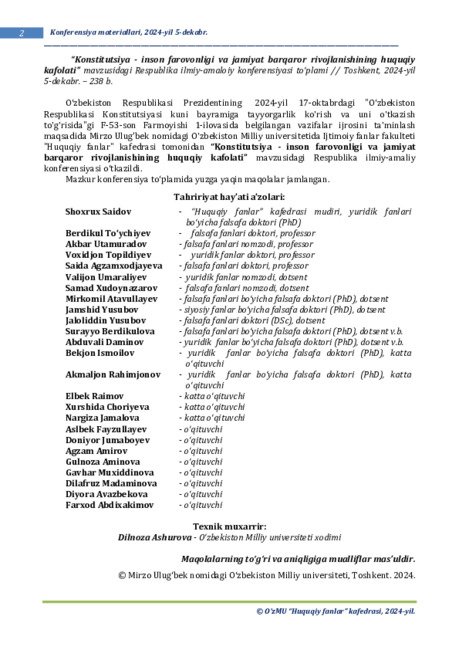
Konstitutsiya - inson farovonligi va jamiyat barqaror rivojlanishining huquqiy kafolati
Respublikasi Konstitutsiyasi kuni bayramiga tayyorgarlik ko'rish va uni o'tkazish
to'g'risida"gi F-53-son Farmoyishi 1-ilovasida belgilangan vazifalar ijrosini ta'minlash
maqsadida Mirzo Ulug’bek nomidagi O'zbekiston Milliy universitetida Ijtimoiy fanlar fakulteti
"Huquqiy fanlar" kafedrasi tomonidan “Konstitutsiya - inson farovonligi va jamiyat
barqaror rivojlanishining huquqiy kafolati” mavzusidagi Respublika ilmiy-amaliy
konferensiyasi o‘tkazildi.
Mazkur konferensiya to‘plamida yuzga yaqin maqolalar jamlangan.
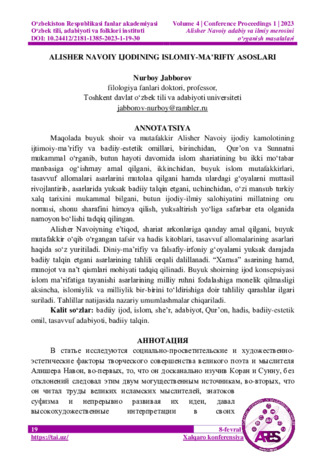
Islamic and educational foundations of Alisher Navoi's creativity
The article examines the socio-educational and artistic-aesthetic factors of the creative perfection of the great poet and thinker Alisher Navoi, firstly, the fact that he thoroughly studied the Koran and the Sunnah, followed these two powerful sources without deviations, and secondly, that he read the works great Islamic thinkers, experts in Sufism and continuously developing their ideas, gave highly artistic interpretations in his works, thirdly, that he perfectly knew the history of the Turkish people to whom he belonged, and that he was able to mobilize all his creative and scientific potential to protect and elevation of the honor and glory of the nation.
It discusses how Alisher Navoi followed the principles of faith and Sharia, tafsirs and hadiths read by the great thinker, the works of Sufism scholars. His artistic interpretation of religious-enlightenment and philosophical-mystical ideas at a high level is confirmed by the analysis of his work. The essence of the parts of "Hamsa" is being investigated, such as "hamd" (praise of Allah), "munajat" (request to Allah) and "nat" (praise of the prophet). Analytical views are put forward on the
complementarity of Islamism and nationalism, the support of the concept of the great poet's work on Islamic enlightenment, which did not prevent his works from expressing the national spirit. As a result of the analysis, theoretical generalizations are made.

Integration processes in the turkic world: issues of cooperation and legal development

Improvement of the educational work system on the integrated diagnostic basis(in the examole of higher education institutions)
The aim of the research work is to develop methodological, practical proposals for improving the system of educational work in higher education institutions on a comprehensive diagnostic basis.
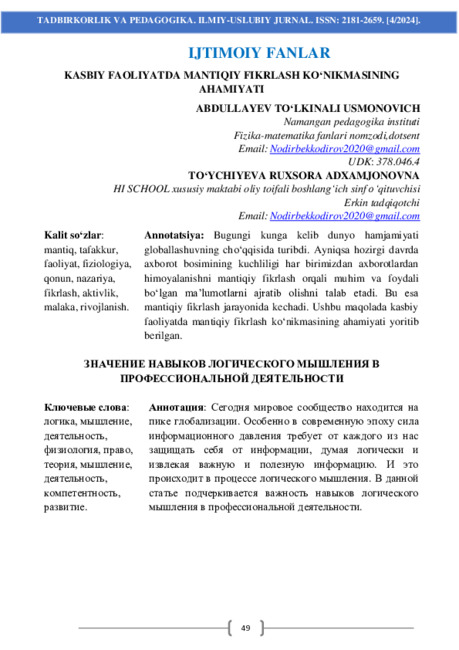
IMPORTANCE OF LOGICAL THINKING SKILLS IN PROFESSIONAL ACTIVITY
Today, the world community is at the peak of globalization. Especially in the present era, the strength of the information pressure requires each of us to protect ourselves from information by thinking logically and extracting important and useful information. And this happens in the process of logical thinking. This article highlights the importance of logical thinking skills in professional activity.
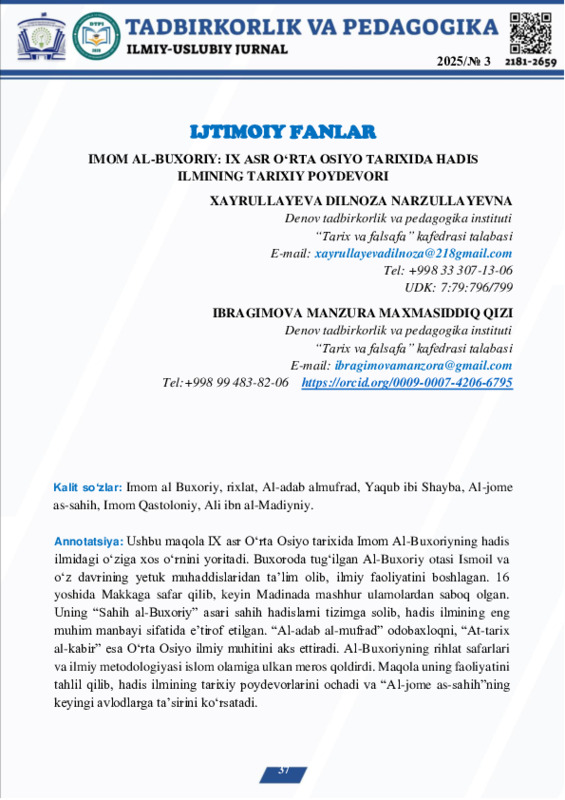
IMAM AL-BUKHARI: THE HISTORICAL FOUNDATION OF HADITH SCIENCE IN THE HISTORY OF 9TH CENTURY CENTRAL ASIA
This article explores Imam Al-Bukhari’s unique role in the development of hadith science in 9th-century Central Asian history. Born in Bukhara, Al-Bukhari was educated under the influence of his father Ismail and prominent muhaddiths of his era. At 16, he traveled to Mecca and later studied with renowned scholars in Medina. His work, “Sahih al-Bukhari”, is recognized as a cornerstone of hadith science, systematizing authentic hadiths. “Al-adab al-mufrad” addresses ethics, while “At-tarikh al-kabir” reflects Central Asia’s scholarly environment. Al-Bukhari’s journeys (rihlat) and methodology left a profound legacy in the Islamic world. The article analyzes his contributions, uncovers the historical foundations of hadith science, and highlights the impact of “Al-jami as-sahih” on future generations.

Ilmiy qadriyatlar va ularning inson axloqiy va ma’naviy yuksalishiga ta’siri

Ideas of postnonclassical epistemology in virtual theory
The aim of the research work: is to study, through philosophical reflection, the essence, ontological and epistemological aspects of post-nonclassical epistemological ideas in virtual science.
Scientific novelty of the research work: of the study is as follows:
recommendations on the use of virtual media to introduce feelings of patriotism and humanism, national identity, the awakening of historical memory, as well as definitional rules that reveal the content of virtual concepts such as virtual image, virtual model, constant reality;
effective methods of using virtual technologies for enriching the spiritual world of youth, introducing innovative ideas, the foundations of a national idea and ideology, such as Internet lessons, a tele-dialog, interactive classes, and methodological recommendations for their implementation, have been developed;
perfected such virtual methods of using virtual libraries as adequacy, imagery, emotionality (storing books in a virtual cabinet, the availability of a search system, the convenience of a virtual directory);
the philosophical reflection in epistemology (critical approach, revision of positions, axiological evaluation, analysis of the mechanism of ideological continuity in traditionalism and innovation) is carried out.
Hussain Javid's creation is in Uzbekistan learning improved
The article analyzes the study of the work of the Azerbaijan poet and playwright Huseyn Jovid in Uzbekistan. Analytical views were expressed regarding the attention of the author’s works at the beginning of the twentieth century of the great Uzbek poet and playwright Abdulhamid Chulpan, the translation of his works into Uzbek by Usmon Kuchkor and Tahir Kahhor at the beginning of the 21st century, the dissertation about the work of Huseyn Jovid in the Uzbek literary criticism, as well as the creation of a number of research today. On a scientific basis, is illuminated the role of the literary heritage of Hussein Jovid in the development of Uzbek-Azerbaijan literary relations is highlighted.

HOZIRGI ZAMON SHARQ FALSAFASIDA INSON MUAMMOSI

FАLSАFА o‘quv qo‘llanma(Falsafa fanidan)
Mazkur o‘quv qo‘llanmada falsafa fanining mohiyati, uning inson va jamiyat hayotidagi o‘rni, tarixiy va nazariy asoslari yoritilgan. Unda Sharq va G‘arb falsafasi o‘rtasidagi tafovutlar, ularning ijtimoiy va ilmiy taraqqiyotga qo‘shgan hissasi ko‘rib chiqiladi. Borliq va rivojlanish, bilish, jamiyat, tarix, madaniyat va sivilizatsiya, inson va qadriyatlar kabi asosiy falsafiy muammolar tahlil etilgan. Har bir mavzu doirasida nazariy yondashuvlar, asosiy tushunchalar, zamonaviy talqinlar va mantiqiy xulosalar berilgan. O‘quv qo‘llanma falsafa fanini chuqur o‘rganishga qaratilgan bo‘lib, oliy o‘quv yurtlari talabalari uchun mo‘ljallangan.
Furqat's life and creative heritage abroad: sources, textual research, poetics
In this regard, he is a great representative of Uzbek literature of the national renaissance period, he left a rich legacy as a poet and writer, literary critic and translator, historian and ethnographer, he made a great contribution to the development of national spirituality with his calligraphy and journalistic activities, he is a famous person of his time. It is important to research the work of Furqat, the son of Furqat, the son of Zakirjon Khalmuhammad, who was a healer of the country's ailments as one of the doctors-judges, especially the eighteen-year period of the poet's life abroad, based on the first sources. There is a certain amount of research in folklore that comments on the period of the poet's life and creative activity abroad. Nevertheless, the results of their analysis show that there is much work to be done in this regard. The earliest information about this can be found in the 32nd issue of the "Tarjimon" newspaper, published under the editorship of Ismailbek Gasprali, on August 18, 1896. In the article titled "Koshghar" in the newspaper, Furqat is recognized as a famous Uzbek poet and tourist. His journalistic article about the cultural life of Yorkent is discussed. The article is important in studying the attitude of modern press to Furqat's work. "Shoro" magazine, published in Orenburg at the beginning of the 20th century, and its position in the Turkestan jadidist movement are clear to experts. The full publication of Furqat's work "From the language of Muhammas Muhammad Khudoyor Khan" in the first issue of this magazine in 1909 is another important evidence that modern thinkers were very interested in the poet's work.
Until now, several collections of articles 5 , pamphlets 6 , critical-biographical essays 7 , methodological manuals 8 and monographic works 9 have been created, in which Furqat's life and work abroad have been researched to one degree or another. In these studies, certain achievements were made in terms of studying the period of Furqat's life and creative activity abroad. In our opinion, the scientific results achieved in them can be classified as follows: 1. The route of Furqat's trip to foreign countries was determined based on the direction of the travel routes at that time .
2. New sources related to the poet's life and creative activity abroad were identified, put into scientific circulation, researched and analyzed .
3. A scientific analysis of several works written by Furqat abroad was carried out .
4. Various opinions were expressed about the poet's reasons for going abroad and not returning to the country. It can be seen that certain achievements have been made in literary studies in the scientific study of the period of Furqat's life and work abroad. However, it is impossible not to mention one feature that is characteristic of most of these studies, especially scientific works created during the Shura period, which is clearly visible and often does not correspond to the original essence. Despite this, in the interpretation of almost every poem, every work, the approach based on the requirements of the communist ideology, an attempt to make the poet unhappy with the system he lives in, to be a victim, and to artificially set him against religion and religious people is evident. . Therefore, it shows how urgent tasks are to reevaluate these works based on a new way of thinking, to study them first of all as examples of art and to determine their place in the history of our literature. Without disparaging the scientific results achieved in these studies, it should be noted that the following issues, which are important in studying the period of Furqat's life and work abroad, have not been sufficiently studied:
1. Reasons for furqat to go abroad and not to return to the country.
2. Poet's attitude to the colonial policy of Tsarist Russia.
3. Scientific analysis of some of Furqat's works written abroad (for example, "Qavaidi Chin va umuroti politiki", "In the description of Russian soldiers", "Masarratnoma", etc.).
4. How long the poet stayed in each foreign country.
5. Textual analysis of Furqat's works written abroad.
The following issues have not been studied at all: 1. Furqat's religious-educational works ("Hajnoma" and poems in this direction) created during his stay in Arab countries;
2. Comparison of the works written abroad with the first sources;
3. The attitude of foreign scientists to the poet's life and work;
4. Analysis of foreign publications of Furqat's works. The topic of this scientific work is also relevant because it is an attempt to solve these problems.

Formation of informational culture of personality in the conditions of development of civil society
The aim of the research work is social and philosophical substantiation of social, spiritual, moral factors of formation of personal information culture.
Scientific novelty of the study is the following:
there elaborated proposals and recommendations on protection of individual's spiritual world from such information threats as information attacks, ideological attacks, disinformation in the conditions of civil society development;
there defined spiritual and social factors of public consciousness, information space, information literacy influencing the development of the content and purpose of information culture;
there substantiated objective and subjective basis of formation of the information culture from social and philosophical point of view, that is, the substratum of human thinking is the asymmetry of the cerebral hemispheres, as well as memory, fantasies, sensory-emotional experiences;
there improved integrative, gnosiological, axiological functions of information culture and mechanisms affecting development of personal information culture in order to prevent the negative impact of information attacks on the spiritual and moral world of the individual.

