
All articles
Ўрта Осиё Республикаларининг замонавий декоратив санъати
The present report summarizes the results of the scientific study made by the author during the last fifteen years and published in two books:
1. A.Khakimov. Modem Decorative Art of the Central Asian Republics. Comments to the Problem of Tradition and Innovation. Tashkent, "FAN" Publishers, 1988, 10 quires.
2. A.Khakimov. Modem - Decorative Plastic Art of the Central Asian Republics. Tashkent, "FAH" Publishers, 1992, 12 quires.
The first book consists of the introduction, three chapters, summary and the index of literature.
Chapter I "Methods of study of the decorative art in the region" determines the main mcthodologic approaches, gives the survey of the entire problem, elaborates the main methodological basis of the research.
Chapter II "The Development of traditions in the folk art of Central Asia" examines actual aspects of the development of the folk art, gives the outline of the creative work of the folk masters from the point of view of the problems of cultural heritage.
Chapter III "Creation and development of the professional decorative art of the Central Asian Republics in the context of the problem of the regional and national peculiarities" gives the broad picture of the new phenomenon in the artistic culture of the region that has appeared by the end of the 1960ies - beginning of the 1970ies.
The summary contains the main conclusions.
The second book logically continues and develops the material of the first one, mainly the contents of its Chapter III, and also consists of the introduction, three chapters, summary and the index of literature.
Chapter I "Masters, tendencies and problems of the development of the easel, monumental and decorative plastic art of the region in the 1970i.es - beginning of the 80ies" is written on the basis of the analysis of the creative work of the leading sculptors of Uzbekistan, Tajikistan and Turkmenia it gives characteristics of the main tendencies of the development of these kinds of the plastic art, peculiarities of their interaction arc determined alongwith the local specific features.
Chapter II "Decorative plastic art of the region as an independent phenomenon: analysis of the subject matter and style" demonstrates an attempt to make analysis and arrange into a certain system tremendeous artistic material both in cultural, historic and modern contexts, the artistic material is classified according to its style and subject matter into blocks. The author gives analysis of the individual specific features of the decorative plastic art.
The major attention is given to the problem of interaction of the decorative plastic art and the environment.
Chapter III "Decorative plastic art and the environment" deals with this question.
The summary contains conclusions.
So, the present research consists of the contents of the two separate books that deal with the research of the different: aspects of one phenomenon - the decorative art of the Republics of the Central Asian region in fee 1970ies-1990ies.
Samples of the folk art, items produced by the factories of art industries and non-traditional decorative art of the four Central Asian Republics - Uzbekistan, Kirguizia, Tajikistan and Turkmenia form the basic material of the research.
The main idea is to give the complete systematic characteristics of the development of the decorative art of the region in the 1970ies - 1990ies. The accent is made on the problem of cultural heritage and determination of the main peculiar features of the examined artistic process. In this connection the research has been done in the following aspects:
- elaboration of the theory and methods of the approach towards the solution of the problem of the cult-oral heritage in connection with the regional material;
- characteristic of the decorative art of the region as an entire artistic structure, examination of the forms of interaction of its main kinds;
- study of the main actual problems of the folk art and the creative work of the leading artisans;
- study of the main tendencies in the creative work of artists specialising in non-traditional decorative art and art industry;
- study of the Questions of interaction of different decorative forms with the urban environment in the region;
- determination of the regional and national peculiarities of the examined artistic process;
The main scientific results, their actual and modern character may be seen in the following:
- the notion "decorative art of the region" has been introduced into the scientific usage. The notion is given the characteristics, general sight of interaction of different kinds of art comprising the notion is given in the work;
- the ways and methods of study of the problem of cultural heritage and. innovation in various spheres of this system arc determined;
- the main tendencies in modernisation of both traditional and non-traditional decorative art is stated;
- the huge previously never described layer of the artistic practice taking place in the region -i.c. the non - traditional decorative art, has been studied, analysis of it has been made, it has been arranged into a certain system and introduced into the scientific usage, so it may be mentioned that the new perspective direction has been opened in 'the practice of art criticism of the region;
- the problem of interaction of various forms of decorative art with the architectural and landscape environment has been studied;
The research has been carries out at the department of the decorative applcid art of the Art Research Institute named after Khamza within the schedule of its pre-planned work, results were discussed and approved at the sessions of the Scientific Council of the Institute.
Ўзбек миллий қадриятларини ифодаловчи мақолларнинг тарихий илдизлари ва уларнинг ёшлар тарбиясидаги ўрни
Мақолада ўзбек миллий мақолларининг қўлланилиши, уларнинг илдизлари ва миллий қадриятларимиз билан узвий боғлиқлиги, ҳар бир сўзнинг маъно хилма-хиллиги, ибораларнинг турғунлиги, шаклий барқарорлигининг устунлик қилиши, қулланиш ўрнига қараб уларнинг маъно доираси доимий равишда кенгайиб бориши ва оиладаги,ёшлар тарбиясидаги ўрни қанчалик муҳим эканлиги бир неча мисоллар билан кўрсатилган
«Manaqib Abi Hanifa» of Abu-l-Mu’ayyad аl-Маkki alKhorazmi is a Unique Source on Hanafī Madhab
Subjects of research: the Hanafi madhab trends; views of Hanafi madhab representatives; Abu-l-Mu’ayyad al-Makki al-Khorazmi’s life, his scientific heritage and his «Manaqib Abi Hanifa».
Purpose of work: study of Abu-l-Mu’ayyad al-Makki al-Khorazmi’s «Manaqib Abi Hanifa» as a source in the field of Hanafi madhab.
Methods of research: historical, comparatively-analytical.
The results obtained and their novelty: An extensive investigation is carried out on the “Maniqib Abi Hanifa” by Abu-l-Mu’ayyad al-Makki al-Khorazmi for the first time on the basis of the manuscript kept at the library of Sulaymania under number 1631; the significance of the work is defined as an important source on the history of Hanafi madhab in the Muslim world and in Mavcraunnahr, in particular. Owing to the comparatively-contrastive analysis of the copy, the unpublished part of the work, including parts 32-40 dedicated to the disciples of Abu Hanifa, was introduced into the scientific usage.
Practical value: Mavcraunnahr has, since the ancient times, been a soil for religious tolerance, a huge contribution in the formation of Hanafi madhab, which is considered as compromising in terms of the representatives of various religions and sects, is due to the local scientists, their scientific legacy is currently regarded as reliable source in the fight against religious fanaticism.
Degree of embed and economic effectivity: seven scientific articles have been published on the theme of the thesis, two scientific reports and special courses have also been carried out at Tashkent Islamic University.
Field of application: the materials of the thesis can be widely used in the preparation of materials for the special courses at the Faculty of Qualification for imams (Muslim religious servants), in composing texts of lectures and manuals for the bachelors and masters of Religious Studies, Islamic Studies, also in the organization of social events within the republic in the places dealing with spiritually-cducational themes.

Traditional yalla art Namangan
The aim of the research work. The aim of the study is to describe the centuries-old musical and creative traditions and to determine their place and significance in the Uzbek contemporary music culture.
The scientific novelty of the research work:
identified religious, mythological, folk-ritual and other cultural layers of historical background of art yallachi;
revealed semantics, and trichord the basis of intonational dictionary of women's musical creativity;
installed create typical artistic images in art yllachi on the basis of receipt of modal cells and different rhythmic formulas;
on the basis of examples and actual materials the reflection of the Uzbek woman's rich spiritual world, peculiarities of her creative thinking and sensitive attitude in the art of yallachi is proved;
the significance of the yalla genre in the formation and development of the Uzbek pop song.
Traditional Embroidery of Southern Regions of Uzbekistan in the 20th – beginning of the 21st century
Subjects of research: Traditional embroidery and Oq-cnli carpets of the Southern regions of Uzbekistan - Surkhandarya and Kashkadarya districts.
Purpose of work: To identify local specifics of the traditional embroidery in Surkhandarya and Kashkadarya in 20th -21st centuries, to describe the process of preservation and revival of the traditional hand made embroidery in the region.
Methods of research: Comparative Art analysis is made in order to identify the local features of the Regional Embroidery on the basis of studying and classification of the embroidery items using the materials from the Scientific Expeditions and Museum Collections.
The results obtained and their novelty: Main centres of the Embroidery were allocated as well as masters and graphic artists of the region concerned. The role and the significance of the Traditional Embroidery nowadays and the local traditions of the regions concerned were closely examined. There were technological art peculiarities studied on the basis of analysis of the embroidery in each centre of the village, typical for the local traditions. The important emphasis was paid to the studying of Compositional techniques and the type of decorations used in the centres of traditional embroidery on the basis of comparative analysis of the traditional embroidery of Surkhandarya and Kashkadarya districts and their significance within the Embroidery Schools throughout Uzbekistan.
Practical value: Results of the present studies could be used as the Guidance Book for the Graphic and Embroidery Artists. This research carries a very important practical meaning for reserving and reviving traditions of embroidery in Southern Regions of Uzbekistan.
Degree of embed and Economic affectivity: Main clauses of the dissertation arc similar to the ones used in 12 scientific publications and magazine editions.
Field of application: Materials from this Research work might be used for the lectures on the History of Applied Arts of Uzbekistan and also in publishing textbooks or manuals on the subjects concerned. These materials would be beneficial for the State Grants in Scientific Art Researches.

Theory and a history of art
Subjects of the research : the rock drawings revealed by the author, and also occurring in the publications, devoted to discovered in the mountain gorges of the Central Asia petroglyphs.
Such statement of an issue has been put forward in the seventies of XX century. Therefore the author addresses to petroglyphs of the Central - Asian region (Uzbekistan, Kazakhstan, Tadjikistan, Kyrghyzstan), and in searches of analogues - Caucasus, Mongolia, Altai and other areas that enables to establish the general tendencies of development of rock paintings, as well as its thematic direstion.
Aim of the research: studying of compositional, reconstructive and art -technological regularities of rock drawings of the Central Asia, revealing their contents, the form, means of expressiveness, and also a place and value in culture of an antiquity. According to the purpose of the dissertation tasks have been assigned.
Method of research: is based on the analysis and generalization of literary sources and results of natural works; complex interpretation of each scientific valued phenomenon; classifications of drawings, graphic reconstruction of all details in modern graphic style.
The results achieved and their novelty: For the first time on the basis of complex research of petroglyphs of the Central Asia classification of rock drawings taking into account general composition, research area, a degree of richness of stages characters and their arrangement on a natural background of one or another form arc conducted. For the first time graphic reconstruction of rock drawings with their contents revealing and preservation of the general composition in space is carried out.
Practical value: Practical value of work is in the opportunity of using of the analytical materials, conclusions and graphic reconstruction as translation into modern plastic language for: a) creation of scientific studies on a history of Uzbekistan, and also methodical manuals for students of High Schools on preparation of experts in the field of the fine arts, architecture and design; 6) restoration of the ethnographic data, including ancient household ceremonies, rituals; в) formation of inhabited complexes.
Degree of embed and economic effectivity: Basis of work and researched issues arc revealed in a number of publications in scientific magazines, in proceedings and other editions.
Field of application: a history of art, ethnography, cultural science, art criticism, museum and archival science.
The role of the integration processes between religious values and fine art on the spirituality of a person
Subject of research: the works on fine arts, dealing with Zoroasterism, Buddhism and Islam as spiritual values on the territory of Central Asia.
Purpose of work: the scientific-philosophical investigation of the basic integration values in fine arts, the scientific explanation of the specifics and mechanisms of its impact on social and public life.
Methods of research: there are used the methods of scientific estimation such as analysis and synthesis, induction and deduction, historical and logical approaches to the research.
The results obtained and their novelty: in this dissertation paper are researched the religious values of fine arts on the base of identification substantional components and laws of the development; are shown the place and the meaning of Islam arts within the system of national ideas; are investigated the scientific and philosophical and methodological basics of the influence of integration of Islamic values and fine arts on formation of perfect personality.
Practical value: research results have practical importance on growing up the effect of spiritual-educational work of religion through Islamic moral value integrated in fine art, on ideological activity against fundamentalism, religious extremism, and immoral recidivism and forms of the immunity against global spiritual problems of the time being.
Degree of of embed and economic effectivity: the research results give the opportunity for better understanding first, the concept of integration religious values in fine arts; open the dialectics of the process. The results of the investigation give the scientific and methodological base for further scientific investigation in the area of spiritual problem of the society and person.
Field of application: research materials can be used in the training process in preparing lectures, training-aids and programs on the subjects of “National Idea”, “The basic of Spirituality”, “Spiritual studies” “Art studies”, and other courses on the main topic" The integration of religious values and fine arts”.
The role of fine art in technology science
national identity, patriotism, respect for national cultural and historical traditions and intellectual heritage of our people, strengthening the position and prestige of our republic in the world. A person who learns a trade and acquires knowledge finds his place in the universe. Working and pleasing him to the wind also has its own etiquette. This article discusses the etiquette of apprenticeship to the Master, the etiquette of master-app
The problems between fathers and sons in uzbek prose: genesis, realistic analyze (1970 - 2000)
Subjects of research: different genre of folk creativity, ancient literature, religious philosophic resources classic and modern literature works of writers such as and so on S.Ahmad, O.Yoqubov, P.Qodirov, M.Ali, O.U.Xoshimov, E.Samandarov, M.Mansurov, M.M.Dost, Sh.Botaev, N.Norqobilov.
Purpose of work: the last quarter of the previous ccnturc, investigation of the problem of scientific and theoretical idea and samples of uzbek prose on historical and modem themes of the beginning of XXI centre.
Methods of research: comparative - typological method of analyses were used.
The results obtained and their novelty: The first investigation in monograph cal direction of the important place taken in artistic literature of the problem between fathers and sons, genesis and resources of the ideological aesthetic system: a) the beginning of the problem between fathers and sons in different periods proceeding of their character and social-aesthetical mind was clarified; b) influence of religious- philosophical ideology and analyses of spiritual-enlightened side on literary process; c) the direction of ideological-educational aim in clarifying of the reflection of social progress in genre were investigated; d) comparative-typological analyze of the problem of fathers and sons as human beings problem in russian and world literature.
Practical value: the result of dissertation and conclusions of the scientific-theoretical side of uzbek literature can be used in institutes and universities, faculties of philology, at Lyceums, colleges, schools, can be organized selected lessons, making textbooks and organizing different spiritual-educated measures dealing with national peculiarities.
Degree of embed and economic efficiency: Lyceums, middle school and the lessons on theory of literature, history of literature and making textbooks also acceptable the result of the investigation were clarified in the articles of the writer.
Field of application: modern national literature, critic-aesthetic social-humanitar sciences, spheres of the sprite.
THE IDEAS OF MODERNISM AND THE SOLUTION OF EDUCATIONAL ISSUES IN ABDULLA AVLONI'S DRAMAS.
The expression of social dexterity in Uzbek fiction
As it is known, the social status of occupation in the communication is determined, compared to the
participants-curry, relationship status, position and role in the family. Speech communication is an important tool for providing information about the social status of the participants. For example, the speech units selected by the owner, the speech etiquette forms can transport information about the social status of the speaker. In particular, the participants' concluding remarks in the life of society are received great attention in the communication culture of Uzbekistan. In this article deixis theory in linguistics, deixis of the social condition, its representatives are discussed. In communication gestural units they are mainly used to express participants' social condition. The social status of linguistics in the speech of the participants of the dialogue is pointed as social deixis, we used terminology of social condition deixis. After all, the social status (social further status) of speech participants is provided in terms of social deixis. The speech units that
express social status deixis not only explain speaker and social condition of other participants, but also inform about its subjective evaluation. Linguistic and also extralinguistic units are used to make deixis of social status in the Uzbek language. Language units of deixis of social status language include pronouns, contact units, social lexic units and some supplements. Personal pronoun organize complicated deictic character as a tool to form of social status and person's deixis. They indicate participants of the speech which makes clear individual's deixis and determine social status deixis via showing their relations and
social factors in the same time. Supplement -s which indicates grammar meaning of possession, personal
suffixes, respect does a task of clarifying social status deixis too. Also, one of active language units that could explain speech participants' social status is reference units. Reference units' have a special duty of not only grabbing attention of listener in the speech, but also defining social relationship between speech participants. Communication units are actively used as a tool of indicating speech participants' social status in our speech. Even spelling name incorrectly to the listener indicates disrespectfulness, lowness of listener's social status or using words that mean relativity with strangers’ services as a respect. In speech deictic points which have social symbol are used in lexical field too. This include socially specialized lexic units. In
the conversion of speech participants practicing certain field's representatives' special words, slangs indicate that they are in a one group and they are socially equal. Character (right) which was formed by human's job, position, adorenes identifies not only that person's duty (responsibility), but also his position along communicative act. Overall, in Uzbek language expression units of the social condition deixis are various, therefore when each of them are analysed deeply they could obviously give intriguing informations about not only pragmalinguistics, but also sociolinguistics of Uzbek linguistics' researches

The conception of revival the gardening art of Temurids in the landscape architecture of Uzbekistan
The purpose of research work: is improvement and development of effective ways of revival of traditional landscape gardening art of the period of Temurids in modem landscape architecture of Uzbekistan.
Scientific novelty of the research work is as follows:
genesis of ancient gardens of Egypt, Mesopotamia, Persia, Greece, Rome, China, Sogda, Medieval Japan, Mauritian Spain for the purpose of identification of the techniques and receptions of a garden planning which have influenced on formation of the "Chor-bag" gardens and "Hiaban" boulevards of the 14th - 15th centuries is scientifically proved;
the interference fact, common and distinctive features of landscape gardening art of the Middle East, Central Asia, Mauritian Spain and Northern India of the period of the 14th-17th centuries are elicited;
types, parameters and methods of creation of 38 "Chor-bag" gardens and "Hiaban" boulevards (of above -mentioned regions) are investigated and specified in the summary table;
for the purpose of identification of features of architectural, vegetable and water compositions, the graphic-analytical analysis of miniatures, illustrating the gardens of XV-XVI cc. period is held;
scientific - theoretical bases (types and parameters, modularity of creation of gardens, water devices, selection of plants, architecture of garden objects) and design offers on revival "Chor-bags" and "Hiabans" of Temurids in landscape architecture of Uzbekistan are formulated.
The concept of creativity of two great historians
The great Azerbaijani poet Sheikh Nizami Ganjavi started a unique poetic phenomenon in world literature - khamsalik. Although it was written in Persian, it is known that the great poet's "Panj Ganj" reflects the Turkish thought and the Turkish spirit. The great Uzbek thinker Hazrat Alisher Navoi brought the poetic tradition started by Nizami Ganjavi to a high stage of development with his "Khamsa". According to Professor Almaz Ulviy, the author of remarkable scientific studies on Azerbaijani-Uzbek literary relations, Alisher Navoi did not limit himself to the consistent continuation of Nizami's traditions, but also raised the level of development of Turkish literature. After all, the respect for his great predecessor, the recognition of his unique services in the development of poetic thinking is clearly felt in every epic of Hazrat Alisher Navoi's "Khamsa". This is also confirmed by the fact that separate chapters of "Khamsa" epics are dedicated to him.
The basis of the third renaissan is science and enlightenment
This article highlights the origins of the Third Renaissance in New Uzbekistan based on knowledge, the views of the great scientists of the first and second Renaissance, the attention paid to the field of education today, and the most important ongoing reforms, outlines the importance of directed investment in science, spirituality and education – as an investment in the great future.
Talaba yoshlarni kasbga tayyorlashda qo‘g‘irchoq teatrining muhim o‘rni
Ushbu maqolada bo‘lajak boshlang‘ich sinf o‘qituvchilarining o‘qish darsini tashkil etishda hikoya va ertaklarni sahnalashtirishda qo‘g‘irchoq teatrining muhim jihatlari haqida keng to‘xtalib o‘tilgan.
Surkhandarya region Uzbek folk song arts
Subject of the inquiry: ritual, working, season and non ritual folk songs of Surkhandarya region: models of “second folklore” from the repertoire of folk-ethnographic ensembles.
Aim of the inquiry: research and systematization of folk song creation models of Surkhandarya region; exposure of appropriate of musical-poetic songs structure, and also definition of their role in spiritual life of people.
Method of inquiry: sources on theme arc estimated in advantage of independence ideology. During the treatment of folk song creation models scientific methods formed in modem ethno music science research were used.
The results achieved and their novelty: it must be underlined that this work is the first attempt of complex research and classification of Surkhandarya region folk songs; genre features and immanent appropriates of folk songs arc exposed.
Practical value: received scientific results have significance for further working out of folk music problems, and also can be used in folklore scientific researches, ethnography and philology.
Degree of embed and economic effectively: results of the inquiry reflected in 9 scientific articles.
Sphere of usage: materials of the dissertation can be used in lections on “Basis of Uzbek traditional music”, “Musical culture of East countries”, “Musical art of Uzbekistan” in high and specialized education establishments of the Republic of Uzbekistan.

Sources of Khamza’s poetry, its textual analysis
Reasearch objects: Khamza’s archive in the State Literature museum named after Alisher Navoiy on Academy of Science of the Republic of Uzbekistan, the poet’s manuscripts in fund of the institute of Oriental studies named after Abu Raykhan Bcruniy on Academy of Science of the Republic of Uzbekistan and in Kakand Literature museum named after Gafur Gulom.
Purpose of work: Implementation of textual-comparative analysis of the manuscript “Devony Nikhoniy” and collection “Ethnic poems for ethnic songs”, and solving theoretical-methodological problems of study of Khamza’s poetry
Method of research: historical-comparative
Research results and their novelty:
The problem of sources of Khamza’s poetry and its textual analysis is investigated as an object of investigation for the first time;
Theoretical-methodological principles of study of Khamza’s poetry are defined on basis of the analysis of investigations on poet’s oeuvre;
On basis of textual analysis of poems in “Devony Nikhoniy” texts of lyric works of poet were restored in accordance with the original; As a result of comparative analysis of the original and edited versions of poems on social-political theme from “Ethnic poems for ethnic songs” collection there were defined textual differences, and made theoretical generalizations.
Practical meaning: the materials of research can be used in higher educational institutions, especially, in practical lessons on subjects like “Uzbek literature in the period of National revive”, “Uzbek literature” at philological faculties, in creation of manuals and tutorials for bachelors and masters on subjects like “Textual study”, “History of literary source study and textual study”, “Stages of development of Uzbek written text”.
Results of use: According to results of research there were given scientific lectures and 10 scientific articles were published.
Field of use: literary criticism, literary source study and textual study.
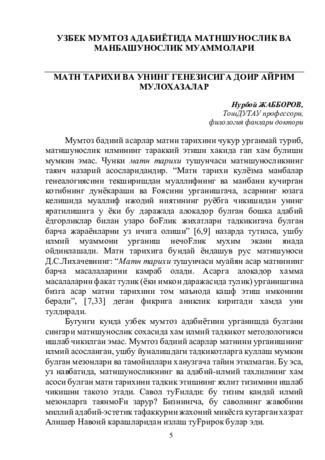
Some comments on the history of the text and its genesis
Without a deep study of the history of the text of classical works of art, it is impossible to talk about the progress of the science of textology. Because the concept of text history is one of the basic theoretical foundations of textual studies. "The history of the text includes all the processes from the investigation of the genealogy of the manuscript sources to the study of the worldview and ideas of the author and the scribe who copied the source, from the realization of the author's creative intention in the creation of the work to the study of its interrelated aspects with other literary monuments that are related to its creation to one degree or another" [6 ,9], it becomes more clear how important it is to study this scientific problem.
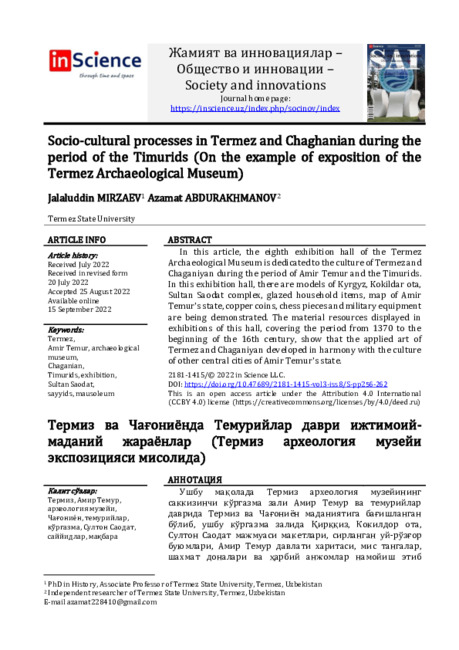
Socio-cultural processes in Termez and Chaghanian during the period of the Timurids (On the example of exposition of the Termez Archaeological Museum)
In this article, the eighth exhibition hall of the Termez Archaeological Museum is dedicated to the culture of Termez and Chaganiyan during the period of Amir Temur and the Timurids. In this exhibition hall, there are models of Kyrgyz, Kokildar ota, Sultan Saodat complex, glazed household items, map of Amir Temur's state, copper coins, chess pieces and military equipment are being demonstrated. The material resources displayed in exhibitions of this hall, covering the period from 1370 to the beginning of the 16th century, show that the applied art of Termez and Chaganiyan developed in harmony with the culture of other central cities of Amir Temur's state.
San’at mafkuraviy qurol sifatida
Mafkura va san’at insoniyat madaniyatining o‘zaro bog‘langan jabhalari bo‘lib, dunyo haqidagi tushunchamizga ta’sir ko‘rsatadi va uni shakllantiradi. Mafkura individual va jamoaviy dunyoqarashni boshqaradigan e'tiqodlar, qadriyatlar va tamoyillar majmuini ifodalaydi, san'at esa his-tuyg'ular, g‘oyalar va istiqbollarni etkazish uchun ishlatiladigan keng ko'lamli ijodiy ifodalarni o‘z ichiga oladi. Ushbu abstrakt mafkura va san’at o‘rtasidagi munosabatni o‘rganib, ularning aks etishi, bir-biriga qarshi kurashishi va ta’siriga e’tibor qaratadi.

Rindona meaning (related to the nature of may (wine) and freedom of mind) and the nature of lyric character in Uzbek classic poetry
The object of research work is to identify factors for the emergence of rindona type poems, to reveal important features, historical development and important characteristics of a lyric image-rind.
Scientific novelty of the research work is as follows:
revealed development factors of rindona poems, system of images, ideological and literary features, scales of description, methods of expression and the nature of lyric character;
proved religious mythological concepts of Eastern people for the emergence of rindona poetry, their social lifestyle, customs and traditions, their essence and aesthetic features;
researched the impact of khamriyat from ancient Arabian and Persian-tajik literature on classic Uzbek literature;
brought evidences from literary unique features of poems, bayts (a coupled lines) and misras (lines) created by the first half of XV century in Eastern literature, in particular, in Turkish poetry;
proved the potentials of expression in Uzbek literature, symbols' and characters' inner worlds, histrorical and literary features;
revealed social reasons for the scale of popularity of rindona poems in Uzbek classic literature and aesthetic criteria;
proved lyric character's outlook, the main idea of rindona poems of spiritual-educational picture, poetic nature, inter-connections with literary representation principles;
studied the similar and distinguishing features of rindona poems created in the first half of XII-XV century's Uzbek literature, the problems of lyric character.
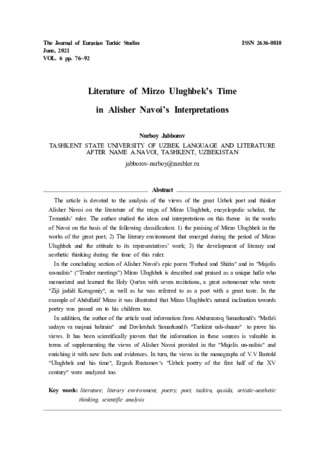
Literature of Mirzo Ulughbek’s Time in Alisher Navoi’s Interpretations
The article is devoted to the analysis of the views of the great Uzbek poet and thinker
Alisher Navoi on the literature of the reign of Mirzo Ulughbek, encyclopedic scholar, the Temurids’ ruler. The author studied the ideas and interpretations on this theme in the works of Navoi on the basis of the following classification: 1) the praising of Mirzo Ulughbek in the works of the great poet; 2) The literary environment that emerged during the period of Mirzo Ulughbek and the attitude to its representatives’ work; 3) the development of literary and aesthetic thinking during the time of this ruler.
In the concluding section of Alisher Navoi's epic poem "Farhod and Shirin" and in "Majolis un-nafois" (“Tender meetings”) Mirzo Ulughbek is described and praised as a unique hafiz who memorized and learned the Holy Qur'an with seven recitations, a great astronomer who wrote "Ziji jadidi Koragoniy", as well as he was referred to as a poet with a great taste. In the example of Abdullatif Mirzo it was illustrated that Mirzo Ulughbek's natural inclination towards poetry was passed on to his children too.
In addition, the author of the article used information from Abdurazzoq Samarkandi's "Matla'i sadayn va majmai bahrain" and Davlatshah Samarkandi's "Tazkirat ush-shuaro" to prove his views. It has been scientifically proven that the information in these sources is valuable in terms of supplementing the views of Alisher Navoi provided in the "Majolis un-nafois" and enriching it with new facts and evidences. In turn, the views in the monographs of V.V Bartold "Ulughbek and his time", Ergash Rustamov’s "Uzbek poetry of the first half of the XV century" were analyzed too.

Interpretation of the Seasons Theme in the Art of Musical Composition
Subjects of research: Artistic representation of the season cycle in the art of musical composition in a broad historical (from the end of the 18th to the early 21st century) and geographical range. Pieces selected for the analysis include classical specimens of world musical culture of the past and works by modern (Uzbek and foreign) composers, most of which are studied in this perspective for the first time.
Purpose of work: Using the art of composition as example, to demonstrate various interpretations of “the seasons” theme in its historical evolution, to identify its different renditions in the works of contemporary Uzbekistan composers and to prove their connection with national artistic traditions.
Methods of research: The object of research determined the application of his-torico-typological, comparative (synchronic and diachronic) and holistic methods of research.
The results obtained and their novelty: This is the first attempt to trace the historical evolution of various interpretations of the seasons theme in the musical art. The results of the study and some theoretical theses of the dissertation can contribute to the construction of scientific theory of artistic content as a complex evolving system reflecting stages in the development of creative thinking.
Practical value: is in broadening the knowledge about the art of composers representing different national schools of composition, who developed the seasons theme, and in contributing to the enrichment of musicology with studies of new contemporary music pieces.
Degree of embed and economic effectiveness: The dissertation materials have been used in the lecture course titled “History of World Music” taught at the department of music history and criticism of the State Conservatory of Uzbekistan.
Field of application: The key theses of the study could be used in academic work and pedagogical practice, in lectures on the history of world music and musical styles, and the history of Uzbek music, as well as in cultural studies. The outputs allow enhancing the standards and effectiveness of education activities performed by lecturers-musicologists.
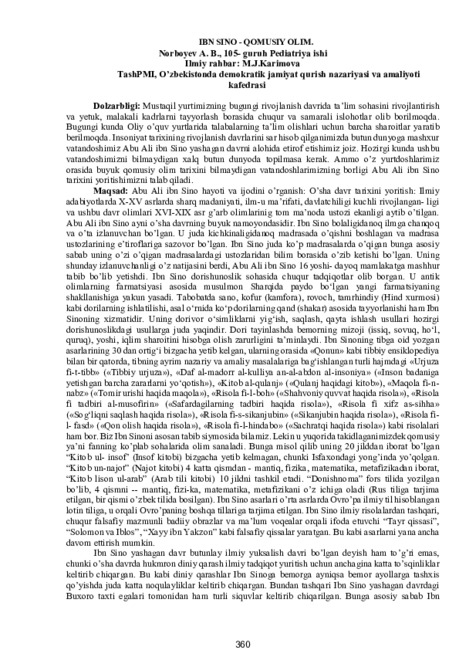
Ibn Sina is an encyclopedist
Mustaqil yurtimizning bugungi rivojlanish davrida ta’lim sohasini rivojlantirish va yetuk, malakali kadrlarni tayyorlash borasida chuqur va samarali islohotlar olib borilmoqda. Bugungi kunda Oliy o’quv yurtlarida talabalarning ta’lim olishlari uchun barcha sharoitlar yaratib berilmoqda. Insoniyat tarixining rivojlanish davrlarini sar hisob qilganimizda butun dunyoga mashxur vatandoshimiz Abu Ali ibn Sino yashagan davrni alohida etirof etishimiz joiz. Hozirgi kunda ushbu vatandoshimizni bilmaydigan xalq butun dunyoda topilmasa kerak. Ammo o’z yurtdoshlarimiz orasida buyuk qomusiy olim tarixini bilmaydigan vatandoshlarimizning borligi Abu Ali ibn Sino tarixini yoritishimizni talab qiladi.

History of development of the applied arts of Khorezm (16th – beginning of 20th centuries)
The aim of the research work is to define the main stages of development and artistic features of applied arts of Khorezm in the period of Khiva khanate.
The scientific novelty of the research work:
Retraced the evolutionary development, historical and artistic features of the applied arts of Khorezm in the 16th - beginning of the 20th centuries;
Determined the negative or positive aspects of influence of socio-political processes on the development of art crafts on the basis of the analysis of art history;
Revealed the local features of applied arts of Khorezm;
Worked out the classification of the ornamental system of the artistic craft of Khorezm;
Discovered the interrelation between architecture and applied arts;
Elaborated number of recommendations on the restoration of disappeared species and artistic-technological methods of Khorczmian applied arts.

