
Current Issue
Vol. 1 No. 1 (2024)
Published:
19-11-2025
It is with great pleasure and pride that I present to you the first issue of the STARS Scientific Journal, which opens up “New Horizons: Economic Strategies and Innovations in an Era of Change.” This issue is the culmination of our passion for knowledge, our commitment to innovation, and our desire to contribute to the development of Uzbekistan's society and economy.
Articles
6-21
72
42
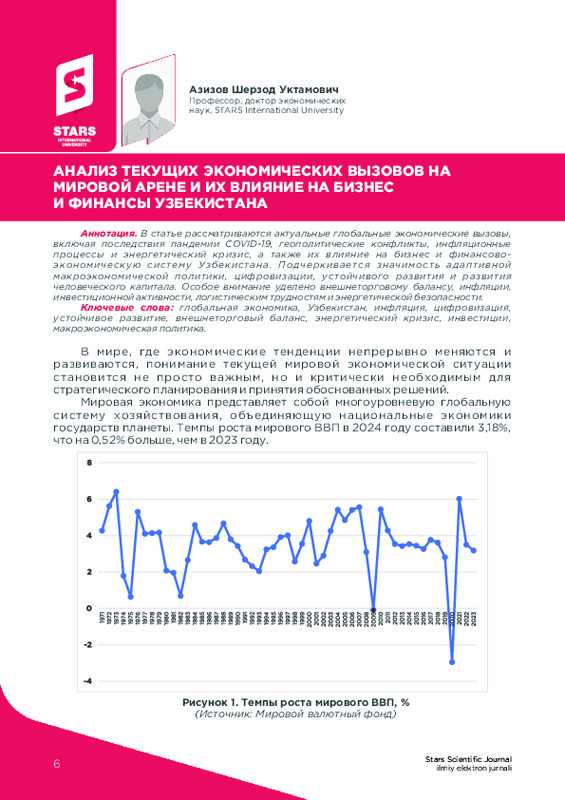
Analysis of current global economic challenges and their impact on Uzbekistan's business and financial sectors
The article analyzes current global economic challenges such as the COVID-19 pandemic, geopolitical conflicts, inflation, and the energy crisis, and their impact on the business and financial systems of Uzbekistan. It emphasizes the importance of adaptive macroeconomic policy, digitalization, sustainable development, and human capital growth. Special focus is given to Uzbekistan's foreign trade balance, inflation trends, investment dynamics, logistical disruptions, and energy security

22-34
63
20
New views on industrial policy
The article analyzes the new generation of industrial policies currently being implemented in a number of countries around the world. The new generation of industrial policies being developed and implemented is characterized by great diversity complexity and multiple objectives. The process of developing industrial policies varies depending on the institutional conditions of a particular country but has a number of common principles and characteristics. It was further noted that the industrial sector will not be able to automatically modernize, become competitive and continue to develop over time - this will require the presence of an effective industrial policy. Further, attention is focused on the fact that in the coming years, developing countries will need a new program of action, which will pay special attention to internal reforms aimed at accelerating private investment, deepening trade relations and more efficient use of new innovative industrial policies. Along with this, the article considered options for industrial policy models. It is noted that a synthesis of horizontal industrial policy with built-in elements of vertical industrial policy is used for industrial development. In conclusion, a number of proposals and recommendations are developed that are related to the need to develop a new industrial policy and the use of its effective tools, as well as improving the mechanisms for the formation and management of industrial policy in the national economy.

35-46
91
18
Regulation of external debt in the Republic of Uzbekistan: legal and regulatory analysis and prospects for harmonization with international standards
This article presents a comprehensive legal and institutional analysis of public external debt regulation in the Republic of Uzbekistan. Based on national legislation, macroeconomic data, and international frameworks (IMF, World Bank, UNCTAD, G20), the paper identifies gaps in the existing debt management system and proposes ways to enhance debt sustainability. The research emphasizes the importance of transitioning from a fragmented to a strategic debt management model, aligned with international best practices. Specific recommendations include the development of a medium-term debt strategy (MTDS), increased transparency, the promotion of domestic debt markets, and the institutional strengthening of oversight mechanisms. The article aims to support policy improvements in fiscal and debt governance for sustainable development.

47-54
52
15
Implementation of financial technologies in banking and disadvantages of their use
This article addresses the implementation of financial technologies m commercial banking operations. The study analyzes the specific areas of banking activities where modern financial technologies are being applied. Based on the research conducted, practical proposals and scientific recommendations have been developed.

55-59
102
39
Analysis of consumer expenditure in the Republic of Uzbekistan from 2020 to 2024: trends, structure, and projections
This article examines the dynamics of consumer spending by the population of Uzbekistan from 2020 to 2024. It analyzes the expenditure structure, the impact of internal and external factors, and presents forecasts for the near future. Particular attention is paid to regional disparities, inflationary pressures, and the role of social transfers. The study substantiates the need for a comprehensive approach to forming a sustainable consumption model. It emphasizes that modern consumption is not only an economic but also a social category reflecting inequality, access to opportunities, and quality of life. Based on the analysis, directions are proposed for improving public policy to enhance living standards, ensure food security, and stimulate domestic demand. The findings of the study may serve as a basis for designing effective strategies for social and economic transformation. The article also highlights the importance of international experience in managing consumer spending and adapting best practices to the national context.
60-66
85
15
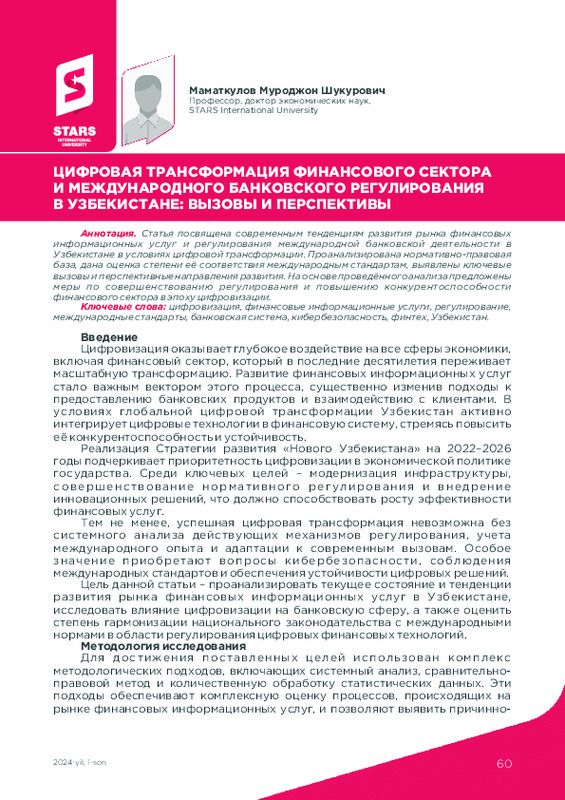
Digital transformation of the financial sector and international banking regulation in Uzbekistan: challenges and prospects
This article explores current trends in the development of financial information services and the regulation of international banking in Uzbekistan in the context of digital transformation. The study analyzes the regulatory and legal framework, assesses its alignment with international standards, and identifies key challenges and future directions. Based on the analysis, the article proposes a set of recommendations aimed at improving regulation and enhancing the competitiveness of the financial sector in the digital era.

