

THEORETICAL ASPECTS IN THE FORMATION OF
PEDAGOGICAL SCIENCES
International scientific-online conference
112
TYPES, CLASSIFICATION, MORPHOLOGY OF TUMORS, AND THEIR
CLINICAL PRESENTATION
Ibodullayeva Dilsora
Sotvoldiyeva Nilufar
Jo`rayev Nabijon
Burxonova Muxlisa
Students of Tashkent Medical Academy
https://doi.org/10.5281/zenodo.14545800
Abstract:
Tumors are abnormal growths of cells that can occur in any part
of the div, leading to a variety of clinical manifestations depending on their
type and location. Tumors are generally classified into two main categories:
benign (non-cancerous) and malignant (cancerous). Benign tumors are typically
well-defined, slow-growing, and non-invasive, whereas malignant tumors
exhibit rapid growth, invasive potential, and can metastasize to distant organs.
The morphology of tumors, including cellular appearance, growth patterns, and
nuclear characteristics, is crucial for determining their nature and
aggressiveness. The clinical presentation of tumors varies from asymptomatic
masses to symptoms like pain, weight loss, fatigue, and abnormal bleeding,
depending on whether the tumor is benign or malignant. Accurate diagnosis and
classification through imaging and biopsy are essential for appropriate
treatment and management. This article discusses the various types of tumors,
their morphological characteristics, and how they present clinically in patients.
Keywords:
Tumors, Benign Tumors, Malignant Tumors, Tumor
Classification, Tumor Morphology, Tumor Growth Patterns, Cellular
Differentiation, Clinical Presentation, Cancer, Metastasis, Diagnosis, Biopsy.
Introduction:
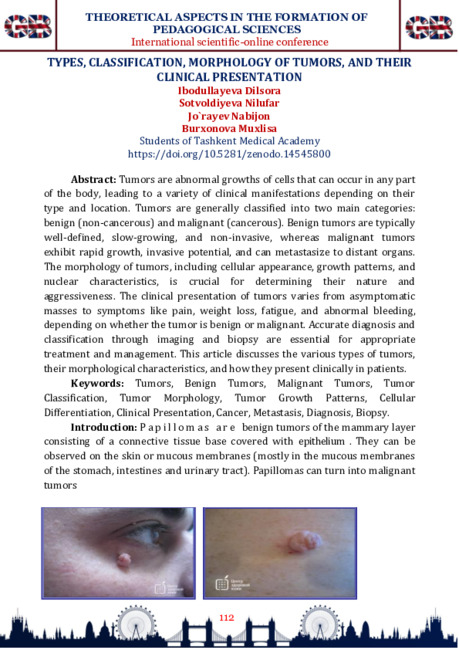
P a p i l l o m a s a r e benign tumors of the mammary layer
consisting of a connective tissue base covered with epithelium . They can be
observed on the skin or mucous membranes (mostly in the mucous membranes
of the stomach, intestines and urinary tract). Papillomas can turn into malignant
tumors

THEORETICAL ASPECTS IN THE FORMATION OF
PEDAGOGICAL SCIENCES
International scientific-online conference
113
A d e n o m a s - is formed in glandular tissue. Sometimes it can turn into
glandular cancer. They are found in all organs of the div with glandular tissue,
including salivary glands, lymph, mammary gland, thyroid gland, ovaries, etc.
Prostate adenoma
D e r m o i d c y s t s - are sac-like structures that are formed as a result of the
penetration of smaller pieces of skin during embryonic development . They have
a dense membrane, which surrounds a mushy mass of hair (hair), a mixture of
epithelial cells migrated with sebum. It is more located in the groin and front
chest area.
Cancer is the most common malignant tumor that develops from epithelial cells.
Cancer affects all organs that have epithelial cells . Epithelium changes and has an
atypical structure is a symptom of cancer.
Rapid and continuous growth of cancer leads to necrosis of tumor parts,
bleeding, then disintegration and formation of cavities and wounds. A cancer
ulcer is distinguished by its characteristic features: the edges and bottom are
covered with a dense, brown, oily film. Metastases of cancer through lymphatic
and blood vessels are characteristic. The cancer process is often accompanied by
cachexia (severe weight loss and emaciation) . Cachexia is observed especially
quickly when affected by stomach cancer.

THEORETICAL ASPECTS IN THE FORMATION OF
PEDAGOGICAL SCIENCES
International scientific-online conference
114
Stomach cancer
F i b r o m a — benign tumor formed from connective tissue. It occurs in almost
all tissues of the div. More is located in the uterus, skin, subcutaneous tissue. It
can grow and become very large.
Uterine fibroma

THEORETICAL ASPECTS IN THE FORMATION OF
PEDAGOGICAL SCIENCES
International scientific-online conference
115
Neoplastic diseases of the mammary gland
L i p o m a — a benign tumor formed from adipose tissue. It has a granular
structure, is surrounded by a thin-walled capsule, and grows slowly. It is located
in any organ with adipose tissue.
Lipoma
C h o n d r o m a — a benign tumor formed from the tissues of the anus. It is
characterized by slow growth.

THEORETICAL ASPECTS IN THE FORMATION OF
PEDAGOGICAL SCIENCES
International scientific-online conference
116
Finger chondroma ( X-ray appearance )
O s t e o m a — a tumor consisting of bone tissue. It grows slowly. It can
become dangerous.
Osteoma of the tibia
S a r c o m a — a malignant tumor developed from connective tissue . It is
called chondrosarcoma if it originates from bone tissue, osteosarcoma if it
originates from bone, fibrosarcoma from fascia, lymphosarcoma from lymph
nodes, and angiosarcoma if it develops from blood vessels. Sarcoma has all the
symptoms of malignant tumors due to its progressive nature.

THEORETICAL ASPECTS IN THE FORMATION OF
PEDAGOGICAL SCIENCES
International scientific-online conference
117
Sarcoma
A n g i o m a - a benign tumor growing from veins. It is divided into lim
phangiomas and hemangiomas. Hemangiomas, in turn, are 1) simple or capillary
hemangiomas; 2) cavernous or cavernous hemangiomas; 3) divided into
branching hemangiomas.
In severe hemangiomas, a vascular murmur can often be heard in the area of
the tumor.
Hemangioma
Myoma is a tumor formed from muscle tissue. Smooth muscle tumor is called
leiomyoma, transverse muscle tumor is called rhabdomyoma. They grow slowly.

THEORETICAL ASPECTS IN THE FORMATION OF
PEDAGOGICAL SCIENCES
International scientific-online conference
118
Uterine myoma
N e u r i n o m a a—tumor (schwannoma) formed from the Schwann
membranes of the nerve column. Rare. It is often located in the ulnar, median
and ulnar nerves. It consists of a smaller tumor-like structure that directly
causes pain along the conduction pathway.
Despite the fact that glioma-brain and spinal cord tumors belong to benign
tumors, they are characterized by rapid growth and invasion of surrounding
tissues. Recurrence may occur after removal of the glioma .
Carcinoma

THEORETICAL ASPECTS IN THE FORMATION OF
PEDAGOGICAL SCIENCES
International scientific-online conference
119
Cyst
examination and treatment of oncological patients
Diagnosis of malignant tumors.
In the diagnosis of malignant tumors, as in the
diagnosis of other diseases, anamnestic information is of great importance. The
patient's complaints, the results of the examination, and the examination methods
that allow making an accurate diagnosis include cytological and histological
diagnosis. In this case, a punctate or smear is taken from the organ and the
structure of the tumor is determined. In addition, general X-ray, computed
tomography, magnetic resonance imaging, multispiral computed tomography,
radioisotope scanning, positron emission tomography, and UTT examinations of
organs help in timely diagnosis of malignant tumors.
carried out using modern devices with fiber optics (fibrobronchoscope,
fibroesophagoscope, fibrogastroscope, etc.) greatly expand the possibilities of
diagnosis.
Treatment of malignant tumors.
Treatment of a malignant tumor is a
multifaceted process that includes all modern methods. Currently, surgery,
chemotherapy, radiation therapy methods are considered the main methods of
treatment of malignant tumors, immunotherapy, hormone therapy, additional
high temperature and laser treatment methods are widely used in recent years.
Surgical treatment is
the most radical method and is used when most internal
organs are affected - esophagus, stomach, lungs, uterus, etc. In this type of
treatment, an organ is completely or partially removed from the border of
healthy tissue along with regional lymph nodes and surrounding tissue.
Light therapy is used
as an independent treatment and together with surgical,
hormonal and chemotherapy treatment.

THEORETICAL ASPECTS IN THE FORMATION OF
PEDAGOGICAL SCIENCES
International scientific-online conference
120
all methods of radiation therapy can be conditionally divided into 3 groups
according to the method of application of the radiation, with a diverse spectrum
of ionizing radiation :
externally through the skin;
sending the radiation source into natural cavities such as the mouth, uterine
cavity, esophagus, bladder or artificially created cavities;
irradiating the tissue (tumor).
Chemotherapy .
In recent years, special chemical preparations that selectively
affect malignant cells, Tio TEF, embixin, sarcolysin, lofenal, colchamine, etc., have
been used in practice.
Hormone therapy.
In the treatment of some malignant tumors, h o r m o n e
therapy gives good results. For example, male sex hormones - androgens are
used in breast cancer, and female sex hormones (estrogens) are used in prostate
cancer.
All methods give a good therapeutic result when combined together . The earlier
targeted therapy is used, the better the outcome.
Treating benign tumors is not difficult. Since a benign tumor can turn into a
malignant tumor, it is important not to forget that its removal is a preventive
measure against a malignant tumor .
In addition, photodynamic therapy and cryotherapy are effective in
treatment. All the methods of treatment being created should be carried out only
by an oncologist, because the treatment carried out by a specialist is effective
and reduces the occurrence of relapses and metastases. When determining the
treatment method, it is necessary to pay attention to the following
characteristics of the tumor: determination of the stage of the tumor, its growth
into the surrounding tissues, damage to the lymph nodes, the histological type of
the tumor, its size, the age of the patient, and related diseases . The treatment
method should be aimed mainly at the complete removal of the tumor process,
its recurrence and metastasis . Therefore, in most cases, additional (combined)
and complex (complex) methods are used in stages II-III of the tumor process,
that is, several treatment methods are used together for the patient. The use of
treatment methods in the early stages of the tumor process leads to complete
recovery of patients. Therefore, early detection of the tumor process allows the
patient to use treatment methods in time and get a good result. In recent years,
organ-sparing surgical methods have been widely used in the treatment of
malignant tumors, in addition to the use of modern chemical drugs ( taxotere,
eloxatin, nevelbin, herceptin, campto, xeloda, paclitaxel, avastin, tarseva,

THEORETICAL ASPECTS IN THE FORMATION OF
PEDAGOGICAL SCIENCES
International scientific-online conference
121
temodal, etc. ), in light therapy - brachytherapy, " The use of gamma radiation,
radiation therapy , neutron therapy, proton therapy, liquid radioisotopes, and
immunotherapy (anti-tumor substances obtained from immune cells) are
becoming increasingly important. Vaccines are widely used in the treatment of
certain malignant tumors (skin cancer, melanoma, cervical cancer), and this
method makes it possible to use it in the treatment of other neoplastic diseases.
In addition, endoscopic surgery, interventional radiology and
photodynamic (laser) method of treatment with photosensing gives positive
results in the treatment of some types of tumors. All the above-mentioned
treatment methods can be highly effective if they are used only at the initial
stage of the tumor process. Therefore, the measures taken in this regard should
consist of the following:
- it is necessary to pay attention to the quality of conducting screening
examinations and preventive examinations among the population, and it is
necessary to focus on the detection of tumors in the initial stages;
- extensive use of modern methods (x-ray, ultrasound, molecular biological) in
preventive examination works;
- timely detection and treatment of pre-tumor diseases;
- carrying out sanitary-hygiene and promotion work among the population on a
large scale, explaining the necessity of timely treatment of tumor diseases;
- to organize radio, television, newspaper and magazine presentations about
tumor diseases and to increase the medical literacy of our people, and at the
same time to change the attitude towards oncology in a positive direction;
- implementation of modern treatment methods in oncology practice on a large
scale.
The implementation of these measures makes it possible to detect tumor
diseases in the early stages, which can be effective in treating the disease in time.
Identifying and eliminating the factors that cause tumor diseases, which have
been indicated above, will reduce the incidence of dangerous tumor diseases
among the population and play an important role in their prevention. The use of
modern treatment methods increases the standard of living of oncology patients
and improves the quality of life.
Therefore, we should remove from the minds of our people the idea that
oncological disease cannot be cured and pay great attention to this direction of
medicine.
Concept of radical, palliative and symptomatic treatment.
Radical treatment
is treatment measures aimed at the complete elimination of the disease, the

THEORETICAL ASPECTS IN THE FORMATION OF
PEDAGOGICAL SCIENCES
International scientific-online conference
122
complete recovery of the patient from the disease. In this case, the focus of the
disease, that is, the tumor, is surgically removed or the tumor is completely
destroyed by chemotherapy and light therapy. Radical treatment methods
include surgery, chemotherapy, light therapy, hormone therapy, and
immunotherapy.
Palliative treatment is complex treatment measures aimed at improving the
patient's quality of life, which is carried out when radical treatment is
impossible due to the spread of the process or due to contraindications. For
example: placing biliodigestive anastomoses, placing stomas in order to
eliminate mechanical jaundice in pancreatic head cancer, hormone and
chemotherapy in disseminated form of breast cancer.
Symptomatic treatment is treatment measures aimed at eliminating the
symptoms of the disease. Fighting pain, restoring the div's acid-alkaline and
electrolyte balance, using antibacterial, anti-inflammatory, and anti-intoxication
drugs form the basis of symptomatic treatment procedures.
Combined treatment is the simultaneous use of two treatment methods, one of
which is directed against the tumor, and the other can be a method that affects
the div systemically. For example: the combined use of surgery and
chemotherapy.
Complex treatment is the application of three or more treatment methods
(surgery, chemotherapy, nurotherapy, etc.) that have a local and general effect
on the div.
References:
1. Michener, C. D. (2007). The Bees of the World (2nd ed.). Johns Hopkins
University Press.
2. Batra, S. W. T. (1995). "Pollination of fruit crops by mason bees." Horticultural
Reviews, 17, 229-264.
3. Pitts-Singer, T. L., & Cane, J. H. (2011). "The Role of Megachilid Bees
(Hymenoptera: Megachilidae) in Pollination." Pollination and Maintenance of
Plant Diversity, 12(3), 453-469.
4. Linsley, E. G. (1958). The Evolution of the Mason Bees (Genus Osmia).
University of California Press.
5. Gemmell, N. J., & Goulson, D. (2017). "A review of Osmia (Hymenoptera:
Megachilidae) diversity in the British Isles." Entomological Journal, 23(4), 99-
115.
6. Klein, A. M., Vaissière, B. E., Cane, J. H., Steffan-Dewenter, I., Cunningham, S. A.,
Kremen, C., & Tscharntke, T. (2007). "Importance of Pollinators in Changing

THEORETICAL ASPECTS IN THE FORMATION OF
PEDAGOGICAL SCIENCES
International scientific-online conference
123
Landscapes for World Crops." Proceedings of the Royal Society B: Biological
Sciences, 274(1608), 303-313.
7. Zurbuchen, A., Landert, L., Klaiber, J., Müller, A., & Dorn, S. (2010). "Maximum
Foraging Range of Solitary Bees." Ecology, 91(9), 1735-1743.
8. Buchholz, S., & Schmid, M. (2019). "Conservation Strategies for Wild
Pollinators: The Role of Osmia Bees in Biodiversity." Environmental Biology of
Bees, 21(2), 55-67.
9. Winston, M. L. (1991). The Biology of the Honeybee. Harvard University Press.
10. Westrich, P. (1996). Die Wildbienen Baden-Württembergs (The Wild Bees of
Baden-Württemberg). Eugen Ulmer.





