Vol. 6 No. 07 (2024): Volume 06 Issue 07
Articles

INTEGRATING HINDU CULTURAL PERSPECTIVES IN ECONOMIC STUDY PROGRAMS FOR HUMAN RESOURCE DEVELOPMENT
This study explores the integration of Hindu cultural perspectives into economic study programs to enhance human resource development. Hindu cultural insights offer unique perspectives on economic theories, ethics, and sustainable development practices. By incorporating these perspectives into curriculum design and pedagogy, educational institutions aim to enrich students' understanding of economic principles in diverse cultural contexts. This research examines the potential benefits of integrating Hindu cultural perspectives in economic education, focusing on fostering global competence and ethical decision-making skills among students.
COMPREHENSIVE TRAINING: ENCOURAGING QUALITY HUMAN IMPROVEMENT THROUGH STRENGTHENING
This study explores the impact of comprehensive training programs on quality human development by focusing on empowerment strategies. The research investigates various approaches aimed at enhancing skills, knowledge, and capabilities through structured training initiatives. By analyzing case studies and empirical evidence, the study assesses how these training programs contribute to personal and professional growth, workforce productivity, and overall societal advancement. Key factors such as curriculum design, implementation strategies, and evaluation methods are examined to highlight effective practices in fostering empowerment and continuous improvement. The findings underscore the significance of comprehensive training in nurturing a skilled and resilient workforce capable of driving sustainable human development.

COMBATING BANKING FRAUD WITH IT: INTEGRATING MACHINE LEARNING AND DATA ANALYTICS
Banking fraud poses a significant threat to financial institutions, customers, and the stability of the financial system. Traditional fraud detection methods, which rely heavily on rule-based systems, have proven inadequate against increasingly sophisticated fraud techniques. This paper explores the integration of Information Technology (IT), specifically Machine Learning (ML) and Data Analytics, in combating banking fraud. Through a comprehensive review of existing literature and case studies, advancements in fraud detection methodologies are highlighted, emphasizing the effectiveness of various machine learning models and the role of big data analytics in enhancing detection accuracy and real-time processing. Additionally, the challenges and limitations of implementing these technologies are discussed, along with future trends and developments that could shape the future of banking fraud prevention. The study aims to provide a holistic understanding of how IT-driven approaches can revolutionize fraud detection and offer practical insights for financial institutions seeking to bolster their defenses against fraud.
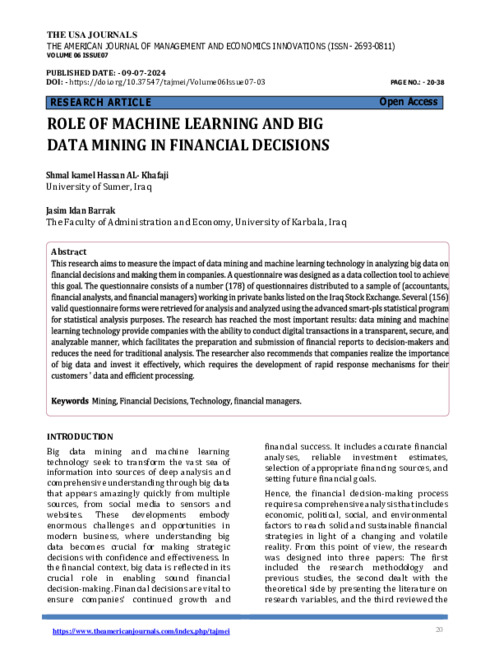
ROLE OF MACHINE LEARNING AND BIG DATA MINING IN FINANCIAL DECISIONS
This research aims to measure the impact of data mining and machine learning technology in analyzing big data on financial decisions and making them in companies. A questionnaire was designed as a data collection tool to achieve this goal. The questionnaire consists of a number (178) of questionnaires distributed to a sample of (accountants, financial analysts, and financial managers) working in private banks listed on the Iraq Stock Exchange. Several (156) valid questionnaire forms were retrieved for analysis and analyzed using the advanced smart-pls statistical program for statistical analysis purposes. The research has reached the most important results: data mining and machine learning technology provide companies with the ability to conduct digital transactions in a transparent, secure, and analyzable manner, which facilitates the preparation and submission of financial reports to decision-makers and reduces the need for traditional analysis. The researcher also recommends that companies realize the importance of big data and invest it effectively, which requires the development of rapid response mechanisms for their customers ' data and efficient processing.

THE CURRENT STATE OF ACCOUNTING FOR TAX LIABILITIES
This article contains research on making management decisions of an enterprise, optimizing taxes, assessing the impact of taxes on enterprise profits, drawing appropriate conclusions taking into account the share of tax expenses in total costs and their reflection in accounting.

