Vol. 6 No. 06 (2024)
Articles

DISTINCTIVE FEATURES OF THE DEVELOPMENT OF INFORMATION SECURITY POLICY IN THE NEWUZBEKISTAN
This article summarizes the world information about the ancient terrorism of Tabor changes , complicates and clarifies information about the risks and threats of a deep scientific understanding of the meaning of the profession of Tobor current The press release talks about the social, political, legal, economic, geological nature of terrorism, that it constantly affects social, political, legal, economic, criminal factors, as well as ethnic and confessional conflicts, as well as product quality. At the same time, as in the modern information environment, terrorism in the ancient world is important for the effectiveness of state strategy and political technologies, and as a cause-and-effect complex created to influence the entire political sphere, which is important for fighting terrorism.
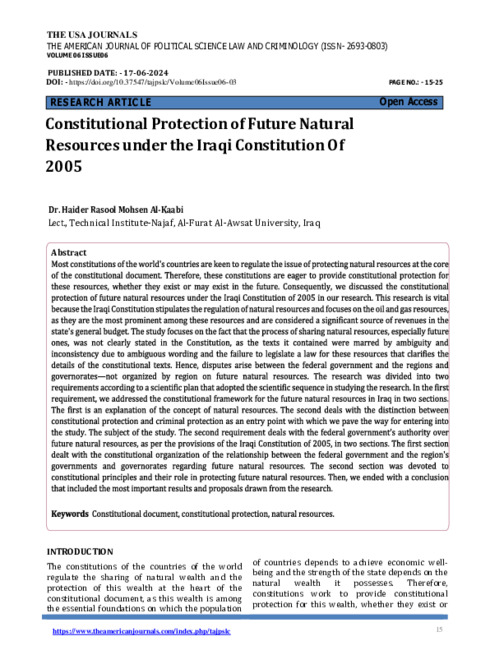
Constitutional Protection of Future Natural Resources under the Iraqi Constitution Of 2005
Most constitutions of the world's countries are keen to regulate the issue of protecting natural resources at the core of the constitutional document. Therefore, these constitutions are eager to provide constitutional protection for these resources, whether they exist or may exist in the future. Consequently, we discussed the constitutional protection of future natural resources under the Iraqi Constitution of 2005 in our research. This research is vital because the Iraqi Constitution stipulates the regulation of natural resources and focuses on the oil and gas resources, as they are the most prominent among these resources and are considered a significant source of revenues in the state's general budget. The study focuses on the fact that the process of sharing natural resources, especially future ones, was not clearly stated in the Constitution, as the texts it contained were marred by ambiguity and inconsistency due to ambiguous wording and the failure to legislate a law for these resources that clarifies the details of the constitutional texts. Hence, disputes arise between the federal government and the regions and governorates—not organized by region on future natural resources. The research was divided into two requirements according to a scientific plan that adopted the scientific sequence in studying the research. In the first requirement, we addressed the constitutional framework for the future natural resources in Iraq in two sections. The first is an explanation of the concept of natural resources. The second deals with the distinction between constitutional protection and criminal protection as an entry point with which we pave the way for entering into the study. The subject of the study. The second requirement deals with the federal government's authority over future natural resources, as per the provisions of the Iraqi Constitution of 2005, in two sections. The first section dealt with the constitutional organization of the relationship between the federal government and the region's governments and governorates regarding future natural resources. The second section was devoted to constitutional principles and their role in protecting future natural resources. Then, we ended with a conclusion that included the most important results and proposals drawn from the research.

DISTINCTIVE FEATURES OF THE DEVELOPMENT OF INFORMATION SECURITY POLICY IN THE NEWUZBEKISTAN
This article summarizes the world information about the ancient terrorism of Tabor changes , complicates and clarifies information about the risks and threats of a deep scientific understanding of the meaning of the profession of Tobor current The press release talks about the social, political, legal, economic, geological nature of terrorism, that it constantly affects social, political, legal, economic, criminal factors, as well as ethnic and confessional conflicts, as well as product quality. At the same time, as in the modern information environment, terrorism in the ancient world is important for the effectiveness of state strategy and political technologies, and as a cause-and-effect complex created to influence the entire political sphere, which is important for fighting terrorism.

ANTI- DIPLOMACY AND CIVIC EXISTENCE: HOW TO REINVIGORATE THE PUBLIC SPHERE IN A DEMOCRACY?
In contemporary democracies, the public sphere is often overshadowed by diplomatic maneuvers and political spectacle, leading to a decline in civic engagement and a sense of disconnectedness among citizens. "Unveiling the Civic Tapestry: Reigniting Democracy through Active Engagement" explores the critical need to reinvigorate the public sphere by fostering genuine civic participation and dialogue. This paper examines strategies to empower citizens, promote inclusivity, and enhance democratic governance through grassroots initiatives, digital platforms, and community-driven projects. By unveiling the intricate threads of the civic tapestry, this study advocates for a renewed commitment to civic engagement as the cornerstone of a vibrant democracy.

MAIN FACTORS INFLUENCING LEGAL MONITORING OF THE IMPLEMENTATION OF LEGISLATIVE ACTS
This article examines the theoretical views of legal scholars on the factors influencing the conduct of legal monitoring. At the same time, the main attention is paid to identifying negative factors that impede legal monitoring and ways to eliminate them.

COOPERATION OF STATE AND PUBLIC INSTITUTIONS IN THE FIGHT OF CORRUPTION
The fight against corruption is a complex process, and only the participation of state bodies will not give the expected result. For an effective result, civil society institutions will also need to participate. The article analyzes the cooperation of state and community institutions in the fight against corruption.
PROSECUTION AUTHORITIES OF UZBEKISTAN AND TURKEY POSITION AND LEGAL STATUS IN THE STATE AUTHORITY SYSTEM
In this article, the role and legal status of the prosecutor's offices of Uzbekistan and Turkey in the system of state power is detailed, and the opinions of various national and foreign scholars are analyzed.
In addition, the author based the article on the importance of the prosecutor's office of Uzbekistan and justified it with various statistical data.

UZBEKISTAN AND THE SHANGHAI COOPERATION ORGANIZATION: THE EMPHASIS ON THE CONNECTIVITY
The geographical location of Uzbekistan at the Hearth of Central Asia is a main precondition of conducting the proactive transport diplomacy. Uzbekistan seeks via the SCO to gain political and diplomatic support for connectivity projects of strategic importance. The expansion of the SCO opens new opportunities for Uzbekistan in implementing its connectivity strategy, in particular, between Central and South Asia.

CONFLICTS OF NATIONAL IDENTITY FORMATION IN THE POST-COMMUNIST SPACE (IN THE CASE OF POST-COMMUNIST UZBEKISTAN)
Because of national independence, post-colonial, post-communist Central Asian values, such as democracy, pluralism, human rights and freedoms, entered the region. Such an important historical event occurred in 1991 after the collapse of the totalitarian, violent communist political regime called the USSR. The violent political system and its ideology disappeared, but its social psychology and mentality remained to a certain extent in the life of society and came into conflict with the values of the new, democratic thought.
This was observed in the field of national identity, national self-awareness. The article analyzes the conflicts between the new, democratic values and the national perception inherited from the past in the field of social consciousness after national independence in the post-communist space, on the example of Uzbekistan, one of the leading countries of the Central Asian region, which is building a democratic society.

