
All articles
The principles of updating Alisher Navoi's poetic traditions in Furqat's poetry
Hazrat Alisher Navoi's works are the pinnacle of the nation's artistic and aesthetic thinking. It is difficult to find a thinker who has reached such a high level of creative perfection in the literature of Uzbek or other Turkic peoples, or even in world literature. That is why there is no poet or writer among his successors who did not learn from Hazrat Navoi's art studio. But there are not many artists who perfected and developed the poetic traditions of the great poet, even if it was through specific poetic images or symbols. The lyrics of Furqat son of Zakirjon Khalmuhammad are of special importance as they are included in the list of such unique creations.
The poetry of Erkin Vahidov
The article examines the issue of artistic expression of the human spiritual world in Uzbek poetry. Detailed comments are made about the artist's artistic skills. The topic is studied on the example of E. Vahidov's work, and the results of theoretical and artistic analysis are summarized
The Poetics of Muhaiyir’s poetry (in the example of ilmi badi)

The poetics of artistic speech in Karakalpak novels (the 1980–2010th)
The urgency and relevance of the topic of the dissertation. In literary theory at world level special value is given to research of original features of poetics of a novel and its place in development of national artistic thinking. For the traditional values, defining national mentality, are reflected first of all in the written literature. Attractiveness of language of the work provides its content and art level. At reflexion of reality of the validity by means of creation of an image, revealing of various properties of character and actions of a personage, it is difficult for a writer to achieve noticeable successes by effective transfer of a creative plan and idea.
With acquiring the independence by our country the special attention began to be paid to the fiction shown as a result of creative thinking of the master of a word, its place and a role in society development, particularly, in spiritual moral and intellectual upbringing of the younger generation. The forthcoming "important task of raising our work to a new level on the wide dissemination of the culture of reading among the youth, inculcation the feelings of love for the book and strengthening of immunity against the ideas alien to our people"105 shows that the fiction is the system of values carrying out especially important social function.
Studying the samples of national literature on the basis of the latest scientific theoretical concepts of world literary theory, particularly, the research of types of artistic speech in the Karakalpak novels, allows to make new conclusions about a composition and stylistic features of the poetic text. The important components in the structure of a literary work, as a theme, idea, plot, composition, conflict are shown through artistic speech and act as the main factor in the realization of the writer’s creative message. At the same time, research of poetics of the art speech having great value in providing a literary work with high artistry on the basis of the latest scientific concepts of modern literary theory is one of the perspective directions in studying the artistry of a literary text.
This dissertation research will definitely contribute to the fulfillment of tasks provided by a number of normative - legal acts, such as the Decree of the President of the Republic of Uzbekistan of February 16, 2017 under No PD 4958 "On further enhancement of the postgraduate education system" and the Resolution of die President of the Republic of Uzbekistan under No PD-2789 dated February 17, 2017 "About the measures for further enhancement of activities of Academy of Sciences, the organization, management and financing of research activives ", as well as the Resolution of the Cabinet of Ministers of the Republic of Uzbekistan under No RCM-222 of October 7, 2010 "On the approval of the State Program for the protection, preservation, propaganda and rational use of non material cultural heritage for 2010-2020" and other documents related to this field of activity.
The aim of the research is to define the scientific-theoretical bases of poetics of artistic speech in the Karakalpak novels of the 1980s and 2010s, the disclosure of its artistic-aesthetic significance and stylistic function in compositional construction of the work.
The poetic function of the content in the inter- pretation of the female psyche
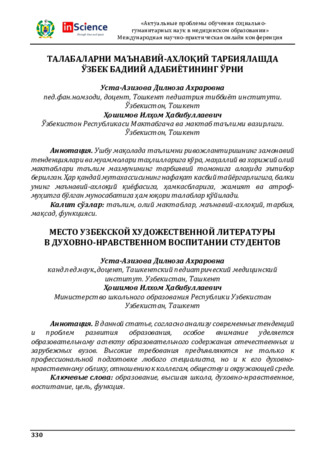
The place of uzbek art literature in the spiritual and moral education of students
In this article, according to the analysis of current trends and problems in the development of education, special attention is paid to the educational aspect of the educational content of domestic and foreign universities. High demands are placed not only on the professional training of any specialist, but also on his spiritual and moral character, attitude towards colleagues, society and the environment.

The place of stanzaic prosody and rhythm in the creation of poetic figures in the epoch of independence
Subjects of research: Uzbek lyric poetry in the epoch of independence: the works by the poets such as Erkin Vohidov, Rauf Parpi, Shavkat Rahman, Usmon Azim, Muhammad Yusuf, Ikbal Mirza.
Purpose of work: The study and investigation of the place and role of stanzaic prosody in modem Uzbek literature in the creation of poetic figures by means of the interpretation and analysis of poetry produced in the epoch of independence.
Methods of research: Comparative and analytical methods arc used in the dissertation.
The results obtained and their novelty: In the dissertation, for the first time, the process of conversion of stanzaic prosody and rhythm into artistic merit is identified. Herein the issue of the origin of strophical types and their interconnection with poetical figures is investigated. Besides, the role of rhyme and envoy in the exposure of the poetic figures is analyzed.
Practical value: The scientific conclusion on the analysis of the role of stanzaic prosody and rhyme in the creation of poetic figures can be the reference source for the further works associated with poetic figures and stanzaic prosody in the widespread investigation of modem Uzbek lyric poetry.
Degree of embed and economic effektivity: The main conclusions of the dissertation were used in delivering lectures and practical training on the theme “Modern literary process”, “Literary theory”, “The science of versification” for the students of Kokand Pedagogical Institute.
Field of application: theory of literature, literary criticism, modern Uzbek literature.
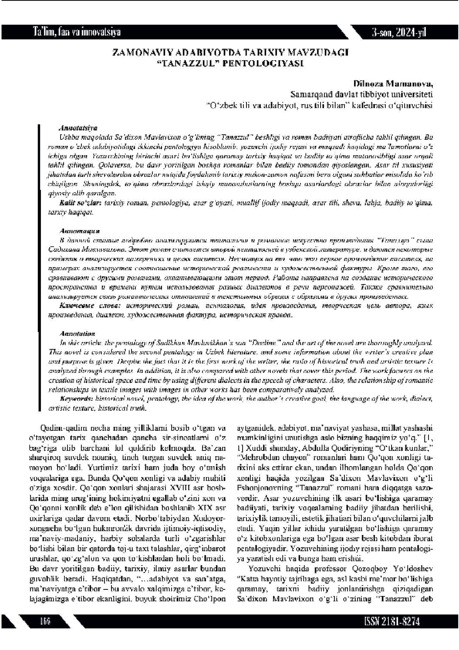
The pentology of "Tanazzul" in historical theme in modern literature
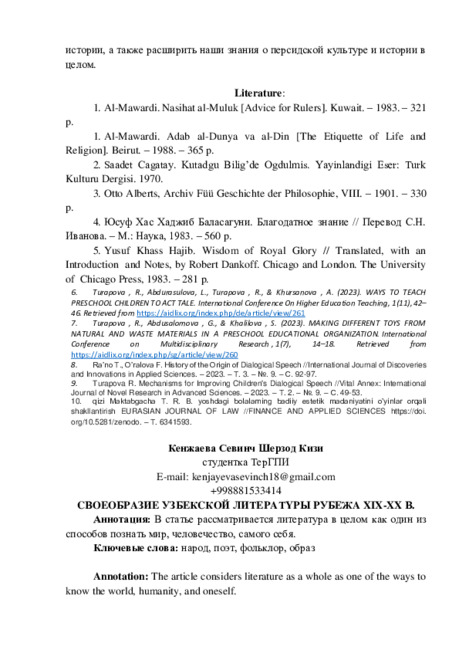
The originality of Uzbek literature at the turn of the 19th-20th centuries
The article considers literature as a whole as one of the ways to know the world, humanity, and oneself.
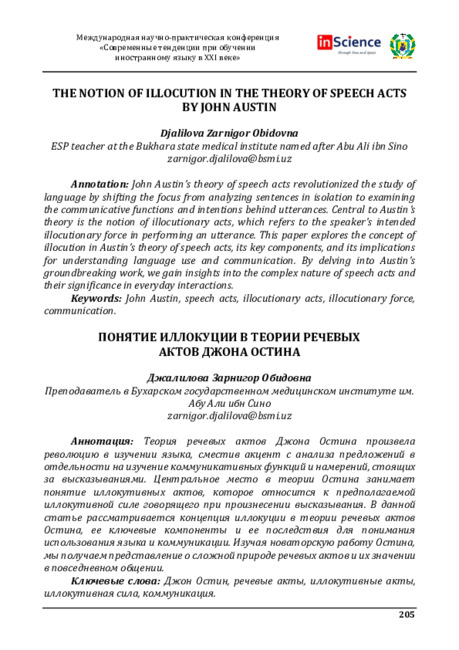
The notion of illocution in the theory of speech acts by John Austin
John Austin’s theory of speech acts revolutionized the study of language by shifting the focus from analyzing sentences in isolation to examining the communicative functions and intentions behind utterances. Central to Austin’s theory is the notion of illocutionary acts, which refers to the speaker’s intended illocutionary force in performing an utterance. This paper explores the concept of illocution in Austin’s theory of speech acts, its key components, and its implications for understanding language use and communication. By delving into Austin’s groundbreaking work, we gain insights into the complex nature of speech acts and their significance in everyday interactions.
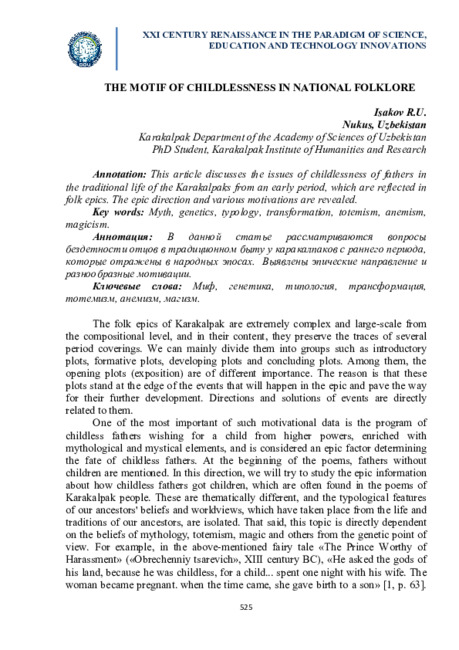
The motif of childlessness in national folklore
This article discusses the issues of childlessness of fathers in the traditional life of the Karakalpaks from an early period, which are reflected in folk epics. The epic direction and various motivations are revealed.

The main features of expressive syntax in modern english literature
the article is devoted to the study of the features of expressive syntactic means in modern English-language fiction. Examples of various expressive syntactic means are given, the most frequent of them are analyzed. The conclusion is made about the important contribution of the considered means to the creation of expressiveness of modern English fiction.
The Literary and Aesthetic World of Amir Khudoiberdi
In Uzbek poetry of the independence period, which is a legitimate part of world literature, special attention is paid to the generalization of scientific theoretical views on the creative worldview and creative philosophy of the socio historical period, the artistic perception of reality in poetry and the study of artistic realization. The intensification of the desire for the deep artistic development of the human spiritual world in the poetry of the independence period is associated with the renewal of the period, the historical environment and the artistic thinking of the creators themselves. The harmony of poetry and literary-aesthetic views is a direct result of the synthesis of the principles of creative phenomenon, personality, perception of the world, which is reflected in the author's "I". Image poetics plays an important role in revealing the creative concept and uniting it into a common denominator. The perfection of the product of artistic thinking as a synthesized system is determined by the level of creative thinking and talent. The work of Amir Khudoiberdi is one of such events in the history of national artistic thought, and in the works of the poet created in different genres, he expresses the life, dreams and will of the people in different socio-historical periods. The poet's tendency to create a holistic artistic history of the Uzbek people in the twentieth century is explained by the vast opportunities provided by independence, the end of ideological monopoly, the restoration of national values, the renewal of literary and aesthetic views, the translation of world literature into Uzbek. The transition from the depiction of things to the depiction of ideas has changed the content of artistic creation, while enriching the formal, semantic scale of artistic research.
Close acquaintance with world poetry has long served as one of the important factors in the renewal of our national literature, separated from its spiritual sources- religious and mystical literature, classical and modern literature. The content of the themes of emotional literature is characterized by a focus on the person, not directly on reality. The synthesis of world literary traditions can be seen in the works of Fakhriyor, Ulugbek Hamdam, Bahrom Ruzimuhammad, Farida Afroz, Nodira Afokova, Zebo Mirzaeva, Khosiyat Rustamova, Gozal Begim. Amir Khudoiberdi is also one of the poets of this literary generation who has his own creative credo and works in various genres. Any national literature manifests itself as a systematic, evolving stable phenomenon only in the harmony of different ideologies, styles, views, approaches, ideas, and even contradictions. Only then can it be a true metaphorical representation of being. Amir Khudoiberdi is one of the new generation of artists who lived in a complex and controversial period and saw and understood the subjective approaches to the literature of the Soviet era. A comprehensive scientific study of the creative style, individuality and mastery in the poetry of the independence period on the example of the work of a poet, the generalization of scientific and theoretical views on the poetry of this period gives important conclusions, this scientific research is the product of such a necessary need. In Uzbek literature, the works of Amir Khudoiberdi have not yet been comprehensively studied. The study of the poet’s work is also important in determining the influence, position, and place of local artists in literature. Also, the issue of art and literature, which is one of the means of spiritual and educational environment, education and their formation in our country, has always been in the forefront. Therefore, as the President of Uzbekistan Sh.M.Mirziyoev said: “...attention to literature and art, culture is first of all attention to our people, attention to our future, as our great poet Cholpon said, we have no right to forget that literature, culture and nation can live ”. This fact also determines the relevance of the topic.
Accordingly, this study is based on the Decree of the President of the Republic of Uzbekistan dated February 7, 2017 No. PF-4947 "On the Strategy for further development of the Republic of Uzbekistan", dated September 13, 2017 No. PQ- 3271 "Development of the system of publishing and distribution of books. to a certain extent in the implementation of the tasks set out in the Resolution "On a comprehensive program of measures to improve and promote the culture of reading and reading" and other regulations related to this activity.
The life and creativity of Karimbek Kami
Subjects of the research: the sources about a literary heritage, life and creativity of Karimbck Kami.
Aims of the research: collection of literary heritage, creation of the scientific biography, definition of the basic genres and themes of poet’s creativity, specification of a national position and relation of the poet to the complex social and political validity of that time, his contribution and place in Uzbek literature of the National renaissance epoch.
Methods of research: comparative and historical
Obtained results and their novelty: The life and creativity of Kami is investigated for the first time in the monographic plan. The sources arc investigated about his life and creativity, his scientific biography is created. The basic themes and genres of the poet’ creativity is classified. Poetic skills and professionalism are attentively studied. The place of the poet in the Uzbek literature of National Renaissance epoch is determined.
Practical importance: The material of the thesis can be used for studying of the National Renaissance’s epoch literature, for the definition of genre and thematic development of the Uzbek poetry, and also for explanation of the history of struggle for Independence.
Degree of application: The basic part of a literary heritage of Kami (Dilni obod aylangiz. Tashkent, “Manaviyat”, 1998) was printed as a result of scientific research. Kami is introduced in Uzbek literature manual as a literary person (Milliy uyg’onish davri O’zbek adabiyoti - Tashkent, “Manaviyat”, 2004). Many articles arc published on a theme of the thesis.
Area of application: studying of the problems of the National Renaissance epoch’s literature, research of the theory and development of classical poetic genres, in creation of a history of struggle for Independence.
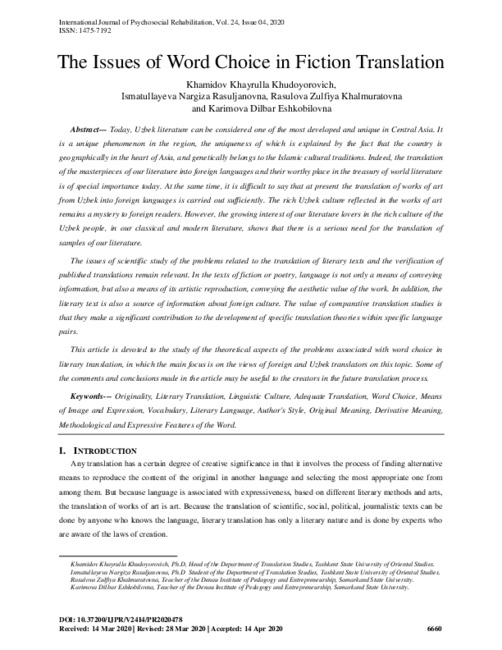
The Issues of Word Choice in Fiction Translation
Today, Uzbek literature can be considered one of the most developed and unique in Central Asia. It is a unique phenomenon in the region, the uniqueness of which is explained by the fact that the country is geographically in the heart of Asia, and genetically belongs to the Islamic cultural traditions. Indeed, the translation of the masterpieces of our literature into foreign languages and their worthy place in the treasury of world literature is of special importance today. At the same time, it is difficult to say that at present the translation of works of art from Uzbek into foreign languages is carried out sufficiently. The rich Uzbek culture reflected in the works of art remains a mystery to foreign readers. However, the growing interest of our literature lovers in the rich culture of the Uzbek people, in our classical and modern literature, shows that there is a serious need for the translation of samples of our literature. The issues of scientific study of the problems related to the translation of literary texts and the verification of published translations remain relevant. In the texts of fiction or poetry, language is not only a means of conveying information, but also a means of its artistic reproduction, conveying the aesthetic value of the work. In addition, the literary text is also a source of information about foreign culture. The value of comparative translation studies is that they make a significant contribution to the development of specific translation theories within specific language pairs.
This article is devoted to the study of the theoretical aspects of the problems associated with word choice in literary translation, in which the main focus is on the views of foreign and Uzbek translators on this topic. Some of the comments and conclusions made in the article may be useful to the creators in the future translation process.

THE ISSUE OF DEFINING AN EPITHET IN THE RESEARCH OF RUSSIAN SCHOLARS
The article studies the role of the epithet as a stylistic device that enhances expressiveness, imagery, and conveys an author’s unique, subjective perspective in literary texts. Despite its significance, there is no unified view on how to define this device, nor a single clear classification of epithets. The study’s object is the epithet as a stylistic tool, and the research subject is the issue of defining and categorizing epithets.
The study aims to investigate how epithets are defined in the works of Russian scholars and to review different approaches to their classification.
To achieve this goal, the following research tasks are set:
- Analyze various approaches to defining the epithet as a stylistic device.
- Explore the different classifications of epithets.
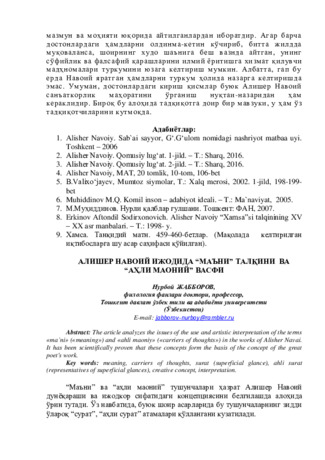
The interpretation of "mani" and the description of "ahli maoni" in the works of Alisher Navoi
Интерпретация «мани» и описание «ахли Маони» в творчестве Алишера Навои
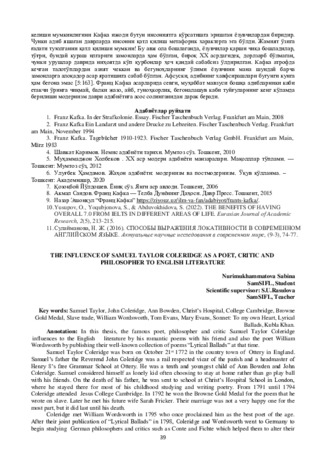
The influence of Samuel Taylor Coleridge as a poet, critic and philosopher to english literature
In this thesis, the famous poet, philosopher and critic Samuel Taylor Coleridge influences to the English literature by his romantic poems with his friend and also the poet William Wordsworth by publishing their well-known collection of poems “Lyrical Ballads” at that time
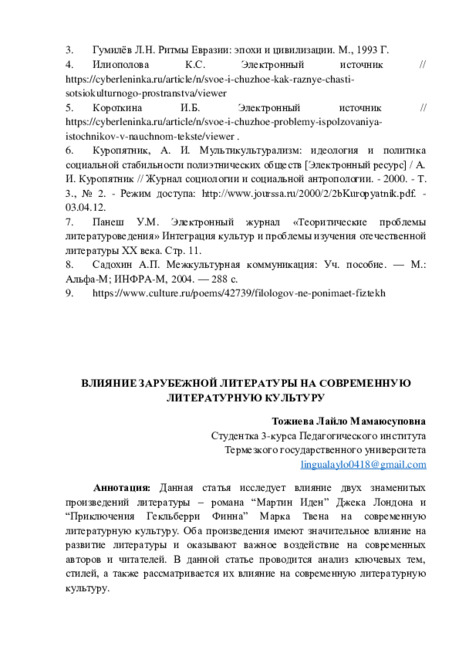
The influence of foreign literature on modern literary culture
Данная статья исследует влияние двух знаменитых произведений литературы – романа “Мартин Иден” Джека Лондона и “Приключения Гекльберри Финна” Марка Твена на современную литературную культуру. Оба произведения имеют значительное влияние на развитие литературы и оказывают важное воздействие на современных авторов и читателей. В данной статье проводится анализ ключевых тем, стилей, а также рассматривается их влияние на современную литературную культуру.
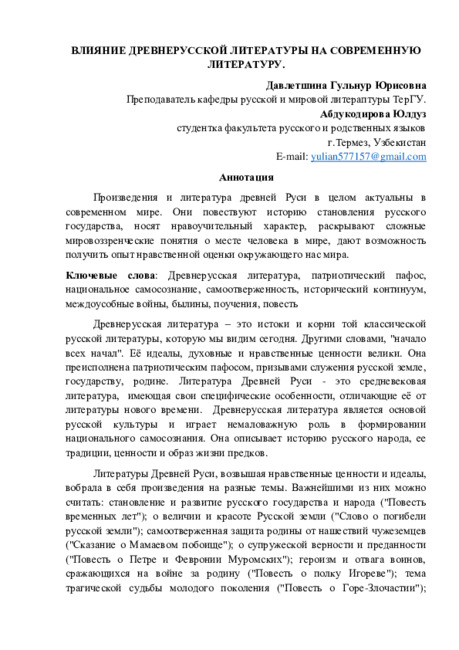
The influence of ancient Russian literature on modern literature
Произведения и литература древней Руси в целом актуальны в современном мире. Они повествуют историю становления русского государства, носят нравоучительный характер, раскрывают сложные мировоззренческие понятия о месте человека в мире, дают возможность получить опыт нравственной оценки окружающего нас мира.
The image of the night of miroj in poetry (Example of the works of A.Navoiy, Furkat and A. Oripov)
This article discusses the reflection of Miraj night in poetry. In the description of the Miraj night, examples from the works of Alisher Navoi, Furqat and Abdulla Oripov are analyzed and the common and different aspects of the theme in the poems of these three authors are studied. The description of the Night of Miraj occupies a special place in the works dedicated to our Prophet Muhammad (blessings to him and his relatives), the fact that this night has risen to the level of a unique image in the literature of the Muslim East, as well as comments on the difference between the nights of Isra and Miraj. It is proved with the help of examples from artistic works that these images are expressed with high pathos in our classic poets and in A.Oripov in a calm and subdued state. The sequence of events on the night of Miraj is considered as an example of the poetic works of all three artists, and scientific conclusions are drawn based on them.
The image of Hamlet in the tragedy “Hamlet”
A revenge tragedy, is a tragedy, as its name implies, in which the tragedy is brought about by the pursuit and accomplishment of revenge. The revenge tragedy was very popular during the Elizabethan and Jacobean periods, and it owed its popularity largely to the influence of Seneca, the ancient Roman dramatist
The image of a literary hero
The image of a literary hero is directly connected with many factors that make up the composition of an artistic work and determine its plot and composition. In particular, when analyzing the events in the plot system, when talking about the time and place where the events take place, when commenting on the purpose of the author and the idea of the work, of course, attention is paid to the image of the literary hero in the story,short story, novel, drama, comedy, tragedy, epic, legend.
How the highlighted life events are covered is determined by how the image of the literary hero is embodied. The skill of a writer, poet, dramatist as a creator, as well as the level of artistry of a work is evaluated depending on how the image of a literary hero is reflected in it.
The uniqueness of each work is evident in the image of the literary hero in it. Not one, but several literary characters move on the "stage" of a work of art. Depending on the level of their participation in the process of events, their place in the events of the plot system, they are conventionally divided into "main character", "main character", "secondary character”. The problem focused in the work connects them with each other. Each of the literary heroes illuminates a specific aspect of the problem, a certain edge of the focused problem with his activity. They contribute to the manifestation of the character traits of the main literary character.
This article discusses how the image of a person is reflected in works of art.
The host of the people of Maoni
In this monograph, the qualities of the great poet and thinker Alisher Navoi as a person and statesman, creative activity are highlighted based on new interpretations. Specific scientific views related to the mystical and literary-aesthetic world of our great-grandfathers have been put forward. Scientific-theoretical opinions are expressed in the Great Five - "Khamsa" regarding the artistic concept of the creator, the poetic interpretation of the image of the mother. The influence of Alisher Navoi's art on the improvement of the nation's literary and aesthetic thinking has been studied.
The monograph is intended for literary and narcissistic scholars, young researchers and general readers.
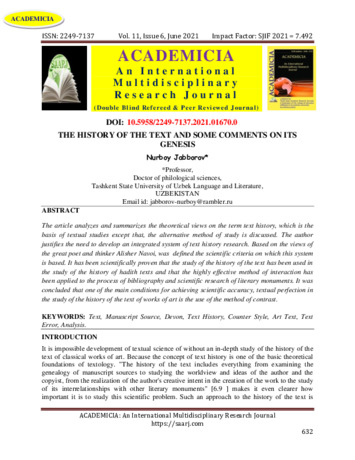
The history of the text and some comments on its genesis.
The article analyzes and summarizes the theoretical views on the term text history, which is the basis of textual studies except that, the alternative method of study is discussed.The author justifies the need to develop an integrated system of text history research. Based on the views of the great poet and thinker Alisher Navoi, was defined the scientific criteria on which this system is based. It has been scientifically proven that the study of the history of the text has been used in the study of the history of hadith texts and that the highly effective method of interaction has been applied to the process of bibliography and scientific research of literary monuments. It was concluded that one of the main conditions for achieving scientific accuracy, textual perfection in the study of the history of the text of works of art is the use of the method of contrast.

