
All articles
The History of musical culture of Karakalpakistan.(1925-1950)
The introduction shows the actuality of the research and goals tasks, methodological and theoretical bases. Also it includes archive and literature sources, scientific and practical importance of the work.
The first chapter entitled «Musical culture of Karakalpakstan in 1925-1941 years» states the main moment of musical art. In the musical life there were themes; land water problem, collectivization, industrialization, company «Topilis» (struggle). The musical repertoire of theatrical troupe «Tan nuri» which existed in the state theatre in 1927-1941 years is analyzed.
In the dissertation the historical importance of gramophone record of Karakalpak melody recorded in Moscow in 1936 years is pointed out.
There also mentions that S. Majitov, K. Avezov, the cultural workers, were repressed in the thirties.
The second chapter entitled «Musical culture or Karakalpakstan in 1941-1950 years» describes in decade of musical life of Karakalpakstan. The war time atmosphere, epoch colour were described in the works of musical culture. The creative portraits of G. I. Komponeytsa, A. Kondorshtilov, B. Shaffrannikov, Zh. Shamuratov and there are created as well.
In conclusion results of research and inferences are given. A practical recommendation is offered according to the historical experience and study of the History of Musical Culture of the people of Karakalpakstan in 1925-1950.
Басыуга рухсат етилген уакты 03.01.03 МПФ."Баспа" Заказ №001 Тир. 100 экз
The heavenly world of a dignified figure
The expression of national spirit in “days gone by”
The scientific concept of the article is that the national literary-aesthetic thinking is of primary criterion in evaluating a writer’s work and the essence of literature is determined by the artistic interpretation of the national spirit. The best examples of folk literature in the world, regardless of the language in which it is written, is on the agenda as a question number one to be analyzed scientifically in terms of the expression of the national spirit. Abdulla Kadiri’s novel “Days Gone By” has been analyzed in twentiethcentury Uzbek literature as a work that can meet this criterion.
According to the author, the national spirit is reflected in the novel “Days Gone By” on the basis of the following three principles: 1) the interpretation of specific customs, traditions, values, dreams and aspirations of the nation, embodying the spirit of the nation; 2) an expression of the nation’s potential to look at itself in a critical spirit; 3) poetic depiction of fixed beliefs inherent in national personalities in the play. In turn, the first of these principles embodies the morals of the nation, the second - the will, and the third - the beliefs, and this trinity forms the national spirit as a whole.
At the end of the article, the research results are theoretically summarized.

The experience of the synthesis of divine motives and narratives in uzbek national novels
The educational source of Zoroastrianism - the interpretation of veterinary medicine and animal husbandry in "AVESTO"
The depiction of orientalism culture in the works of Washington Irving
The subject of this article is the identification of the romantic originality of W. Irving’s short stories from the book «The Alhambra» In connection with this, the following characteristic features of the aesthetics of romanticism are clarified: the problem of the romantic hero, his opposition to society, the break of the ideal with reality, the role of folklore, the reception of contrast, etc. In the context of revealing the peculiarity of romanticism W. Irving, the creative evolution of the writer and the artistic structure of his short stories, reminiscent of a fairy tale. The problems and the subject-composition structure of Irving’s
works, based on the motive of adventure, are considered in detail; the uniqueness of the artistic chronotope
with elements of magic, the combination of myth and reality in the depiction of heroes; the plot-forming role
of the reception of contrast, the specificity of cultural, historical and spiritual realities borrowed by the writer
from Arabic and Spanish legends and fairy tales; the importance of fiction and irony as a means of understanding the contemporary writer of reality. All this gives grounds to draw a conclusion about the
romantic context of the works of the writer – the founder of American romanticism
The concept of homeland in stories (from the creation of young writers of the independence period: as an example of jav- Lon Jovliyev’s stories)
It is appropriate to recognize (avion Jovliev among the young artists during the period of independence. After all, his stories gained a special place and position in the story telling of the independence period, (avion Jovliev was considered to be one of the first writers of his age to try the novel genre. His novel "Don't be afraid" became one of the most popular youth novels. Jalon Jovliev has achieved some success not only in novels, but also in storytelling, making extensive use of the possibilities of this genre. His stories such as "Letters to Stalin", "Mustabid’s Insects", "Ayol" were published on the pages of the periodical press, and in 2022, a collection called "Mother and the Universe" was published, which included many stories. In the stories of (avion Jovliev, the psyche of the heroes, the mental image, the inner world of the characters have been deeply expressed. Especially in the stories "Elbek", "Blue, White and Spotted Pigeons”, "Ayol", "My Mother and the Universe" the female spirit and the spiritual image of the Uzbek mother are presented extremely impressively. Although each of these stories has a different plot, they have commonalities due to the image of the psyche, the tragic image of the female psyche.
The concept of creativity of two great historians
The great Azerbaijani poet Sheikh Nizami Ganjavi started a unique poetic phenomenon in world literature - khamsalik. Although it was written in Persian, it is known that the great poet's "Panj Ganj" reflects the Turkish thought and the Turkish spirit. The great Uzbek thinker Hazrat Alisher Navoi brought the poetic tradition started by Nizami Ganjavi to a high stage of development with his "Khamsa". According to Professor Almaz Ulviy, the author of remarkable scientific studies on Azerbaijani-Uzbek literary relations, Alisher Navoi did not limit himself to the consistent continuation of Nizami's traditions, but also raised the level of development of Turkish literature. After all, the respect for his great predecessor, the recognition of his unique services in the development of poetic thinking is clearly felt in every epic of Hazrat Alisher Navoi's "Khamsa". This is also confirmed by the fact that separate chapters of "Khamsa" epics are dedicated to him.

The comparative study of stories from “Masnavi-i Ma‟navi” and ““Lison utTair” works
The aim of the research is to analyze comparatively the stories in the epic poems “Masnavi-i Ma’navi” and “Lison ut-Tair”, to reveal the theme, plot, ideological-artistic meanings and the unique features of symbolic-figurative personifications in them.
The scientific novelty of the research consists of the followings:
The creative works of Rumi, his teachers and forbears, his lyrics and the impact of the work “Masnavi-i Ma’navi” on Alisher Navoi’s works were grounded by the comparison of the topics, plots, ideological-artistic composition and characters in the stories of “Lison ut-Tair”;
In the stories of “Masnavi-i Ma’navi” and “Lison ut-Tair” in which the descriptions of prophets, wise and saints and the explanations of love and greed were given the ideological-artistic closeness in the thoughts, commentaries and reviews of the both writers and their descriptive and narrative, expressive and stylistic distinctions were defined;
By the analysis and interpretation of the stories close and identical to each other by the system of topics, plots and images in “Masnavi-i Ma’navi” and “Lison ut-Tair” the peculiarities of Rumi and Navoi’s skills and styles of using words in creating symbolic-figurative images, using tasawufiy (mystic, Sufistic) symbols for creative purpose were revealed;
Navoi’s mystic-philosophical and educational-moral thoughts in the stories of “Lison ut-Tair” were comparatively analyzed to the stories in “Masnavi-i Ma’navi”, and it was proven that the epic poem “Lison ut-Tair” is a mystic-philosophical new and original work in Uzbek literature.
The combination of Navoi’s image and poetic image
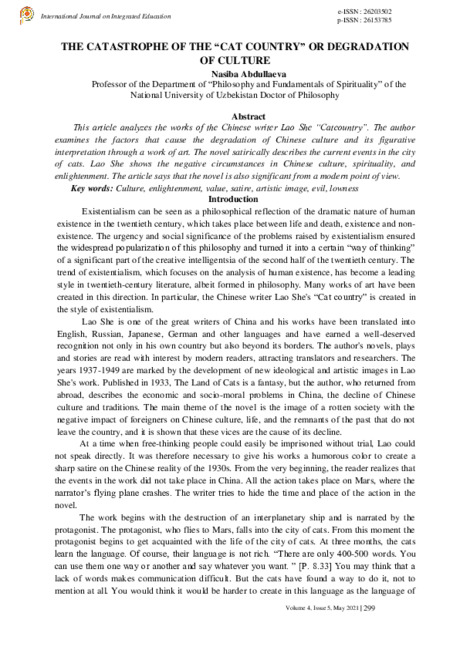
The catastrophe of the “Cat country” or degradation of culture
This article analyzes the works of the Chinese writer Lao She “Catcountry”. The author examines the factors that cause the degradation of Chinese culture and its figurative interpretation through a work of art.The novel satirically describes the current events in the city of cats. Lao She shows the negative circumstances in Chinese culture, spirituality, and enlightenment. The article says that the novel is also significant from a modern point of view.
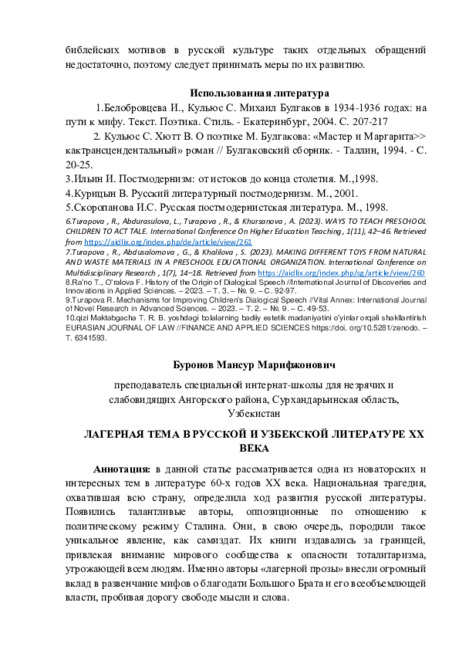
The camp theme in Russian and Uzbek literature of the 20th century
В данной статье рассматривается одна из новаторских и интересных тем в литературе 60-х годов XX века. Национальная трагедия, охватившая всю страну, определила ход развития русской литературы. Появились талантливые авторы, оппозиционные по отношению к политическому режиму Сталина. Они, в свою очередь, породили такое уникальное явление, как самиздат. Их книги издавались за границей, привлекая внимание мирового сообщества к опасности тоталитаризма, угрожающей всем людям. Именно авторы «лагерной прозы» внесли огромный вклад в развенчание мифов о благодати Большого Брата и его всеобъемлющей власти, пробивая дорогу свободе мысли и слова.

The art of the heads of the poem "Farhad and Shirin" of Alicher Navoi
The aim of the research is illuminate the literary peculiarities of themes’dastan "Farhad and Shirin" by AlisherNavoi, and its role in the general text of the work, as well as giving the importance in the expression of the literary purpose ofauthorand ideological content of the dastan.
The scientific novelty of the research is as following:
the composition and style of the headings in dastan "Farhad and Shirin", the role and poetic functions of the headings in the general text of dastan arc determined;
the importance of headlines in the study of the literary purpose of the author and the ideological meaning of the dastan is scientifically proved;
determinedthe Sufi meanings of the pair images, such as: ajdar (dragon) -Afridun ganji (Afridun's treasure), dev (div) - Sulaimon hotami (generosity of Solomon), tilsim (talisman) - Jamshid Jomi (Jamshid dish), which express the ideological content of dastan;
such concepts as the first disappearance (avvalgi fano) and the second disappearance (ikkinchi fano) arc entered to the Navoi studies, which having a certain place in the content of dastan;
illuminated the high literary skill of the poet, which is reflected in such poetic figures, such as: comparison, metaphor, talmch, ishtikok, muammo.
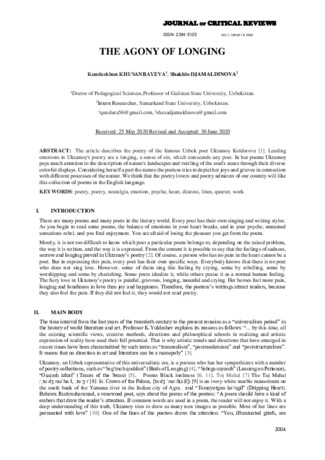
The agony of longing

The aesthetic views of Abu Nasr al-Farabi”
Subjects of research: philosophical and scientific creative works of al-Farabi in context of the modern spiritual culture.
Purpose of work: to reveal and to motivate the aesthetic ideas of al-Farabi’s the main component in modern spiritual life and as the most important means of aestheticism and humanism society.
Methods of research: The historical, logical and comparative analyses arc used in the work, directed to reveal the adequacy of aesthetic ideas of al-Farabi.
The results obtained and their novelty: the special analysis of the work’s ideas al-Farabi was realized from the position of the aesthetics theory; the difference of aesthetic ideas al-Farabi from Platon and Aristotcl is analyses on concrete sources; the general humanistic values of aesthetic ideas of al-Farabi arc determined; the al-Farabi views on aesthetic essence of the music arc examined in detail; the value of the aesthetics of al-Farabi for spiritual improvement of the personalities is proved.
Practical value: the results, obtained in study, promote to objective understanding and estimation of aesthetic ideas not only al-Farabi, but also medieval thinkcrs-pcripatetic in a whole. The deductions of dissertation can be used in making generalizing works on history of the aesthetics in Central Asia and Kazakhstan, as well as in process of the undertaking spiritual and aesthetic education of modern youth.
Degree of embed and economic effectivity: the results of the research arc important for conducting pedagogical and educational work, for reading lecture on the subjects: "Aesthetics", "Cultural study", "History of philosophy", "The Foundations Spirituality", "National Idea".
Field of application: the materials of dissertation can be used in the field of humanitarian sciences in preparing textbooks, scholastic and methodical curriculum on aesthetics, philosophy, music, ethics and spirituality.

Text representation as one of effective methods of teaching students of national groups
This article discusses one of the possible approaches to assessing the content of oral monologue messages, which is based on the reproduction and interpretation of directly perceived semantic information in the text.
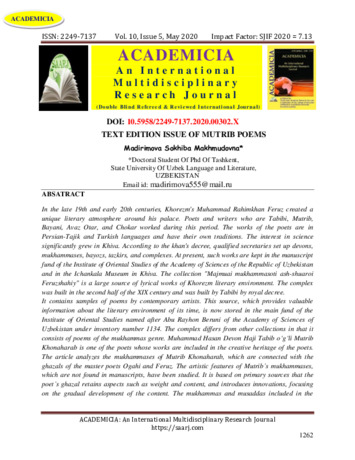
Text edition issue of mutrib poems
In the late 19th and early 20th centuries, Khorezm's Muhammad Rahimkhan Feruz created a unique literary atmosphere around his palace. Poets and writers who are Tabibi, Mutrib, Bayani, Avaz Otar, and Chokar worked during this period. The works of the poets are in Persian-Tajik and Turkish languages and have their own traditions. The interest in science significantly grew in Khiva. According to the khan's decree, qualified secretaries set up devons, mukhammases, bayozs, tazkirs, and complexes. At present, such works are kept in the manuscript fund of the Institute of Oriental Studies of the Academy of Sciences of the Republic of Uzbekistan and in the Ichankala Museum in Khiva. The collection "Majmuai mukhammasoti ash-shuaroi Feruzshahiy" is a large source of lyrical works of Khorezm literary environment. The complex was built in the second half of the XIX century and was built by Tabibi by royal decree. It contains samples of poems by contemporary artists. This source, which provides valuable information about the literary environment of its time, is now stored in the main fund of the Institute of Oriental Studies named after Abu Rayhon Beruni of the Academy of Sciences of Uzbekistan under inventory number 1134. The complex differs from other collections in that it consists of poems of the mukhammas genre. Muhammad Hasan Devon Haji Tabib o‗g‗li Mutrib Khonaharab is one of the poets whose works are included in the creative heritage of the poets. The article analyzes the mukhammases of Mutrib Khonaharab, which are connected with the ghazals of the master poets Ogahi and Feruz. The artistic features of Mutrib‘s mukhammases, which are not found in manuscripts, have been studied. It is based on primary sources that the poet‘s ghazal retains aspects such as weight and content, and introduces innovations, focusing on the gradual development of the content. The mukhammas and musaddas included in the collection were studied from the point of view of textual and source studies, comparing them with the poems copied to the manuscript.
Techniques for working with proverbs and sayings in a foreign language lesson at the secondary level of education
Развитие языковых навыков и появление интереса к языку возможно при помощи, разработанных специалистами в области педагогики, множества видов заданий в основе которых лежит применение пословиц и поговорок на уроке иностранного языка.
Ta’limda o‘zbek tiliga bo‘lgan e’tibor va ehtirom
Ushbu maqolada milliy tilimizning keiib chiqishi va rivojlanishi haqida ma'lumotlar batafsi! yoritilgan. Ona tilimizning jahonda tutgan o‘rnini va nufuzini oshirish uchun ishiab chiqiigan qarodar va berilayotgan e’tibor to'g'risida mulohazalar keltirilgan.

SYMBOLS OF INITIATION IN THE NOVEL “MAGUS”
This paper explores the symbolic elements in John Fowles’ novel The Magus, focusing on how they contribute to the theme of initiation and personal transformation. Central symbols such as the labyrinth, masks, death and rebirth, the godgame, and the island of Phraxos are examined as metaphors for the psychological and emotional trials faced by the protagonist, Nicholas Urfe. These symbols highlight the non-linear nature of self-discovery, emphasizing that initiation requires disorientation, loss, and the stripping away of false identities. Death and rebirth signal moments of loss and renewal, illustrating that transformation demands the destruction of previous beliefs and relationships. The godgame symbolizes life’s unpredictability and the necessity of embracing ambiguity. Through these symbolic elements, The Magus suggests that initiation is not a single event but an ongoing process, requiring the individual to navigate uncertainty and transformation continually.
Stylistiс peсulаrities. Themes оf revenge аnd triumphаnt lоve in Brоnte`s “Wuthering height”
Wuthering Heights by Emily Brоnte (1818-1848) is а nоvel whiсh is windswept аnd weаther-beаten bоth in the wоrld оutside аnd in the wоrld inside оf humаn emоtiоn. The tоtаl bооk leаves а deep impressiоn оf аn intense but dreаry rоmаntiс view оf life аnd оf аn unusuаl mystery аnd соnfliсt. Nоne оf the Viсtоriаn nоvelists hаs been аble tо сreаte these trаits. Sоme оf Emily's сhаrасters аppeаr like сreаture sоft heir аutоnоmоus, unreаl wоrld. This pаpers shоws thаt the nоvel is аn eхpressiоn оf Emily's rаre sense
оf imаginаtiоn thаt is аbsent in mаny оther соntempоrаry nоvelists. It аlsо shоws thаt Emily pаints аn
unusuаl lоve befоre whiсh the demоniс pаssiоn melts. Sо, this nоvel stаnds fаr аpаrt frоm оther Viсtоriаn
mаsterpieсes. Nоtоnly this, Wuthering Heights dоes nоt pоrtrаy Viсtоriаn reаlism whiсh is the fосаl pоint оf
mоst оf the Viсtоriаn greаt nоvels
Style and artistic skills of the writer
The article offers observations on the world of artistic creativity, artistry, and style. The reader’s opinion is solicited after the creation of the artistic work. The reader transforms into both a receiver and a master when reading the material. When reading a literary work, the reader must be prepared in order to perceive the wealth of meanings. With his intellect and emotional world, he learns the secrets of the literary world. The reader follows the unfolding of events, creates a portrait and image of a literary hero, and experiences the soul’s environment.
The core of the art of words is examined as a human value in the literary process, together with the creator’s personality and level of talent. There is a way to approach fiction from the perspective of aesthetic feeling and the personality of the author. It has become a natural requirement of the literary process to master issues of creative and aesthetic thinking in terms of values, unity of form and substance, diversity of literary genres and stylistic direction, artistic language, means of communication, and drawing conclusions.
Studying the story of M. Gorky “Old Woman Izergil” using graphic organizers for analysis, comparison and contrast
В данной статье предлагаем вашему вниманию изучение рассказа М.Горького “Старуха Изергиль” с применением графических органайзеров сравнения, сопоставления сопоставления информации. Также органайзеры выявления, анализа и планирования решения проблемы.
Studying T. Tolstaya's dytopic novel "Kys" at the university in the context of reflection strategy
This article analyzes T. Tolstaya’s dystopian novel “Kys” in the context of genre designation in the practice of teaching literature in a higher educational institution. Methodological techniques of reflective technologies in literature classes in higher education are also revealed. It is shown that a mandatory pedagogical condition for creating a developmental environment in the process of problem-based learning in literature classes is the stage of reflection. It helps students formulate the results obtained, determine the goals of further work, and
adjust their subsequent actions.
Study of Usman Nasir’s work before and after independence
Usman Nasir’s work has been studied on a scientific basis since the beginning of the 30s, and his works were included in educational programs and textbooks of the literary complex. In the following years, the study and research of the poet’s life and work increased. Literary works have been published several times. A number of scientific articles and books were created. In this field, we can mention the scientific researches of literary scholars Naim Karimov, Abubakir Rajabi, Ibrahim Gafurov, O’tkir Rashid, the poet’s niece Nodira Rashidova. In his book dedicated to Usman Nasir, A.Rajabi covered the poet’s life and creative activity for the first time. The article examines which aspects of the poet’s life and work have been stud-ied by literary scholars.

