All articles
Iqbol Mirzo she’riyatining o‘ziga xos xususiyatlari
Maqolada Iqbol Mirzo she’riyatining o‘ziga xos xususiyatlari, shoir ijod idagi yangicha tashbehlar, she’rlaridagi ta’sirchanlik sabablari haqida fikr yuritiladi. Shuningdek, she’rlaridan parchalar tahlil qilinadi.
Interpretations of the image of Khizr in the poetry of Alisher Navoi
The article examines both scientific, artistic and mythical views related to the image of Khizr, and to what extent they influenced Alisher Navoi's work. In the process of writing the article, several foreign and national sources, religious literature were also referred to.
Interpretation of works of poetess in Tazkiras
Interpretation of wind symbols in rauf parfi's poetry

INTERPRETATION OF THE CONCEPT OF UNITY IN THE NOVEL “BILGA KHAGAN”
This article analyzes the concepts of ethnocultural pedagogy and nationalism reflected in the Orkhon-Yenisei epigraphic heritage, especially in the stele “Bilga Khagan”. The sources examine ethnopedagogical values, mechanisms of spiritual and ethnic transmission, and models of sociocultural identification. Bilge Khagan's ethnopedagogical leadership function is revealed through his activities, manifested through archetypal images and ritual-symbolic practices in the formation of national consciousness. The pedagogical significance of the work is explained by the reflection of ethnopedagogical heritage in historical sources, the identification of ancient methods of national upbringing, the analysis of the mechanisms of transmission of spiritual and moral values, the definition of the role of mythological images in the educational process, and the illumination of the theoretical foundations of ancient Turkic pedagogy. In the monuments, the elements of the epic and the didactic function of collective memory are studied separately. These sources provide an opportunity to reconstruct the models of spiritual and moral education of the Turkic peoples as historical examples of ethnopedagogy.
Interpretation of symbols of nature in the poems of Rauf Parfi
national independence, expanding the range of topics, opening the way to the psyche and consciousness of readers through various symbols. riyat. The study of nature and related concepts in poetry is relevant today

Interpretation of Chulpan's creativity in Uzbek literary criticism in the period of independence (on the example of poetry and prose).
The aim of the research. The aim of the research is to substantiate the principles of updating conceptual approaches and techniques in revealing the writer's skill based on a holistic study of the studies of modem Uzbek literary criticism in chulpanistics.
The scientific novelty of the research consists of the following:
a new approach to assessing life and creativity of Chulpan from point of view of universal human ideas and creative heritage, conducting research on the basis of advanced approaches and methods of world literary criticism is assessed as one of main features of Uzbek literary criticism of the period of independence;
The role of socio-acsthctic and biographical interpretations about Chulpan's creativity and biographical interpretations in expressing artistic perfection of poetry, imagery, symbolism, poetic multiplicity and spirit of time arc revealed;
in comparative plane different opinions about Chulpan's creativity were evaluated, a positive trend that appeared in the literary representation of independence, justified as a positive tendency - a pluralistic scientific approach;
a comparative analysis of novel “Day and night” with the novels of F.Kafka and A.Camus is illuminated as a factor demonstrating the invaluable role of Chulpan's works in world literature.
Integrated approach to teaching a foreign language
In the article the necessity to teach a foreign language in the connection with other subjects is discussed. Integrated teaching gives thediscipline a new significance and motivates students to learn the language further. This approach is innovative in foreign languages teaching.
Innovative approaches for the study of languages and literature in the modern literary process
The main objectives of innovative learning are: the growth of intellectual, communicative, linguistic and creative abilities of students, the development of personal qualities of students, the development of skills that affect educational and cognitive activity and the transition to the level of practical creativity, the development of various systems of thinking, the formation of high-quality knowledge,
skills and abilities. This article discusses problems and innovative approaches in the study of Russian language and literature.
Incomplete sentences in the stories of A.P. Chekhov
this article examines contextually incomplete and situationally incomplete sentences in the stories of A.P. Chekhov. Incomplete sentences occur not only in monologue, but also in dialogic speech and are very productive in the considered stories of A.P. Chekhov.
In the works of Khayriddin Sultan reflection of life events
In this article, Khayriddin Sultanov, one of the major figures of modern Uzbek literature, discusses how life events are artistically
reflected in his stories and short stories. In the writer’s works, the reality of life, the historical truth, the complex inner experiences of a person
are impressively reflected artistically, and the reality is viewed from the perspective of high humanity. In the writer’s stories such as “Dunyoning siri”, “Ghulomgar- dish”, “Qog‘oz gullar” and the short stories “Saodat sohili”, “Yozning yolg‘iz yodgori”, “Ko‘ngil Ozodadur... ”, people’s daily life, worries, attention is paid
to the truthful coverage of their aspirations and relationships. The author’s short stories focus on convincingly revealing the spiritual experiences of
a person. The events recorded in the writer’s short stories are similar to events in life. The characters in them look like real people. The thoughts and worries of these heroes will not leave anyone indifferent. The article mentions such features of the writer’s work.
In Isajon Sulton novel Alisher Navoi, landscape is the basis of romanesque thinking

Importance of Tazkirat-ul-Avliya by Muhammad Siddiq Rushdi in the Study of Hagiographic Sources
Subjects of the inquiry: hagiographic heritage of Farididdin Attar, Alisher Navai, Tazkitat-ul-Avliya by Muhammad Siddiq Rushdi, Hizonat-ul-Asfiya by Lokhuri, poetic divans / a collection of poem of one poet I by Huvaido, Majzub, Khazini, Mirmakhmud Qori.
Aim of the inquiry: a fundamental study of Tazkitat-ul-Avliya by Muhammad Siddiq Rushdi as hagiographic source of the 18th century and showing its importance in the study of Oriental hagiographic sources.
Method of the inquiry: scientific character, objective character and historical method, findings based on the comparative analysis and generalization.
The achieved results and their novelty: little-studied works and uninvestigated manuscripts of the 18th-19lh centuries have been introduced into the scientific circle.
Practical value: new methods of interpretation of hagiography, the Sufi literature and Islamic spirituality, as a whole, are suggested and approved in the example of Tazkitat-ul-Avliya.
Degree of embed and economic effectivity: basic results and findings of the thesis have been used while working out and conducting some educational courses, such as Basic Principles of Spirituality, Religious Studies, Cultural Studies, Sufism and Sufi Orders, as well as the special courses on the works of Islam Karimov.
Sphere of usage: History of Islam, Hagiography, Philology, Religious Studies, Ideology of National Independence, Basic Principles of Spirituality, Philosophy, Pedagogy, Source Studies, Textual Study, Sociology of Religion and so on.
Impact characteristics of empathy in newspapers
This article provides information on the impact of empathy in newspapers and magazines and the norms of their application.
The phrase “empathy” is used by psychologist Edward. B was introduced by Tetchener in 1909 in Germany as a translation of einfuhlung (meaning emotion).
So how are grief and empathy different? Depression involves more passivecommunication, but empathy usually involves a very active effort to understand the other person. Many theories have been proposed to explain empathy. Preliminary research on the subject focuses on the concept of empathy. The philosopher Adam Smith allows us to expe rience things we can never feel otherwise.
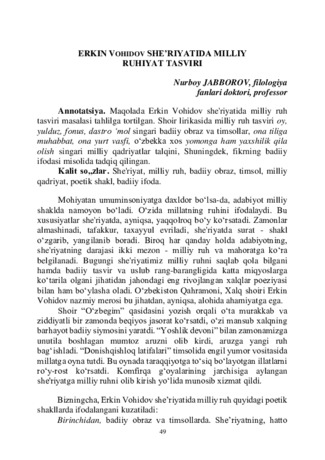
Image of national prayer and poetry by Erkina Vakhidova
The article analyzes the image of the folk spirit in the poetry of Erkin Vakhidov. In the poet's lyrics, the image of the people's soul is explored on the basis of artistic images and symbols, such as the moon, star, lantern, dishes, love for the native language, an attribute of the Motherland, interpretation of national values, such as the ability to do good even evil, characteristic of Uzbeks, as well as artistic expression of thought.

Image of doctors in Zoir Mamajonov's short story "Those Sitting Around the Bonfire"
Тиббиётимиз ривожланиб, янги ўзгаришлар содир бўлаётган бир даврда китобхонлар, ўқувчилар, тиббиёт олий ўқув юртлари талабаларининг китобга бўлган қизиқишларини ошириш, инсон саломатлиги, соғлом турмуш тарзи, маънавий ҳамда маърифий етукликни юқори поғонага кўтариш асосий вазифаларимиздан бўлиб ҳисобланади. Таниқли адиб ва публицист Зоир Мамажоновнинг “Гулхан атрофида ўтирганлар” қиссаси ҳар бир давр учун долзарблигини йўқотмайди, чунки унда инсон саломатлиги посбонлари бўлмиш шифокорларнинг маънавий қиёфаси, одоб ахлоқи, жамият ва ҳар бир инсон учун нақадар муҳимлиги тилга олинади.
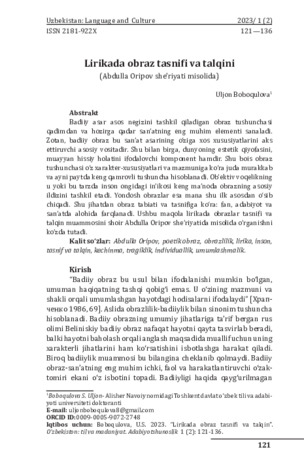
Image classification and interpretation in lyrics (In the example of Abdullah Oripov’s poetry)
The concept of image, which is the basis of a work of art, has been considered the most important element of art since ancient times and until now. After all, an artistic image is the main tool that reflects the unique characteristics of a work of art. At the same time, it is also a component that expresses the aesthetic image of the world, a certain emotional state. Therefore, the concept of image is a very complex and at the same time comprehensive concept according to its characteristics and content. In one way or another, the reflection of objective reality in the human mind is the main root of the image in a broad sense. And the accompanying images grow from this first base. In this respect, according to the nature and clas sification of the image, it is distinguished in science, literature and art. This article aims to study the problem of classification and interpretation of ima ges in lyric poetry on the example of poet Abdulla Oripov
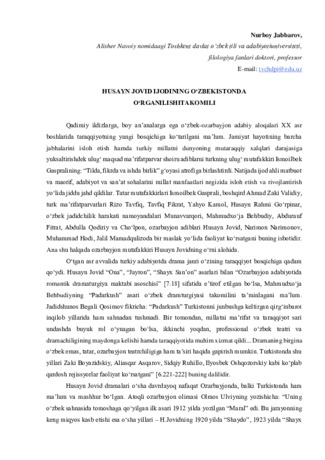
Hussain Javid's creation is in Uzbekistan learning improved
The article analyzes the study of the work of the Azerbaijan poet and playwright Huseyn Jovid in Uzbekistan. Analytical views were expressed regarding the attention of the author’s works at the beginning of the twentieth century of the great Uzbek poet and playwright Abdulhamid Chulpan, the translation of his works into Uzbek by Usmon Kuchkor and Tahir Kahhor at the beginning of the 21st century, the dissertation about the work of Huseyn Jovid in the Uzbek literary criticism, as well as the creation of a number of research today. On a scientific basis, is illuminated the role of the literary heritage of Hussein Jovid in the development of Uzbek-Azerbaijan literary relations is highlighted.
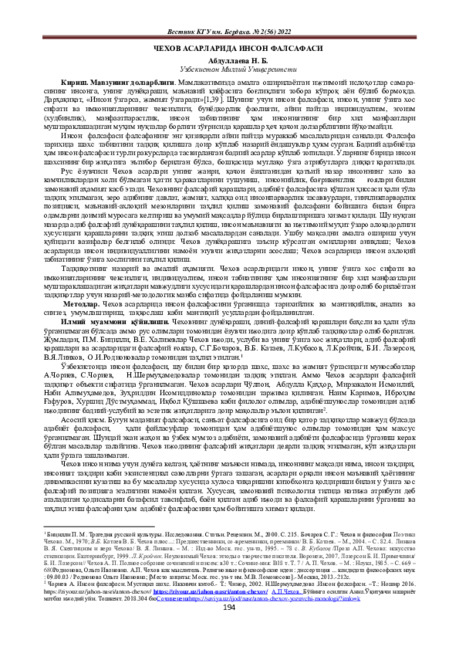
Human philosophy in Chekhov's works
It is becoming more and more clear that the effectiveness of social reforms implemented in our country depends on a person, his worldview, spiritual image. Indeed, "When a person changes, society changes" [1,39]. Therefore, human philosophy, human, his unique quality and limitlessness of possibilities, creative activity, at the same time individualism, egoism (selfishness), self-interest, views that human nature also has important points where the same interests of mankind are shared will never lose their relevance.
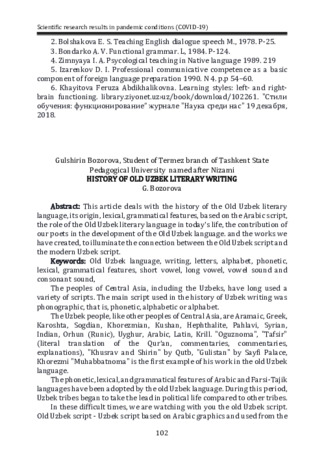
History of Old Uzbek literary writing
the role of the Old Uzbek literary language in today's life, the contribution of our poets in the development of the Old Uzbek language. and the works we have created, to illuminate the connection between the Old Uzbek script and the modern Uzbek script
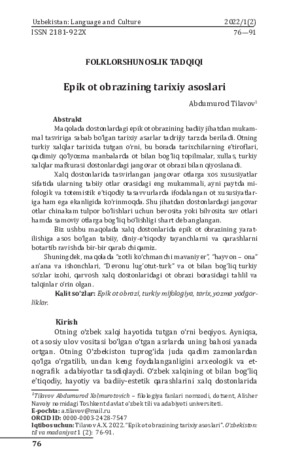
Historical foundations of the epic horse image
The article provides a gradual presentation of the historical works that led to the artistically perfect depiction of the epic horse in the epics. The place of the horse in the history of the Turkic peoples, the confessions of historians in this regard, the findings of the horse in ancient manuscript sources, in short, the ideology of the Turkic peoples is compared with the image of a war horse in the epics.
As characteristic of the war horses described in folk epics, they appear to be the most perfect of the natural horses, as well as the horse features expressed in mythological and totemistic beliefs. In this respect it was understood that the war horses in the epics must be directly or indi- rectly dependent on water horses and celestial horses in order to be true tulpars.
In this article, we will take a closer look at the natural, religious beliefs and views that underlie the creation of the epic horse image in folk epics.
The article also includes “nomadic mavaniyer”, “animal-mother” traditions and beliefs, “Devonu lug'otut-turk” and commentary on Turkish words related to the horse, analysis of the image of the horse in the Karvash folk epics and interpretations took place.
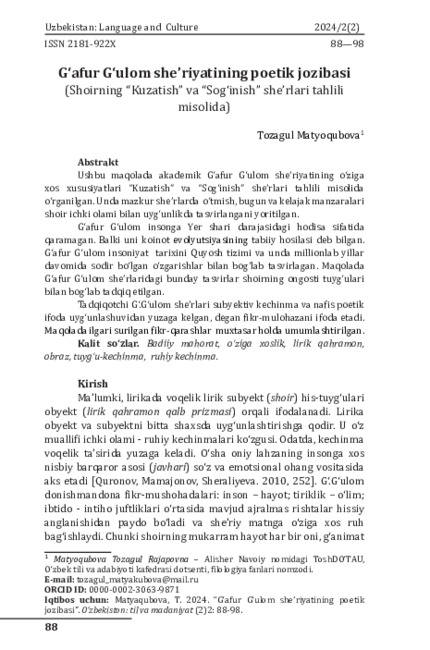
He poetic charm of Gafur Ghulam’s poetry (On the example of the analysis of the poet’s poems «Observation» and «Missing»)
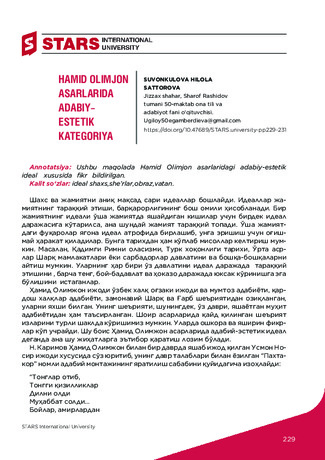
Hamid Olimjon asarlarida adabiy– estetik kategoriya
Ushbu maqolada Hamid Olimjon asarlaridagi adabiy-estetik ideal xususida fikr bildirilgan.
Genre peculiarity of Christopher Buckley’s novel “Thank you for smoking”
manipulate the society by proclaiming the weaknesses as the freedom of choice. Through plot development main characters and author’s attitude towards political establishment were analyzed