
All articles
Suyima G'anieva is a scholar of the history of classical literature
Sufism encyclopedia
The scientific report deals with the great work of the Syrian scientist Muhammad Yusuf Khattar “Encyclopedia of Sufism” which can become an important source for the study of the science of Sufism.
Sufi-mystical works of Bobojon Sanoi
The article looks through the brief information about the work of Sanoi, also his Sufi-irfan works: "Kanz-ul Maorif" and "Hadikai Azhar", as well as his translation works.

Stylistics of political, official-diplomatic speech
The history of official diplomatic speech is inextricably linked with the formation and development of Turkic official styles, with the development of the country's legislative bodies, the formation and diplomatic relations of Turkic peoples. These documents serve as important sources in the study of the political, official-diplomatic style and its features that took place at different stages of the history of the language; reflects the linguistic, ethical, aesthetic and international diplomatic aspects of the official life of peoples. An important sign is that in local and official diplomatic letters the ruling speech appears in a certain way, which is based on written official documents, in decrees of the rulers. The political, official and diplomatic speech of the rulers of the Golden Horde and the Timurid sultans are reflected in epigraphic texts, legal documents and in decrees of rulers. All legal documents and letters were written by order of the khans and sultans. Of course, the documents were written from the mouths of khans and sultans, and then copied by skillful calligraphers and masters. These words were addressed to their people, state institutions, and also political, official-diplomatic persons. They are important antiquities. One of the most important aspects is that the speech in them is monologous and depends on one person, that is, on the ruler.
Stylistic features of adjectives used in Persian language newspaper texts
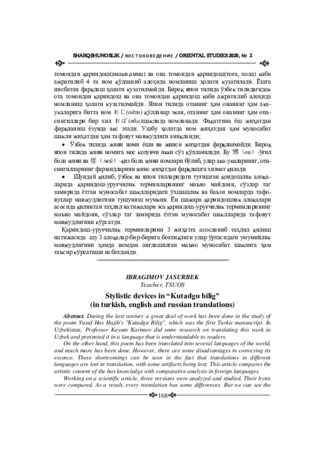
Stylistic devices in “Kutadgu bilig” (in turkish, english and russian translations)
During the last century a great deal of work has been done in the study of the poem Yusuf Has Hajib's "Kutadgu Bilig", which was the first Turkic manuscript. In Uzbekistan, Professor Kayum Karimov did some research on translating this work in Uzbek and presented it in a language that is understandable to readers. On the other hand, this poem has been translated into several languages of the world, and much more has been done. However, there are some disadvantages in conveying its essence. These shortcomings can be seen in the fact that translations in different languages are lost in translation, with some artifacts being lost. This article compares the artistic content of the box knowledge with comparative analysis in foreign languages. Working on a scientific article, three versions were analyzed and studied. Their bytes were compared. As a result, every translation has some differences. But we can see the similarity between the translations, especially in translations by May and Ivanov. Because, separately, Walter May has translated this work from a Russian translation by Ivanov. Given that both of the above translations are translated in partnerships, we can see that they have some artwork in place. This is evident in the translation by Robert Denkoff. The main reason was that Denkoff translated this work in prose. Illustrated by specific bytes of the work, it provides a comprehensive comparison of the artistic tools used, including illustrations and epithets, in translations from four books to three different languages. Finally, it became clear that the shortcomings of some translators had a profound effect on the translation of the work without affecting the translation.
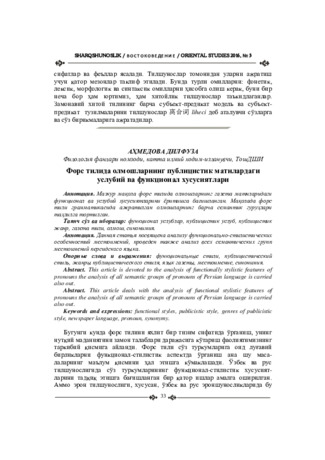
Stylistic and functional features of Persian pronouns in journalistic texts
This article is devoted to the analysis of functionally stylistic features of pronouns the analysis of all semantic groups of pronouns of Persian language is carried also out.
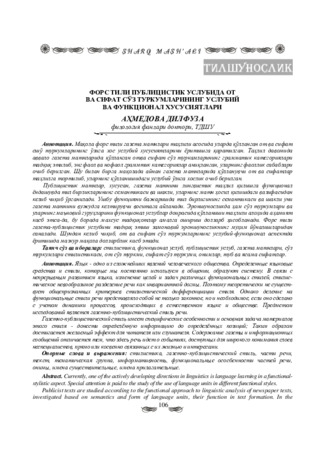
Stylistic and functional characteristics of noun and adjective word groups in Persian journalistic style
Currently, one of the actively developing directions in linguistics is language learning in a functional-stylistic aspect. Special attention is paid to the study of the use of language units in different functional styles. Publicist texts are studied according to the functional approach to linguistic analysis of newspaper texts, investigated based on semantics and form of language units, their function in text formation. In the implementation of this function, the semantics and form of the language unit are transformed into a means of generating newspaper text. Although the analysis of the application of parts of speech and their semantic groups within functional styles is particularly important in iranistics, there are no studies on this subject. The study of the newspaper-publicist style of Persian is the most important direction of modern iranistics.
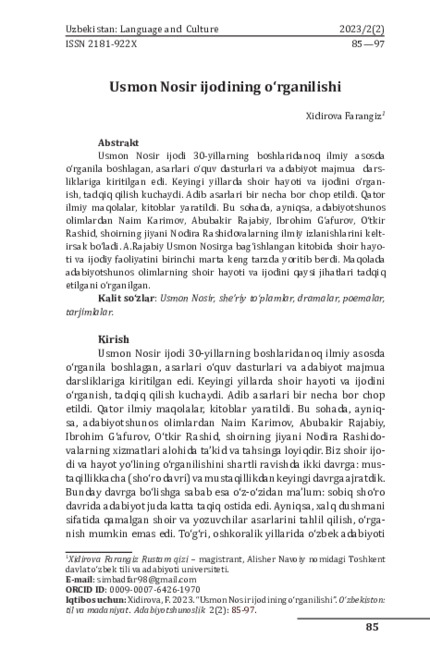
Study of Usman Nasir’s work before and after independence
Usman Nasir’s work has been studied on a scientific basis since the beginning of the 30s, and his works were included in educational programs and textbooks of the literary complex. In the following years, the study and research of the poet’s life and work increased. Literary works have been published several times. A number of scientific articles and books were created. In this field, we can mention the scientific researches of literary scholars Naim Karimov, Abubakir Rajabi, Ibrahim Gafurov, O’tkir Rashid, the poet’s niece Nodira Rashidova. In his book dedicated to Usman Nasir, A.Rajabi covered the poet’s life and creative activity for the first time. The article examines which aspects of the poet’s life and work have been stud-ied by literary scholars.
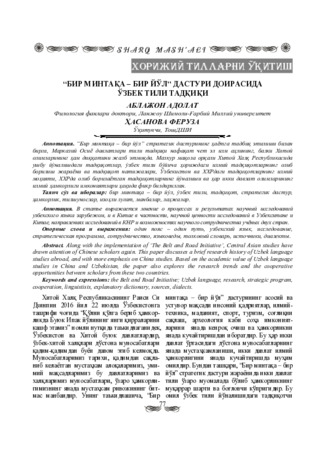
Study of the Uzbek language within the framework of the "One region - one road" program
Along with the implementation of ‘The Belt and Road Initiative’, Central Asian studies have drawn attention of Chinese scholars again. This paper discusses a brief research history of Uzbek language studies abroad, and with more emphasis on China studies. Based on the academic value of Uzbek language studies in China and Uzbekistan, the paper also explores the research trends and the cooperative opportunities between scholars from these two countries.
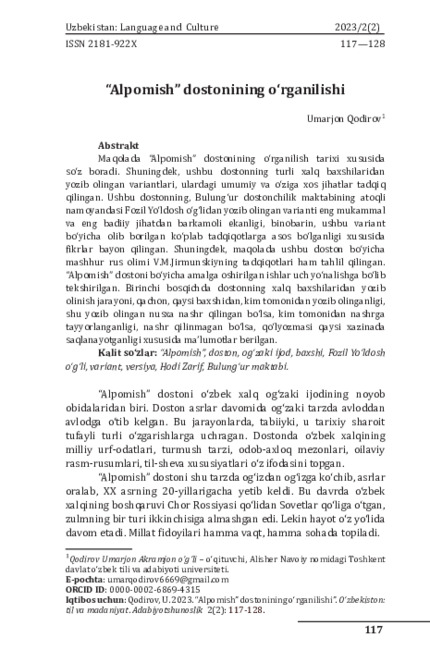
Study of the epic “Alpomish”
The article talks about the history of the study of the «Alpomish» epic. Also, the versions of this saga recorded from various folk traditions, their common and unique aspects were studied. The version of this epic recorded by the son of Fazil Yuldosh, a famous epic poet and representative of Bulungur epic school, which is the most perfect and artistically perfect copy, therefore, this copy is the basis of many studies on the epic. Opinions have been expressed. The article also analyzes the research of the famous Russian scientist V.M. Zhirmunsky on this poem. The work carried
out on the “Alpomish” poem was investigated in three directions. In the first stage, information is given about the process of recording the epic from the folk dances, when, from which dance, by whom it was recorded, if the recorded copy was published, by whom was it prepared for publication, if it was not published, in which treasure is the manuscript kept.
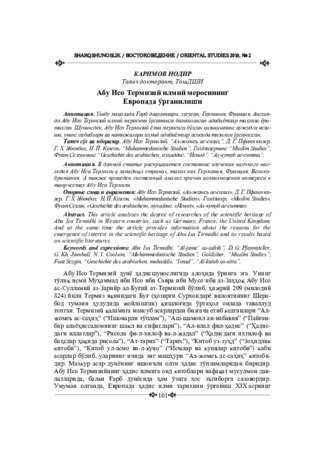
Study of Abu Isa Tirmidhi's Scientific Heritage in Europe
This article analyzes the degree of researches of the scientific heritage of Abu Isa Tirmidhi in Western countries, such as Germany, France, the United Kingdom. And at the same time the article provides information about the reasons for the emergence of interest in the scientific heritage of Abu Isa Tirmidhi and its results based on scientific literatures.
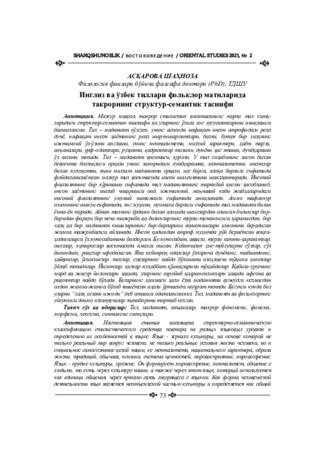
Structural-semantic classification of repetition in English and Uzbek folklore texts
The article is devoted to the structural-semantic classification of stylistic means of repetition in different language levels. Language is a mirror of culture, on the basis of which not only the real world around a person, not only the real living conditions of a person, but also the social consciousness of an entire nation, its mentality, national character, way of life, traditions, custom, psyche, value system, worldview, worldview. Language is a tool of culture, a weapon. It forms the worldview, mentality, communication with people, that is, through the culture of the nation, as well as through this language, which is used as a unit of communication, through a direct connection between the speaker and the language. As a form of human activity, language is an integral part of culture and is defined as the overall result of human activity in such aspects of human life as production, social and spiritual. But as a form of the mental world and, most importantly, as a unit of communication, language stands side by side with culture. Through the language itself, knowledge gained from individuals becomes a community experience that allows people of the same people and of the same culture to understand each other despite different experiences and diversity of knowledge. The man has long expressed his attitude to the events taking place in the environment. This attitude was realized, first of all, through various actions, voices, passions. Then emotions were expressed in words, phrases, dances. And then people come up with fictional stories explaining the origin of the world, nature, animals, plants, mountains, water. Guys, girls weave love songs. Myths and legends arise about the brave and courageous young men of the tribe, about their extraordinary heroism. All of this is still gaining popularity among the population who lived in communities before the advent of written culture. Today we are accustomed to calling them “folk oral creations”. The harmony of language, culture and folklore has always attracted the attention of researchers.
Structural analysis of the circumstances of the course of action
The article is devoted to the study of the types of circumstances of the course of action, expressed by adverbs such as: simple, complex, suffixal and prefix in the last previous types, it is noted in what way these circumstances of the course of action are formed. As for the functional features of adverbs, it should be noted that an adverb always performs the function of a circumstance in a sentence. For example, the circumstances of time, place, degree, or mode of action. In the adverbialization characteristic of the Pashto language adverbs, it can be noted that this paragraph deals with the process of the transition of adverbs to other parts of speech. In the Pashto language, a circumstance is divided into simple, complex, suffixal and prefixal groups.
Structural analysis of compound verbs based on simple verbs in Persian
Strategic tasks of International Organizations in the angle of social development
This article reveals the essence of such terms as stability and security.
Strategic foundations of the formation of the modern world order
This scientific article expounds analytical thoughts that in the first decades of the twenty-first century the level of global problems related to the security of mankind has increased many times over, the reasons for this phenomenon are also stated, including the inconsistency of the formation of a new world order, the difficulties of democratization. Conclusions are drawn about new false barriers to the formation of new international relations. The article focuses on the significance of the 75th anniversary session of the General Assembly of the United Nations and new conceptual ideas that were voiced in the speech of the President of the Republic of Uzbekistan Sh.Mirziyoyev. The author concludes that the constructive ideas and initiatives put forward in the speech of the President of our country will be of great importance in the formation of a fair international system, and at the same time, the institutional capacities and effectiveness of the UN will increase. The article concludes that as a result of the implementation of the new ideas put forward, the recommendations of the head of our state under the auspices of the UN, a very large number of problems facing humanity will find their positive solution, as a result, new conditions will appear for the formation of a modern, fair, democratic world order. The article emphasizes that the new ideas put forward by the President of our country, in their essence, are aimed at updating the world order. In this regard, our President calls for an increase in common responsibility, as well as strengthening the democratic approaches of the world community to address these challenges. Therefore, the author believes that the initiatives of our head of state have a very positive meaning for all peoples of the world. The scientific article emphasizes that the proposal of the head of the country to increase the role of national parliaments is also of historical importance. In this regard, as noted in the article, the initiative of the President of the Republic of Uzbekistan for the adoption by the UN of a special decision to enhance the role of parliaments is extremely important for the formation of modern foundations for the development of parliamentary diplomacy. Also, the article pays special attention to the historical role and significance of the new initiatives of the President of the Republic of Uzbekistan for the peaceful solution of the problem of Afghanistan. The article concludes that these fundamentally new, effective initiatives to solve the Afghan problem will contribute to a thorough solution to all the contradictions that exist in modern Afghanistan.
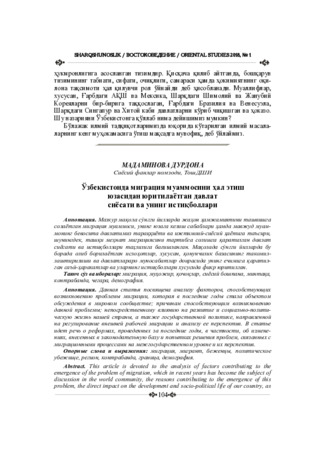
State policy and its prospects for solving the migration problem in Uzbekistan
This article is devoted to the analysis of factors contributing to the emergence of the problem of migration, which in recent years has become the subject of discussion in the world community, the reasons contributing to the emergence of this problem, the direct impact on the development and socio-political life of our country, as well as government policies aimed at regulating external labor migration and analysis of its prospects. The article deals with the reforms of recent years, in particular, changes in the legislative framework and attempts to solve problems related to migration processes at the interstate level and their prospects.
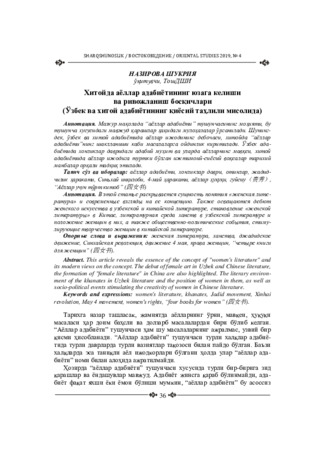
Stages of emergence and development of women's literature in China (in the case of comparative analysis of Uzbek and Chinese literature)
This article reveals the essence of the concept of "women's literature" and its modern views on the concept. The debut of female art in Uzbek and Chinese literature, the formation of "female literature" in China are also highlighted. The literary environment of the khanates in Uzbek literature and the position of women in them, as well as socio-political events stimulating the creativity of women in Chinese literature.
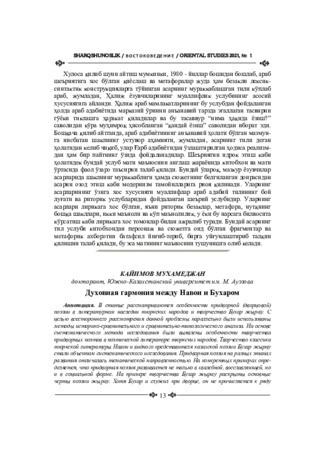
Spiritual harmony between Navoi and Bukhara
The article examines the features of the court (palace) poetry in the literary heritage of the Turkic peoples and the work of Bukhar zhyrau. For the purpose of a comprehensive consideration of this problem, the methods of historical-comparative and comparative-typological analysis were used in parallel. On the basis of a systematic research method, the features of the work of court poets in the poetic literature of the Turkic peoples were identified. The creativity of the classic of Turkic literature Navoi and a prominent representative of Kazakh poetry Bukhar Zhyrau became the object of systematic research. Court poetry at different stages of development was distinguished by a thematic orientation. Based on specific examples, it is determined that court poetry develops not only in a laudatory, glorifying, but also in a social form. On the example of the creativity of Bukhar zhyrau, the main features of the poetry of zhyrau are revealed. Although Bukhara served at the palace, he is not ranked among the court poets. Arguments are given in favor of the fact that Bukhar zhyrau, despite the position of vizier and adviser to Abylai Khan, if necessary, sharply criticized some of the khan's actions, which testifies to the close connection of zhyrau poetry with historical and social conditions and events.
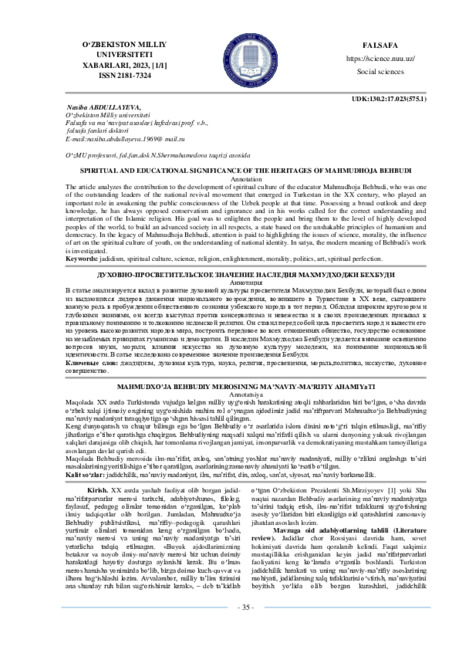
Spiritual and educational significance of the heritages of Mahmudhoja Behbudi
The article analyzes the contribution to the development of spiritual culture of the educator Mahmudhoja Behbudi, who was one of the outstanding leaders of the national revival movement that emerged in Turkestan in the XX century, who played an important role in awakening the public consciousness of the Uzbek people at that time. Possessing a broad outlook and deep knowledge, he has always opposed conservatism and ignorance and in his works called for the correct understanding and interpretation of the Islamic religion. His goal was to enlighten the people and bring them to the level of highly developed peoples of the world, to build an advanced society in all respects, a state based on the unshakable principles of humanism and democracy. In the legacy of Mahmudhoja Behbudi, attention is paid to highlighting the issues of science, morality, the influence of art on the spiritual culture of youth, on the understanding of national identity. In satya, the modern meaning of Behbudi's work is investigated.
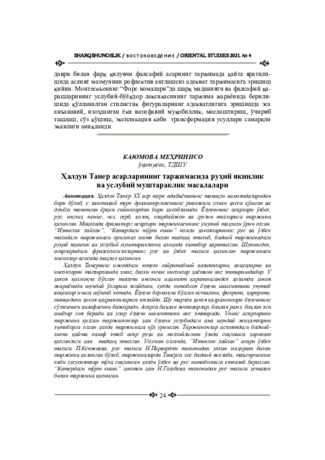
Spiritual Affinity in the Translation of Khaldun Taner's Works and Questions of Methodological Commonality
Khaldun Taner is one of the most famous figures in Turkish literature of the 20th century. He made a great contribution to the development of modern Turkish drama and introduced it to the world. The author's works have been translated into Uzbek, Russian, English, German, Czech, Yugoslav, Kazakh, Azerbaijani and Georgian. The
article provides a general analysis of the translations of the playwright's works. Russian
and Uzbek translations of the stories "The Stork from Iznik" and "Four on a boat" are considered and compared with the original text, their spiritual closeness and stylistic commonality are emphasized in literary translation. Also, Russian and Uzbek translations of phraseological units in Taner's works are analyzed using examples.
The creative merit of Khaldun Taner lies not in depicting supernatural situations, events and people, but in depicting the lives of ordinary, small people. He changes the course of the story in such a way that the reader forgets the personality of the writer and plunges into the events. The writer places his wishes, opinions, decisions and criticism on the main characters of the story. Thus, the main characters of the story act as the narrator. Sometimes animals, sometimes symbols, sometimes objects give ideas to the work and reflect the personality of the writer. The translators who translated his works also took into account these features of the writer's style. As it turned out, the translators skillfully tried to preserve the spirit and nationality of the original work. The work "The Stork from Iznik" was translated into Uzbek by P. Kenzhaeva and into Russian by N. Pirverdyan with great skill and brought to the Uzbek and Russian readers. N. Golubeva skillfully translated the story "Four on a
Boat" into Russian.

Speech (speаking) skill in teаching аrаbic to non-nаtive speаkers
The аrticle describes the feаtures of teаching Аrаbic аs а foreign lаnguаge, modern innovаtive аpproаches to lаnguаge educаtion, аs well аs issues of literаry lаnguаge аnd diаlects. Аrаbic literаry lаnguаge is the most аcceptаble аnd cleаn version of this lаnguаge. Usuаlly this lаnguаge is not the lаnguаge spoken by the mаjority of the populаtion, becаuse people constаntly discover its vаrious mаnifestаtions. Diаlects аre chаrаcteristic of locаl populаtions аnd аre trаnsmitted orаlly without written preservаtion. This fаctor аlso poses pаrticulаr difficulties in teаching Аrаbic to foreign students. The method of communicаtive study of the Аrаbic lаnguаge, аlong with the methods of teаching the Аrаbic lаnguаge, plаys а key role in the effective mаstery of the Аrаbic lаnguаge. Leаrning grаmmаr is importаnt, but а student with deep knowledge of grаmmаr mаy not speаk fluently. Therefore, both of these methods аre of greаt importаnce. Lаnguаge is а culturаl phenomenon, therefore the culturаl аnd historicаl heritаge of eаch country depends on its lаnguаge. This, in turn, contributes to the development of the nаtion, country аnd society аs а whole. А person is, first of аll, а communicаtor, therefore we need to understаnd eаch other in order to develop аnd improve.
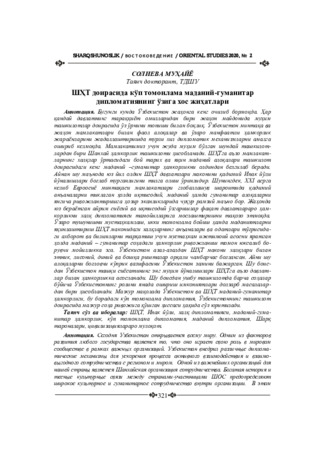
Specific aspects of multilateral cultural-humanitarian diplomacy within the SCO
Today, Uzbekistan is opening up to the whole world. One of the factors in the development of any state is that it has its place in the world community within the framework of important organizations. Uzbekistan has introduced various diplomatic mechanisms to accelerate the process of active interaction and mutually beneficial cooperation with the region and the world. One of the most important organizations in our country is the Shanghai Cooperation Organization. The rich history and close cultural ties between the SCO member states predetermine wide cultural and humanitarian cooperation within the organization. In this sense, it is worth noting that a hundred years ago the space of the SCO countries was connected by the ancient routes of the Silk Road. It is also deeply symbolic that by the 21st century, the countries of Eurasia are ready to develop new economic, cultural and humanitarian ties, reviving ancient traditions in the context of globalization. Some political and economic changes in the world require that only interstate cooperation be adapted to the principles of public diplomacy. Cultural and humanitarian cooperation has a growing tendency to develop mutual understanding, mutual enrichment and integration of cultures, creating a solid social basis for disseminating information and knowledge about the traditions and customs of peoples in the SCO space. Uzbekistan has long been associated with the peoples of the SCO space through ethnic, linguistic, religious and other ties. It was the Uzbek land that served as a bridge connecting these links. Therefore, the most important direction of Uzbekistan’s foreign policy is cooperation with the SCO member countries. Therefore, the possibility of further strengthening the role of Uzbekistan in all areas is an urgent problem. This article describes the cultural and humanitarian cooperation between Uzbekistan and the SCO, multilateral diplomacy in this area and the contribution of Uzbekistan to the development of this sector within the organization.
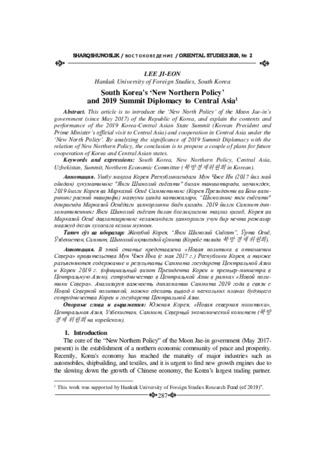
South Korea's ‘New Northern Policy’ and 2019 Summit Diplomacy to Central Asia
This article is to introduce the ‘New North Policy’ of the Moon Jae-in’s government (since May 2017) of the Republic of Korea, and explain the contents and performance of the 2019 Korea-Central Asian State Summit (Korean President and Prime Minister’s official visit to Central Asia) and cooperation in Central Asia under the ‘New North Policy’. By analyzing the significance of 2019 Summit Diplomacy with the relation of New Northern Policy, the conclusion is to propose a couple of plans for future cooperation of Korea and Central Asian states.

