
All articles
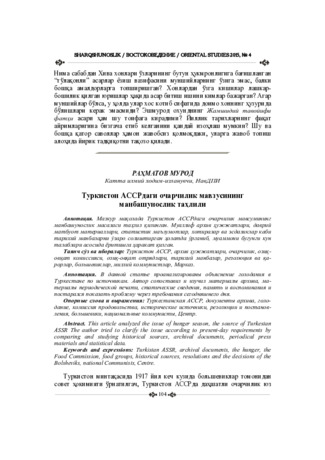
Source studies analysis of the subject of famine in the Turkestan ASSR
This article analyzed the issue of hunger season, the source of Turkestan ASSR The author tried to clarify the issue according to present-day requirements by comparing and studying historical sources, archival documents, periodical press materials and statistical data.
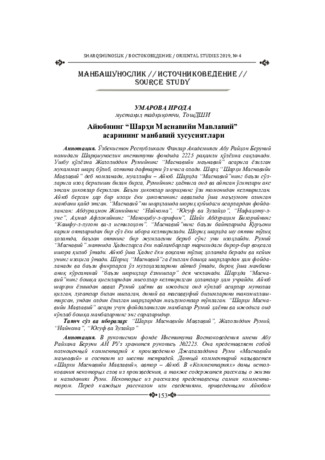
Source features of Ayyub's work "Sharhi Masnaviyi Mawlawi"
In the manuscript fund of the Institute of Oriental Studies named after Abu Rayhan Beruni of the Academy of Sciences of Uzbekistan the manuscript №2225 is stored. It presents a full comment for the composition of Jalaladdin Rumi “Masnaviyi Ma’naviy” and consists of six notebooks. This comment is named as “Sharhi Masnaviyi Mavlaviy”, author – Ayyub. Interpretations of some words from composition are given in “Comments” which also contains stories about Rumi’s life and his edifications. Some of the stories are presented by commentator himself. There are the notes of what sources they are extracted before each story and information, which are submitted by Ayyub. When commenting “Masnaviy” expositor used following compositions: “Nayname”, “Yusuf and Zuleykha”, Abdurakhman Jami’s “Nafakhotu-l-uns”, Akhmad Afloki’s “Manokibu-l-orifin”, Shaykh Abdurakhim Bikhori’s “Kashfu-l-lugot va-l islokhot”. In a number of bytes of “Masnaviy” are given the words and expressions from text or ayat in Koran. Firstly, commentator gives full text or a fragment from particular ayah then provides comments. In composition “Masnaviy” Rumi adduces sayings from Hadith and from various stories which have taken place in life of prophets. Ayyub, in turn, completely overlooks given Hadith and stories and then only adds his comments. Expositor also uses the other texts of comments, which were written for “Masnaviy”, and for some related views he expounds his own persuasions, where he doesn’t indicate the exact names of the sources from which such information was brought, but only limits to the phrase “some commentators write”. There are cases of examples as well from other parts of “Masnaviy” in “Comments”. Before writing “Comments” Ayyub explored many books about Rumi’s life and work, worked with dictionaries, improved his knowledge in the sphere of religion and tasawwuf, collected data from earlier written comments. The sources which were used while writing “Comments of Masnaviyi Mavlavi” composition are the most valuable among many others about life and work of Rumi.
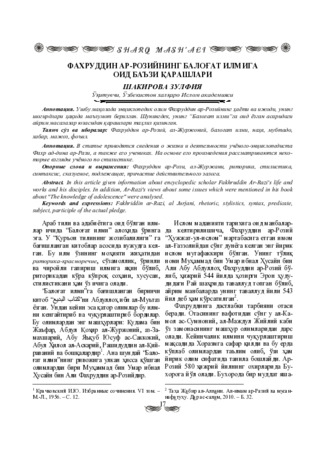
Some views of Fakhruddin Ar-Razi on the science of puberty
In this article given information about encyclopedic scholar Fakhruddin Ar-Razi's life and works and his disciples. In addition, Ar-Razi's views about some issues which were mentioned in his book about "The knowledge of adolescence" were analysed.
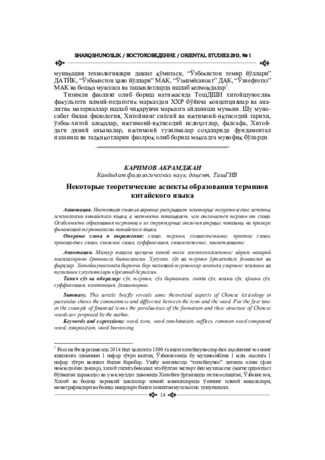
Some Theoretical Aspects of the Formation of Chinese Terms
This article briefly reveals some theoretical aspects of Chinese lexicology in particular shows the commonness and difference between the term and the word. For the first time in the example of financial terms the peculiarities of the formation and their structure of Chinese words are proposed by the author.
Some reflections on the creation of "One Thousand and One Nights".
There are different opinions about the origin of the “Thousand and One Nights”, one of the masterpieces and pearls of world civilization, and science it was translated into different languages of the world. Scientists of the world expressed opinions on this issue, and the author in the article cites his views on these conclusions. Scientists are divided into two camps in their views on the origin of the source. On the first side were scholars who believed that the source of all fairy tales in the collection is Arabic folklore. We admite true who thinks that this work of Persian folklore. The omnibus was writed in pehlavi language and was very famous in Iranian language. This folklore product was translated from pehlavi into Arabian language e in golden age of Arabian translation, actually in 9-10 centuries. The names of heroes “Thousand and One Nights” Padishah Shakhriyor and Princesse Shakhrezad are persian. The book “Alf Leila wa Leila” belongs and tells not only about the Arabs, but also when creating the work, the motifs of fairy tales from Central Asia, Iran and India were used. Analyzed on the example of a combination of motifs and plots of world folklore of different peoples and the processes of “plot migration”. There two options for this source. The first option is the translation of Persians into Arabic in the 8 th century. The second version was assembled in the 10 th century by Jahshiyor, who came from Baghdad. Explain of oral creation is recognized Egyptian fary tales, were collected by Jaxshiyor, was written in 13-14 centuries. The famous omnibus which named “Thousand fary tales” was collected in Egypt after that the new fary tales were added. “A Thousand and One Nights” was originally created in the form of Indian fairy tales cultivated by Arab masters, and became a unique monument of the Arab people. The current copy of the collection is a valuable monument of the Arab people. It is also a unique gem of world civilization. Literatury antiques of all Orient nation and uzbek are recognized antiques like on “Thousand and One Nights”.
Some grammatical and semantic features of doubling on example of nouns in japanese languages
This article reveals the general grammatical properties of reduplication on example of nouns in Japanese. The concept of "reduplication" (from lat. "Reduplikatio - "doubling") today does not have a clear and general definition for all researchers. In different interpretations under this concept the unequal circle of the phenomena-from a set of intraverbal to a set of interverbal doublings is brought. The most common structural types of reduplication are represented in different languages in one form or another. In all languages (or in most languages), reduplication can be complete (complete doubling of the reduplicant in the reduplicator) and divergent (with a change in the sound composition of the reduplicant). Along with the universal structural-semantic manifestations of reduplication, different languages are characterized by a peculiar interpretation of general, invariant structural types of intraword doubling and general, invariant semantics. As our observations show, being few in each particular language, the most productive models of reduplication generally coincide in languages with the same morphological structure. At the same time, differently structured languages show clear differences in this respect. In isolating and agglutinative languages that use the agglutinative technique in word construction, reduplication occurs within the root morpheme. In Slavic languages with synthetic inflectional order, synonymous suffixes and prefix morphemes are predominantly duplicated. With significant similarities in structural models of reduplication, languages of the same morphological type also have differences in this respect, although very slight. Such discrepancies mainly concern the productivity, unproductiveness of some structural models within the same onomasiological classes.
Some factors in the Turkification of Sughd and their reflection in "Devonu Lugatit-Turk"
Some comments on verbs of action in Arabic
This article briefly describes the set of verbs in Arabic and Uzbek, its study by linguists, comparative lexical-semantic analysis of action verbs in both languages. In the study of the lexical-semantic relations of action verbs in Arabic language, special attention should be paid to aspects related to the meaning of verbs, such as synonyms and antonyms between them. Among the verbs of action in Arabic, there are many verbs that have polysemantic meanings, and sometimes they are used in their original meaning, and sometimes in other meanings as well. The meaning of these verbs also depends on the event or situation to which they are related. While the original, original meaning of the verb is mainly related to the normal state of the subject, other meanings serve to express his emotional state. During study of lexical-semantic relations related to action verbs in Arabic, special attention should be paid to which prepositions these verbs come with, because a particular action verb depends on whether the object to which the action is directed is animate or inanimate may require a different preposition. In synonymous relations, the verbs of action differ according to the extent to which the action lasted, for what purpose it was performed, or by what means it was performed. There are similarities and differences in the expression of the verb "to come" in Uzbek and in Arabic. In Uzbek, the main semantic of this action verb is quite simple, but the content is almost identical to the Arabic lexeme "to come". In Uzbek, this verb requires that the object to which it is directed come mainly in the infinitive, place-time, exit, and direction verbs, while in Arabic they are represented by a preposition giving the meaning of an infinitive or a definite conjunction. In expressing some of the meanings of the verb "to come" in the Uzbek language, it is necessary to use their Arabic alternative, and in some cases, the meanings of this verb in the Uzbek language. in Arabic it is also expressed by the verb "to come", but in this case it is necessary to choose a verb that expresses the expected meaning from the synonymous verbs that mean "to come" in Arabic.
Some comments on the study and classification of literary translation issues
This article is an overview of issues related to literary translation, which tells about the history of the study of literary translation, its formation as a science, and talks about its education. It provides information on the history of the industry, scientists who have contributed to the development of the industry. The article reflects scientific views on literary translation, which can be viewed not only from translation, but also from linguistic anguish of view as an object of research. Indeed, the features of the use of metaphor, metonymy, lexicostylistic examples and phraseological units in the original literary text and the methods of their translation, the strategies for translating these linguistic units and the translation technology based on the comparison of two different translations are closely related to linguistics. ¬ We can say that literary translation as a complex direction is a very interesting science that has a sufficient base of scientists for different approaches to it, views, scientific conclusions. From a linguistic point of view, the study of its various aspects is the same object of study, as well as its aspects of speech, communicative, psychological, etymological, cultural, philosophical, religious. Its classification features can also be considered as the focus of scientists, an object of study for various scientific studies. In this sense, in the article to the classification of literary translation are also analyzed. We can also see that its classification features have been at the center of attention of scientists and as an object of study of various scientific studies. Reflecting on classifications or attempts made in European and Uzbek translation studies, the author defines various approaches to disclosing aspects of translation and the need to enrich its classification characteristics.
Some comments about the balance of the year
This article deals with the system of the chronology of the torment – a twelve-year animal cycle – common among the peoples of Central and East Asia and its great popularity in all parts of the globe. On the basis of various sources and scientific hypotheses of scientists, considerations on the time and place of origin, the creators of twelve-year animal cycle are analyzed in it.

Some comments about Abdurauf Fitrat's work "Family".
This article is devoted to the analysis of the work "Family" by Abdurauf Fitrat, a brilliant representative of modern literature. In the example of this work, written in 1914, an attempt was made to show the writer's creative laboratory as well as his personal attitude to the most pressing social issues of his time. The ideas of nationalism, freedom, progress and science, which led Fitrat's work, formed the core of his political and legal views, and laid the foundation for the writer to become one of the great representatives of modern literature. The article emphasizes that the publicist Fitrat's approach to the issue of marriage, the role of women in society, was based on the spirit of the time in which he lived, comparing it with verses from the Qur'an, and the social significance of these observations. Issues such as family components, national traditions and customs in family management, family quality discipline and their impact on the future of the nation, which were put forward by the author, were not left out of the study.
Some characteristics of words with different morphemes in Chinese
This article is devoted to the study of the features of the formation of words with different orders of morphemes in the Chinese language, as well as the corresponding models of this method of word formation.
Some aspects of the Movarounnahr school of Sufism (as an example of Hakimiya and Khojagon-Naqshbandiya relations)
This article is devoted to the school of mysticism, which is an integral part of Islam in our country, and its peculiarities. In the context of today's scientific achievements, Movarounnahr is not mentioned among the mystical schools of the Islamic world, and there is a tradition of adding it to the Khurasan school. The school of the mysticism of Movarounnahr is famous mainly in the framework of the activities of Abduhaliq Gijduvani, the seven-pir chain, and Bahauddin Naqshband. However, as one of the first beginners in this field, Muhammad Hakim Termizi's factor is very important, and the combination of all of them plays a special role in the establishment of this direction as a school with its own characteristics. However, as one of the first beginners in this field, Muhammad Hakim Termizi's factor is very important, and the combination of all of them plays a special role in the establishment of this direction as a school with its own characteristics. This commonality has a sharp difference from other Islamic schools of the world. These differences and peculiarities require the study of the Movarounnahr's way of suluk as a "school", which still needs to be sufficiently studied in our country and around the world. It can be said that the distinctive features of the Movarounnahr school of Sufism reached its peak in practice through the activities of Abduhaliq Gijduvani and Bahauddin Naqshband after Muhammad Hakim Termizi sufficiently theoretically perfected it. In its time, this school demonstrated movements of reformism throughout the Islamic world that reflected the true purpose of religion. In particular, Gijduvani and Bahauddin Naqshband appears as a person who firstly practices backdoor dhikr and strengthened this practice and strengthened the socialization of mysticism on the basis of personal maturity through factors such as conversation and professional necessity Both men returned to the realm of mysticism the principle that all Muslims should strive for science, and by developing a system of "rashha" for "saliks", defined a high ideological framework, a disciplined practice - a clearly defined scope of action. Most importantly, all of these rules they introduced were based on the theory of the school of “hakimiya” that was recognized as a separate school in Movarounnahr in the X-XI centuries and founded by Muhammad Hakim Termizi. In particular, rashhas, professions, the primacy of science, and many other aspects were the hallmarks of this school.
Some aspects of the history of the establishment of the police service in the Turkestan General Government
The article deals with the introduction of the police service in the Turkestan General-Governorship, some of its aspects, as well as activities of the rais in the Kokand Khanate. The issues of regulating trade in local bazaars by police and their subordinates – the aqsaqal as well as their election are also discussed. Local and foreign archive materials were used in the preparation of articles.
Some aspects of the historiography of the ethnography of the peoples of Central Asia in the XXI century
The article tries to reveal correctly interpreted and incorrectly stated points in the content of articles or abstracts, as well as researches and publications on the field of ethnography, ethnogenethes and ethnic history of people of Central Asia, particularly Uzbekistan since the beginning of the XXI century.

Some aspects of philosophical issues in the work "Nukot" by Mirzo Bedil
The article is dedicated to study the work of the great scholar Mirza Bedil, which consists of 66 nukat. The author’s convictions had big positive influence to the social-philosophical view of Central Asian nations. Some wisdoms of the author shows, the particular value of his philosophical view.
Socio-political terminology of modern Chinese: content, analysis and problems of translation
The article is devoted to a comparative analysis of the socio-political terminology of the modern Chinese language.The purpose of the article is to search for an integrated approach to the study of the cognitive side of social and political terms of the Chinese language from the side of law enforcement in the process of translating official materials from Chinese into Uzbek or Russian.
Socio-ideological foundations of the formation of the philosophical worldview of Mahatma Gandhi
The ideological basis for the formation of the worldview of Mahatma Gandhi is based on the ideas put forward by his predecessors. If we consider this period from a theoretical and ideological point of view, then one of the most important aspects of the doctrine inherent in the Indian national liberation movement is its religious content. In the process of the Indian national liberation movement, the task of modernizing and adapting religious and philosophical teachings to the demands of the movement with the aim of adapting them to current political problems was especially urgent. Issues of social inequality, casteism and national unity were examined. The first national enlightened thinker of India was Ram Mohan Roy, who played an important role in the birth of the
national liberation movement in India. Dadabhai Naroji, one of the national thinkers of the second half of the nineteenth and early twentieth centuries, demanded the participation of Indians in the government and emphasized the need to create an Indian state as an Indian nation. Bonkimchondro Chottopaddhai believed that the main obstacle to the development of the country was the lack of common interests among the upper and lower layers of the population. The philosophical aspects of Hinduism were reflected in the views of Swama Vivekanda, who promoted the idea of a common religion. Bal Gangadhar Tilak condemned the vices of poverty. Rabindranath Tagore called rural society "the support and mother of the people." The ideas put forward by these thinkers prompted Mahatama Gandhi to come to the forefront of the national liberation movement, forming the basis of his socio-ideological views.
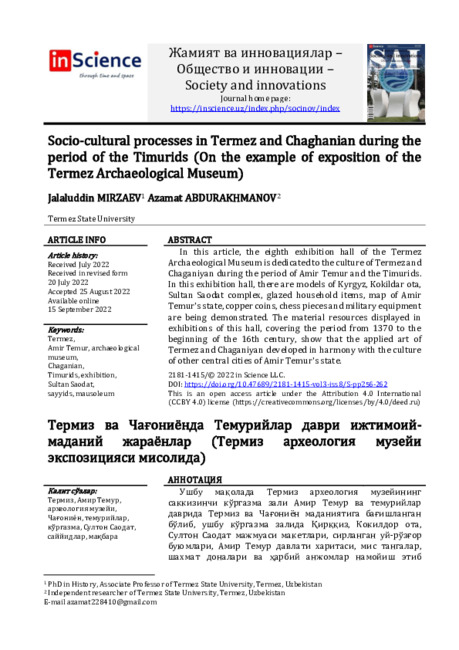
Socio-cultural processes in Termez and Chaghanian during the period of the Timurids (On the example of exposition of the Termez Archaeological Museum)
In this article, the eighth exhibition hall of the Termez Archaeological Museum is dedicated to the culture of Termez and Chaganiyan during the period of Amir Temur and the Timurids. In this exhibition hall, there are models of Kyrgyz, Kokildar ota, Sultan Saodat complex, glazed household items, map of Amir Temur's state, copper coins, chess pieces and military equipment are being demonstrated. The material resources displayed in exhibitions of this hall, covering the period from 1370 to the beginning of the 16th century, show that the applied art of Termez and Chaganiyan developed in harmony with the culture of other central cities of Amir Temur's state.
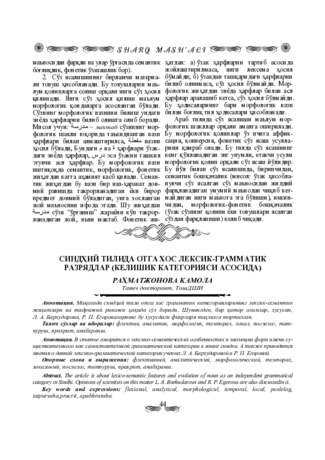
Simile in literary translation (in the example of Premchand's novel "Gift of Love")
The paper illuminates complication and speciality of simile translation from Hindi into Uzbek in literary text. Original and translated text analyzed according to grammatical, sematic and lexico-stylistic features
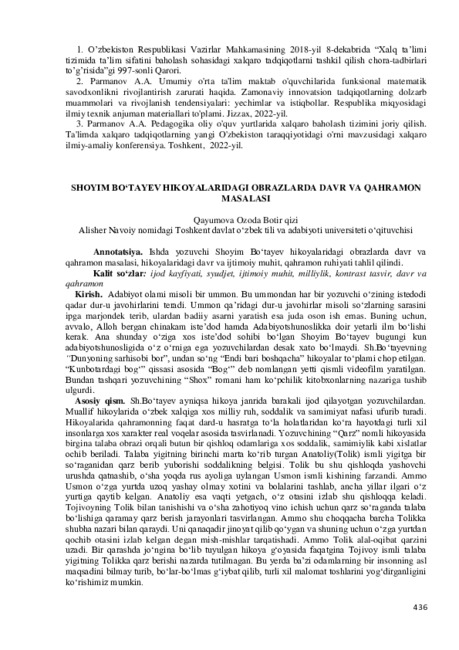
Shoyim Bo‘tayev hikoyalaridagi obrazlarda davr va qahramon masalasi
Ishda yozuvchi Shoyim Bo‘tayev hikoyalaridagi obrazlarda davr va qahramon masalasi, hikoyalaridagi davr va ijtimoiy muhit, qahramon ruhiyati tahlil qilindi.
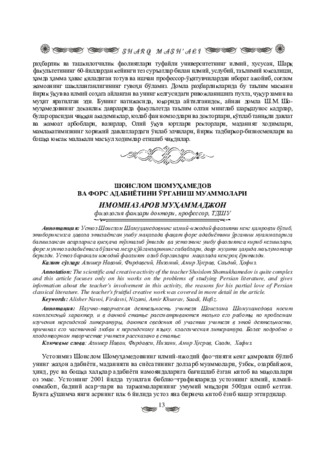
Shoislam Shomuhamedov and the problems of studying Persian literature
The scientific and creative activity of the teacher Shoislom Shomukhamedov is quite complex and this article focuses only on his works on the problems of studying Persian literature, and gives information about the teacher's involvement in this activity, the reasons for his partial love of Persian classical literature. The teacher's fruitful creative work was covered in more detail in the article.

Separation and periodization of the history of Turkish official style into stages of development
This article is the first to carry out a scientific analysis of the study of the history of the Turkic official style, and the division into stages and periodization of the development of the history of the Turkic official style from the ancient period to the Middle Ages. The emergence of the Turkic official style and its historical development until the 16th century can be divided into four successively connected, and at the same time, stages with their own characteristics: I. Office-work of the most ancient period (from the III century BC to the VI century). II. Office work during the reign of the Turkish kaganates (VI-IX centuries). This stage, in turn, can be divided into two periods: 1) Office work during the period of the First and Second Turkish Khaganates (VI-VIII centuries); 2) Office work during the Uyghur Khaganate (VIII-IX centuries). III. Office work in the 9th – 13th centuries. This stage of the Turkic office work is also divided into two periods: 1) Office work during the reign of the Karakhanids (from the second half of the X century to the end of the XII century); 2) Office work during the reign of the Kuchu and Hansu states (IX-XIII centuries). IV. Office work in the XIII-XVI centuries. This stage of Turkic records management is divided into the following periods: 1) Office work among the Chigatai ulus (XIII-XIV centuries). 2) Office work in the state of the Golden Horde and subsequent khanates (from the first half of the XIV century to the second half of the XVI century). 3) Office work in the Timurid state (from the second half of the XIV century to the XVI century). 4) Office work of the early period of the Ottoman Sultanate (from the second half of the 15th to the 16th century In the historical development of the Turkic official style, the office work of the period of the Turkic Khaganates, the period of the Karakhanids and the period of the Temurids are of particular importance.
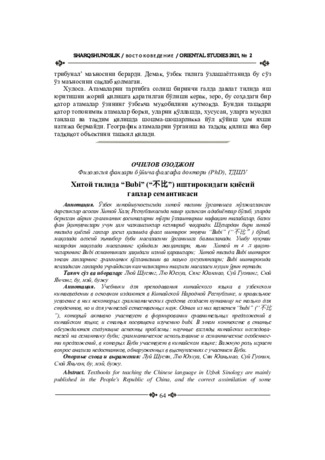
Semantics of comparative sentences with "Bubi" ("bùbǐ") in Chinese
Textbooks for teaching the Chinese language in Uzbek Sinology are mainly published in the People's Republic of China, and the correct assimilation of some grammatical means in them creates, but there cannot be a student. One of them is "bubi" ("不比"), which actively participates in the formation of comparative sentences in Chinese, and the article is devoted to the study of bubi. In this context, the article discusses the following aspects of the problem: scientific views of Chinese researchers on the semantics of bubi; the grammatical use and semantic features of the sentences in which Bubi participates in the Chinese language; An important role is played by the question of analyzing the shortcomings found in the speeches with the participation of Bubi.
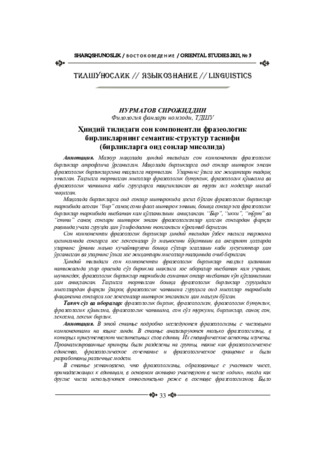
Semantic-structural classification of phraseological units with a numerical component in Hindi (in the example of unitary numbers)
In this article, the phraseological units with numerical components in Hindi are studied in detail. The article analyzes only the phraseological units in which the unit numbers are present. Their specific aspects have been explored. The examples analyzed were divided into groups such as phraseological integrity, phraseological compounding, and phraseological confusion, and different models were developed. The article finds that the phraseological units formed with the participation of unit numbers are mainly active in the number "one", while other numbers are used relatively less in the composition of phraseological units. Phraseologism involving the numbers "one", "two", "four" and "seven" are shown to be expressed in all three groups, unlike the other numbers. When numerical phraseological units are translated from Hindi into Uzbek, numerical lexemes lose their meaning and are often replaced by other words that enhance the meaning, and their specific features are explained in the interpretation of examples. The analysis of numerical component phraseological units in Hindi revealed that there are relatively few expressions specific to the form of the phrase, as well as the relatively frequent use of somatic nouns in phraseological units. In contrast to the examples in the group of other phraseological units were analyzed, it was also found that only the numerical lexemes were present in the examples belonging to the phraseological group.

