
All articles
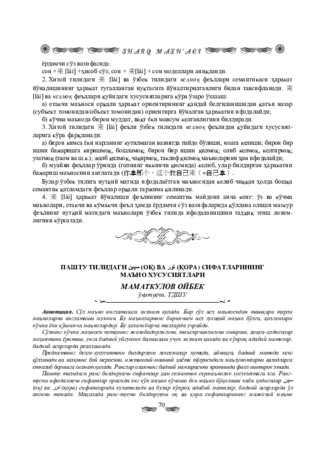
Semantic properties of the Pashto adjectives nyps (white) and rwt (black)
The word serves a meaning. A word can have different meanings than its original meaning. The first of these meanings is the original lexical meaning, the rest are figurative or additional meanings. This condition occurs in all languages. The figurative meaning of the word serves to increase the attractiveness and effectiveness of speech, to illuminate the essence of events, to give it an artistic harmony, and is realized in more literary texts, works of art. The lexemes that characterize the subject are widely used in speech, especially in the literary text, and serve to pass on to future generations the rich heritage of the people, information about their social life. Colors play an active role in creating the artistic landscape of the world. Color adjectives in Pashto also have semantic semantic meaning. Among the adjectives that express color, the most significant are the transitions or loss of meaning in the adjectives نیپس (white) and روت (black), which are reflected in more literary texts and works of art. In addition to the figurative meanings of the white and black adjectives denoting color, the article analyzes the lexical-semantic analysis of the occurrence of these adjectives in word combinations, compound words and fixed compounds. The article describes the active participation of white and black qualities in the creation of famous horses, such as land, sea, mountain, road, as well as the fact that these qualities are used in the creation of verbs. In the concluding section, the figures show the occurrence of the adjectives white and black in figurative senses and their participation in compound words and phraseological combinations.
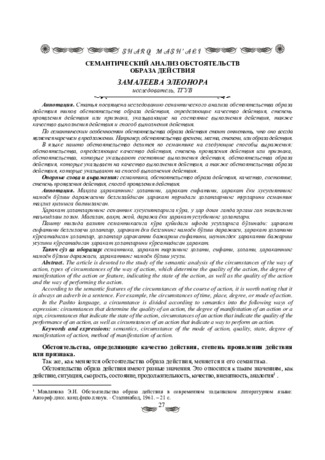
Semantic analysis of the circumstances of the mode of action
The article is devoted to the study of the semantic analysis of the circumstances of the way of action, types of circumstances of the way of action, which determine the quality of the action, the degree of manifestation of the action or feature, indicating the state of the action, as well as the quality of the action and the way of performing the action. According to the semantic features of the circumstances of the course of action, it is worth noting that it is always an adverb in a sentence. For example, the circumstances of time, place, degree, or mode of action. In the Pashto language, a circumstance is divided according to semantics into the following ways of expression: circumstances that determine the quality of an action, the degree of manifestation of an action or a sign, circumstances that indicate the state of the action, circumstances of an action that indicate the quality of the performance of an action, as well as circumstances of an action that indicate a way to perform an action.
Scientific theoretical foundations and principles of speech etiquette units (Western theory)
In this article “Speech etiquette units” learned by Western and Eastern countries’ scholars will be discussed. The aim of the research is to study the area of “Speech etiquette units” widely and deeply. For this, the tasks of comparing, analyzing, summarising the general approach of the theories were accomplished. Method of research has theoritical and empiric character such as reviewing, analyzing, comparing and empiric observing method is used to conduct an observation over live and virtual mass-media, also daily life communications. The first works of the initial researchers were studied and the next generation researchers’ attitude towards them is was also taken into consideration. The actuality and practice effectivity of learning this topic was proved via particular facts. American, European and Russian scientific sources were studied. In conclusion, in Western culture (USA, Italy, Spain, France, and etc.) people prefer not to pressure on somebody and not be under pressure. It refers to negative politeness which is without some fake arts of politeness. The opinion is expressed directly by the western people. In Russia using fake etiquette units is not accepted. In Britain, the principles of decorating the speech, not expressing the idea clearly, not making pressure are important and their communication culture refers to negative face.
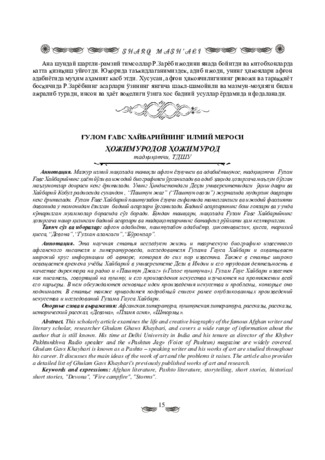
Scientific legacy of Ghulam Ghavs Khaybari
This scholarly article examines the life and creative biography of the famous Afghan writer and literary scholar, researcher Ghulam Ghaws Khaybari, and covers a wide range of information about the author that is still known. His time at Delhi University in India and his tenure as director of the Khyber Pakhtunkhwa Radio speaker and the «Pashtun Jag» (Voice of Pashtun) magazine are widely covered. Ghulam Gavs Khaybari is known as a Pashto – speaking writer and his works of art are studied throughout his career. It discusses the main ideas of the work of art and the problems it raises. The article also provides a detailed list of Ghulam Gavs Khaybari's previously published works of art and research.
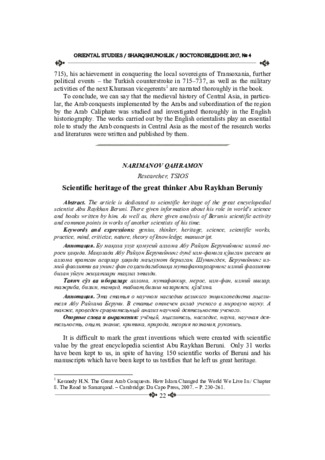
Scientific heritage of the great thinker Abu Raykhan Beruniy
The article is dedicated to scientific heritage of the great encyclopedial scientist Abu Raykhan Beruni. There given information about his role in world's science and books written by him. As well as, there given analysis of Berunis scientific activity and common points in works of another scientists of his time.
Scientific and spiritual heritage of Mahdumi Azam Kosani-Dahbedi
Sayyid Ahmad ibn Jalal ad-Din Kwajagi Kasani-Dahbedi (868/1461–949/1542) was a brilliant scholar and great thinker of Mawarannahr. He has been mentioned in manuscripts as a Makhdum-i A`zam Kasani, Makhdum-i A`zam Dahbedi, Makhdum-i A`zam Kasani-Dahbedi or shortly Makhdum-I A`zam. This article is devoted to the study of scientific-spiritual heritage of the afore-mentioned outstanding scholar on the base of the first sources, stored at the Manuscripts Fund of the Center for Oriental Manuscripts named after Abu Rayhan Beruni under the Tashkent State Institute of Oriental Studies.
Sayfiddin Bakharzi's work is in the research of foreign scientists
In the Sufi historiography of Central Asia, most of the problems are studied in the context of the teachings of Naqshbandiya and Yassaviya orders. According to the history and historiography of these two teachings of spiritual improvement, the works of both foreign and local researchers can be shown. However, we cannot say that these reflections have left a strong sense in the socio-spiritual life of the region like other teachings, including the Kubraviya order. For example, there are very few scientific works that give analytical conclusions and summarize the scientific views on the personality and spiritual heritage of Najmiddin Kubra’s famous followers as Sayfiddin Bokharzi (1190-1262), Kamal Zhandi (672/1273) and Husayn Khorezmi (836/1433) who played an important role in the dissemination of this discipline in the region. Considering this aspect of the problem in the present article, we tried to carry out a historiographical analysis of the particular problems associated with the personality of Sayfiddin Bokharzi. The study of the identity of the Bokharzy also continues after independence. It would not be an exaggeration if we say that conducting an analysis after in-depth study of it and free examination on the basis of documents, analysis as one of the followers of Sufism, is a requirement of the present. This person is known to many local specialists by O.D.Chekhovic's researches, which devoted to waqf properties in Bukhara. Today, Sayfiddin Bokharzi, whose grave is in Bukhara, is remembered in Uzbekistan as a representative of Sufism, a religious leader who owns pious endowments in the past. Is it really so? What else do we know about Sayfiddin Bokharzi and his activities? This article is devoted especially to the disclosure of Sayfiddin Bokharzi’s relation with the his preceptor Najmiddin Kubro, the personal life, generations and disciples of Sayfiddin Bokharzi, the relations of Bokharzi with the Berka Khan the ruler of Golden Horde and his written heritage in the base of published works of foreign researchers. We hope that in the future wide attention will be paid to the personality of Bokharzy, and his bright personality and spiritual legacy will receive wide recognition.
Sayfi Bukhari's work "Aruzi Sayfi" is an important guide to poetry
This article researched Sayfiy Bukhari’s (died in 1503) “Aruzi Sayfiy” treatise from the viewpoint of the modern poetry. It is about the structure of the treatise, description of asls, bakhr and doiras (metric circles). Here is revealed the significance of “Aruzi Sayfiy” in the Timurids period.
Saudi literature representative Mansur Al-Hazimi poetry scope of topics
This article covers the study of the poet's revenge in the Devon of the scientific heritage of Mansur Al-Hazimi, the representative of poetry in modern Saudi literature in Arabic “pleasure-babble and stories”. We believe that the poems of Mansur al-Hazimi written with the attribute of love and nature in the book ةريزجلا نم ةيبرعلا ءارعش (“Poets of the Arabian Peninsula”) are rich in content and beauty of form, persistently producing all the elements concerning the form and content of Mansur al-Hazimi, giving them polish and gloss, skillfully using the language opportunities, so that the clear fluency of the the ideas are simple and concise, attacking the reader in thought, literally witnessing the reader's compatibility. Also, his poetry was compared with each other in terms of meaning in the poems of Uzbek literature.
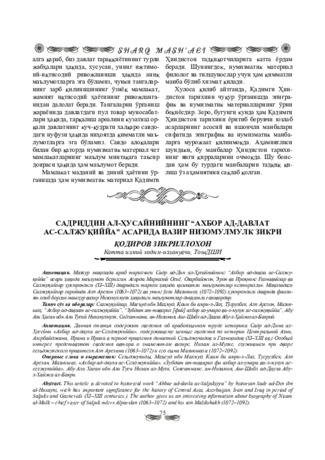
Sadriddin al-Husayni's work "Akhbar ad-Dawlat al-Saljuqiyya" mentions the minister Nizamulmulk
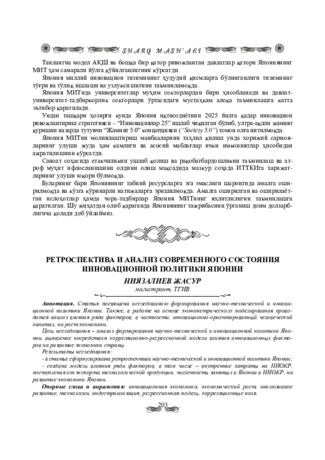
Retrospective and analysis of the current state of innovation policy in Japan
The article is devoted to the study of the formation of scientific, technical and innovation policy in Japan. In addition, an analysis of the influence of a number of factors on the growth of the economy, among which are innovation-oriented human capital, is made on the basis of econometric modeling in the work. The purpose of research is to analyze the formation of the scientific, technical and innovation policy of Japan, to identify through the correlation and regression model the influence of innovative factors on the development of the country's economy. Scientific novelty:
- The article formulates a retrospective of the scientific, technical and innovation policy of Japan;
- A model of the influence of a number of factors on the economic development of Japan has been created, including domestic expenditures on R&D, income from the export of technological products, and the number of people employed in R&D in Japan
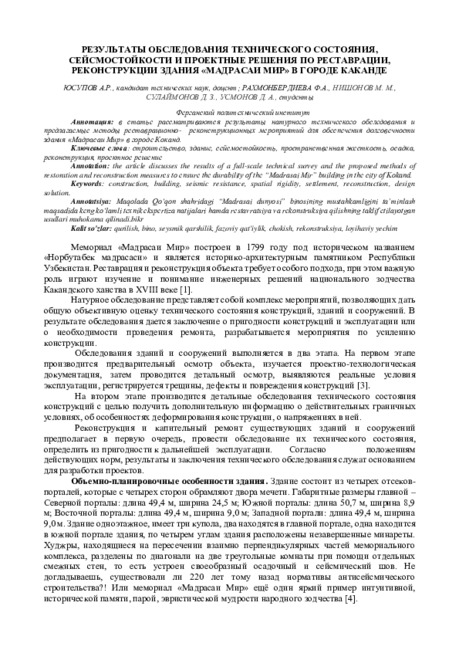
Results of a survey of the technical condition, seismic resistance and design solutions for the restoration and reconstruction of the Madrasai World building in the city of Kakand
the article discusses the results of a full-scale technical survey and the proposed methods of
restoration and reconstruction measures to ensure the durability of the “Madrasai Mir” building in the city of Kokand.
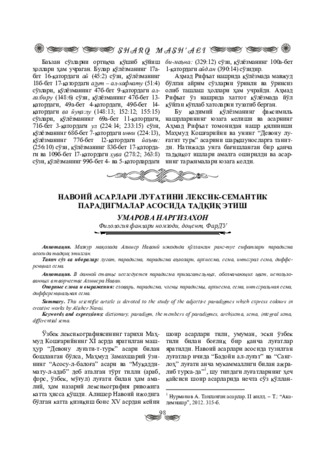
Researching the vocabulary of Navoi's works based on lexical-semantic paradigms
Representation of the concept of good and evil in Korean classic stories
In this article concepts of “good” and “bad” have been observed as the universal idea of humans mind in terms of Cognitive Linguistics in the texts of Korean classical stories, its characteristic plots have been described on the basic materials of Korean poets.
Representation of copulative phraseological units in Persian
Remarks on the expression of copulative units in Persian
Relations between Kokan Khanate and China during Erdona period
The article is enlightened moments of establishment of political and diplomatic relationships between the Kokand khanate and the Manchurian Empire (1644– 1911) that took place in the middle of 1759, which was period of reign of the Kokand ruler (khan) Irdona (1753–1763). Thanks to the strong diplomatic skills of Irdona-biy, relations between the two countries developed. The study of this problem has a great importance in the historical science of Uzbekistan.
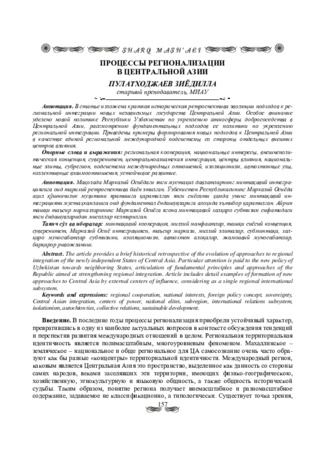
Regionalization processes in Central Asia
The article provides a brief historical retrospective of the evolution of approaches to regional integration of the newly independent States of Central Asia. Particular attention is paid to the new policy of Uzbekistan towards neighboring States, articulation of fundamental principles and approaches of the Republic aimed at strengthening regional integration. Article includes detail examples of formation of new approaches to Central Asia by external centers of influence, considering as a single regional international subsystem.
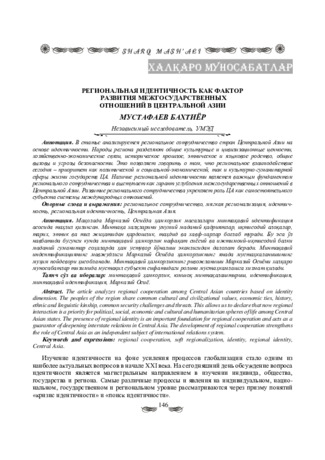
Regional identity as a factor in the development of interstate relations in Central Asia
The article analyzes regional cooperation among Central Asian countries based on identity dimension. The peoples of the region share common cultural and civilizational values, economic ties, history, ethnic and linguistic kinship, common security challenges and threats. This allows us to declare that now regional interaction is a priority for political, social, economic and cultural and humanitarian spheres of life among Central Asian states. The presence of regional identity is an important foundation for regional cooperation and acts as a guarantor of deepening interstate relations in Central Asia. The development of regional cooperation strengthens the role of Central Asia as an independent subject of international relations system.
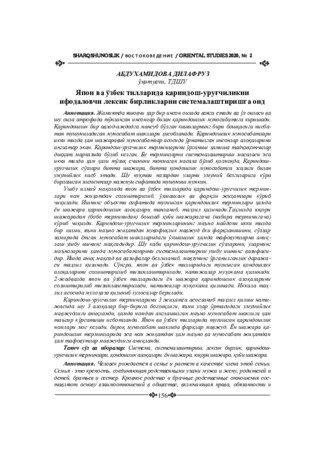
Regarding the systematization of lexical units representing kinship in the Japanese and Uzbek languages
All Humans were born in their family, they grow as a member of family. Family is considered as a place which has a bond to live together of relationship with man and wife, parents, children as well as siblings. Blood relation and relative by marriage are main part in attitude of society, In addition it can consist of their duties and aims. That kind of attitude among society is said kinship. And the words which are related to this are called kinship terms. These terms possess form of naming and address. This terms posses two types: address and naming which are differentiated in relationship. This article provides comparison between similarities and differences in the terms of kinship in Japanese and Uzbek languages. Direct and соllateral family ties from the ascending line (grandfather) to the descending line (grandson) are analyzed. The objective of this work is to identify answers to questions such as whether the meanings of kinship terms are uniquely suited in Japanese and Uzbek languages and whether relationship structures are similar or different. In this scientific article, the names of kinship relations in Japanese and Uzbek are systematized, their meanings and relations are determined. In Japanese and Uzbek languages, the name blood relationship is consistent but there are differences in relation. From the point of view of соllateral family kinship, it was found that there are differences in the name of the kinship, in both their meaning and attitude.
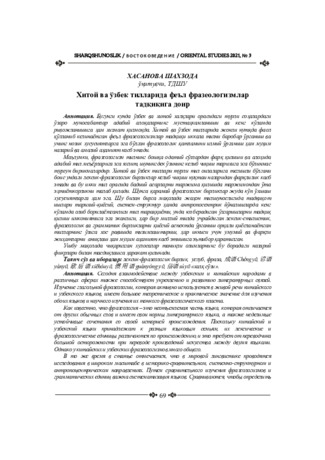
Regarding the study of verb phraseology in Chinese and Uzbek languages
As you know, there are different branches and directions in the world of translation. Friendly relations between the Uzbek and Chinese peoples serve to strengthen and expand literary ties. In modern Chinese and Uzbek linguistics, more and more attention is paid to the study of language, especially vocabulary, semantics, analogies and metaphors. The fact that research in world linguistics is carried out on a large scale in the historical-comparative, system-structural and anthropocentric directions makes it possible to study the development of the language and the changes taking place in it. In the field of comparative linguistics, a number of studies have been carried out in order to systematize the lexico-stylistic, phraseological and grammatical units of each national language through a comparative study of comparable languages in order to identify common features and differences for both. Each language has its own vocabulary. The fact that a word is expressed using lexical, phraseological and lexico-phraseological words, in turn, shows how long the language has a history. The correct and purposeful use of this wealth makes speech effective and expressive. Since ancient times, writers and philosophers have paid particular attention to the use of phraseological units to make them more effective and efficient. Phraseology is a holistic phrase that distinguishes a language from other ordinary words and has its own set of literary linguistic norms, as well as its own origin story. Phraseological compounds have been widely used in Uzbekistan since the first half of the last century. Created a number of articles, monographs, dissertations, glossaries, textbooks, teaching materials.
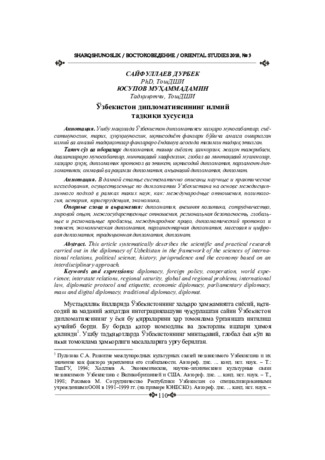
Regarding the scientific study of Uzbekistan's diplomacy
This article systematically describes the scientific and practical research carried out in the diplomacy of Uzbekistan in the framework of the sciences of international relations, political science, history, jurisprudence and the economy based on an interdisciplinary approach.
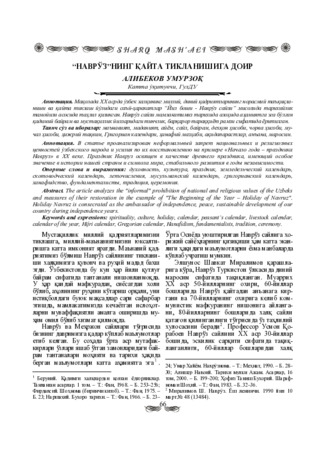
Regarding the revival of "Navroz"
The article analyzes the "informal" prohibition of national and religious values of the Uzbeks and measures of their restoration in the example of "The Beginning of the Year – Holiday of Navruz". Holiday Navruz is consecrated as the ambassador of independence, peace, sustainable development of our country during independence years.
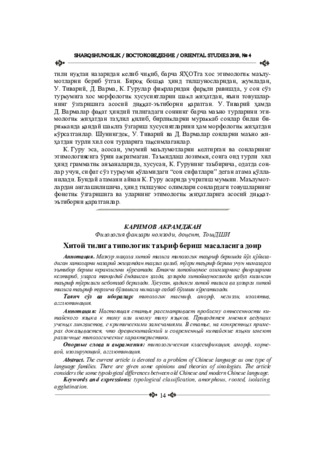
Regarding the issue of typological definition of the Chinese language
The current article is devoted to a problem of Chinese language as one type of language families. There are given some opinions and theories of sinologists. The article considers the some typological differences between old Chinese and modern Chinese language.
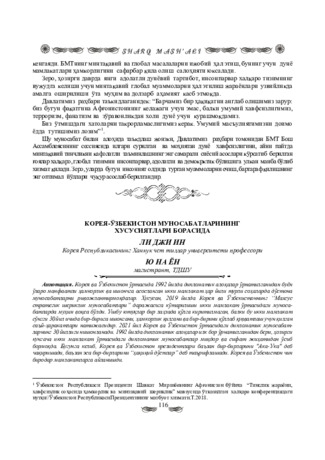
Regarding the characteristics of Korea-Uzbekistan relations
Since the establishment of diplomatic relations between Korea and Uzbekistan in 1992, the two countries, based on mutually beneficial cooperation and trust, have been developing friendly relations in various fields every year. In particular, the rise of Korea and Uzbekistan to the level of "Special Strategic Partnership" in 2019 was an important event in relations between the two countries. These achievements have not been achieved overnight, but are the result of the two countries ’trust, cooperation and efforts to support each other over the past 30 years. 2021 will mark the 30th anniversary of diplomatic relations between Korea and Uzbekistan. Since the establishment of diplomatic relations in 1992, diplomatic relations between the two countries have been growing in quantity and quality. Today, the presidents of Korea and Uzbekistan sometimes call each other "Aka-Uka" and sometimes describe each other as "true friends." Korea and Uzbekistan have become true brothers. Accordingly, Korea and Uzbekistan, which are actively developing diplomatic, economic, social, as well as health, cultural and labor exchanges as strategic partners for each other, will be a great synergy if they expand cooperation in the future and meet each other's needs and develop together. effect is expected to occur.

