
All articles
Taxonomy and bioecology of Hemiptera Diaspididae in fruit and landscape trees
Morphometric signs of copper bees under the conditions of Uzbekistan
the exterior signs of honey bees in different zones of the Tashkent region, the influence on their manifestation of external environmental conditions was studied
Image pre-processing techniques for crop pest detection
Pest detection systems are important tools for crop yields. Because they serve as robust techniques while preventing some damages there. In this paper, some image pre processing techniques are discussed and efficient methods are described.
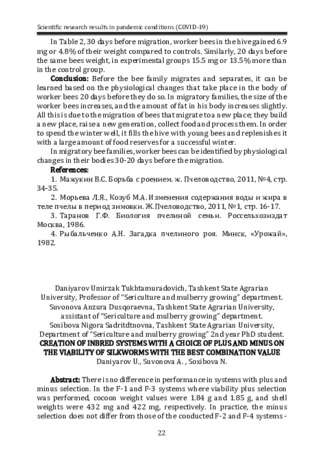
Creation of inbred systems with a choice of plus and minus on the viability of silkworms with the best combination value
was performed, cocoon weight values were 1.84 g and 1.85 g, and shell weights were 432 mg and 422 mg, respectively. In practice, the minus selection does not differ from those of the conducted F-2 and F-4 systems-1.72 g and 1.85 g, respectively; 394 mg and 420 mg. Clearly, the choice of viability leads to the accumulation of recessive hemispheric and subletal genes in the homozygous state in the system. As a result, some organisms die at different stages of development. But some of them survive. Probably on the one hand, because harmful genes are less accumulated, and on the other hand, because there are enough positive genes to compensate for the
effects of harmful genes, i.e., the GCC is formed. Had this process not taken place, no doubt the system would have perished as a result of negative selection over several generations. It follows that GCC does not occur in systems with high viability. The predominance of
positive genes over negative genes is achieved without them. In addition, the process of mutation is accelerated under the influence of negative selection.
Thus, not only the reserve but also the newly emerging genes remainthe source for the blocks of both categoriesThis increases gene diversity
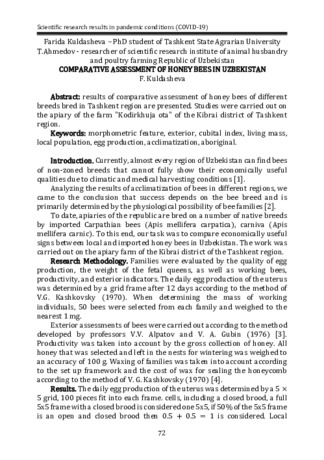
Comparative assessment of honey bees in Uzbekistan
the apiary of the farm "Kodirkhuja ota" of the Kibrai district of Tashkent region.
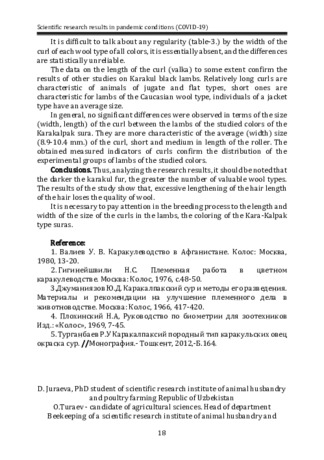
Changes in the body of working honey bees preparing to migrate
population, and on the basis of which migration can be prevented.
Biology and economic significance of melon fly and development of its control measures
The aim of the research is decreasing losses caused by melon fly via studying its biological and ecological characteristics during pest’s development, terms of pest appearance on the crops, number of generations in its life cycle, and development of control measures aimed eliminating of the pest at early stages of growing melons.
Scientific novelty of the research work is expressed in the followings:
Reasons of spreading of melon fly in conditions of the Republic of Karakalpakistan have been justified for the first time. Host plant species of the melon fly arc determined and negative impacts of the pest on yields of these species have been identified. Morphological characters of various growth stages of the pest and its impact on yields in differing ecological conditions have been determined. Dynamics of pest development, phenology and criteria for assessing crop losses caused have been studied. Tactics of pest control and optimal terms for use of imagocide insecticides have been developed. Biological, on-farm and economical efficacies of this tactics and control means against this pest of melon crops have been justified.

