All articles

IN THE DIGITAL SPACE – CHANGING THE SOCIAL AND MORAL ENVIRONMENT
Today, the transformation of personal needs is taking place on the Internet, media products, video games, social networks, marketing activities that arouse the interest of the general public. Global popularity, the status of modern networks, and the impact of social networks on our traditional moral and aesthetic values are issues that require special study. The tools of cyberspace play a key role in satisfying personal aesthetic needs and changing the aesthetic worldview. In connection with the need of people to communicate using the technical capabilities of the Internet, a new area and direction called “Social Networks” has been formed. Social networks, which originally served only to communicate with anyone, are now becoming an incomparable tool for people to respond to social and political changes taking place in society with their advanced thoughts.
Improving the solution by the internal affairs bodies of the problems of citizens in need of social protection and their families in industry activities
The article analyzes the issue of improving the activities of internal affairs bodies in solving the problems of socially needy citizens and their families.
Improving the methodology for calculating the tax burden on legal entities
This article presents an analysis of the tax burden on legal entities, which examines the analysis of the current state of the tax burden on legal entities and the methodology for calculating it. Methods for calculating the tax burden on legal entities are also proposed.
IMPLEMENTATION OF THE MAIN PRINCIPLES OF EDUCATION AND TRAINING IN THE TRAINING OF FOOTBALL PLAYERS
Imkoniyati cheklangan bolalarni jamiyatga moslashtirishda ijtimoiy xizmat ko‘rsatishning o‘ziga xos xususiyatlari
Maqolada imkoniyati cheklangan bolalar bilan ijtimoiy ish olib borish yo‘llari ularning jamiyatga moslashish jarayonlarining o‘ziga xos xususiyatlari va amaliy jihatlari yoritilgan. Imkoniyati cheklangan bolalar bilan muloqotga kirishish, ularni ham sog‘lom insonlar qatorida imkoniyatlarini yuzaga chiqarishda ijtimoiy ish va sotsiologiya mutaxasislariga zaruriy va ilmiy tavsiyalar berilgan. Bu maqolada bugungi kunda ijtimoiy hayotda dolzarb hisoblangan imkoniyati cheklangan bolalar hayotini yaxshilashga, ularning jamiyatda faol o‘zini namoyon qilish borasidagi asosiy echimlar ko‘rsatib berilgan. Ilmiy maqolada qayd etib o‘tganki, imkoniyati cheklangan bolalarni sog‘lom hayotga qaytarish, ular bilan ijtimoiy ish olib borish yo‘llari vasamarali yo‘nalishlari ochib berilgan. Ayniqsa, bu turdagi bolalar xuquqlarini himoya qilish ular bilan muomala qilish jarayonlari hususida zaruriy tavsiyalar berib o‘tgan.

Ichki ishlar organlari xodimlarida korrupsiyaga qarshi tafakkurni shakllantirishda ijtimoiy-falsafiy tushunchalarning ahamiyati
Maqola ichki ishlar organlari xodimlarida korruptsiyaga qarshi fikrlashni rivojlantirishda ijtimoiy-falsafiy tushunchalarning rolini o'rganadi. Muallif korruptsiya va uning sabablarini tushunishda falsafiy va sotsiologik yondashuvlarning ahamiyatiga e'tibor qaratadi.
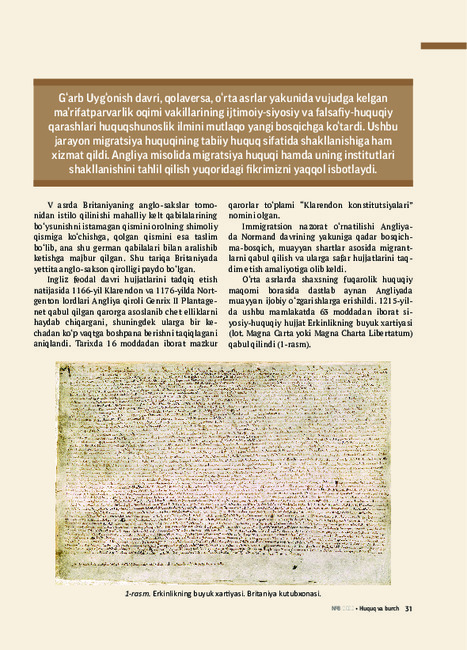
History of migration law in England
History of coverage of a strong social protection system in works
In the article the author the fact that people can achieve social policy only in the conditions of strong social opportunities in the state. Social opportunity means the ability to distribute places, powers, levels, positions, privileges on the social ladder. Of course, this distribution is influenced by the paradigm of economic opportunities. For example, despite the fact that income or wealth are economic opportunities, they also describe social status.

Harmony of freedom and social responsibility in development of the person
Subjects of research: features of formation of freedom and responsibility of the person and of its interrelation with national mentality.
Purpose of work: definition the role of freedom and social responsibility in spiritual development of youth its influence on practical activities of the person.
Methods of research: methods of scientific knowledge as: the analysis and synthesis, the comparative analysis, generalization, dialectics, system set, also principles of objectivity and heredity.
The results achieved and their novelty: on the basis of the socially-philosophical and comparative analysis general essence, genesis of such concepts as «personal freedom», «social responsibility», «a spiritual debt and responsibility» its role in society prosperity the place and role of formation of feelings of freedom and responsibility in the conditions of globalization is shown.
Practical value: conclusions, practical offers and recommendations made in given dissertation can be used by working out of scientific courses and at teaching in average and higher educational institutions, also in holding of fundamental researches deal with questions of interrelation of the person freedom and social responsibility.
Degree of embed and economic effectively: results of research was used in carrying out of scientific-theoretical actions, and also at carrying out of a practical training among students of the Andizhan State University and stated in author’s articles published in republican and international conferences.
Field of application: results of disscrtational work can be used in scientific researches, in teaching activity, in system of increasing of qualification of young shots, at carrying out of cultural-enlightenment and educational actions of social youth movement «Kamolot» and in its units, in areas and regions, in work with youth of political parties.

GLOBALIZATION AND SOCIAL SYSTEMS: THE INFLUENCE OF OTHER CULTURES AND ECONOMIC SYSTEMS
This article analyzes the impact of the globalization process on social systems, cultures, and economic structures. Globalization, primarily through the exchange of trade, technology, information, and cultures, is increasingly strengthening its social and economic influence on the global scale. The article primarily examines how globalization has brought about changes in social structures, political systems, and cultural traditions. Specifically, it analyzes the interactions with other cultures, the formation of new economic systems, global migration of labor, and the integration of local economies into the global market.
Gender roles in STEM
This article discusses the importance of introducing educational programs for preschool children to master basic knowledge of science, technology, engineering and mathematics (STEM knowledge). It is proven that teaching STEM knowledge to pre-school children gives them great potential for further development in primary and secondary school. When revealing the subject of STEM knowledge for preschoolers and the gender aspects of its successful teaching, it is concluded that, along with the preparation of such educational programs, it is necessary to develop the special knowledge of boys and girls.
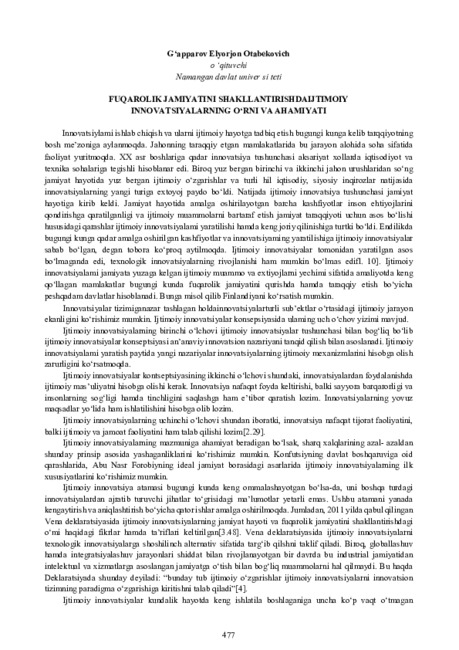
Fuqarolik jamiyatini shakllantirishdaijtimoiy innovatsiyalarning o‘rni va ahamiyati
Innovatsiylami ishlab chiqish va ularni ijtimoiy hayotga tadbiq etish bugungi kunga kelib tarqqiyotning bosh me’zoniga aylanmoqda. Jahonning taraqqiy etgan mamlakatlarida bu jarayon alohida soha sifatida faoliyat yuritmoqda.
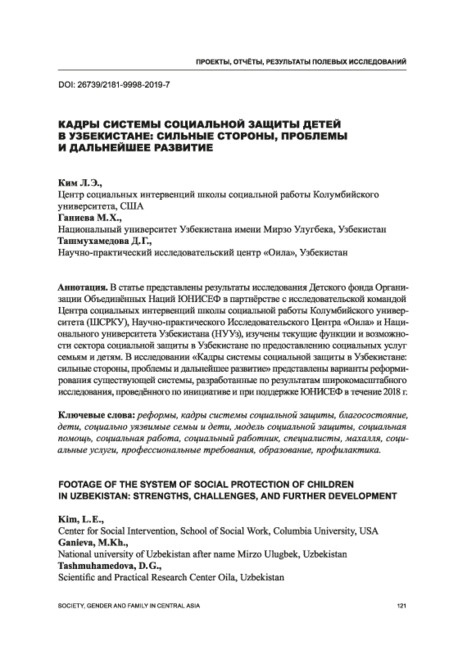
Footage of the system of social protection of children in Uzbekistan: strengths, challenges, and further development
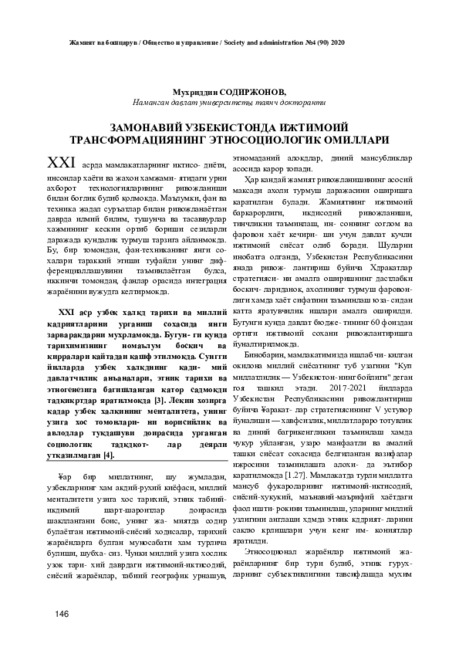
Ethnosociological factors of social transformation in modern Uzbekistan
The article examines economic and political changes in Uzbek society and radical changes in the daily life of people. The article also describes ethnosocial factors of social transformation in modern Uzbekistan, the subjectivity of ethnic groups in ethnosocial processes. Taking into account such aspects as the unique cultural traditions and values of different nations and peoples makes it possible to ensure the sustainable and consistent development of interethnic relations in the system of national interests. Ethnic social processes in the region are discussed in terms of ethnic unity and harmony, ethnic conflicts, ethnic migration and the importance of the ethnic economy.
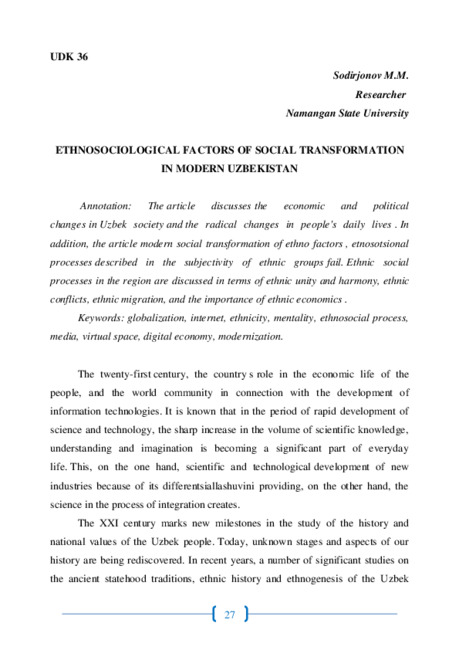
Ethnosociological factors of social transformation in modern Uzbekistan
The article discusses the economic and political changes in Uzbek society and the radical changes in people's daily lives. In addition, the article modern social transformation of ethno factors , etnosotsional processes described in the subjectivity of ethnic groups fail. Ethnic social processes in the region are discussed in terms of ethnic unity and harmony, ethnic conflicts, ethnic migration, and the importance of ethnic economics .

Ethnopsychological features of adaptation of brides to family (on an example of Kazakh families)”
Subjects of research: brides from Kazakh and Uzbek families (bridegrooms, mothers-in-law, sisters and brothers of spouses: altogether 400 subjects).
Purpose of work: studying of cthnopsychological features of adaptation of brides to family on an example of Kazakh families.
Methods of research: conversation-interview, socio-psychological questionnaire, H.J.Eyscnck’s personality questionnaire, “Moral readiness for marriage” test; E.G.Gazicv’s “Matrimonial relations estimation scale”, K.Thomas’s technique “Description of behavioral strategies in conflict situations”, K.Rogers’s and R.Diamond’s technique “Definition of socio-psychological adaptation”, D.H.Olson, J.Portner, I.Lavi’s “Scale of family adaptation and unity”, methods of mathematical statistics.
The results obtained and their novelty: for the first time the cthnopsychological features of adaptation of brides living in Kazakh families arc studied. The role of preparation level for family life and abilities to co-operate and to accept new social roles in adaptation of brides to family is proved. The corclation between the socio-psychological and cthnopsychological features influencing adaptation to family is defined.
Practical value: the results of this research can be used in improvement of the activity of specialists engaged in the problems of young family and matrimonial mutual relations at optimization of adaptation of brides to the new family, in prevention and solving the family conflicts.
Degree of embed and economic effectivity: the dissertation materials arc used in activity of “Makhalla” committees of Navbakhor and Konimckh districts of Navai region, in carrying out lectures, seminars and practical training on the courses “Ethnopsychology”, “Psychology of interpersonal relations”, “Social psychology” for students of National University of Uzbekistan.
Field of application: ethnopsychology, family psychology, psychology of interpersonal relations, family counseling.
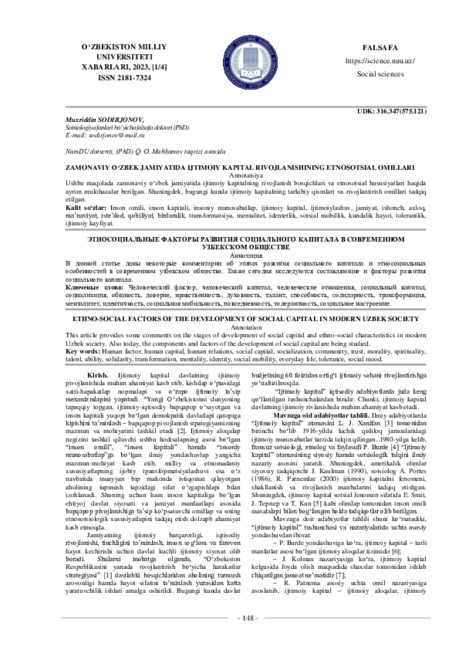
Ethno-social factors of the development of social capital in modern uzbek society
This article provides some comments on the stages of development of social capital and ethno-social characteristics in modern Uzbek society. Also today, the components and factors of the development of social capital are being studied.
Ensuring interethnic harmony and religious tolerance in the new Uzbekistan
The brochure highlights the priority directions of the state policy of the Republic of Uzbekistan aimed at strengthening interethnic harmony and religious tolerance in society, the development of friendly relations with foreign countries.
It also provides information for the period of 2017-2024 on ensuring security, strengthening interethnic harmony and promoting religious tolerance in Uzbekistan, cooperation of national cultural centers and friendship societies operating in our country to develop friendly cultural and educational ties aimed at developing multinational and multi-confessional New Uzbekistan based on the mechanism of public diplomacy, effective coordination of work to strengthen friendship with compatriots living abroad.
In preparing this brochure, data from the Committee on Religious Affairs of the Republic of Uzbekistan were used.
The brochure is intended for political scientists, ethnologists-anthropologists, sociologists, teachers, students of sociology, specialists in the field of interethnic relations and a wide range of readers.
The brochure was prepared in accordance with the conclusion of the Committee on Religious Affairs of the Republic of Uzbekistan No. 02-07/6804 as of November 15, 2024.
It was recommended for publication by decision No. 3 of the meeting of the Scientific and Educational-Methodical Council of the International Islamic Academy of Uzbekistan as of November 19, 2024.
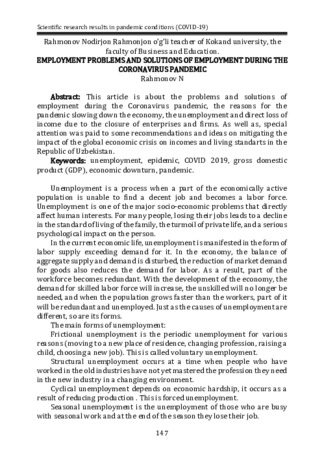
Employment problems and solutions of employment during the coronavirus pandemic
pandemic slowing down the economy, the unemployment and direct loss of income due to the closure of enterprises and firms. As well as, special attention was paid to some recommendations and ideas on mitigating the impact of the global economic crisis on incomes and living standarts in the Republic of Uzbekistan
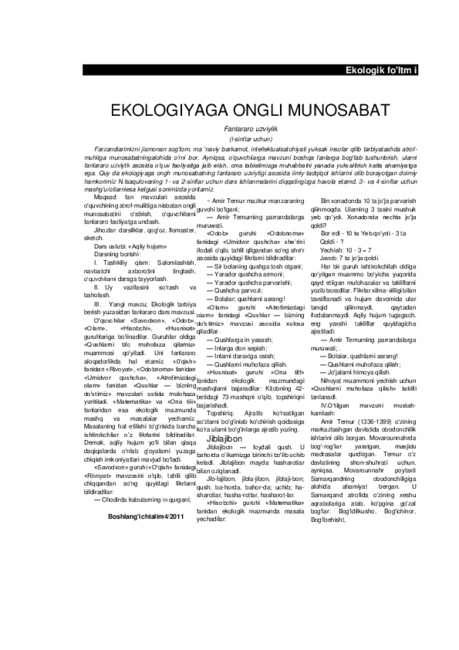
Ekologiyaga ongli munosabat
Farzandiarimizni jismonan sog'tom, ma 'naviy barkamot, intellektualsatohiyati yuksak insofar qilib tarbiyatashda atrof-muhitga munosabatningalohida o'rni bor. Ayniqsa, o'quvchiiarga mavzuni boshqa fanlarga bog'fab tushunbrish, ularni fanlararo uzviytk asosida o'quv faoliyatlga jaib etish, ста tabiatimizga muhabbatni yanada yuksaltirish katta ahamiyatga ega. Quy da ekoiogiyaga ongh munosabatning fanlararo uzviytigi asosida iimiy-tadqiqot ishlarini olib borayotgan doimiy hamkorimiz N.Isaqulovaning 1- va 2-sinflar uchun dars ishlanmalarini diqqatingizga havola etamd. 3- va 4-sinflar uchun mashg'u/otiarniesa ketgusi sonimizda yoritamiz.
Education of a perfect person: the harmony of spirituality and enlightenment
Ушбу мақолада комил инсон тарбиясида маънавият ва маърифат уйғунлиги, фарзанд таълим-тарбиясига миллат келажаги учун қайғуриш, бахтли-саодатли умр кечириш, ўзгаларга тобе бўлишдан ҳимояланиш, бир сўз билан айтганда, ҳаёт-мамот масаласи тўғрисида маълумотлар берилган.
Economic benefits of joint maintenance and energy efficiency improvement in high-rise residential buildings
This article outlines the economic benefits of increasing energy efficiency during the current reconstruction of multi-storey residential buildings.
Diverse perspectives of the problem of periodization in developmental psychology
Periodization within developmental psychology involves the segmentation of human growth and maturation into distinct, meaningful phases or stages. This concept is fundamental for comprehending and examining the intricate progression of human development. Currently, the ongoing changes in our country, including the public education system, are focused on educators and all those involved in teaching. The goals include fostering independent thinking and activity in students, as well as instilling strong moral values in them. This entails tackling intricate and weighty responsibilities, such as nurturing their critical thinking, communication skills, reading proficiency, and work aptitude. To effectively address these objectives, it’s imperative to possess not only the theoretical underpinnings of pedagogy, subject-specific teaching methodologies, and a grasp of fundamental aspects of students’ physiology and hygiene, but also a degree of psychological knowledge. Every educator should possess some level of proficiency in psychology, as they interact with a diverse student body of varying ages, each with unique individual traits [11].

Diniy va dunyoviy sohalarda totuvlikka ta'sir etuvchi omillarni aniqlash