




274
4.
Vecino, A. M. (2007). Exploring the wonder of creative writing in two EFL writers. (Master’s
thesis). Universidad Distrital Francisco José de Caldas, Bogot
5.
Journal for the Study of English Linguistics, (Vol. 1, 2013), p. 40-41
6.
Wing, J. (2008). Using Authentic Video in the Language Classroom. UK: Cambridge
University Press.
MECHANISMS OF FORMATION OF SPEECH SKILLS ON THE BASIS OF MEDIA
TECHNOLOGIES
Zаrlikоv Ikrаm
Doctoral student, Karakalpak state university named after Berdakh,
The expansion of the socio-economic and cultural cooperation of the countries in the world
is increasing the interest, need and desire to learn foreign languages, especially English. In the
educational system of developed countries, special attention is paid to learning English in
accelerated ways from the school period. The development of students' language and speech
competences on the basis of media technologies is becoming an urgent issue in teaching English
in general education schools. Especially for A1 levels, it has become a priority to acquire the
linguistic competence noted in the content of English language teaching and to develop the ability
to use it in speech communication. The experience of world countries shows the need to create
and improve teaching methods based on the development of lexical competence in teaching
English to students.
The development of media technologies in the development of speech and language
competences in the linguistic competence of general education school students is considered an
urgent issue today.
According to the document adopted by the Council of Europe, the following components
in the structure of linguistic competence are distinguished: lexical, grammatical, semantic,
phonological, spelling and orthographic. [2.53]
In our opinion, the formation of linguistic competence consists of the following structural
stages:
– designing the educational process;
– organizing the educational process on the basis of ICT tools;
– conveying the essence of virtual technology to students in conducting the educational
process in the formation of linguistic competence;
– evaluation of the result, programming of future activities based on virtual technologies.
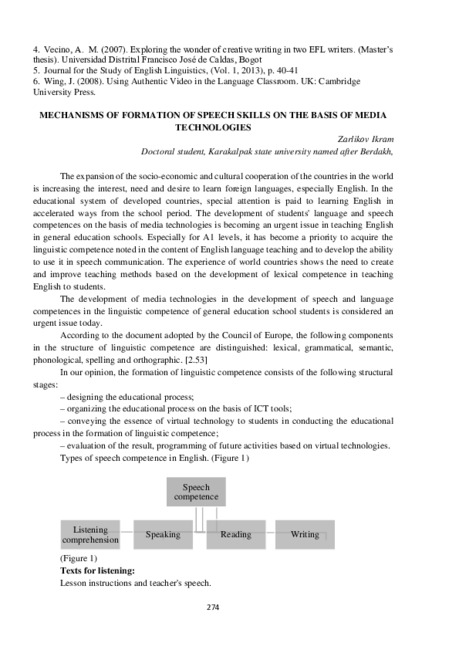
Types of speech competence in English. (Figure 1)
(Figure 1)
Texts for listening:
Lesson instructions and teacher's speech.
Speech
competence
Listening
comprehension
Speaking
Reading
Writing

275
Fairy tales and stories.
Recorded speech of the native speaker (songs, poems, dialogues and etc.).
Decision PD-1875 dated December 10, 2012 of the President of the Republic of Uzbekistan
"On measures to further improve the system of learning foreign languages"[1.25] was adopted.
This decision is the requirements for the preparation of A1 level graduates in the English language
for learning a foreign language in the continuous education system of the Republic of Uzbekistan.
(Figure 3)
(Figure 3)
Requirements for English listening comprehension competence of A1 level students:
-
can understand and follow simple instructions;
-
able to understand simple questions and sentences;
-
can understand simple poems, stories and songs;
-
able to understand simple authentic speech in familiar contexts.
English speaking competence of A1 level students:
Dialogue.
-
can ask for and give information;
-
able to ask for help;
-
can answer simple questions.
Monologue.
-
able to talk about his place of residence, family, friends and acquaintances;
-
can introduce himself or herself and talk about his or her likes and dislikes;
-
able to make very short presentations on a familiar topic.
English reading competence of A1 level students:
-
can understand the main content of informative texts on familiar topics;
-
able to understand a short text describing a place or people (using visuals where
necessary);
-
can understand simple messages such as simple letters and e-mails;
-
able to understand and follow simple written instructions or directions.
English writing competence of A1 level students:
-
can write personal simple messages (greetings, notes and e-mails);
-
able to fill out a simple form with personal information (full name, address and etc.);
-
can write simple poems and stories.[5.18]
According to the decision PD-1875 of December 10, 2012 "On measures to further improve
the system of learning foreign languages"[1.37], the English language competence of A1 level
students is based on the following requirements. (Figure 4)
Linguistic competence
Speech competence
Language competence

276
(Figure 4)
Of course, the effective organization of this process requires the skill from not only the
teacher, but also the student to know the English language. So, in this process, the activity and
creative cooperation of both subjects are required. In conclusion, the following can be given:
– pedagogical conditions, pedagogical reflection and skills play an important role in the
development of A1 level students' English language skills (speaking, reading, listening
comprehension and writing);
– the linguistic competence formed as phonetic, lexical and grammatical skills (speaking,
listening comprehension, reading and writing) is considered as the main levels.
– it is important for students of A1 level to demonstrate their ability to learn English
(speaking, reading, listening comprehension and writing), to put their knowledge into practice with
the help of virtual technology, and to understand its effective aspects. For this:
– it is necessary for the student to effectively use virtual and information technology
electronic educational resources, multimedia presentations, media technologies, modern electronic
teaching-methodical materials and audio-visual tools during the educational process;
– students need to make good use of the advanced foreign experience in developing
international cooperation and communication.
Lexical competence is characterized by knowing the vocabulary of the language, including
lexical and grammatical elements, and being able to use them in speech. Lexical competence
includes the following:
1) independent words - parts of speech (noun, adjective, verb, adverb and etc.);
2) phraseological units are semantically invisible and stable compounds, which are
distinguished by a separate integral content and the invariance of the component structure, and are
fixed in the speaker's memory. They are single-meaning complex and contradictory meaning units
(speech signs, proverbs and sayings, phraseological verbs, complex prepositions and etc.);
Grammatical skill is, in fact, the ability to know the grammatical rules of the language and
use them in speech. It includes the ability to understand and express a certain meaning, forming it
in the shape of phrases and sentences structured according to the rules of the target language.
Language competence
Phonetic competence:
- can pronounce all sounds of
a foreign language clearly;
- able to put the accent on
words
and
sentences
correctly;
- can distinguish and use
intonation
patterns
in
communicative situations.
Lexical competence:
- able to use acquired
lexical tools in context
(text);
- can use simple words
related to the topic in
communicative situations;
- able to distinguish and
use
some
international
words and related words.
Grammatical competence:
- can use simple grammatical
and
syntactic
structures
in
communicative situations;
- able to connect words and
phrases with the conjunction
"and";
- can say sentences correctly,
using verb forms and simple
time participles, and describe
stories
and
events
in
the
correct sequence.

277
In the teaching of the English language, scientific opinions are expressed about the
development of lexical, grammatical and pronunciation skills of speech, as well as speaking,
listening comprehension, reading and writing skills.
According to S. Shevchenko, the computer "allows the personalization of official
thinking"[3.24]. From this point of view, media technologies are not only a means of learning, but
the computer is also distinguished by its capabilities. Because it is used to concretize the acquired
knowledge by mastering formal operations. Such concretized knowledge includes all the elements
necessary for mastering formal means of thinking.
In our dissertation, based on the principles of concentrism, it is necessary to pay attention
to the following issues in the development of the educational process using the ideas of cognitive
psychology and cognitive computer graphics of the use of media technologies in teaching English
to A1 level students:
studying professional resources in English;
teaching A1 level students in English on the basis of multimedia and studying learning
problems;
analyzing and summarizing philosophical, pedagogical, methodological and linguistic
literatures on the use of media technologies in teaching English to A1 level students;
comparing, formalizing and abstracting the studied processes and events;
empirical: observation, interview, test, pedagogical consultation and experiential
learning;
statistical: methods of processing experimentally obtained data;
clarifying the didactic and psychological characteristics of foreign language
acquisition of A1 level students;
determining the place and place of multimedia technologies in relation to the
conditions of teaching English to A1 level students;
analysing English language teaching programs and their linguistic and didactic
possibilities;
developing a model of formation of the basics of speech in a foreign language from
the point of view of a person-oriented approach of A1 level students;
experimentally testing the effectiveness of foreign language teaching to A1 level
students using multimedia programs;
preparing students for living in modern information conditions and forming global
thinking skills in it;
teaching to perceive information in different forms and content and to understand their
essence;
developing students' skills based on non-verbal communication using technical means
and acquiring knowledge about its methods effecting to the human psyche and its negative
consequences.
According to I.A.Zimnyaya's classification of basic competences[4.38], the goals and tasks
of media education can be realized in the process of developing the competences of value-semantic
orientation in the world, social interactions with civil society and communities and etc.
Media technology provides the following opportunities during the English language
course:

278
- developing competence necessary for students to be able to independently create a certain
reality in the mass media and to analyze the methods of doing so;
- understanding the socio-political and economic essence of the information disseminated
through mass media and having complete knowledge about the promoted material;
- being able to independently evaluate media texts and developing the level of perception;
- decoding media texts in order to recognize and evaluate the practical importance of
cultural values and ideas in them;
- recognizing, analyzing and applying various technical uses and creation of media texts;
- knowing that the creators of media texts do it based on different motives;
- is to understand that every student participates in the analytical process by choosing to
research media texts. This process and the meanings associated with it depend on psychological,
social and natural factors.
REFERENCES:
No. 124 dated 08.05.2013. On approval of the state education standard for foreign languages
of the continuing education system (lex.uz)
2.
The World Declaration of the United Nations "Higher Education of the 21st Century" (1998),
UNESCO's document "Integration and Development of Higher Education" (1995), CEFR.
Learning, teaching, assessment. Language Policy Unit, Strasbaurg.
3.
Shevchenko S.I. Formation of communicative competence in reading in English using
computer technologies at universities: Abstract of dissertation of candidate of pedagogical
sciences – Kiev, 2004. – p. 24.
4.
Zimnyaya I.A. Pedagogical psychology: A textbook for universities. 2nd edition, additional
correction and processing. M.: Logos, 2003. –p. 38.
5.
lex.uz/acts/-2165717?ONDATE=20.05.2013 00
6.
Zarlikov, I., & Boltaboyeva, A. (2022). The value and effectiveness of new technologies in
foreign language teaching. Renaissance in the Paradigm of Innovations in Education and
Technology in the 21st Century, (1), 184–185.
https://doi.org/10.47689/innovations-in-edu-vol-
7.
Urazimbetova G., & Aytbaeva, M. (2023). ENGLISH AND KARAKALPAK TOPONYMIC
PHRASEOLOGICAL UNITS IN LINGUISTICS.
Eurasian Journal of Academic Research
,
3
(6),
https://www.in-academy.uz/index.php/ejar/article/view/16868
https://www.doi.org/10.5281/zenodo.8023020
8. Zarlikov I., & Aytbaeva , M. (2023). Media technologies in the english lesson as a technical
tool and media education. Renaissance in the Paradigm of Innovation in Education and
Technology in the XXI Century, 1(1), 52–56.
https://doi.org/10.47689/XXIA-TTIPR-vol1-iss1-
SECTION 3. COMPARATIVE LINGUISTICS AND
TRANSLATION
A CROSS-CULTURAL ANALYSIS OF APOLOGY EXPRESSIONS IN KARAKALPAK
AND ENGLISH
Abdikarimova Guldana
MA student, Karakalpak State University, Nukus, Uzbekistan
