
All articles
Development trend of modern literature
Mazkur maqolada jahon davlatlarida zamonaviy adabiyotning rivojlanish tendensiyasi,janrlari, janrlar haqida qisqacha maʼlumot, postmodernizm tushunchasi va oʻtgan davr adabiyoti bilan hozirgi davr adabiyotini taqqoslangan holda koʻrib chiqamiz.
Development of students ' speech culture on the russian lesson
This article deals with speech competence, the concept of "speech culture" in modern society, and the aspects and main qualities of speech culture
Development features of uzbek epic poem- writing during the second half of the twentieth centuries
The urgency and relevance of the theme of dissertation. World literary genres' imrove, in particular, the development of poems, artistic and aesthetic principles, universal values and mental development of the industry to assess the level of expression. National poetic thought a unique tradition and reflects the views of the Uzbek poet’s ancient roots. Uzbek folklore and classical literature traditions formed under the influence of modem epic 30-ycars of the twentieth century as an independent genre.
Uzbek epic-poem stages of development, and improving the properties and the history of the twentieth century poetic epic genre and the most important challenges facing the knowledge of the theory of literature of all time.
50-80 years of the twentieth century worked by artists under the influence of the dominant ideology of social problems related to the theme of freedom and liberation for the period through certain images, they were trying to display by means of symbols. During the years of independence, free thought, freedom has led to the renewal of thinking and outlook of the people. Life, social events, the activities of the human personality and attitude - changed the poetic concepts. Artistic expression inherent in the old system madhiyabozlik pomp, solemnity replaced aesthetic psychologism life, honesty, and take real images. Besides, «We all know that a real author lives with grief of people, and gets inspiration from people to enter into new topics from life which includes the changes of present time»
In fact, we can see at the second half of the twentieth century a number of socio-political changes which occurred in the development of society, in particular, continued to reflect on people's aspirations toward the independence years of Uzbek epic-poetry writing.
In turn, it became the main reason and duty of making research in all the branches of literature, including genre of epic-poem writing in structural development, evolution and mental crushing.
Thus, the principles of development of Uzbek epic poem writing in the second half of the twentieth century, hundreds of poets and creative experiences, studied subjects and issues of painting and artistic skills, and it was the main reason of creating basis of the theory and history of genre. Investigations have been done at changings in poesy, philosophical, public and esthetic points, structure of genre in Uzbek epic poems which were written at the second half of the twentieth century.
Scientific researches and analyses of the hundreds of ideological and artistic features, compromise the principles of this type of development carried out in. In the second half of the twentieth century in Uzbek epic-poem writing, artistic, philosophical, journalistic and aesthetic aspects studied and changed in the structure of the genre. Therefore, it has the main importance which leads to analyze the development law of Uzbek epic-poem writing in Uzbek Literature.
It’s known, leading factor of cpic-pocm writing development bases on the traditions of folk in Eastern classic poetry and the World poetry too. The formation of national independence changed the minds of people of the country. By influence of social reality of life renewed outlook, artistic-aesthetic principles, creative and methodical research on the number of individual achievements in Uzbek Literature. As a result, primarily ideological approaches, agony of artistic and ideological stereotypes arc removed in the epic poems of the period.
Social problems, psychology of society, world and human relations took leading priority on analyzing social-psychological and spiritual-behavior issues have become more valuable, Justice, honesty, humanity, universal values such as truth and analytical approach in terms of diversity, in turn, changed into various forms. In this context, improving created poems in the second half of the twentieth century, the study of issues related to the evolution of the literary point of view has become a pressing issue.
Scientific investigations arc the main task of our nowadays literature for the development of the Uzbek epic-poems which have been written at the second half of the twentieth century on comparison of epic poems with the former Soviet regime and Independence, to identify the place of creating epic poem genre in the history of literature of the twentieth century (lyric, lyro-cpic, dramatic), showing the main influence to the tendencies for the development of Literature of the twenty first centur.
This dissertation research serves as a certain level on the basis of President Decree of the Republic of Uzbekistan and implementation of the tasks set by other normative-legal acts PD №451, August 25, 2006 “Efflectiveness of works of national Idea and spiritual enlightenment”, PD №1271 dated January 27.2010 of the state program “The year of harmonious developed generation”, PD №2256 October 31, 2014 decision related to the “Celebration of 100th anniversary of People’s poetess of Uzbekistan Zulfiya”, PD № 4797, May 13, 2016 decree of President of the Uzbekistan “On establishment of the Tashkent State University of the Uzbek language and literature named after Alisher Navoi”.
The purpose of the research work: The aim of the dissertation is the estimation of development tendencies, uniform methodological features of genre and artistic perfection and aesthetic features of Uzbek poem of the second half of the twentieth century.
Scientific novelty of the research is followed as: in the second half of the twentieth century the qualitative changes of Uzbek poets in the structure of poetic style, development of defining the principles of national folklore, traditions of classical literature in the world literature art-aesthetic experience of the factors identified;
in the Uzbek and world literary criticism research views of epic pocmic genre, the concepts of the development of the genre, the classification of epic poem genre arc summarized , the Uzbek epic poem interior classification arc improved;
the poem from the 50s of twentieth century period till the beginning of the new century, and their common and specific features, the nature of traditional folk and classical poem written in this direction, and artistic composition properties were identified;
epics content in the period of independence were showed, socio-political processes, the psychology of the people, changes in the worldview, on the basis of clear examples the national independence ideology were harmoniously reflected;
there was clarified to serve for opening actual ideas of the time as expression the role of epics based on fairy tale, myth, legend.
CONCLUSION
The Uzbek epic-poem writing of the second half of the twentieth century forms a certain artistic system. Gradual progress of epic-poem writing of the period nourished with the artistic and aesthetic experiences of Uzbek folk and classic literature in epic-poem writing, world epic-poem writing, and combined aspects peculiar to lyric and epic description included in it grabs attention. Formal and meaning features, stylistic directions of them differ with their uniqueness.
Epic poems of the second half of the twentieth century created lyric, lyro-cpic, dramatic work according to portrayal of the reality and included historical and modem themes. Genre types have been increased as a result of stylization of forms, plots and method of description of folklore epic genres such as epic-poem, fairy-tale, legend and tale; use of metric system as in classic epic-poems; narrate reality in the form of masnaviy; usage of letter style; give attention to interpretation of mystical, educational-didactic ideas; follow world modem literature traditions.
At the second half of the twentieth century the development of epic poem writing divides into three main parts: 50-60, 70-80, and period of independence. In each period hero’s thought, view to life, aim, meaning of life, descriptions and other principles differs from each other.
Creating works in the style of folk epic-poems on the basis of poets’ creative and stylistic researches have shown new ways of poem inheritance in epic-poem writing of the period.
Relying on Uzbek classic literature traditions poets of the period also have achieved the creation of a system of poems in the style of traditional classic epicpoem writing. For instance, poems in mystical, philosophical and moral meanings, in the form of metric (a’ruz) system and masnaviy poetic form have appeared.
Epic-poem writing of the period has become perfect as a result of using artistic and aesthetic experiences of the world epic-poem writing too. Especially, the sphere of creativity has been widened of epic-poem writing and they became the reason of opening a big field of epic-poem writing.
In Modem epic-poem writing of our literature can be seen the similarity with world epic-poems with meaning, description, inner attitudes of characters and feelings. Modernistic renewals of Uzbek epic-poem writing have become evident mostly in poets’ using traditional artistic description means in a non-traditional way, interpretation of characters, forming poetic syntax, increasing symbolic meaning of images.
Poets of the national spirit of the period, the art in order to further strengthen the efficacy simple folk and analytical folk (applause, cursing, and folk songs: lyrical samples, lullaby, yor-yor, kelinsalom, mourning, and visit arc included into epic-poem writing) arc effectively used. In this way can be seen feeling, thought, pain, spiritual mood, historical events, national tradition and others arc widely described.
Fairy-tale stylization, myth, story, epic poem and other branches of epic arc widely used for creating characters. As a result, in epic-poem writings were found stylization and syntez of folk. Using myth, stories, fairy-tails arc told the hidden pain of the nation. In one word we can say that in the developing of Uzbek epic poem folk has the main support which has become the main tendency.
Epic-poem of the period became more attractive including folk songs and enriching the description of even with lyric episodes and it has increased the quality and the value the poem.
The process of enriching the structure of poems with lyric genres of classic literature ghazal, rubai, tuyuk, fard, qasida have been realized through including them into the text of the work or imitating to the classic lyric genres, writing lines in their form, rhythm and tunc.
Period epic-poems writing system is expanded and images enriched. In particular, folk heroes, and historical personalities, the real roots of the main image as the poet of the national independence, people's freedom, hope and aspiration for freedom is covered and supported. Writers arc succeeded using the symbolic characters as the singers of social problems, moral and spiritual issues, different psychological situations.
The period epic-poems arc different by the structure of traditional epicpoems with syntax. It was achieved with its rhetorical question, ellipsis, by default, alliteration pioneer; enrich the content of the philosophical work to strength lyric.
In general, the second half of the twentieth century, in Uzbek epic-poems two different social systems (at first soviet and then independence) during two ideologies (at first communism and then idea of national independence) had a big role. Writers achieved their goals trying to use the hidden in the heart of the nation under siege and creating a totalitarian regime to reveal the painful feeling; desire to see freedom of the country, revealing the important ideas of the era, such folk, myth, legend, fairy talcs, poems and other genres of synthesis and stylization. Epicpoems of independence draws your attention to the religious and moral values, life of famous people who left signs in history, religious philosophical, and mystic topics became the main subject. While the researching on epic-poem writing of the period traditional epic-poems, classical epic-poems, including masnaviy, in the form of letter, in the form of a’ruz were created. In this way the meaning of epicpoetry has been renewed with colorful description and shape.
Devan owners mentioned in the seventh meeting of “Majalis un-nafais”
This article provides information about the owners of the Timurid poetrys whose names are mentioned in “Majalis un-nafais”. Including, Shah Garib Mirza, Khalil Sultan, Sayyid Ahmad Mirza, Sultan Mas’ud Mirza, who created a beautiful literary atmosphere of their time and set an example for others, patrons of science those who are able to create in various genres and weights of classical literature as creators are the confirmation of our opinion. In addition, studying the subject of poetry of artists is one of the responsible tasks facing our science. Study of devan of artists known to science and applying the unknown to science is also essential factor of literature.
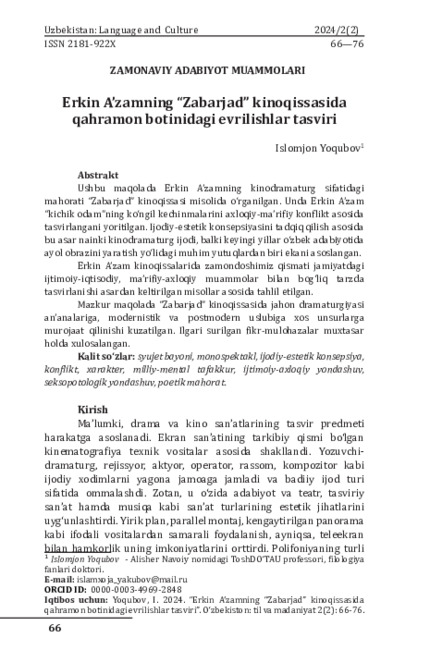
Description of the evolution of the hero in Erkin Azam’s film “Zabarjad”
In the stories of E. Azam, the fate of our contemporaries is depicted in connection with socio-economic, educational and moral problems in society, analyzed on the basis of examples from the work.
This article notes that the film story "Zabarjad" refers to thetraditions of world drama, elements characteristic of the modern and postmodern styles. The previous comments are briefly summarized.
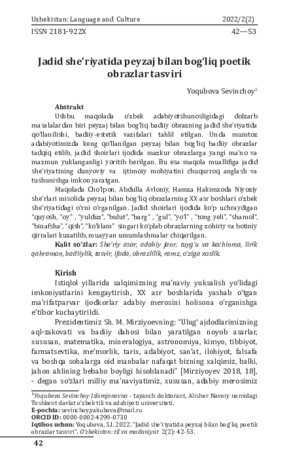
Description of poetic images related to landscape in Jadid poetry
This article analyzes the use of the artistic image related to the landscape, which is one of the topical issues in literary studies, in modern poetry, and its artistic and aesthetic functions. It analyzes the artistic images related to the landscape widely used in our classical literature, and it is explained that new meaning and meaning are given to these images in the works of modern poets.
This allowed the author of the article to gain a deeper understanding of the worldly and social nature of modern poetry. The article examines the role of images related to the landscape in Uzbek poetry of the beginning of the 20th century on the example of the poems of Cholpon, Abdulla Avloni, Hamza Hakimzada Niyazi. «sun», «moon», «star», «cloud», «leaf», «flower», «road», «morning», «wind», «purple», «winter», which are often found in the works of Jadid poets. the external and internal aspects of many images such as «koklam» were observed and certain generalizations were made. Keywords Image, modern poetry, tradition, originality, poem, verse, artistry, inner content.
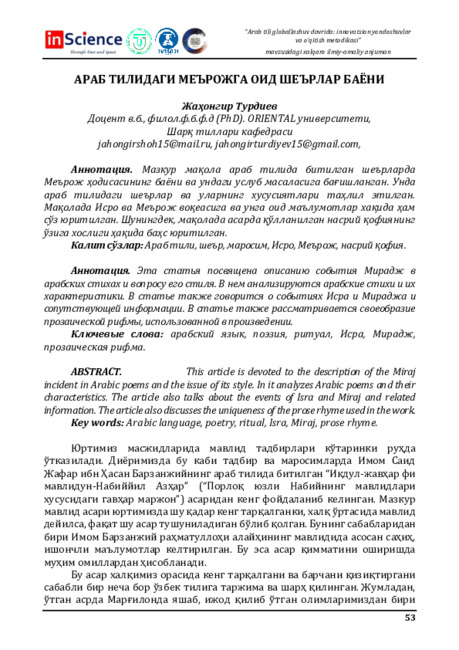
Description of Arabic verses about Miraj
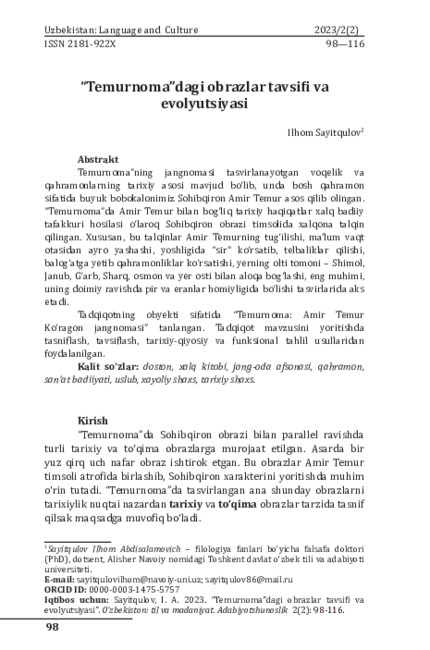
Description and evolution of images in “Temurnoma”
“Temurnoma” is a work of folklore that interprets the image of Sahibkiran in folklore. In this regard, along with historical images, which are interpreted by folklore, textual images also play an important role in the characterization of Amir Temur. In “Temurnoma” the image of Sahibkiran and various historical and tissue images are used in parallel with the image of Amir Temur, who played an important role in illuminating his character. One hundred and forty-three characters took part in the play. These images unite around the image of Amir Temur and play an important role in illuminating the character of Sahibkiran. In this study, such images described
in “Temurnoma” were classified as historical and textual images from a historical point of view.
The depiction of some non-historical fabricated images in the work is the basis for evaluating it as an epic work dedicated to the interpretation of the image of Sahibkiran in the imagination of the people. The depiction of historical figures who were contemporaries of Amir Temur in the war,
but did not meet him in real life, is based on the fact that the ideal of the ethnos was accompanied by people close to him. While the main images
form the core of the plot, the auxiliary images play a supporting role in the interpretation of the image of Sahibkiran. Episodic images participate as a peripheral element in the system. The “Temurnoma” also contains folklore-inspired fairy-tale textual images, indicating that the work is based on pure folklore.

Death of heroes of Navo'i
The article analyzes the details of the deaths of the heroes of the epics "Farhod and Shirin" and "Layli and Majnun" in Alisher Navoi's "Khamsa". In the epics, heroesFarhod and Shirin, the cause of death of Layli and Majnun are explained. It has also been proven that many students' misconceptions that "these heroes killed themselves" are wrong, and that the suicide of these heroes is completely contrary to Navoi's moral and religious views. The fact that the deaths of these heroes took place quite naturally, by themselves, without revealing any cause, is shown by the examples taken from the epics. It is said that even in the most desperate moments of one's life, one should not commit suicide, but accept one's destiny and pray to the Creator in accordance with the etiquette of prayer.
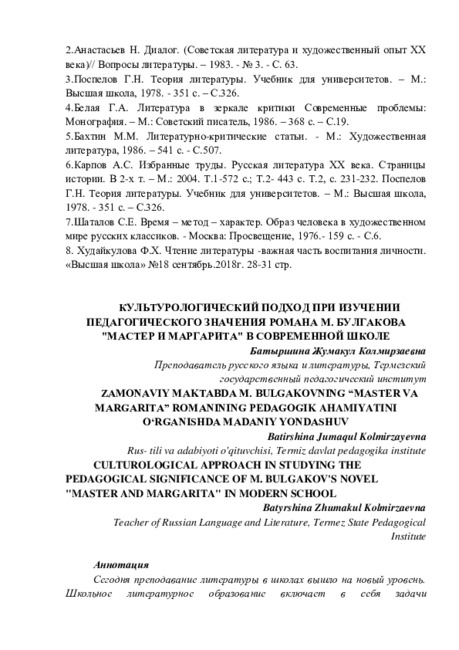
Culturological Approach In Studying The Pedagogical Significance Of M. Bulgakov's Novel "Master And Margarita" In Modern School
Today, the teaching of literature in schools has reached a new level. School literary education includes the tasks of artistic and general cultural development of schoolchildren, the formation of a reader who is ready for independent communication with the art of the word, capable of comprehensively understanding a literary work in the context of the spiritual culture of mankind. In this article, we will consider the pedagogical significance of M. Bulgakov's novel "The Master and Margarita" on the basis of a cultural approach to teaching
in a modern school.
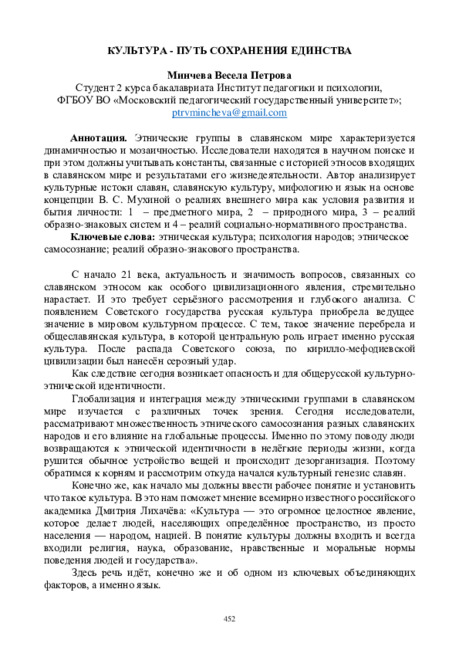
Culture is the way to preserve unity
Этнические группы в славянском мире характеризуется динамичностью и мозаичностью. Исследователи находятся в научном поиске и при этом должны учитывать константы, связанные с историей этносов входящих в славянском мире и результатами его жизнедеятельности. Автор анализирует культурные истоки славян, славянскую культуру, мифологию и язык на основе концепции В. С. Мухиной о реалиях внешнего мира как условия развития и бытия личности: 1 – предметного мира, 2 – природного мира, 3 – реалий образно-знаковых систем и 4 – реалий социально-нормативного пространства.
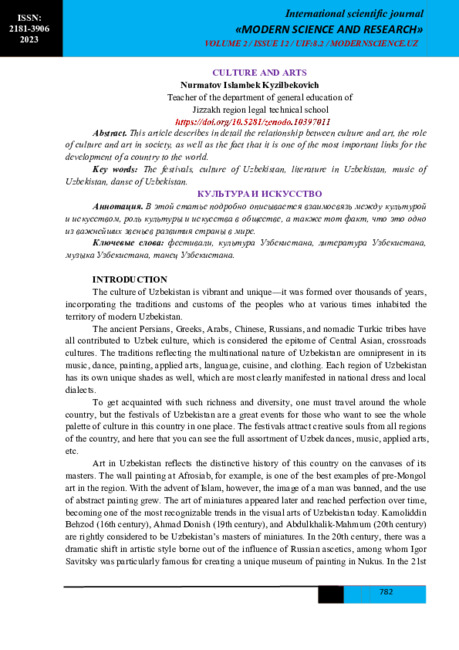
CULTURE AND ARTS
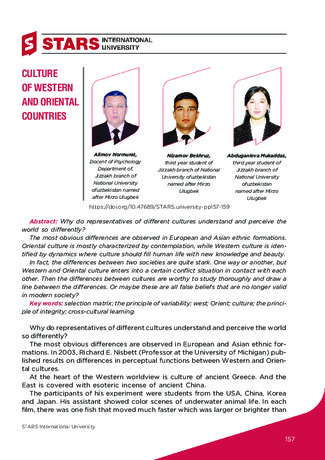
Culture of western and oriental countries
Why do representatives of different cultures understand and perceive the world so differently?
The most obvious differences are observed in European and Asian ethnic formations.Oriental culture is mostly characterized by contemplation, while Western culture is identified by dynamics where culture should fill human life with new knowledge and beauty.
In fact, the differences between two societies are quite stark. One way or another, but Western and Oriental culture enters into a certain conflict situation in contact with each other. Then the differences between cultures are worthy to study thoroughly and draw a line between the differences. Or maybe these are all false beliefs that are no longer valid in modern society?
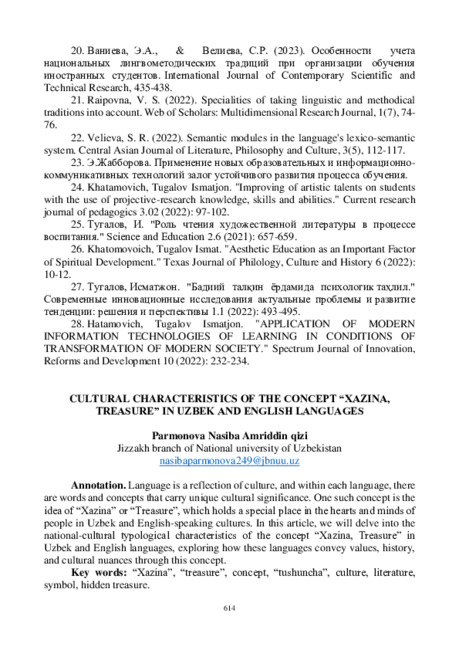
Cultural characteristics of the concept “xazina, treasure” in uzbek and english languages
Language is a reflection of culture, and within each language, there are words and concepts that carry unique cultural significance. One such concept is the idea of “Xazina” or “Treasure”, which holds a special place in the hearts and minds of people in Uzbek and English-speaking cultures. In this article, we will delve into the national cultural typological characteristics of the concept “Xazina, Treasure” in Uzbek and English languages, exploring how these languages convey values, history, and cultural nuances through this concept.
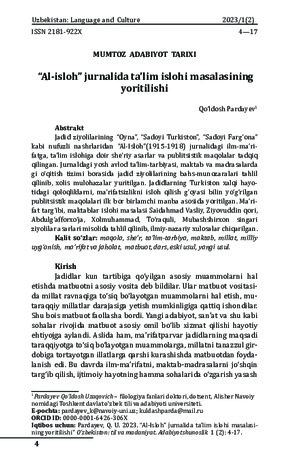
Coverage of the issue of education reform in “Al-islah” magazine
The study of poetic works and journalistic articles about the reform of knowledge and education in the journal “Al Islah” (1915-1918) from the influential publications of modern intellectuals, such as “Oyna”, “Sadoi Turkestan”, “Sadoi Ferghana” was researched. The journal analyzed the disputes of modern intellectuals about the upbringing of the younger generation, the system of education in schools and madrassas, impartial comments were given. Jadid’s journalistic articles with the idea of reforming the backwardness and lack of enlightenment in the life of the people of Turkestan are covered for the first time based on the original source. On the example of the work of such intellectuals as Saidahmad Vasli, Ziyovuddin Kari, Abdulgafarkhoja, Khalmukhammed, Torakuli, Mubashshir Khan, the issue of promoting education and reforming schools is analyzed, and scientific and theoretical conclusions are made.
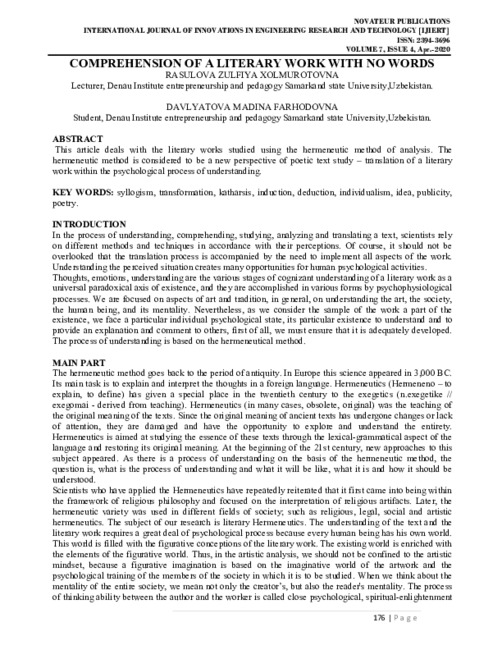
Comprehension of a literary work with no words
This article deals with the literary works studied using the hermeneutic method of analysis. The hermeneutic method is considered to be a new perspective of poetic text study – translation of a literary work within the psychological process of understanding.

Comparison of gender symbols and poetry of A. Akhmatova and X. Khudoyberdieva, similarities and differences
Anna Akhmatova and Halima Khudoyberdieva, in their poetic works, discuss gender roles and women's life experiences in the context of their own societies. The article analyzes the differences in symbols and images used by these poets to express women's experiences. Akhmatova often turns to symbols of nature and animals, emphasizing the strength and resilience of women in the face of social pressure. While Khudoyberdieva focuses on the everyday struggles of women in Soviet Central Asia. Both poets also discuss the importance of solidarity among women and highlight the challenges they face. This article provides an overview of key themes and approaches to the study of gender aspects in the poetry of Akhmatova and Khudoyberdieva.
Comparative typology of the oral epic poems “Alpomish” and “Jumong”
The importance and necessity of the theme of the thesis. The epic poem “Alpomish” is the most valuable monument of the Uzbek people’s ingenious folklore. Patriotism, bravery, unity and creativeness arc glorified in every version of this epic poem listed in the repertory of Uzbek Bakhshi. This majestic epic poem, being the Uzbek people’s national pride, has given every person great spiritual force over the past centuries. Therefore, “Alpomish” is considered to be an invaluable heroic epic poem representing the Uzbek people’s uniqueness and glorifying their historic development. The president of the Republic of Uzbekistan I.Karimov wrote that the Uzbek people, striving to maintain this uniqueness since ancient times, have brought up their children in the spirit of patriotism, gallantry and honour to sacrifice themselves for their compatriots. In this sense the precious gem of national oral works “Alpomish” represents the heroic song, which has been passing down from generation to generation, showing the uniqueness of the Uzbek people. If the Uzbek people’s long and glorious history is represented by the epics, “Alpomish” represents outstanding couplet of these epics'.
The epic poem “Alpomish” depicts the valour of the young men, who cherish honour and consider heroic history of the Uzbek people, their hearth and home, and their calmness to be sacred. Everything that is depicted in “Alpomish” has exerted a big influence on artistic imagery and aesthetic views of Central Asian peoples. In relation with this, definition of archaic plot that had made appearance of plot of the epic poem, illumination of its evolutionary stages from the repertory of local “Bakhshi” and research for their influences on the epics of other nations is the actual assignments for the folklorists.
Historical-typological features of the Uzbek national heroic epics have been studied only in terms of folklore materials of Central Asian Turkic peoples up to the present time. General features of the epics of non-Turkic nations have been examined only in comparison with Homer’s “The Odyssey”. However, researchers have not paid attention to the study of the influence of Turkic epics on the folklores of East Asian peoples including Korean. They have not figured out the problems of genetic similarities and common features of heroic epics of these peoples, cither. Whereas, while the Uzbeks, especially the epic narrators from traditional epic performing school of eastern Uzbek area still perform such ancient epic poem as “Alpomish”, the Koreans have preserved the ancient performing traditions through epic songs, shaman songs and Pansori. One of those great epic poems, which have played an important role in the development of exclusive national spirituality of the Korean people, is the epic poem “Jumong” regarded as one of the oldest model of Korean folk talcs. In view of the fact that epic singers performed this epic poem, it is recognized as archaic model of heroic epics.
Lofty ideas expressed in “Alpomish” have contributed a lot to the spiritual renovation of the Uzbek people just as much as the Korean heroic epic poem “Jumong” represents one of the emotional props constituting the root of development of Korea. This testifies how close to each other the mental values of these two peoples arc. The president of the Republic of Uzbekistan I. Karimov, indicating that South Korea can be ranked among forward nations in such a short period and stating several factors that made such impetuous development possible, writes that the Korean people in the course of building their state have turned into a great creative force, whereas they arc highly appraised for their spirituality1. Therefore, it is important to testify essential characteristics of epic imagery of these two nations and common features appeared in their ancient traditional origins of folk talcs, based on the comparative analysis of the national heroic epic poems “Alpomish” and “Jumong”.
Research on the study of genetic origins of the Uzbek and Korean folk tales will elevate the level of epic study of Korea. Since the researchers, who have studied the history, advancement and law of development of the Korean folklores, consider that the genesis of heroic epic poems ascends to epic traditions of Central Asian peoples. It is necessary to pursue a comparative research of the Korean heroic epics with one of the ancient heroic epic poems of Turkic peoples in order to evolve these scientific views, i.e. to establish academic concepts that genesis of the Korean national epic poem ascends to the archaic tales of “Paleolithic-Asian culture” created in ancient Central Asia. On the basis of comparative study of the outstanding model of the Korean folklore “Jumong” and Uzbek heroic epic poem “Alpomish” it is essential to figure out the history of its origin and law of historical-evolutionary development.
The purpose of the research: The main purpose of this research work is as follows:
to state the historical basis of the Uzbek and Korean national heroic epic poems and their specific features;
to give evidence on the role of shaman mythology in the process of shaping of heroic epic poems and its subsequent development;
to depict features common to the heroic epic poems of both nations.
CONCLUSION
Despite the fact that Uzbekistan and South Korea arc geographically far away each other, and they differ from each other in lifestyle, culture, literature and arts, it is quite surprising that their folklores arc very close. As we have researched the epic poems “Alpomish” and “Jumong” by means of the comparative typological analysis, we could be able to reveal many similarities in these two epics. Our study has proved that the Uzbek and Korean national heroic epics as well as the two ethnic groups stemmed from the same “Altai language family” as well as the common genetic roots share many similar features in the course of historic developments.
Based on the study of the Uzbek and Korean folk heroic epics through comparative typological, comparative historical, psychoanalytical methods and theoretical foundations, the following conclusions have been drawn:
1. The epics “Alpomish” and “Jumong” are structurally composed of five parts: 1) the aristocratic origin; 2) the miraculous birth; 3) the prosecution and dismissal; 4) the manifestation of miraculous powers; 5) the danger and overcoming it. Each of the popular heroic epics is similar to each other in plot structure.
2. We can sec the aspirations and expectations of the people that the heroes should realize in “Alpomish” and “Jumong” through the motif of unnatural birth of the hero. The epic heroes were obtaining new names after their miraculous successes. This means that the heroes became the socio-political subject and an Alp (hero), i.e. his rebirth as a hero.
3. An enormous attention is paid to the motifs of various contests and struggles in the epics “Alpomish” and “Jumong”; the struggle between the brothers, the contest for choosing the groom, the struggle for the throne, etc. All these contests and struggles arc considered the stages of initiation into becoming a hero.
4. Firstly, the interpretation of the motifs of archcry in the both epics denotes the recognition of the hero as a hero and the new naming of the heroes means their “rebirth.” Secondly, the heroes’ victory over their rivals, their election as leaders means the patrons’ recognition of him as heroes who had received education from the saints. Thirdly, the main mission entrusted to the epic hero is to put an end to fragmentation of society. The heroes in the epic poem, who displayed their ability in archcry, showed their relationship with the sun God, i.e. archery showed its superiority over the other. It is a symbol of exposing strength and power. Fourthly, the genetic basis of archaic imaginations expressed in the motif of archcry is related to shamanism in Siberia. Moreover, it is important that the journey into the world of spirits was expressed in the shamans’ view on the mythological cosmogony. It is known that the shamans of Siberia in their travels to the Heaven, i.e. the Upper world considered as the abode of spirits took a bow with themselves instead of a drum.
5. The image of horse is very important in the epics “Alpomish” and “Jumong”. Horse is a zoomorphic symbol of the ruler. The assistants who chose a good horse for Alpomish and Jumong have a particular importance. Firstly, a horse is considered an expression of the force of law in the mythology. Secondly, a horse symbolically expresses cults of both the sun and throne. In Korea the white horse was regarded as a sacred animal, and the Turks counted the piebald horse their cult. Thirdly, the Siberian shamans looked upon a horse as their patron.
6. If the epos “Jumong” is the epic poem about the founder of the state, the epos “Alpomish” is an example of the national epos glorifying the appearance of nation and strengthening of Uzbek statehood. In this respect if we consider the desires and drcams as subconscious feelings of a nation, the highest arts arc reflected in the epos.
7. The epics “Alpomish” and “Jumong” are considered as the epics that could cover all the ancient mythological worldviews of the people. These epics originally appeared in the form of shaman epics and later evolved into the heroic epics.
8. In the heroic epic poems, the represented image was designed to show the hero’s capabilities and to make an idol of the civilized hero. In the course of centuries, the archaic epic mythology or civilized character or the cult of demiurge disappeared and Korean heroic epic became to be recorded and published in the form of short stories and legends. There arc hypothetical views that the first Korean epic songs of mythological imaginations about the founder of the state might be performed as shaman epics. Shaman epic songs that were performed during the cult of statehood ceremony later emerged as a sacred ritual “Gut” invoking the divine ancestors. Then epic songs began to spread in the form of epics glorifying the history of the demi-god and demi- human recognized as builder of the new state.
9. The main hero of the epic about the ancestors who had built a state made an appearance as a demi-god and demi-human. However, the epic focuses more on its human qualities. At first shaman epics turned up and then epics about state founder began to appear. Over many centuries, both the epics were evolving together. The heroic epics appeared comparatively later and developed with shaman epics in the form of archaic epics. However, the heroic epics gradually settled down as chief epos genre expressing the basis of statehood. With the emergence of state, the practical functions of ancient shamanic epics began to fade. Moreover, the events associated with the state construction secured a consistent development for the heroic epos. This hypothesis fully corresponds with the Korean epos “Jumong”.
10. The epos “Alpomish” does not give any information on the founder of the state. However, we become aware of the process of integrating tribe as a nation in this epos. In ancient times, shaman epic songs were performed in rituals dedicated to the cult of ancestors. The shaman’s role in this performance was great. As is known, the shaman was not only performer of epic songs, but also served as a healer. In addition, the shaman as a priest brought good luck to hunters with his magical spells. For some nations, the archaic shamanic practices have been continued and preserved up to now in their folk tales. However, as the lapse of time only the Bard (Bakhshi) became to perform the epic songs. This assertion could be supported by the linguistic and etymological study on “Bakhshi” (Bard) and its genesis. Currently in Korea, male shamans arc called “Baksu”. The etymology of this term is of an ancient origin and is widespread among the narrators in many East-Asian nations, still maintaining its ancient attributes.
11. The Altai epos “Alip-Manash”, an ancient version of “Alpomish”, contains numerous details associated with shamanism. According to the storytelling tradition of Altai, a man could learn from his dream that he would become a shaman (Bakhshi). This motif is the same with the idea to previse through God's prediction that the community concerned will become a state. The second motif is a common imagination about belief in the sacred tree. The third motif of this tradition is associated with “Munojat” (“prayers to God”). “Munojat” has existed in shamanism since Islamism appeared in Sufism in the original form.
12. The epos “Jumong” is closely interrelated with the shamanism of the ancient Turks who resided in Siberia. The first evidence of this motif is to pray to God at the tree depicted in the epic poem, the second is the interpretation of images of animals. Such animals as horses and birds were divine beings of the shaman, which showed the way in celestial journey. Third is the departure of the epic hero from his homeland to “foreign land”. This is deeply intertwined with the spiritual journey of the shaman. In general, the correspondence between the epics “Alpomish” and “Jumong” states the proximity of artistic thought between the Uzbek and Korean peoples and its developing stages. Such proximity could be possible owing to the subconscious feelings of these two nations who aspire to understand the world and the human.
13. In ancient times the ancestors of the Koreans that assumably belonged to Altaic family might reside with the Turkic peoples in Central Asia. In this respect those two ethnic groups could have strong ties in cultural and economic aspects. It would be quite possible that the Turkic nations could have influenced on the formation and development of Korean heroic epic poems. As a result of comparative study between “Alpamish” and “Jumong”, it has been revealed that the narrative structure of the Korean epics and the development of their main motives have a deep relationship with Uzbek oral tradition and epic poems.
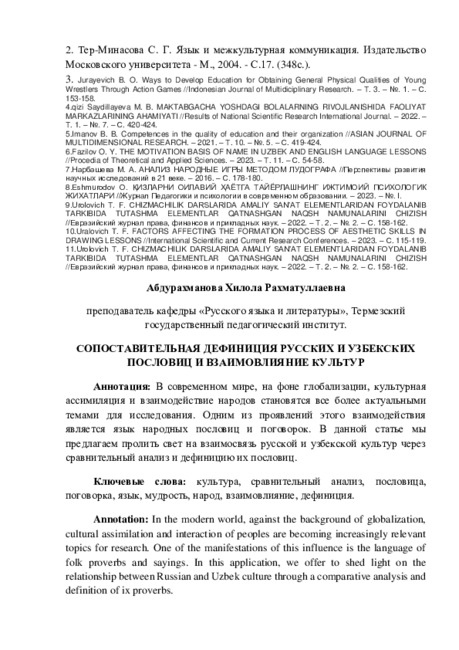
Comparative definition of Russian and Uzbek proverbs and mutual influence of cultures
In the modern world, against the background of globalization,
cultural assimilation and interaction of peoples are becoming increasingly relevant
topics for research. One of the manifestations of this influence is the language of
folk proverbs and sayings. In this application, we offer to shed light on the
relationship between Russian and Uzbek culture through a comparative analysis and
definition of ix proverbs.

Comparative analysis of Uzbek translations of Makhtumkuly poetries
The aim of the research work is the study of scientific and theoretical laws and the most important principles of translation from related languages on the example of Uzbek translations of Makhtumkuly poems.
The scientific novelty of the research work is as follows:
Determined the most important role of poetry of Makhtumkuli in the literary translation, inter mutual impact in scientific-cultural environment of Uzbekistan and also its expanded scale;
it is proved that in translations from related languages, false and approximate equivalents are «false words»;
the principles of continuity, traditionalism, characteristic of the reinterpretation arc established based on the comparison of translations of a certain poem;
substantiated and classified shortcomings in the texts of the poems of Makhtumkuli in translations of religious terms and concepts;
proved the relation between the ignorance of the language by translators and the confusion in orthography with the use of archaic words in the texts of classical works;
it is proved that translation from related languages also has a creative character and that it is not a transliteration, but a translation.
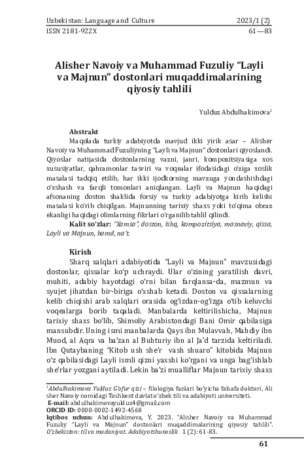
Comparative analysis of the prologues of Alish- er Navoyi and Muhammad Fuzuliy’s «Layli and Majnun» epic
The two great epics in Turkish literature, Alisher Navoi and Muhammad Fuzuli’s «Layli and Majnun» are compared. As a result, of our comparisons, opinions and conclusions about the weight, genre, composition, individuality of the protagonist and events of both epics are expressed. The similarities and differences between the two artists’ approaches to the topic will be analyzed.The article discusses the emergence of the legend of Layli and Majnun in the form of epics in Turkish and Persian literature, which was passed from language to language among the Arab peoples. The idea that the Majnun is a historical figure ora fabricated character is supported by the views of scholars.
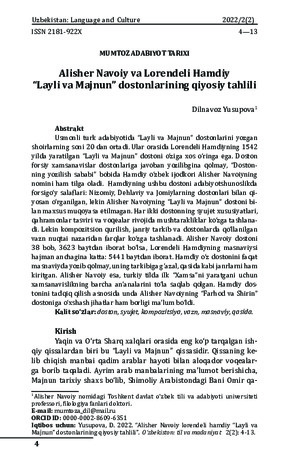
Comparative analysis of the poems “Leyli and Majnun”by Alisher Navoi and Laurendeli Khamdi
In Ottoman-Turkish literature, the number of poets who wrote the epic “Leyli and Majnun” exceeds 20. Among them, the epic “Leyli and Ma- jnun” by Laurendeli Hamdi, created in 1542, occupies a special place. The epic was written not only in response to the epics of Persian authors, but in the chapter “The reason for writing the epic” Hamdi also mentions the name of the Uzbek writer Alisher Navoi. This epic of Hamdi was studied in literary criticism with the epics of Persian predecessors: Nizami, De- hlavi and Jami, but was not specifically compared with the epic of Alisher Navoi “Leyli va Majnun”. In the features of the story of both poems, the description of the characters and the development of events, similarities are found. However, there are noticeable differences in compositional con- struction, genre content and in the metrics used in the epics. The epic of Alisher Navoi consists of 38 chapters and 3623 verses, while the masnavi of Laurendeli Hamdi is much larger: it consists of 5441 verses. Hamdi not only wrote his epic in masnavi, but also included genres such as ghazal and qasida in it. Alisher Navoi, who created the first Hamsa in Turkish, com - pletely preserved all the traditions of the Hamsa.
During the study of the epic Hamdi, it became known that it has similar features with the epic of Alisher Navoi “Farhad and Shirin”.
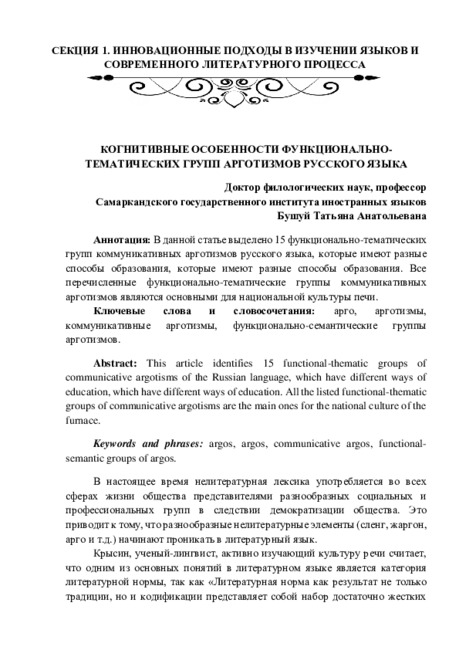
Cognitive features of functional-thematic groups of argotisms in the Russian language
This article identifies 15 functional-thematic groups of communicative argotisms of the Russian language, which have different ways of education, which have different ways of education. All the listed functional-thematic groups of communicative argotisms are the main ones for the national culture of the furnace.
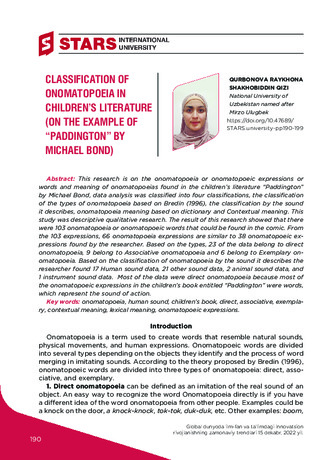
Classification of onomatopoeia in children’s literature (on the example of “Paddington” by Michael Bond)
This research is on the onomatopoeia or onomatopoeic expressions or words and meaning of onomatopoeias found in the children’s literature “Paddington” by Michael Bond, data analysis was classified into four classifications, the classification of the types of onomatopoeia based on Bredin (1996), the classification by the sound it describes, onomatopoeia meaning based on dictionary and Contextual meaning. This study was descriptive qualitative research. The result of this research showed that there were 103 onomatopoeia or onomatopoeic words that could be found in the comic. From the 103 expressions, 66 onomatopoeia expressions are similar to 38 onomatopoeic expressions found by the researcher. Based on the types, 23 of the data belong to direct onomatopoeia, 9 belong to Associative onomatopoeia and 6 belong to Exemplary on omatopoeia. Based on the classification of onomatopoeia by the sound it describes the researcher found 17 Human sound data, 21 other sound data, 2 animal sound data, and 1 instrument sound data. Most of the data were direct onomatopoeia because most of the onomatopoeic expressions in the children’s book entitled “Paddington” were words, which represent the sound of action.
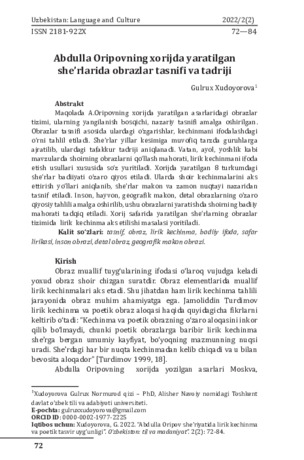
Classification and development of images in Abdulla Oripov’s poems written abroad
In the article, the system of images in A. Oripov’s works created abroad, the stage of their renewal, and theoretical classification are im - plemented. Based on the classification of images, the changes in them, their role in expressing the experience are analyzed. Poems are divided into groups according to the years, and the mood of thinking in them is determined. The poet’s ability to use images and ways of expressing lyrical experience are discussed in topics such as motherland, woman, and youth. The art of poems in 8 categories created abroad will be compared. The ways of reflecting the poet’s experiences are defined in them, and the poems are classified in terms of space and time. A comparative analysis of human, animal, geographical space, detailed images is carried out, and the poet’s artistic skill in creating these images is studied. The problem of the reflection of lyrical experience in the system of images of the poems created during the trip abroad is highlighted.

