
All articles
Qayg‘usiz abdolning qayg‘ulari
Ushbu maqolada o‘zbek kitobxonlari hali tanishib ulgurmagan Turk tasavvuf adabiyotining yirik vakili Qayg‘usiz Abdolning hayoti va ijodi haqida atroflicha ma’lumot berilgan. Uning asarlaridagi asosiy mazmun mohiyat to‘g‘risida so‘z ketgan va parchalar keltirilgan.
Qashqadaryo viloyati Yakkabog‘ tumani shevasining o‘zbek adabiy tilida tutgan o‘rnini o‘rganish muammolari
Ma’lumki, so‘nggi yillarda respublikamizda tilga bo‘lgan e’tibor jadal sur’atlarda rivojlanib bormoqda. Shu munosabat bilan yurtimizning turli hududlarida yashovchi aholi shevasining o‘zbek adabiy tiliga munosabati masalasini o‘rganish dolzarb masalaga aylandi. Ushbu maqolada Qashqadaryo viloyati Yakkabog‘ tumani Terak qishlog‘i shevasiga xos bo‘lgan oziq-ovqat nomlari leksikasini tahlil qilish va uning o‘zbekadabiy tiliga munosabati masalasini o‘rganish bosh mezon qilib olingan.
Psychologisher und pedagogisher rolle der romane “Steppenwolf” von herman hesse
Bücher spielen eine wichtige Rolle in der Entwicklung der Gesellschaft und werden auch als wichtig für die persönliche Weiterentwicklung angesehen. Jeder Buchleser zieht einige Schlussfolgerungen aus der Arbeit, die ihm gefällt. Besonders hervorzuheben sind die Werke der englischen Schriftstellerin Herman Hesse , die einen unvergleichlichen Beitrag zu den von den Lesern geliebten Detektivwerken geleistet hat. Bei der Analyse ihrer Werke müssen mehrere Aspekte berücksichtigt werden.
Psychological value of the novels by agatha christie
Books play an important role in the development of society and are also considered important for personal improvement. Every book reader draws some conclusions from the work he likes. In particular, the works of the English writer Agatha Christie, who made an incomparable contribution to the detective works that are loved by readers, should be highlighted. In the process of analyzing her works, it is necessary to take into account several aspects.
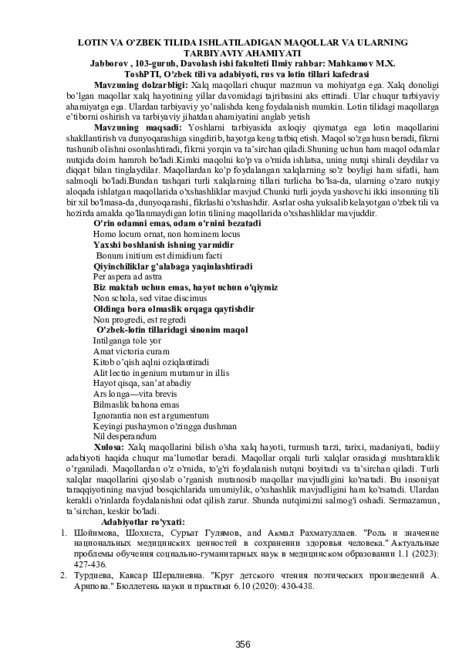
Proverbs used in Latin and Uzbek and their educational significance
Xalq maqollari chuqur mazmun va mohiyatga ega. Xalq donoligi bo’lgan maqollar xalq hayotining yillar davomidagi tajribasini aks ettiradi. Ular chuqur tarbiyaviy ahamiyatga ega. Ulardan tarbiyaviy yo’nalishda keng foydalanish mumkin. Lotin tilidagi maqollarga e’tiborni oshirish va tarbiyaviy jihatdan ahamiyatini anglab yetish

Problems of literary time in the historical novels (based on the novels of A.Yakubov and P.Kadirov
Topicality and necessity of the thesis. Literary time is being concerned as the literary-aesthetic category in the world literary studies, expressing the scope of the universe interpretation, the author’s outlook and imagination regarding the world foundation, defining personages, the composition means of expressing the sequence and duration of the events. A creative comprehension of the literary time as a means arranging the work composition, structure, and constructing an epic field of the text demands a special approach to understanding the aesthetic character of the work. Since the literary time includes all the elements of a fictional work, it is impossible to present the plot, composition, conflict, system of characters, feelings and the mood of the characters without the description of the literary time.
In the following development of the scientific-theoretical thought in the world, the literary time is accepted to be one of the poetic means to demonstrate the reality as well as to be a literary process that is basic for the expression of the reality in the compositional construction and illustration of the plot relying on the writer’s intention and the ideological conception of the literary work. The literary time enables to cognate the literary world picture created by the author in terms of the descriptive subject and object of the work. Therefore, one of the topical tasks of the modem Uzbek literary studies is to describe a historical evidence, event, the life of outstanding people, the chronology of the near past based on the literary time; on the example of the creative works of a certain period, creators or an individual writer arc analyzed in separate or comparative-typological aspect.
The tendency of developing new methods and approaches of the world literary criticism in line with the existent scientific traditions of the Uzbek literary studies has been formed in the years of independence. One may observe the reformation of the universe imaginatively in aggregation of the Western and Eastern literary traditions. The fact that “Uzbekistan is to be competitive worldwide in the sphere of science, intellectual potential, modem personnel training and high technologies”28 sets the task to raise the level of the researches equal to the world standards.
The present research work will assist, to a certain extent, to carry out the tasks determined in the decrees and resolutions as well as in other normative-legal documents including “On enhancing the effectiveness of spiritual-enlightenment affairs and promoting the branch development to the new level” No. PD-3160 as of July 28, 2017, “On measures of further improvement of the activity of the Academy of Sciences, organizing scientific works, management and financing” No. PD-2789 as of February 17, 2017, and “On measures of developing publishing and distributing book products, popularizing and enhancing reading books and reading books on culture” No. PD-3271 as of September 13, 2017.
The aim of the research work is to study the system of the literary time along with its classical forms, types, categories and styles based on the historical novels “The Treasure of Ulughbck” (“Ulug’bek Xazinasi”) and “The Ancient World” (“Ko’hna Dunyo”) by O.Yakubov, “Starlit Nights” (“Yulduzli Tunlar”) and “Generations Passing” (“Avlodlar Dovoni”) by P.Kadirov.
Scientific novelty of the research work includes the followings:
a theoretical-conceptual status of the literary time as a literary-aesthetic category has been demonstrated by facts to be a complex system in line with its creative classic types, forms and styles;
creative-aesthetic principles of transforming the reality of historical time into literary time reality, literary-aesthetic study of the historical real time through literary time have been investigated;
literary past time has been defined to be primary within creative-aesthetic dialectics of the preset and future forms, as well as historical and psychological chronos of historical novels and epic time categories have been determined;
the types, forms, categories and styles of the literary time in historical novels based on the authors’ creative wish and idealistic-aesthetic concepts of the works as a unique chronos “atlas” through synthesis of creative-individual and comparative-typological summaries.
Conclusion
1. Time is the base of art division into types and a creative discovery within philosophical and literary-aesthetic event. It is an existing form in modem science of literature and is called as artistry fictionalization and fictional artistry. Time is a literary-aesthetic category assembled differently in the art of words, the phenomenon of the poetic fiction, inseparable attribute of the literary world, occurred form of fictional incidence and essential feature of a literary character.
2. Literary time is a complex and various system emerging from the work’s ideal-aesthetic concept; it includes literary time forms, types, categories, styles as a dialectic creative-aesthetic phenomenon. The study of the historical novels has demonstrated the creative-aesthetic system from scientific theoretical viewpoint.
3. Writing styles of individuality of Odil Yakubov and Pirimkul Kadirov’s historical novels considering the transformation of the philosophical category of time into the philosophy of literary time and historical time truth into novel time truth have been studied and generalized from scientific-analytical viewpoint.
4. Literary time is the subject and the object of the depiction in the literary work. Fiction describes the ideas, dreams and expectations of the character and events happened around the time. Literary time is a literary-aesthetic means of planning the work structure, plot, composition and forming an epic text field. It expresses social ideals, the author’s outlook and an ideal-literary intention in a certain historical period.
5. A writer explores his/her literary time world creatively as a result of his/her creative-aesthetic intention, genre features of the work and ideal-literary concept. This creative world involves literally universal time forms - past, present and future.
6. Past time -“hereditary” leading time of historical chronos. Transforming creatively that historical time “innate” reality into literary time reality provides the coincidence of literary past time form with real history in all historical novels’ epic time hierarchy. Literary present time is considered as a target, nuclear of historical novels’ epic time illusion: both literary past time and literary future time take place in present literary time. Literary future time is much more abstract, a bit real, and quite symbolically-philosophically predictable in a literary time system. Especially its compound feature of mixed epic time is seen out of universal time measures with the sense of creative abstraction.
7. Historical time is a leading category of epic time in historical novels. It can “absorb” the rest of time categories. Historical novels in the analysis can be divided into three types according to their historical period: a) historical novels based on factual data (“Starred Nights” (“Yulduzli Tunlar”), “Generations’ Pass” -“Avlodlar Dovoni”), “The Treasure of Ulughbck” - “Ulug’bek Xazinasi”); b)literary fiction and generalization arc preferred more (“The Ancient World” -“Ko’hna dunyo”); c) historical facts based on literary fiction (all of the novels involved in the analysis). Main characteristics, typology of all three types arc historical chronos and chronological time given in a parallel way.
8. Creative-aesthetic discovery of psychological chronos as the “result” of dramatic-tragic time content is dependent on psychological intensification in the art of word. Psychological chronos becomes the major category in dramatic-tragic time of epic time in a psychological novel (“The Treasure of Ulughbck” -“Ulug’bek Xazinasi”).
9. Solution time is a “climax” of assembling all levels, forms, types and categories of a historical novel epic time into the final point. In historical novels solution time depends on the coincidence of historical real time with literally adjusted time by the author. The novels about historical characters are concluded mostly using “close” time in an epic style. Typological coincidence of historical novels epic time demonstrates unexpected paradox creative content: historical great people (Babur, Khumoyun, Akbar) and geniuses (Bcruniy, ibn Sino, Ulughbck) - literary personages symbolically open and eternal with no solution in past, present and future time. For this reason, “open” solution time of the novels in the analysis belongs to the same typological group in different creative individualities.
10. Historical novels arc retrospective works according to their genre and theme, that is the epic time is determined as a leading style rather than retrospection, prospection and retardation. Creatively-widely “popularized” retrospection shows the valid connection between past and present time periods based on compositional means. It is depicted into two dimensions - historical personage and historical time, fictional personage and fictional time concerning mini-retrospections, retrospection in retrospections, retrospection’s inner retrospections in retrospections, retrospection and prospection intermingled retrospections.
Problems of literary relations and interaction of cultures
The scientific article explores the issues of literary connections and the interaction of cultures of Western and Eastern literature, which in the process of intercultural communication reproduced the exchange of cultural and literary values. The author emphasizes that mutual exchange had a positive impact on the processes in the development of interacting cultures, which are reflected in their literature. The main goal of the work is to describe the interaction and mutual influence of contacting literatures. The objective of the study is to analyze the features of interliterary connections of contacting cultures.
Problems of interaction between cultures in understanding fiction
In the study of Russian literature, the processes of cultural integration play an important role, and these processes play a more important role in the study of the literature of other lands. Sometimes there are problems of cultural inconsistency, that is, the reader's perception of the picture of the world cannot accept the picture that the reader wanted to express. The article deals with some problems of mutual influence of cultures and literary ties.

Problems of a comprehensive study of sources, commentary and scientificcritical text of the work «Sabatul azhizin».
The purpose of the research. The purpose of the research consists of studying of sources regarding the biography of Sufi Allayar, his literary heritage, in particular, the composition of authentic scientific critical text «Sabatul ajizin» on the basis of complex analysis of scientific-artistic value and its hermeneutics.
The object of research arc manuscripts of composition «Sabatul ajizin»that arc stored in the collections of manuscripts’ funds of our country and abroad, comments in various printed versions of work, as well as books-commcnts.
Scientific novelty of the research consists of the following:
Identified the authenticity of the sources of biography of Sufi Allayar and information, obtained in the collection «Tuhfatul ahbab»;
In the chronological system highlighted reciprocal relation of qualitatitive and qualitative indicators in the history of three-century studying of the work «Sabatul ajizin»;
Biography of the poet and his literary heritage arc enriched with new scientific historical information;
Determined conditional geographical frontier of the spread of publications of «Sabatul ajizin» from Eastern Europe till Central Asia;
Highlighted the historical roots of hermeneutics of «Sabatul ajizin», which arc connected with the traditions of tafsir (comments of Koran), hadeeth (expressions of prophet), and science of interpretation;
The oretically justi ficd that the couplets of «Sabatul ajizin» arc formed on the basis of unrepeatable eloquence and perfection of Koran and their artistry;
Proved that the authentic text of «Sabatul ajizin» was not mechanically copied from the main manuscript, but created through logical argumentation;
Highlighted that constructive solidity and structural wealth of compiled full scientific indicator to «Sabatul ajizin» is the primary factor in provision of accuracy of critical text;
Created scientific critical text that is provided with full scientific indicator and dictionary, which consists of more than thousand words.
Primary creative research of Luqmon Burixon’s story genre (on the example in the stories named “Pauper”(“Yalangoyoq”) by Luqmon Burixon and “Thief” (“O’g’ri”) by A. Qahhor)
In particular, the author's story “Pauper” (“Yalangoyoq”) is compared with the story named “Thief”(“O’g’ri”) by the master of the Uzbek story genre A. Qahhor. The creative influence of Luqmon Burixon on Qahhor is studied in the example of a story
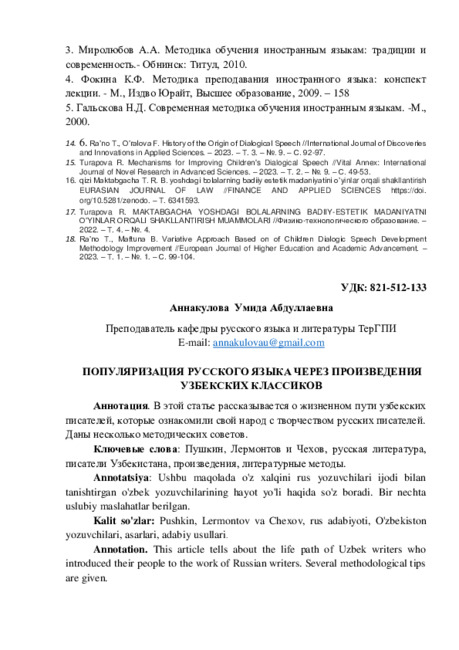
Popularization of the Russian language through the works of Uzbek classics
This article tells about the life path of Uzbek writers who introduced their people to the work of Russian writers. Several methodological tips are given.
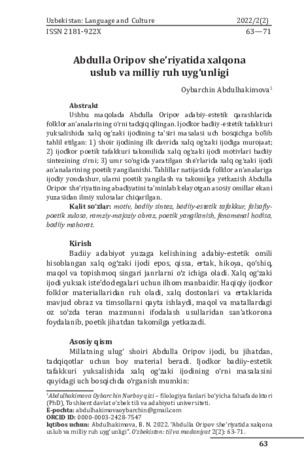
Popular style and nationality in Abdulla Aripov’s poetry the harmony of spirit
In this article, Abdulla Aripov’s literary and aesthetic views the role of folklore traditions is explored. The question of the impact of folk oral creativity on the rise of the artist’s artistic and aesthetic thinking is an- alyzed in three stages: 1) appeal to folk oral creativity in the first period of the poet’s work; 2) the place of the artistic synthesis of motives of folk oral creativity in the improvement of the poetic thinking of the creator; 3) poetic renewal of folk oral traditions in poems created at the end of life. As a result of the analysis, scientific conclusions were drawn that the creative approach to folklore traditions, their poetic renewal and improvement are the main factors that ensure the immortality of Abdulla Aripov’s poetry.
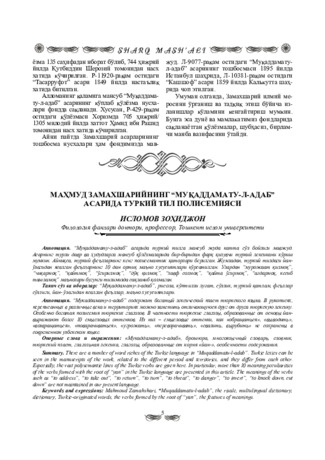
Polysemy of the Turkic language in Mahmud Zamakhshari's "Muqaddamatu-l-Adab"

Poetry of Ameer Hamza Shinwari and Khyber Literary school (traditions and process renovation)
The aim of the research is to provide to expose the improvement of Pashto literature deals with new period on Pashto literature in the territory of Pakistan in XX century, Emir Hamza Shinvoriy’s literary works, his skill, Khaybar literary school founded by him, creative works by the representatives of the school, the process of traditionalism and recrudescence in this literature.
The scientific novelty of the research work:
the role of statesmen of national renaissance in developing Pashto literature deals with new period in the territory of Pakistan in XX century has been extended;
the levels of creative life of Emir Hamza Shinvoriy were exposed on the basis of facts, the manifoldness and ideological-literal value of poet’s prosaic poems have been proved;
the traditionalism and improvement paradigms in poetry of Emir Hamza Shinvoriy and his impact on the poetry of that period have been vindicated;
the founding, the factor of improvement of Khaybar literary school and the role of the school in Pashto literature have been substantiated;
literary skill of well-known representatives of Khaybar literary school and the traditions of this school in Pashto poetry has been exposed.
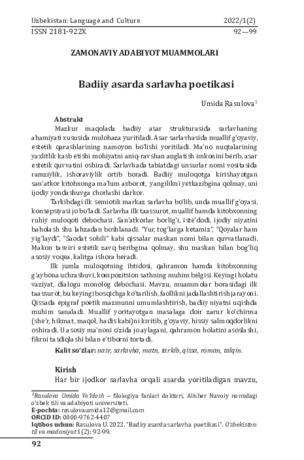
Poetics title in a work of fiction (art)
The article discusses the importance of the title in the structure of a work of art.The title of the work emphasizes the manifestation of the author’s ideological and aesthetic views. The integrity of the semantic pointsallows you to clearly express the essence, increases the aesthetic power of the work. The integrity of the semantic points allows you to clearly express the essence, increases the aesthetic power of the work. With the name of the element in nature, the simbolizm in the title increases. An artist entering into an artistic dialogue must not only convey certain information and novelty to the reader, but also encourage him to a creative approach.
The first semiotic center in the content is the title, which contains the author's idea, concept. The title is a preface to the first impression, the dialogue between the author and the reader. Assessing the essence, talent, and creative intent of artists begins at this point. Stories such as "Let's go to the mountains", "Rocks also cry", "The coast of Happiness" are strengthened by the name of the place. The image of the place not only gives aes- thetic pleasure, but also points to the main event, the key related to this place.
The first sentence is the beginning of the dialogue, the unseen meeting of the character and the reader, an important sign of the compositional level. The next situation and condition is the prelude to dialogues and monologues. The subject, the first impression of the conflicts are the process of moving to the next level, the acceleration of activity. In the story, the epigraph is important to generalize the poetic content, to read the artistic intention. The author increases the ideological, emotional weight byinserting the necessary extract (such as a poem, a saying, proverb, hadith)on the subject covered. It draws attention by the fact that it has the main meaning in itself, justifies the state of the character.
Poetics of national spirit and images in stories of Khairiddin Sultan
In the article, the artistic, plot and compositional features of Khayriddin Sultan’s short story “Ajoyib kunlarning birida”, the importance of language and style, the writer’s ability to create an image and use of words are thoroughly analyzed.
The origin of the “short story” genre, its genre development, the opinions and debates of world and Uzbek literary experts on this topic are studied in comparison.

Poetics of historical romance by D. Balashov (on the material of literary work «Mister Great Novgorod », «Marpha - Lander», «Moscow sovereigns»
Field of the research: historical-literary story by D.Balashov «Mister Great Novgorod», historical romance «Marpha - Lander», series of novels «Moscow sovereigns».
Aim of the research consists of learning peculiarity of poetics of historical romance D.Balashov, researching degree of authors activity and forms of its manifestation in the system of central romance categories : hero, conflict, plot, style.
Methods of the research summarizing - theoretical comprehension, systemic analysis, comparative - typological and conceptual analysis.
Recieved results and their novelty: complex analysis of problems of historical romance carried out, qualitative principles of poetics D. Balashov revealed, systemic analysis of his activity is given, typological likeness and stylistic peculiarity of historical romanistics of the writer arc presented Practical value of the research consists of that scientific conclusions received on the basis of systematic analysis of the activity of D.Balashov, facilitate deep understanding of peculiarities of literary process, revealing artistic peculiarity of historical romance D. Balashov, received result might be used in further working out theoretical problems of historical romance, conclusions might be used in the courses of lectures and practical classes on the problems of historical novel.
Degree of adoption into practice: results of the research were adopted into practice learning theory and history of literature at the faculty of foreign languages of Navoi State Pedagogical Institute.
Sphere of employment: system of public education, secondary special and higher education and for undergraduates, for (system of) institutes of retraining pedagogical personals
Poetic synthesis of Alisher Navoi's traditions in the poetry of Abdulla Oripov
The article deals with the issue of poetic renewal of the traditions of Alisher Navoi in the poetry of the representative of modern Uzbek poetry Abdulla Oripov. The concept of creativity of two poets, their coverage of the development of the national language, tradition and innovation in the ghazal genre, following in rhythm, common features and differences in the artistic interpretation of the content of hadiths are analyzed. As a result of the analysis, scientific and theoretical conclusions were made.

Poetic and compositional functions of a dream in literary work
The aim of the research is to identify the essence of a dream as a poetic form of art, its compositional and stylistic functions on the basis of studying social and psychological factors, aesthetic laws related to a dream in Uzbek literature.
The scientific novelty of the research is determined by the following:
the fundaments of characteristic features of a dream motif in a literary work and the interpretation of its poetic and compositional functions have been worked out;
aesthetic, stylistic-compositional functions of a dream motif in the plot of a literary work, its importance as a particular poetic art have been thoroughly studied, and its types according to theme and structure have been classified;
the usage of a dream as the art of molding, the method of reflecting a reality symbolically, as an inserted story, a type of literary form or compositional means, a literary detail, an episodic description, the means of a psychological analysis, anexposition or a beginning of the plot and its ending point, the means for developing the course of events in the plot, the means of organizing and consolidating the events in the literary work, the esthetic means connecting them logically, as a core motif of the plot have been scintifically grounded;
specific features of using a dream motif in folklore and written samples of literature in order to determine its specific traditionalism have been examined from comparative and typological aspect;
the skill of writers to describe the emotional state of heroes of the novels, to open the essence of events and to form the structure of the literary work have been evaluated.
Place and role of language education in the new bani world
In the modern world, characterized by instability, anxiety, non-linearity and incomprehensibility, language education is of particular importance. Language education promotes the development of competencies that are necessary to successfully live and work in a BANI world, including critical thinking, creativity, intercultural communication, adaptability and lifelong learning.
Philosophy of the problem of life and death in the novel “Laurel” BY E. Vodolazkin
Our task is to determine the essence of the writer's thoughts when turning to the material of the Russian Middle Ages about death and life in the aspect of the relationship between time and eternity, physicality and spirituality, general and personal.
Phase in general linguistics
Phase verbs are quite well studied in many languages of the world, although so far opinions of leading linguists differ regarding their status, belonging to the aspectual semantic zone and semantics itself. In English given verbs, consideration of phase verbs faces the problem of their categorical membership.
Peculiarities of folklore and realistic description methods’ usage in dastan "Shezhire" by Berdakh
Subjects of research: a special research of the peculiarities of folklore and realistic description methods’ usage in dastan "Shezhire" by Berdakh by determination of folklore, literary-realistic qualities of its genre sources.
Purpose of work: to open the peculiarities of folklore and realistic description methods’ usage in Berdakh’s work «Shezhire», being one of the actual problems of folkloristic and literary criticism.
Methods of research: historian-philological, comparative-historical, historian-typological, artistic-aesthetic methods of description are employed at work.
The results obtained and their novelty: The dastan «Shezhire» by Berdakh as an object of special research is subjected to scientifically-theoretical analysis for the first time in karakalpak literary criticism. For the first time it is studied the peculiarities of folklore and realistic description methods’ usage in "Shezhire" by Berdakh in context of folklore, literary-realistic genre sources of this work.
Practical value: The Material to thesis can be used in study of Berdakh’s creative activity, in research of the genre systems of his epic works and its evolutional development histories, as well as when making the new history of karakalpak classical literature. Scientifically-theoretical results of the research can be useful also when making textbook, scholastic textbooks, exemplary scholastic programs, texts of lecture on karakalpak literature of XIX century, including on creative activity of Berdakh, preparing the dictionaries of literary criticism terms.
Degree of embed and economic effectivity: The Theoretical deductions, the study methods and concrete results are used in process of the teaching karakalpak literature, as well as when preparing modern textbooks and scholastic-methodical textbooks for students of high school, students of academic lyceums, professional colleges and secondary schools of the Republic. The Materials of the thesis were published in scientific journals and collections, are approved in scholastic process in high schools and secondary school.
Field of application: The Results of the research can be used in preparation of monographs, textbooks and scholastic textbooks on theories and practice of the teaching of karakalpak classical literature, in practice of the teaching of special courses and seminars on creative activity of Berdakh in philological faculties of high schools, as well as in deal of the propaganda of spiritual valuables of karakalpak folk.
Paralingvistikaning nazariy jihatlari
Maqolada paralingvistik vositalar haqida qisqacha ma’lumot berilgan hamda ularning o‘rganilish darajasi va ahamiyati ochib berilgan. Murojaatda noverbal shakllari ham keng tahlil qilingan. Shuningdek, lingvistik va nolingvistik aloqalar, ular o‘rtasidagi o‘zaro ta’sir va qarama-qarshiliklar , ma’lum tasvirni yaratish imkoniyatlari muhokama qilingan. Muloqot jarayonida noverbal vositalarning xususiyatlari masalasi ham yoritilgan.
O‘zbek va turk tillari uchun elektron tarjimon infologik modeli
Maqolada ikki til orasida tarjima jarayonini amalga oshirish tizimi, mohiyati yoritilgan. Shuningdek, ikki til elektron tarjimon infologik modeli tahlil qilingan.

