
All articles
Three personal seals of the Kokan ruler Omar Khan (1810–1822).
Three personal seals (muhr) of Umar-Khan are described in this article. There are imprints of all these three seals in the manuscripts from the COMTSIOS fund. All of three seals have the same legend in the centre – Amir al-Muslimin Sayyid Muhammad Umar ibn Narbuta-khan. One of the seals does not have a date. Dates are available in other two seals – 1226/1811-12 and 1231/1815-16. These dates can help determining the historical data connected with the activity of Umar-khan.
Theory and problems of democratic development in egypt and the middle east
Over the past 30 years, multi-party regimes have replaced single-party regimes in Arab countries. This process began in Egypt in 1976 with the division of the Arab Socialist Union into three groups. Later, in the late 1990s, Egypt established an electoral system that served the interests of the ruling party’s candidate under the provisions of the election law. This was since the powers of the head of state were constantly amending the constitution. Although Egypt is officially a republic, it can be considered a modern version of a parliamentary monarchy. Because the unlimited power of a political leader combines the functions of a party leader and a head of state in the person of one person. As Western democratization processes take place, tensions between moderate and radical forces and movements in the Arab world will increase. In general, the processes of developing a democratic and civil society in Egypt are unique, which is very different from the western understanding of these problems. At present, the Egyptian leadership faces a major problem of how to achieve political and social modernization in society.
Theoretical views on issues of Orientalism and Occidentalism: problems of studying Uzbekistan and Central Asia
In this article the author gives critical review of the famous conception of ‘orientalism’ and critically considers its antinomy – ‘occidentalism’. Irrelevance of both conceptions is shown.
Theoretical aspects of researching the history of modern diplomacy of Uzbekistan
The article notes that although representatives of the social and humanitarian sciences have not yet sufficiently studied the processes of formation and development of diplomacy of the Central Asian states and territories, subordinate to them, as well as the history of the development of the Uzbek diplomacy, a comprehensive study of various periods in the history of the problem and issues of international cooperation mainly began in the years independence. The author on the basis of the problem-chronological method conditionally subdivides the conducted research into several directions.
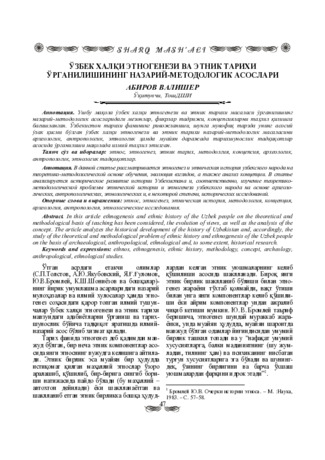
Theoretical and methodological foundations of the study of the ethnogenesis and ethnic history of the Uzbek people
In this article ethnogenesis and ethnic history of the Uzbek people on the theoretical and methodological basis of teaching has been considered, the evolution of views, as well as the analysis of the concept. The article analyzes the historical development of the history of Uzbekistan and, accordingly, the study of the theoretical and methodological problem of ethnic history and ethnogenesis of the Uzbek people on the basis of archaeological, anthropological, ethnological and, to some extent, historical research.
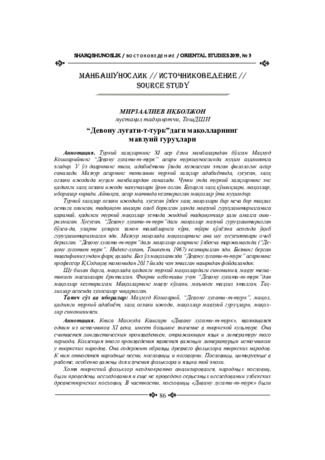
Thematic groups of proverbs in "Devonu Lug'ati-t-Turk"
The book of Mahmud Kashgary “Divanu Lugati-t-Turk”, which is one of the sources of the XI century, is of great importance in the Turkic culture. It is considered a linguistic work reflecting the language and literature of that period. The collection of this work is an important source of literature among Turkic peoples, especially folklore. The contains samples of ancient folklore of Turkic peoples. These include are folk songs, proverbs and sayings. The proverbs cited in the work are especially important for the study of folklore and the language of that era. Although Turkic folklore has been repeatedly analyzed, especially Uzbek folk proverbs, studies have been carried out, and the thematic group has not yet conducted a serious study of ancient Turkic proverbs. In particular, the proverbs “Divanu Lugati-t-Turk” were divided into a thematic group, but were not read and grouped in accordance with the text of the manuscript. This article analyzes these features. Proverbs in “Divanu Lugati-t-Turk” were first grouped in meaning in the first edition of the dictionary in Uzbek publication (Divanu Lugati-t-Turk. Index Dictionary, Tashkent, 1967). Our description is different from the previous one. In our article, we used the publication “Divanu Lugati-T-Turk”, published in 2017 by Professor K. Sadikov. Along with this, this article analyzes the synonymy of ancient Turkic proverbs and thematic issues. To prove the above questions, quotes from the dictionary “Divanu Lugati-t-Turk” are given. The article analyzed the scope and significance of this topic. As a result of the analysis, conclusions were drawn.
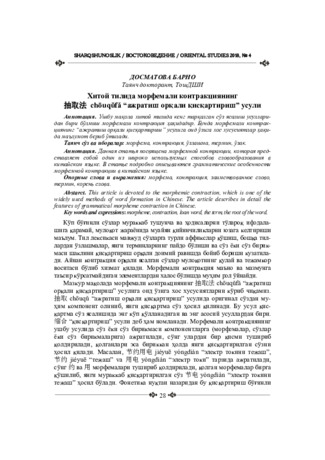
The 抽取法 chōuqǔfǎ "reduction by separation" method of morpheme contraction in Chinese
This article is devoted to the morphemic contraction, which is one of the widely used methods of word formation in Chinese. The article describes in detail the features of grammatical morpheme contraction in Chinese.
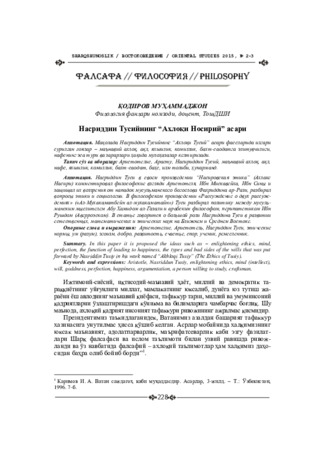
The work of Nasriddin Tusi "Ethics of Nasiri"
In this paper it is proposed the ideas such as – enlightening ethics, mind, perfection, the function of leading to happiness, the types and bad sides of the wills that was put forward by Nasriddin Tusiy in his work named “Akhloqi Tusiy” (The Ethics of Tusiy).
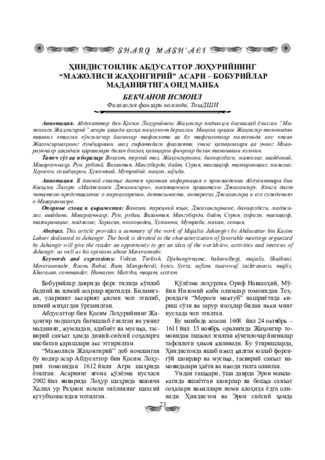
The work of Indian Abdusattar Lohuri "Majoli Jahangiri" is a source of Babur culture
This article provides a summary of the work of Majalisi Jahangiri by Abdusattar bin Kasim Lahuri dedicated to Jahangir. The book is devoted to the characterization of favorable meetings organized by Jahangir will give the reader an opportunity to get an idea of the worldview, activities and interests of Jahangir, as well as his opinions about Maverannahr.
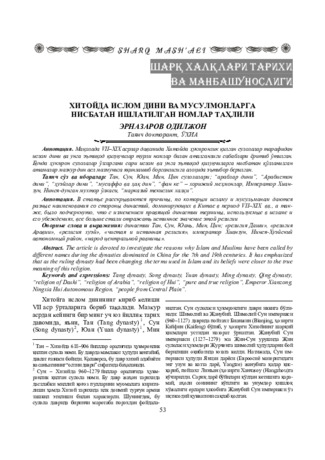
The word "saw" and its meanings in ancient Turkish monuments
In the work “Devonu lugati-t-turk” the author Makhmud Kashgari gave scientific explanation to Turkic words and terms. Including to the word Saw. In the article has been made a research of the meaning of this word and its formation as a term in Turkic script.
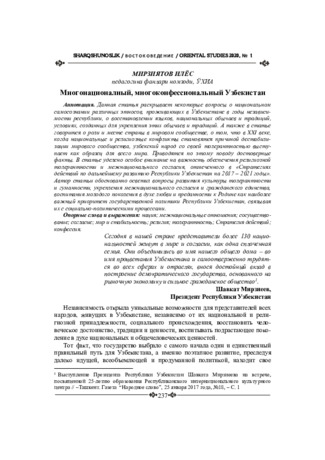
The view of Chinese experts on the world after the pandemic
This article studies the evolution of the coronavirus epidemic into a pandemic that has become an unprecedented threat to humanity in the 21st century, its impact on the lifestyle of Chinese society, changes in China’s domestic and foreign policies due to coronavirus infection, and the results of the Chinese government’s effective struggle against the “disaster”. Moreover, the author analyzes the situation in international relations due to COVID -19, changes in international relations under the influence of the pandemic, the transformation of relations between major powers as a result of the coronavirus, a variety of methods for combating COVID -19 in different countries of the region, China’s experience in combating the pandemic and its significance for the world, and the crisis caused by the pandemic in people's lifestyles and in all sectors of the economy. What is more, the assessments and approaches of Chinese experts and specialists in combating the pandemic are examined based on their experience in overcoming the crisis. Finally, it reflects the opinions of Chinese scientists and experts about the huge changes that could happen in the world order after a pandemic.
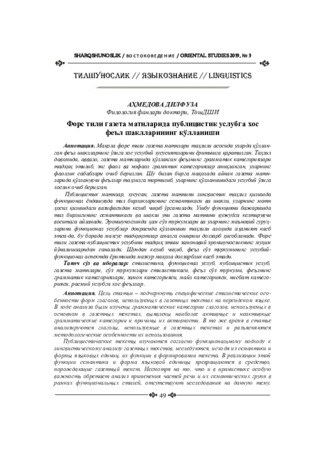
The use of verb forms characteristic of journalistic style in Persian language newspaper texts
The purpose of the article is to emphasize the specific stylistic features of verb forms used in Persian language newspaper texts. The analysis examined the grammatical categories of verbs used mainly in newspaper texts, identified the most active and inactive grammatical categories, and identified the reasons for their activity. At the same time, the article analyses verbs used in newspaper texts and explains the methodological features of their use. Newspaper-journalistic style has specific features and the main task of the materials of this style is to report certain information to certain positions; thereby achieving the desired effect on the reader or listener. The content of the newspaper and informational messages is different in that here we are talking about events that are available for a broad understanding of the layers of non-specialists, directly or indirectly related to their lives and interests. From this point of view, this article is relevant in stylistic-functional aspects of the verb category.
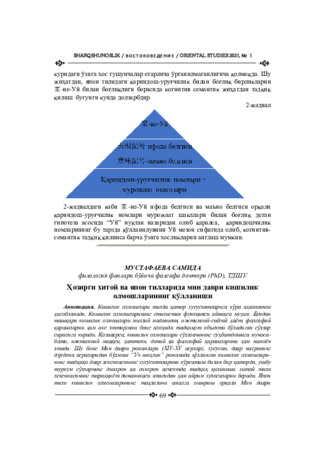
The use of personal pronouns from the Ming period in modern Chinese and Japanese
Personal pronouns are important according to a number of features in the language. The stylistic function of personal pronouns is particularly important. In addition, personal pronouns are among the words that will be the subject of special research, as they reflect the national culture, socio-political life, philosophical views. In addition, personal pronouns reflect the speaker’s attitude toward the interlocutor, his social status, and even his religious and philosophical views. Therefore, the study of personal pronouns used in the novels of the Ming period (XIV-XV c.), especially in the novel "Three Kingdoms", shows the features of the lexicon of the period, as well as the study of this series of words in diachronic and synchronous terms gives some conclusions about the dynamics of Chinese lexicon. By analyzing Japanese personal pronouns, it is possible to draw conclusions about the influence of Ming period novels on the lexicon of other languages in the synosphere.
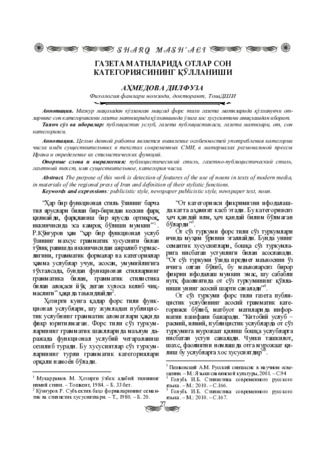
The use of nouns and number category in newspaper texts
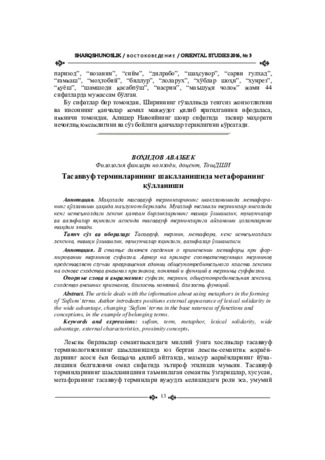
The use of metaphor in the formation of mystical terms
The article deals with the information about using metaphors in the forming of ‘Sufism’ terms. Author introduces positions external appearance of lexical solidarity in the wide advantage, changing ‘Sufism’ terms in the base nearness of functions and conceptions, in the example of belonging terms.
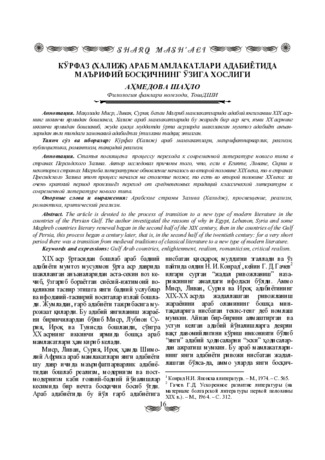
The uniqueness of the educational stage in the literature of the Gulf (Khalij) Arab countries
The article is devoted to the process of transition to a new type of modern literature in the countries of the Persian Gulf. The author investigated the reasons of why in Egypt, Lebanon, Syria and some Maghreb countries literary renewal began in the second half of the XIX century, then in the countries of the Gulf of Persia, this process began a century later, that is, in the second half of the twentieth century: for a very short period there was a transition from medieval traditions of classical literature to a new type of modern literature.
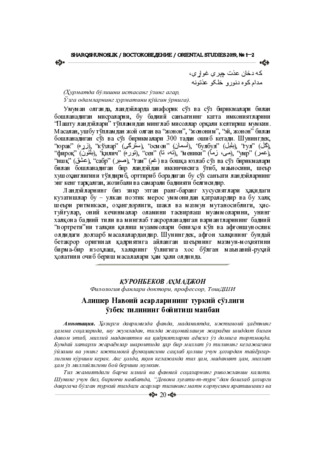
The Turkish vocabulary of Alisher Navoi's works is a source of enrichment of the Uzbek language
Currently, there is a rapid process of globalization in all spheres of social life, including in the field of national languages and mercilessly endangers the leveling of national cultures and values. In such conditions, each nation should take care of the future of its language and strive to preserve the social function of the language. Otherwise, in the near future, both the language (the culture) and the nation itself will lose their national identity and even existence. Language is the key to all scientific and technological progress. To this end, we must collect the vocabulary of all the works of the classical period, starting with “Divan Lugati-t-Turk” (an essay in Turkic vocabulary) by Mahmud Kashgari to the present, create a text corpus of the Uzbek language, create concordant vocabulary works. At the next stage, comes collecting all borrowings in the language, classifying them according to European languages and, if possible, replacing them with an equivalent in the Uzbek language or with an analogue from the Turkic languages. The words of Arabic and Persian origin are widely used in the Uzbek language from many times, being an integral part of it. It is better to replace them if there are suitable equivalents in the Uzbek language. In Uzbek language, the full-blooded norm of the term of creation does not yet exist. In this area, it is necessary to study the experience of highly developed countries and develop a promising program for the term of the Uzbek language. It is necessary to collect all the dictionaries of the Turkic languages that are currently developed and to use their experience in order to improve the Uzbek language. Alisher Navoi is the founder of the modern Uzbek language and the author of the largest collected works in the Uzbek language. For this reason, it is necessary, first of all, to develop concordances of his works and create a complete author's dictionary of his works.
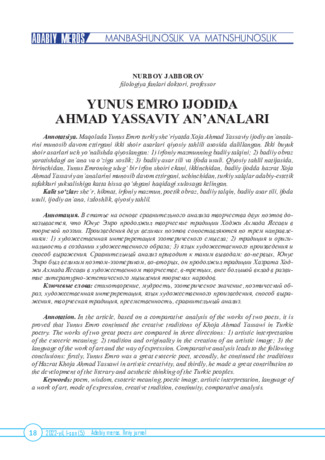
The traditions of Ahmad Yassavi in Yunus Emro's work
In the article, based on a comparative analysis of the works of two poets, it is proved that Yunus Emro continued the creative traditions of Khoja Ahmad Yassawi in Turkic poetry. The works of two great poets are compared in three directions: 1) artistic interpretation of the esoteric meaning; 2) tradition and originality in the creation of an artistic image; 3) the language of the work of art and the way of expression. Comparative analysis leads to the following conclusions: firstly, Yunus Emro was a great esoteric poet, secondly, he continued the traditions of Hazrat Khoja Ahmad Yassawi in artistic creativity, and thirdly, he made a great contribution to the development of the literary and aesthetic thinking of the Turkic peoples.
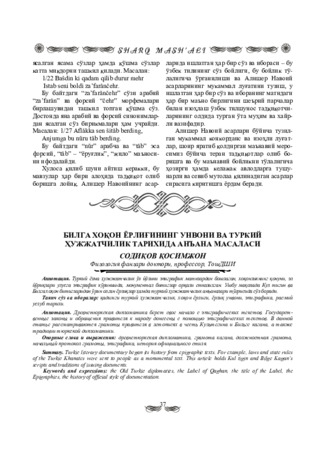
The title of the Bilga Khagan label and the question of tradition in Turkish documentary history
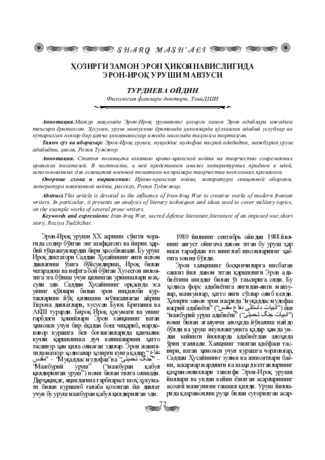
The theme of Iran-Iraq war in contemporary Iranian fiction
The symbol of "flower" in the epic "Hayrat ul-Abror".
The article deals with the methaphoric meaning of the word- symbol “flower” in the poet’s interpretation of the poem “Wonders of the Good People” from Alisher Navoi’s work “Khamsa”(Quintuple).
The Sugdian script and its distribution geography in the early Middle Ages
The article is devoted to the geographical spreading of the Sogdian Script in the territory of Central Asia in the 1 st Millennium A.D. The spreading of the Sogdian manuscripts is not limited with the range of Central Asia, although they were found on the North-Western China, Tibet and India. On the basis of these sources IT WAS analyzed the wide spreading of the Sogdian Letter on these areas and its compared with other types of letters.
The study of the history of the Arab conquests in the English historiography
In this article, the study of the history of the Arab conquests in the English-language historiography in XX–XXI centuries is discussed. The data about the well-known English orientalists and their works on the history of conquests is analyzed.
The structure of Babur's work "Mubayyin" and the semantics of the terms representing Hajj and Umrah
The study and research of written sources related to language learning serves as a mainstay for the development of this field. Therefore, the role of the work of Zakhiriddin Muhammad Babur "Mubayin" in the development of our literary language and national literature is invaluable. The aim of the author's work was a poetic and clear explanation of the science of Sharia to his son Humayun. By the 15th - 16th centuries, the lexical layer of the Old Uzbek literary language had become significantly poorer. Purely Turkish words have been replaced by Arabic, Persian and Tajik. This, in turn, alienated the general public from science and education. This led to the crisis of the old Uzbek literary language. Babur, who understood the process correctly, tried to use pure Turkish words in his works. With this work, Zakhiriddin Muhammad Babur contributed to the development of the Uzbek literary language, the history of the Uzbek literary language, terms, words and phrases in the religious and philosophical spirit of the Uzbek literary language, as well as to the science of Sharia. During the writing of the mubayyn, the artist again introduced obsolete Turkic words into the history of the Uzbek literary language. He also strove to write a work that would be convenient, easy and understandable for the reader of that period. As a result, Mubayin became popular among the people of his day.
The strategic tasks of modern education and upbringing of young people in the presidential address
This article analyzes the priority directions of social development at the present stage based on proposals, initiatives and conceptual ideas put forward in the Address of the President of the Republic of Uzbekistan to the Oliy Majlis in 2018. As noted in the article, the Strategy of Action on the five priority directions of development of the Republic of Uzbekistan in 2017–2021 contributes to the improvement of the strategic framework to ensure the vital needs and legitimate interests of the population and strengthen the foundations of a decent and comfortable life. In this regard, as noted in the article, the Address of the President of the Republic of Uzbekistan Shavkat Mirziyoyev to Oliy Majlis on December 28, 2018, and the fact that 2019 was proclaimed the “Year of Active Investments and Social Development” became the logical continuation of the years of “Dialogue with the people and human interests”, “Support for active entrepreneurship, innovative ideas and technologies” in the country. It indicates that in the third stage of the reform strategy, the importance of social development as a priority of state policy increases. According to the author, increasing the economic potential of the country by attracting investment will inevitably lead to the development of social spheres. The article focuses on the development of the social sphere. The author reveals the essence of the concept of “social development”. As noted, “social development” is a change that contributes to the emergence of new social relations, institutions, norms and values in society. In this regard, features and criteria of social development are shown. The article outlines the main tasks for the further development of the social sphere in 2019, as defined in the Presidential Address. In particular, comments were given to initiatives and conceptual ideas for further improvement of science, modern and continuing education, further strengthening of state social support for young people, and the development of a national idea. The article widely describes the concept of “investment in human capital” and the article notes that investments in human capital include expenditures on health care, general and special education, employment, vocational training, raising children and others. The effectiveness of such investments is reflected in the pace of development of society in all areas. The article shows how the issues of modern education and upbringing of young people and their social support are important in the social development of the country. The article analyzes important practical steps taken to ensure that the sphere of education and training directly serves further human improvement.

