
DOI:
https://doi.org/10.71337/inlibrary.uz.science-research.139726Keywords:
muscle topography functional groups innervation peripheral nerves biomechnics.Abstract
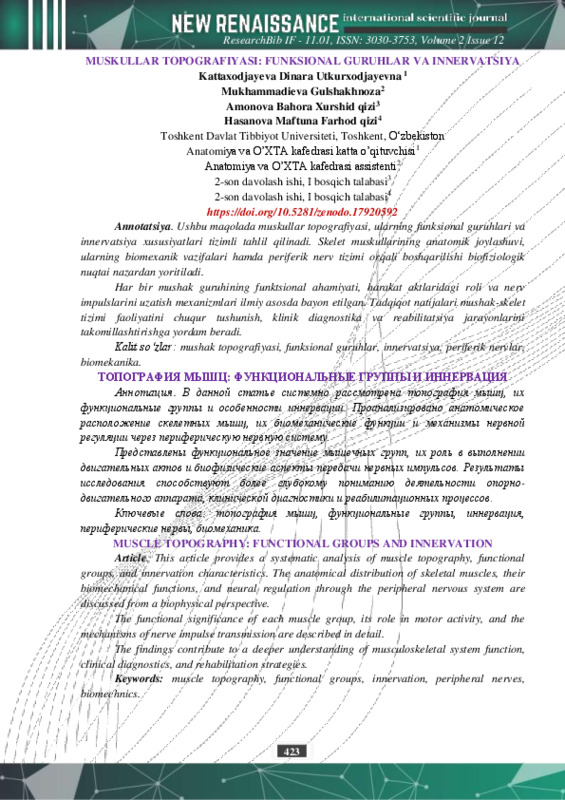
This article provides a systematic analysis of muscle topography, functional groups, and innervation characteristics. The anatomical distribution of skeletal muscles, their biomechanical functions, and neural regulation through the peripheral nervous system are discussed from a biophysical perspective. The functional significance of each muscle group, its role in motor activity, and the mechanisms of nerve impulse transmission are described in detail. The findings contribute to a deeper understanding of musculoskeletal system function, clinical diagnostics, and rehabilitation strategies.References
Gray’s Anatomy: The Anatomical Basis of Clinical Practice.
Netter, F. — Atlas of Human Anatomy.
Moore, K. L., Dalley, A., Agur A. — Clinically Oriented Anatomy.
Standring S. — Gray’s Anatomy for Students. https://www.elsevier.com/books/grays-anatomy-for-students
Junqueira’s Basic Histology: Text and Atlas.
Tortora, G., Derrickson, B. — Principles of Anatomy and Physiology.






