Vol. 1 No. 1 (2024)
Articles
4-32
1207
290
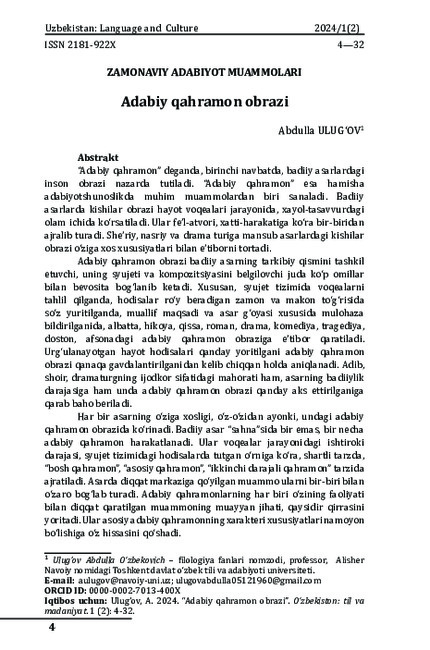
The image of a literary hero
"Literary hero" means, first of all, a human image in works of art. "Literary hero" is always considered one of the important problems in literary studies. In works of art, the image of people is shown in the process of life events, in the world of imagination. They differ from each other according to their character and behavior. The image of people in poetic, prose and dramatic works attracts attention with their unique features.
The image of a literary hero is directly connected with many factors that make up the composition of an artistic work and determine its plot and composition. In particular, when analyzing the events in the plot system, when talking about the time and place where the events take place, when commenting on the purpose of the author and the idea of the work, of course, attention is paid to the image of the literary hero in the story,short story, novel, drama, comedy, tragedy, epic, legend.
How the highlighted life events are covered is determined by how the image of the literary hero is embodied. The skill of a writer, poet, dramatist as a creator, as well as the level of artistry of a work is evaluated depending on how the image of a literary hero is reflected in it.
The uniqueness of each work is evident in the image of the literary hero in it. Not one, but several literary characters move on the "stage" of a work of art. Depending on the level of their participation in the process of events, their place in the events of the plot system, they are conventionally divided into "main character", "main character", "secondary character”. The problem focused in the work connects them with each other. Each of the literary heroes illuminates a specific aspect of the problem, a certain edge of the focused problem with his activity. They contribute to the manifestation of the character traits of the main literary character.
This article discusses how the image of a person is reflected in works of art.
The image of a literary hero is directly connected with many factors that make up the composition of an artistic work and determine its plot and composition. In particular, when analyzing the events in the plot system, when talking about the time and place where the events take place, when commenting on the purpose of the author and the idea of the work, of course, attention is paid to the image of the literary hero in the story,short story, novel, drama, comedy, tragedy, epic, legend.
How the highlighted life events are covered is determined by how the image of the literary hero is embodied. The skill of a writer, poet, dramatist as a creator, as well as the level of artistry of a work is evaluated depending on how the image of a literary hero is reflected in it.
The uniqueness of each work is evident in the image of the literary hero in it. Not one, but several literary characters move on the "stage" of a work of art. Depending on the level of their participation in the process of events, their place in the events of the plot system, they are conventionally divided into "main character", "main character", "secondary character”. The problem focused in the work connects them with each other. Each of the literary heroes illuminates a specific aspect of the problem, a certain edge of the focused problem with his activity. They contribute to the manifestation of the character traits of the main literary character.
This article discusses how the image of a person is reflected in works of art.
33-45
128
92
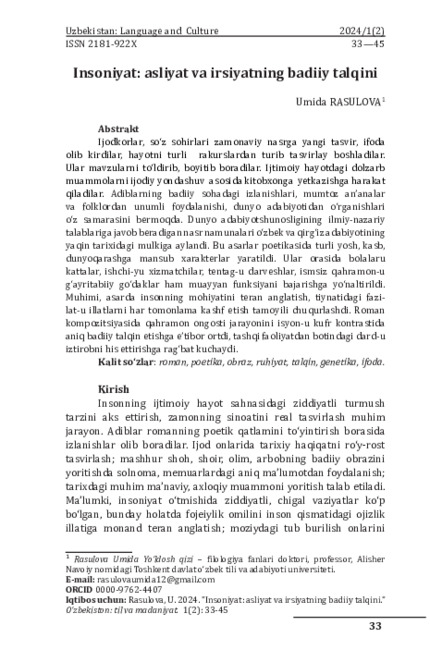
Artistic interpretation of humanity, originality and genetics
Wordsmiths, the enchanters of language, introduced a fresh perspective and expression to contemporary prose, depicting life from various vantage points. They infused vitality into subjects and sought to communicate present societal issues to readers through a creative lens. Authors’ exploration in the realm of art, adept incorporation of classical conventions and folklore, and drawing inspiration from global literature are yielding significant results. In recent times, Uzbek and Kyrgyz literature has acquired ownership of prose examples that align with the scientific and theoretical standards of world literature. Within the poetics of these literary works, a diverse array of characters representing various ages, professions, and worldviews has been crafted. This includes individuals such as children and adults, workers and servants, the foolish and the hermits, nameless heroes, and supernatural infants, each assigned specific roles and functions. Crucially, the piece delves into a profound comprehension of an individual's core, delving into both the virtues and flaws within their character. The novel places emphasis on providing a vivid artistic portrayal of the hero’s introspection, highlighting the contrast between rebellion and disbelief. Moreover, it amplifies the motivation for the character to experience internal pain and suffering as a result of external actions.
46-58
232
323
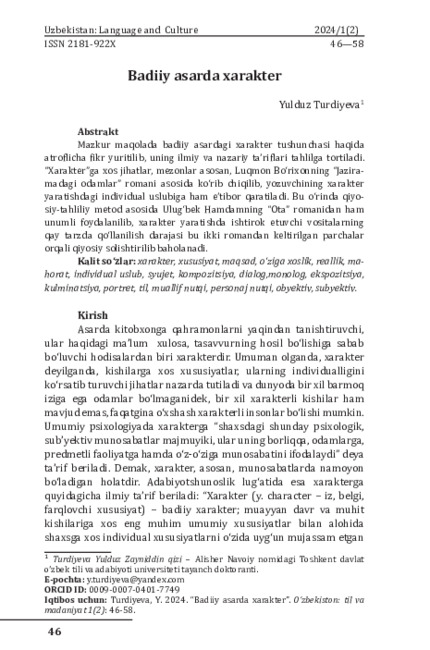
Character in a work of art
In this article, the concept of character in a work of art is discussed in detail, and its scientific and theoretical definitions are analyzed. Aspects and criteria specific to «character» are considered mainly based on Luqman Borikhan’s novel «People in the Heat», and attention is also paid to the writer's individual style of character creation. Based on the comparative-analytical method, the novel «Father» by Ulugbek Hamdam is also used effectively, and the degree of use of the tools involved in character creation is compared and evaluated through excerpts from these two novels.
59-67
96
88
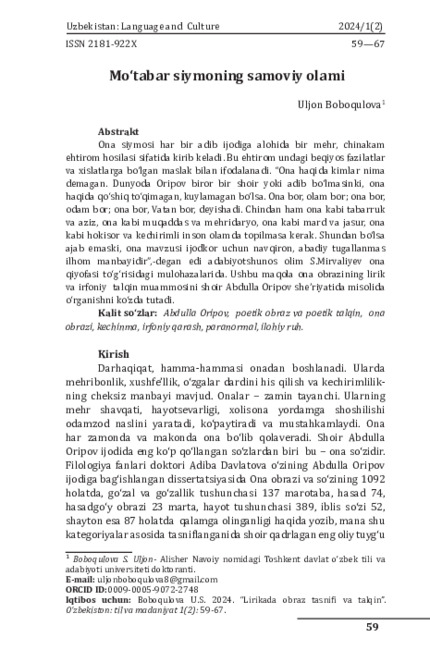
The heavenly world of a dignified figure
The figure of the mother enters the work of every writer as a product of special love and true respect. This respect is expressed by admiration for his incomparable qualities and qualities. «Who didn’t say what about the mother? Oripov is a poet or a writer in the world who has not written or sung a song about his mother. There is a mother, there is a universe; there is a mother, there is a person; they say there is a mother, there is a country. Indeed, there is no one in the world who is as blessed and dear as a mother, as holy and kind as a mother, as brave and brave as a mother, as humble and forgiving as a mother. Therefore, it is not surprising that the theme of the mother is a source of inspiration for the creator,» S. Mirvaliyev, a literary scholar, said in his comments on the image of the mother. This article aims to study the problem of lyrical and mystical interpretation of the image of the mother in the example of the poet Abdulla Oripov's poetry.
68-80
109
174
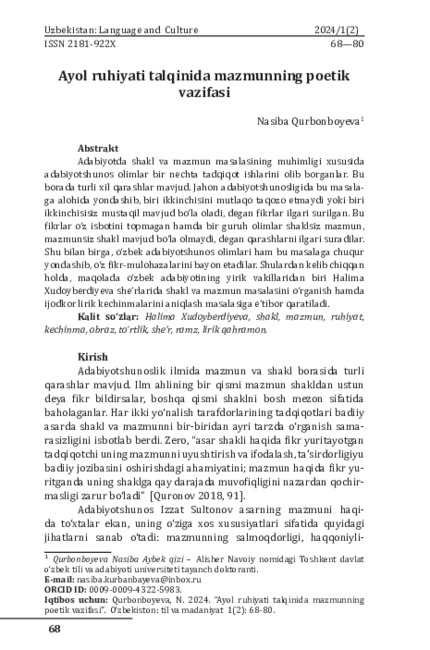
The poetic function of the content in the inter- pretation of the female psyche
Literary scholars have conducted several researches on the importance of form and content in literature. There are different views on this. In world literary studies, they approach this issue separately and put forward opinions that one does not require the other at all, or that one can yexist independently without the other. These ideas have not been proven, and a group of scientists put forward the opinion that there can be no content without form, and no form without content. At the same time, Uzbek scholars of literature also deeply approach this issue and yexpress their opinions. Based on this, the article focuses on the study of form and content in the poems of Halima Khudoyberdiyeva, one of the great representatives of Uzbek literature, and the issue of determining the lyrical yexperiences of the creator.
81-97
409
142
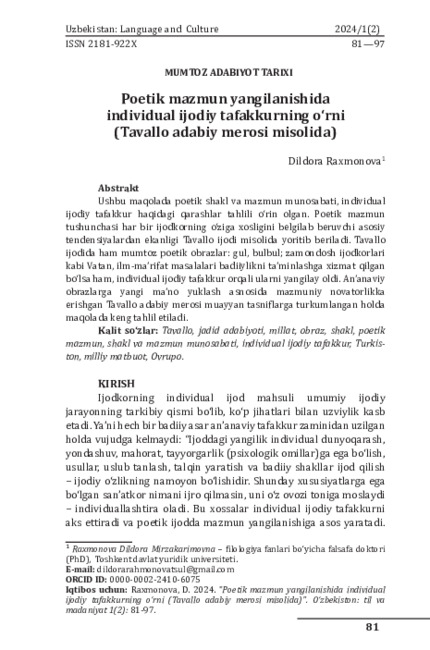
The role of individual creative thinking in the update of poetic content (in the example of the literary heritage of Tavallo)
This article contains an analysis of views on the relationship between poetic form and content, individual creative thinking. The concept of poetic content is one of the main trends that determine the uniqueness of each artist. Classical poetic images in Tavallo’s work: flower, nightingale; Vatan, like contemporary artists, was able to renew them through individual creative thinking, even if the issues of science and enlightenment served to ensure artistry. The literary heritage of Tavallo, who achieved substantive innovation in giving a new meaning to traditional images, is broadly analyzed in the article, categorized into specific classifications.
98-119
583
172
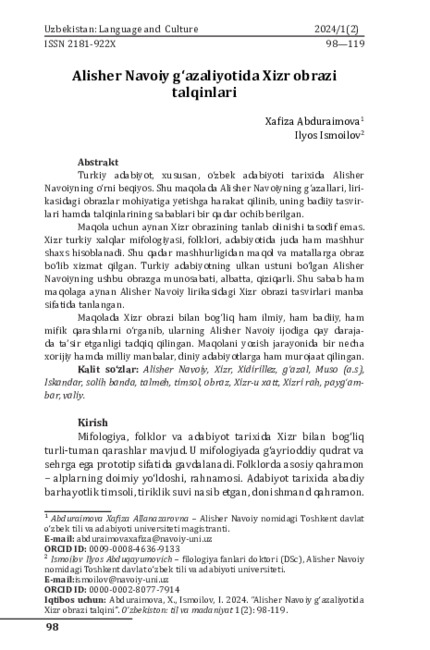
Interpretations of the image of Khizr in the poetry of Alisher Navoi
The place of Alisher Navoi in the history of Turkish literature, especially Uzbek literature, is incomparable. In this article, an attempt is made to get to the essence of the images in Alisher Navoi's ghazals and lyrics, and the reasons for his artistic images and interpretations are revealed to some extent.It is no coincidence that the image of Khizr was chosen for the article. Khizr is a very famous person in the mythology, folklore and literature of the Turkic peoples. Due to its popularity, it has served as an image for proverbs and sayings. The attitude of Alisher Navoi, a great pillar of Turkish literature, to this image is certainly interesting. For this reason, the images of the image of Khizr in Alisher Navoi’s lyrics were chosen as a source for the article.
The article examines both scientific, artistic and mythical views related to the image of Khizr, and to what extent they influenced Alisher Navoi's work. In the process of writing the article, several foreign and national sources, religious literature were also referred to.
The article examines both scientific, artistic and mythical views related to the image of Khizr, and to what extent they influenced Alisher Navoi's work. In the process of writing the article, several foreign and national sources, religious literature were also referred to.
120-137
346
636
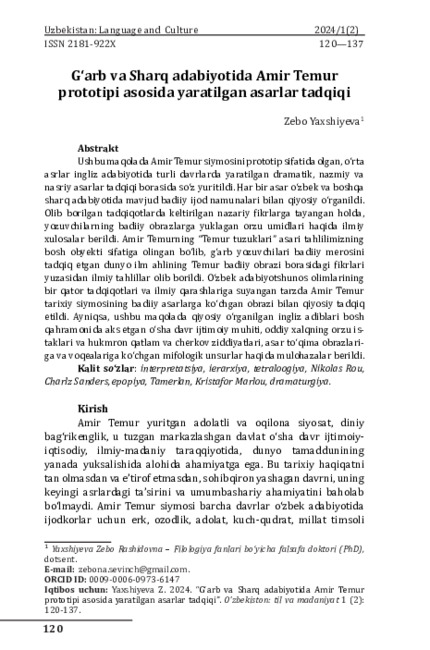
Research of works based on the prototype of Amir Temur in western and Eastern literature
In this article, discussed the study of dramatic, poetic and prose works created at different times in medieval English literature, which received Amir Timur’s image as a prototype. Each work was studied in a comparative way with existing examples of artistic creation in Uzbek and other Eastern literature. Scientific conclusions were made about the dream hopes that the writers imposed on artistic images relying on the theoretical considerations presented in the studies carried out. The work of Amir Timur "Timur's laws" was taken into the quality of the main object of our analysis, and scientific analysis was carried out on the views of the people of World literary Science on the Timur artistic image, which studied the artistic heritage of Western writers. A comparative study was carried out with the image of the historical figure of Amir Temur, who moved to works of art relying on a number of studies and scientific views of Uzbek literary scholars. Especially in this article, scientific summaries were given on the social environment of that time, the desire of the common people and the conflicts of the ruling layer and church, which were reflected in the main character of the English scolars, which were studied in a comparative way, on mythological elements that moved to the images and events of the fabric of the work.
138-151
275
210
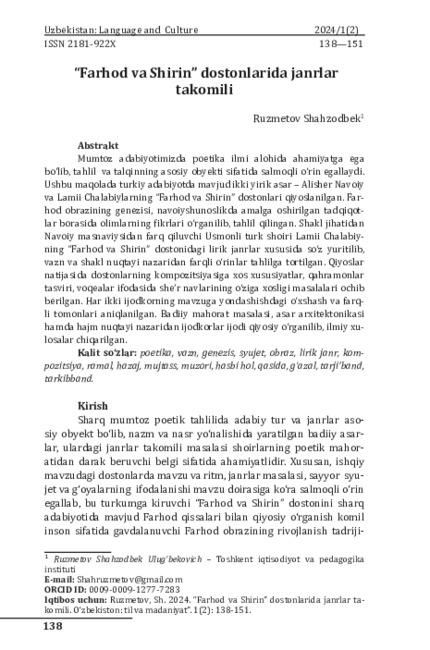
Genre Evolution in the Epics of “Farkhod and Shirin”
In our classical literature, the science of poetics acquires special importance and occupies a significant place as the main object of analysis and interpretation. This article compares two major works of Turkic literature - the epics "Farhad and Shirin" by Alisher Navoi and Lamia Chalabi. The opinions of scientists, who have worked on the genesis of Farhad’s image and research conducted in Navoi science, were studied and analyzed.Lyrical genres in the epic "Farhad and Shirin" the Ottoman Turkish poet Lamia Chalabi that differs in form from Masnavi’s of Navoi, is considered in terms of poetic weight and shape, while analyzing different places. As a result of the comparisons, the peculiarities of the composition of epics, the images of heroes, the questions of the originality of the varieties of poetry in the expression of events are revealed. The similarities and differences in the approach of both authors to the topic are showed. The issues of artistic craftsmanship, the architectonics of the work, as well as the creativity of the creators in terms of volume, have been studied comparatively, and scientific conclusions have been concluded.
152-173
972
346
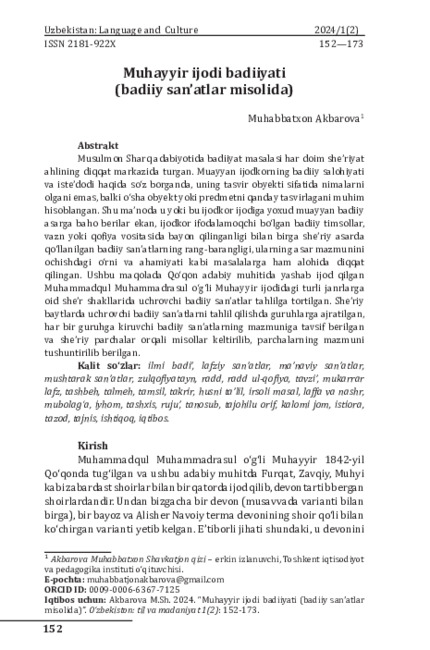
The Poetics of Muhaiyir’s poetry (in the example of ilmi badi)
In the literature of the Muslim East, the issue of artistry has always been the focus of attention of poets. When it comes to the artistic potential and talent of a particular artist, it is considered not importance of what he took as the subject of the image, but how he depicted this object. In this sense, when assessing the creativity of a particular creator who wants to express the variety of artistic techniques used in the poetic work, are taken into account, as well as the fact that the artistic symbols that are expressed through the poetic weigh or rhyme. Particular attention was also paid to such issues as the role and meaning in revealing the content. In this article, the visual art encountered in various genres of Mukhayyir's poetry, the son of Muhammadqul Muhammadrasul, who lived and created in the literary environment of Kokand, were analyzed. In the analysis of this kind of art found in the poetic verses are divided into groups, and in each group visual art is described, examples are given through the poetic passages, and the meaning of the passages are explained.
174-184
234
186
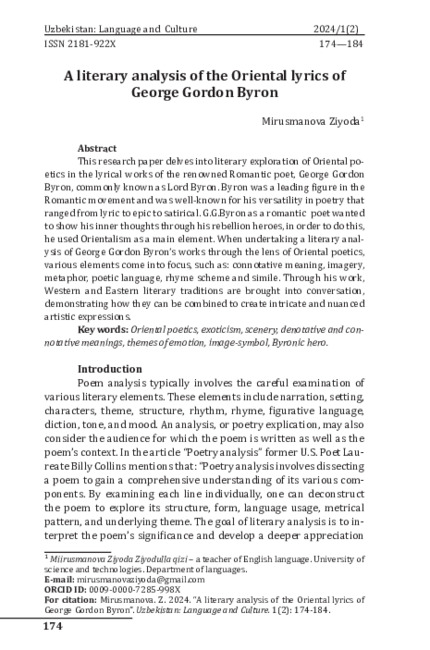
A literary analysis of the Oriental lyrics of George Gordon Byron
This research paper delves into literary exploration of Oriental poetics in the lyrical works of the renowned Romantic poet, George Gordon Byron, commonly known as Lord Byron. Byron was a leading figure in the Romantic movement and was well-known for his versatility in poetry that ranged from lyric to epic to satirical. G.G.Byron as a romantic poet wanted to show his inner thoughts through his rebellion heroes, in order to do this, he used Orientalism as a main element. When undertaking a literary analysis of George Gordon Byron's works through the lens of Oriental poetics, various elements come into focus, such as: connotative meaning, imagery, metaphor, poetic language, rhyme scheme and simile. Through his work. Western and Eastern literary traditions are brought into conversation, demonstrating how they can be combined to create intricate and nuanced artistic expressions.

