Vol. 1 No. 1 (2021): Oriental studies
Articles
The Ottoman State in the Mirror of Turkestan Press (late XIX - early XX centuries)
It is to show that the image of the Ottoman state was formed through the Turkestan press during the reign of the Russian Empire. Turkestan periodicals regularly publish articles and reports published abroad. The political developments in Turkey have been closely followed. In particular, the processes related to the coming to power of young Turks in 1908, changes in the Turkish army, various wars are given special attention. It is also noted that the spread of ideas of pan-Islamism and pan-Turkism and this is extremely dangerous for Turkestan. Socio-political processes in Turkey in the early twentieth century, the activities of young Turks in Turkey, party struggles in the country, as well as the attitude of the European community to the leadership of the "Unity and Development" party in the political process were widely covered in Turkestan periodicals. It was also noted in the Western media that the interpretation of these processes was covered without a full understanding of the political activities of young Turks.
The evolution of the problems of knowledge and truth in Indian philosophy
This article is devoted to the consideration and analysis of Indian philosophical thought, with the definition of specific aspects of the evolution of the problems of knowledge and truth. It is shown that the theory and practice of cognition is an important component for all Indian philosophical teachings, with the emergence of a special interest in theoretical and cognitive problems already in the pre-philosophical period and unquenchable in the modern era. And already starting from the second half of the 19th century, epistemological problems begin to acquire new meanings due to the cha-racteristic changes that occur in life, in science and culture. It is noted that the process of cognition in Indian philosophical teachings has never been focused on conquering the world, comfortable settling a person in it, but always on comprehending true reality, with the acquisition of a true goal in life. The author hopes that the presented study will open up an important perspective of reflection on the special views that have developed in Indian philosophy about the development of ways of knowing and searching for truth.
Philosophical understanding of the symbol and symbolic worldview as the basis of the aesthetic culture of China
Today, Uzbekistan is opening up to the whole world. One of the factors in the development of any state is that it has its place in the world community within the framework of important organizations. Uzbekistan has introduced various diplomatic mechanisms to accelerate the process of active interaction and mutually beneficial cooperation with the region and the world. One of the most important organizations in our country is the Shanghai Cooperation Organization. The rich history and close cultural ties between the SCO member states predetermine wide cultural and humanitarian cooperation within the organization. In this sense, it is worth noting that a hundred years ago the space of the SCO countries was connected by the ancient routes of the Silk Road. It is also deeply symbolic that by the 21st century, the countries of Eurasia are ready to develop new economic, cultural and humanitarian ties, reviving ancient traditions in the context of globalization. Some political and economic changes in the world require that only interstate cooperation be adapted to the principles of public diplomacy. Cultural and humanitarian cooperation has a growing tendency to develop mutual understanding, mutual enrichment and integration of cultures, creating a solid social basis for disseminating information and knowledge about the traditions and customs of peoples in the SCO space. Uzbekistan has long been associated with the people of the SCO space through ethnic, linguistic, religious and other ties. It was the land of Uzbek that served as a bridge connecting these links. Therefore, the most important direction of Uzbekistan’s foreign policy is cooperation with the SCO membe countries. Therefore, the possibility of further strengthening the role of Uzbekistan in all areas is an urgent problem. This article describes the cultural and humanitarian cooperation between Uzbekistan and the SCO, multilateral diplomacy in this area and the contribution of Uzbekistan to the development of this sector within the organization
Integration processes in Central Asia: issues of interstate relations and cooperation
In the article explores the differences in the approaches of each Central Asian country to regional cooperation. The initiatives put forward by the leaders of the countries of the region were analyzed. The author describes the features of the foreign policy concepts of the countries of the region. The factors of foreign policy of the Central Asian countries are analyzed. The need for regional integration was explained by analyzing the evolutionary processes taking place in Uzbekistan's neighbors in Central Asia. Regional cooperation is based on an understanding of the evolution of geopolitical processes in the modern world, where the tendency to build international, political, economic, and other relations is growing. It is emphasized that such a view is extremely relevant for modern Central Asia, which is a link interconnected by relatively different ancient local ties. Some factors were considered, the development of a special legal document or a concept that reveals prospects aimed at enhancing the development of the countries of the region directly with neighbors. The speeches of the leaders of the countries of the region from the tribunes of influential international organizations and forums on the creation of a new system of international relations in the region have been studied. The main regional and international initiatives of the Central Asian states in the field of security and development were highlighted. Analyzed issues are the measures taken by the countries of the region to solve border problem
International relations between the United States and China in Central Asia during the pandemic
This article attempts to clarify political views on the sudden appearance of a new type of coronavirus COVID-19 on the world stage, in particular, against the background of tense relations between the United States and China, aspirations of certain lobby groups to replace the green peril with the red-yellow threat in the paradigm of world politics. Discussions are expressed about the spread of the pandemic that has seeped into Central Asia; the degree of its influence on the relations of the states of the region with China which may prompt the establishment of new conditions of the world order in international relations and changes in state governance. An interesting point of the article is the attention paid to the diversity of the dynamics of the spread of COVID-19 in countries bordering China, as well as the need to learn and exchange the best practices in minimizing the consequences of the pandemic.
Features of the education system of the Islamic Republic of Iran: state and development prospects
The article is an attempt to analyze the main stages of the historical evolution and development of the education sphere of the Islamic Republic of Iran. An emphasis is also made o the analysis of the educational processes after the accomplishment of the "Islamic revolution" of 1979, paying special attention to the activities of higher educational institutions at the beginning of this century through their place and role in modern socio-political life of Iran.
Main Trends in the Political Transformation of Syria
The article examines the main trends in the political transformation of Syria in the late XX - early XXI century, as well as the domestic and foreign policy of Syria, taking into account the changes in the region. The evolution and transformation of the Syrian society, the originality of political rule are analyzed. The demonstration by Damascus of its position regarding the building of a democratic society in the country is noted. The article analyzes the external factors that have influenced the evolution of the Middle East policy of the SAR. An assessment of the results of the policy of the Syrian leadership regarding building relations with the countries of the Middle East is presented. A number of factors influencing the evolution of Syrian foreign policy in the new geopolitical situation in the region are analyzed. The foreign policy activity of Syria is considered, taking into account external influences and contacts, the impact of which affected the political life of the country. The role of the army in modern Syrian society, the forms of its relationship with the civilian authorities of the state and the ways of influencing the internal and foreign policy of official Damascus are considered. The transformation of Syrian society, the originality of political rule, the centralization of power in the process of developing political decisions are revealed. Disclosed are the initiatives of President B. Assad regarding the liberalization and modernization of the Syrian society. The article also reveals in detail the main events that became catalysts in the chain of political transformation in the Middle East and in the political transition of power in the leading Arab states, in particular, the coming to power in the second half of the 1990s - early 2000s of young Arab leaders.
Modern strategic directions of development of ideas and values of democracy in Uzbekistan
This scientific article sets out analytical views on the intensification of international globalization and the impact of such a situation on the processes of democratic development, the need to improve the conceptual foundations of modern democracy, and the growing role of the state institution in the development of democracy, and that the effectiveness of democratic reforms largely depends on the viability of the state and its institutions for the development of more effective models of democracy. The article focuses on new and very significant conceptual ideas and conclusions on the further development and deepening of democratic reforms, improvement of democratic institutions in our country, which were put forward in the message of the President of the Republic of Uzbekistan to the Oliy Majlis. In particular, the article considers new ideas for the development of democracy, which are comprehensively and deeply substantiated in the Presidential Address. According to the results of the election campaign in our country in December 2019 under the motto “New Uzbekistan - New Elections”, new political conditions were formed for the implementation of democratic reforms at a higher level, and the further deepening of democratic reforms remains the only way for us. In this regard, the article pays special attention to the issues of increasing institutional capacity and the formation of new modern democratic institutions on the scale of our society, created an effective management system. The article also presented analytical views on the following conceptual conclusions of the head of our state on the political system of our society and the further improvement of its functioning: further strengthening the role and responsibility in the public administration of local executive and representative authorities; introduction of a system of reporting of khokims of districts on the execution of their programs to regional Kengashes; expanding social partnerships; development of public control; creation of the Public Chamber of the Republic of Uzbekistan in order to closer interaction between the state and society; the formation of strong institutions of democracy based on the most urgent needs of our society. The scientific article concludes that because of these processes, the effectiveness of democratic reforms in our country will increase significantly, and as a result, the democratic foundations of the political and social development of our country will be further strengthened
Issues of the history of Central Asia in the scientific heritage of the Russian orientalist P.I. Lerkha (source analysis)
Scientific study of Central Asia has its deep roots in Russian science. The ramified system of oriental scientific and educational institutions, the richest collections of oriental manuscripts, books, objects of material culture served as a sufficiently representative source base for the research of oriental scholars. The deep and disinterested interest of scientists in the achievements of Eastern civilizations played a certain role in acquainting the peoples of other countries with the culture and history of Central Asia. One of such representatives of Russian oriental studies, who, with his works and social and scientific activities, made a certain contribution to the development of science and culture of the peoples of Central Asia, in particular, to the history of the study of Uzbekistan, was Petr Ivanovich Lerkh. The range of scientific interests of Petr Ivanovich was extensive. He could study the languages, dialects and dialects of various peoples; he could be carried away by prehistoric archeology, as a result of which a number of interesting articles appeared in this direction; the result of his enthusiasm for oriental numismatics was the release of his corresponding scientific work. Moreover, it should be borne in mind that the geography of his scientific research, whatever direction they were, was also extensive: from remote provinces of Russia to the newly annexed neighboring outskirts. This is evidenced by archival materials where the works of P.I. Lerkh on archeology, linguistics, numismatics, ethnography, etc. He also did not reject the study of the works of foreign scientists concerning history, ethnography, oriental studies, in particular. The trip made by P.I. Lerkh in Khiva and Bukhara expanded the scope of the scientist's scientific activity. Since then, Central Asian countries and peoples, eastern numismatics, as well as primitive antiquities began to enter the circle of his scholarly research. During the trip 1858-1859 the scientist acquired over 30 oriental manuscripts for the Asian Museum. The versatility of scientific interests and abilities of a scientist can also be judged by his scientific reports in scientific communities. The article uses a wide range of sources of archival scientific institutions of the Russian Academy of Sciences, in particular, materials from the personal fund of P.I. Lerkh from the scientific archive of the Institute of Oriental Languages in St. Petersburg.
New artistic and methodological principles in United Arab Emirates storytelling
The United Arab Emirates are one of those Arabic countries where national literature of modern type – which replaced Arabic medieval adab–came into existence as late as in the 1970s. Nevertheless, among the earliest Emirati short – stories, most of which were based on the principles of moralizing sentimentalism and romanticism, one could find samples of mature realism (in Muhammad al – Murr’s writings) and even of modernism (in Abdullah al – Mirri’s writings). In the 1980s along with the steady development of the realistic trend in Emirati fiction, many writers turned to the aesthetics of modernism by abandoning in their works the idea of objective, reality, as well as clear plots, and concentrating instead on ‘’internal’’ states of the mind, in which the objective reality is odd, subjectively transformed. Moreover, some writers (Miryam Jum’a Faraj, Su’ad al – Arimi, Harib al – Zahiri, Salma Matar Sayf) used a complicated language of narration, full of similes and metaphors typical for Arabic poetry, as well as ornate lexical – syntactical constructions, reproducing thus a specific style, which was named by scholars of Arabic literature ‘’poetic modernism’’. Besides, in some Emirati short – stories of that time, one can find features of magic realism (in Abd al – Hamid Ahmad Abd al – Hamid’s and Salma Matar Sayf’s works), absurdism (in Zabiyya Khamis’s works) and post – modernist parody (in Salma Matar Sayf’s works). The themes of Emirati short – stories embrace Emirati local realities and problems, as well as general human and philosophic subjects (in particular, in Basima Yunis’s and Jum’a al – Fayruz’s writings).
A Semantic Analysis of Somatic Phraseologisms in Hindi
Phraseological units in the language are connected with the specific psychology, lifestyle, mentality, customs of each people, etc. The phraseology Department – the study of the phraseology of a foreign language – not only increases the effectiveness of studying vocabulary, but it also gives an opportunity to get acquainted with the features of the linguistic sphere of the language more closely. Consideration of various linguistic aspects of phraseological units belonging to the phraseological layer of a foreign language on the example of the Indian language is of great importance in the deep study of phraseologisms of the Indian language, in the ability to read and analyze phraseologisms in artistic texts. The main purpose of writing this article is to provide a semantic analysis of phraseologisms in the Indian language, which are formed from somatic nouns. In carrying out the goal, the following tasks were taken into account: - at first the main source is the designation of all somatic nouns given on the first roof of V.M. Beskrovny's dictionary «Хинди-русский словарь» and the collection of somatic phraseologisms from additional dictionaries; - to study the semantically collected examples; - somatic phraseology in World linguistics research on the extent of World linguistics; - to reveal specific aspects of expression in the interpretation of examples; New lexemes from somatic words are also made and enrich the lexical system of the Indian language. And the results from this can be used in the Indian language lexicology, ethnolinguistics, Indian language textbooks, educational manuals, as well as new regulated information that is given in the compilation of a phraseological Dictionary of the Indian language. The main issue is the semantic separation of somatic phraseologisms of the Indian language into different groups. Most of the phraseological units are somatic phraseologisms, and in this respect many scientists have come to many conclusions by studying this classification in different ways. The collected samples were drawn from the semantic point of view to the analysis and the intended purpose was achieved.
The role of the affix "zú zú" in the formation of modern Chinese neologisms
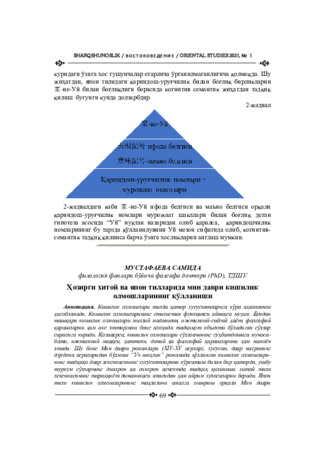
The article is devoted to the study of the method of word formation in modern Chinese using the «族zú» affix. It is known that the lexical stock of a language is constantly replenished due to the internal capabilities of the language and extracted from a foreign language. Of course, Chinese is no exception. Which method is the most effective for a language, depends on a number of features of the language. In Chinese, affixing is the second most productive after word addition. Like the vocabulary of a language, its morphemic units are constantly replenished. In addition to the trend observed in world linguistics, the affix method is becoming more and more active in word formation in the Chinese language, therefore the number of affix units in the language is also increasing. One of the affixes that plays an important role in the construction of modern Chinese neologisms is 族 zú, which participates in the construction of a number of new words in the Chinese language. Most of these words refer to a noun and serve to denote a social group that has a specific character. Words formed with the participation of 族 zú are more involved in the formation of words that are applied to a specific group of people in accordance with their social status or role in social life. But, in our opinion, 族 zú is not a full affix unit, but a semi-affix. Therefore, when words are formed with the participation of, zú, it does not completely lose its original meaning, the meaning of a group or community. Like the vocabulary of a language, its morphemic units are constantly replenished. In addition to the trend observed in world linguistics, the method of affixation in the Chinese language is becoming more and more active in word formation, therefore the number of affix units present in the language is also increasing.
The use of personal pronouns from the Ming period in modern Chinese and Japanese
Personal pronouns are important according to a number of features in the language. The stylistic function of personal pronouns is particularly important. In addition, personal pronouns are among the words that will be the subject of special research, as they reflect the national culture, socio-political life, philosophical views. In addition, personal pronouns reflect the speaker’s attitude toward the interlocutor, his social status, and even his religious and philosophical views. Therefore, the study of personal pronouns used in the novels of the Ming period (XIV-XV c.), especially in the novel "Three Kingdoms", shows the features of the lexicon of the period, as well as the study of this series of words in diachronic and synchronous terms gives some conclusions about the dynamics of Chinese lexicon. By analyzing Japanese personal pronouns, it is possible to draw conclusions about the influence of Ming period novels on the lexicon of other languages in the synosphere.
Approaches to the study of kinship units in Japanese
In Japanese society, 家-iе –“house” is a very important and comprehensive concept. A house is a complete system made up of the homeowner and the family. 家-iе –the word “house” is considered to have different meanings, such as place of residence, family, family group, belonging to a tribe, inheritor, social status. In this study, terms such as 主人(syujin)–husband, 家内(kanai)-wife, 奥さん(okusan)-your wife, 嫁(yome)-bride are related to家-iе –“house”. Comparative studies of kinship terms have been studied by many researchers. In addition, anthropological, dialectical, historical, typological, applied and focus studies have recently been observed. European and American scholars (Embree, Norbeck, Cornell, Beardley, Befu, Fisher) after that Japanese scholars (Suzuki, Fuji, Komori) have researched in-depth scientific works on the pecularity of Japanese kinship references. In the article analyzes the researches about kinship terms related to家-iе –“house” have been observed. Thera are four main scientific points of view about the use of kinship references: 1)the social position taken as a criterion of the house is taken as status names(positional terminology, social status); 2)kinship terminology 3)modified teknonymy; 4) oikonimi ー oykonim iе –“house”. Which viewpoint is more effective? It is one of the controversial topic in the japanese kinship references. The meanings of kinship terms have not been widely analyzed in nowadays’ researches. It has been found that specific concepts in personality thought have not sufficiently been studied in the application of kinship terms.
Techniques for using verbal synonyms in Persian
The article discusses issues related to the ways of using verb synonyms. In particular, the range of issues related to the study of synonymy is wide. Interest in studying the ways of using verb synonyms is of interest from both practical and theoretical points of view. It has deep social roots and is closely related to the issues of the culture of speech, which cover not only the norms of the language, but also the skillful conscious selection of linguistic means, as well as their expedient use. The stylistic differentiation of the Persian language, the structural diversity of verbs opens up many opportunities for the development of various methods of using verb synonyms. In the development of various ways of using verb synonyms, not only the verb part of complex verbs, but also the nominal part participates. In addition, to give the statement different stylistic shades, various idiomatic verb phraseological units are used. The presence of a developed synonymy in the language is an indicator of the richness of the language. The functional value of synonyms is realized in speech. Therefore, when using synonyms, certain techniques are developed that help to reveal the individual signs of synonyms, emphasize their characteristic features, enhance or, conversely, reduce the strength of the expressed expression. On the other hand, the characteristic features of synonyms are diverse. This is due to the stylistic and emotional coloring, imagery, associativity. That is why the methods of using synonyms and their stylistic functions are of particular interest.
Problems of the study of word formation in Dari linguistics
In Iranian studies, the scientific description of the Dari language mainly notes its differences from the modern Persian language. In the word-formation of the Dari language, special attention is paid to the affixational word-formation of parts of speech. In recent years, the comprehensive development of the Dari language has become noticeable, during which time there have been tangible changes in all its fields. In this regard, the study of the questions of the ways of forming, developing and improving the Dari language, substantiating the reasons, regularities and possibilities of this process, as well as determining the principles of word-formation, is becoming increasingly essential. This, in turn, points to the need for a separate study of the Dari language directly based on its materials. The article studies affixal and semi-affixal word-formation and the problems of compounding in the Dari language within the framework of genetically related languages. The derivational affix in the Dari language, also in Persian, produces a word that belongs to a certain lexical-grammatical category: in derived words, derivational features are simultaneously categorical. The leading role in replenishing the vocabulary of the modern Dari language belongs to word-formation through semi-affixes. In the Dari language, words in which the second part is expressed by a verb (the stem of simple verbs of the present tense, their variants with the suffix -i or the particle of negation, the form of the imperative mood) make up the majority of word-formation. The stems of prefix and compound verbs of the present tense are much less common here. Due to a large number of verbal word morphemes, semi-affixation, as well as affixation and compounding, is the most productive way in the system of word-formation. Semi-suffixes are used mainly in the formation of new socio-political and scientific-technical terms. In word-formation, an indicator of the method of lexicalization, i.e. the transformation of combinations with conjunction into complex words is high enough. The process of lexicalization of word-combinations in the Dari language is still at the stage of formation, which gives reason to assert the complexity of the distinction between a complex word and a word-combination. Among the phonetic, grammatical and semantic features that make it possible to distinguish a complex word from a word-combination, the main one is the grammatical feature.
The Precedent Phenomenon of Chinese Folk Tales
Russia and China are connected not only by a three-and-a-half-thousand-kilometer-long border, but also by mutually beneficial cooperation: political, economic, and cultural. Every year there is a growing interest in the Chinese language, respectively, and Chinese culture. A precedent phenomenon is an integral part of the culture of any country, creating an expressive characterization of a character or situation. Knowledge of precedent phenomena is an indicator of the literacy of a language personality. In this article, we will answer the question of what is a precedent phenomenon, and what is its significance in the language culture of a particular country. Consider the precedent phenomena from Chinese fairy tales, it is the fairy tale that helps to update the knowledge about the five-thousand-year-old culture of China. Let's analyze Chinese fairy tales for the presence of precedent phenomena. We will also analyze the jokes used in oral speech by modern Chinese, which contain precedent phenomena from the fairy tales, legends, and legends. Understanding fairy-tale stories, characters and situations helps to understand the way of thinking, beliefs, and values of the people. The fairy tale reflects the national specifics peculiar to the people. The value of a fairy tale lies in the fact that it, a fairy tale, is a carrier of national memory. Knowledge of the precedent phenomena of Chinese culture will help to study the culture of the middle state more deeply; it will facilitate communication. In the article, we give examples of precedent phenomena specific to the people of China, which reflect the national character. The analysis can be useful both in the study of Chinese culture, and to improve the quality of speech communication between native Chinese speakers and foreigners, as well as the effectiveness of learning Chinese by forming an understanding of precedent phenomena and ways of using them. Understanding the traditional culture of the Chinese nation through the study of precedent phenomena is ideal for improving the level of knowledge and understanding of the Chinese language, as well as Chinese culture for international students.
Spiritual harmony between Navoi and Bukhara
The article examines the features of the court (palace) poetry in the literary heritage of the Turkic peoples and the work of Bukhar zhyrau. For the purpose of a comprehensive consideration of this problem, the methods of historical-comparative and comparative-typological analysis were used in parallel. On the basis of a systematic research method, the features of the work of court poets in the poetic literature of the Turkic peoples were identified. The creativity of the classic of Turkic literature Navoi and a prominent representative of Kazakh poetry Bukhar Zhyrau became the object of systematic research. Court poetry at different stages of development was distinguished by a thematic orientation. Based on specific examples, it is determined that court poetry develops not only in a laudatory, glorifying, but also in a social form. On the example of the creativity of Bukhar zhyrau, the main features of the poetry of zhyrau are revealed. Although Bukhara served at the palace, he is not ranked among the court poets. Arguments are given in favor of the fact that Bukhar zhyrau, despite the position of vizier and adviser to Abylai Khan, if necessary, sharply criticized some of the khan's actions, which testifies to the close connection of zhyrau poetry with historical and social conditions and events.

