




Objective: to assess the prediction of ogres after cardiac surgery in children based on psychological characteristics and standardized ogre stimuli. Materials and Methods: We examined 42 children aged 2 to 6 years who underwent heart surgery for "OK" defects. Ogre sensations in the preoperative period with injections in 2 fingers and venipuncture; in the postoperative period was detected 4 times, i.e. immediately after waking up and after waking up 1 and 2 hours later. Results and conclusion. Prediction of the severity of postoperative acne syndrome can be determined based on the preoperative orange score at two time points and day 1 of the postoperative assessment.
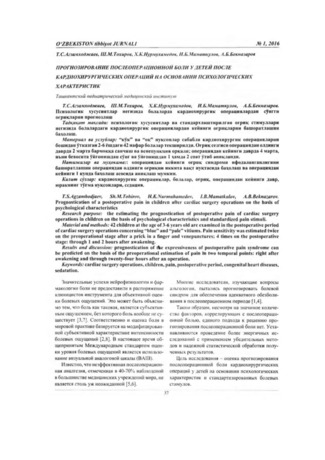
Objective: to assess the prediction of ogres after cardiac surgery in children based on psychological characteristics and standardized ogre stimuli. Materials and Methods: We examined 42 children aged 2 to 6 years who underwent heart surgery for "OK" defects. Ogre sensations in the preoperative period with injections in 2 fingers and venipuncture; in the postoperative period was detected 4 times, i.e. immediately after waking up and after waking up 1 and 2 hours later. Results and conclusion. Prediction of the severity of postoperative acne syndrome can be determined based on the preoperative orange score at two time points and day 1 of the postoperative assessment.
Ветшев ПС. Ветшева МС. Принпильт анальгезии в раннем послеоперационном периоде. Хирур:мя. 2012• 12: 49-50.
Овечкин А.М.. Ефременко ИВ. Фармакотерааия острой послеоперационной боли. основанная на применении препаратов. воздействующих на комплекс. Анестезиология и реаниматология 2013; З: 63-69.
Степанова Я.В,. Щелкова 0.10., Лебединский К.М.- Мазурок ВЛ. Прогнозирование послеоперационной боли на основании психологических характеристик больных и стандартизированных болевых стимулов. Анестезиология и реаниматология. 20) 3; 3: 58-63.
Aasvang Е.К., Hansen В., kehler Н. Canpreoperat(ve elec:rical nocicept:ve stimulauon pred'Ct acute ра:п after grow:ng hermotomy. .l Pain. 2008; 9 (10): 940-944.
Bisgaard Т.. klaskov Rosenbcr•g Ј., kehler П. Characteristics and predicuon ofcarly раю aftcr card1010gic operatton. Раш. 2010; 90 (3): 261-269.
Brown У(Ј.. Weiskopf R.B., L•ger е: al. Epinephrine-induced premature ventncular contracticns and changes in arterial b100d pressu,-e and heart :ate durmg 1-653. isoRurane, and ga[othane anesthesia in swine. Anestestotogy. 2008: 70 (2): 293-298.
Donovan М.. Dillon Р.. МсСплге Т. [ncidence and characteristics of рат in а sample of mcdical surgical (п patients. Pain. 2007; 30 ( Ъ: 30-65. 8. Weis (ГГ.. Srnvatanakul К.. .A110za J.l. Attttudes of patients. house-staff, and nurses towa:-d postoperative analgetic саге. .Anesth Analg. ( ] 70-74.

inLibrary — is a scientific electronic library built on the paradigm of open science (Open Science), the main tasks of which are the popularization of science and scientific activities, public quality control of scientific publications, the development of interdisciplinary research, a modern institute of scientific review, increasing the citation of Uzbek science and building a knowledge infrastructure.
CONTACTS:
Republic of Uzbekistan, Tashkent, Parkent street 51, floor 2