Vol. 1 No. 7 (2025): Journal of Applied Science and Social Science

Vol. 1 No. 7 (2025): Journal of Applied Science and Social Science
Published:
04-08-2025
Articles

3-7
66
23
STRATEGIES FOR INCREASING THE COMPETITIVENESS OF SMALL AND MEDIUM BUSINESSES IN THE DIGITAL ECONOMY
This article analyzes effective strategies for increasing the competitiveness of small and medium-sized businesses in the digital economy. At a time when the economy is transitioning to a digital basis on a global scale, the use of innovative technologies, e-commerce, digital marketing and automated management systems is becoming an important factor for small and medium-sized businesses. The study examines the opportunities for small and medium-sized businesses to reduce costs, expand their customer base, and improve the quality of products and services through modern technologies. The importance of digital infrastructure, state support and digital literacy is also highlighted. Using the example of Uzbekistan, strategies are developed to strengthen the competitiveness of regional small and medium-sized businesses in national and international markets through digital transformation.

8-12
57
15
TECHNOLOGICAL AND EXPERIMENTAL METHODS USED IN DETERMINING QUALITY INDICATORS
The scientific concept of the quality of knitted products. The essence of the quality of knitted products is determined by their aesthetic, functional and technological properties. The quality category here means not only appearance or durability, but also includes the service life of the product, its suitability for the human body, hygienic safety and compliance with production technologies. The concept of quality requires a complex, i.e. multi-criteria approach to knitted fabrics.

13-19
63
22
CONTROL THE QUALITY OF PRODUCTS MANUFACTURED AT THE ENTERPRISE BY ASSESSING THE UNCERTAINTY OF MEASUREMENTS
Measurement of the results uncertainty in evaluation A and B kind of components clear separation and correct calculation necessary. A type statistic basically experimental stability shows , Btype working issuer specification and calibration to the documents based without Their combination through general expanded uncertainty is determined , this and measurement result reliability level determines . Quality under control this approach decision acceptance in doing important material evidence as service does .

20-24
61
27
TEACHING FUTURE TECHNOLOGY EDUCATION TEACHERS THE SEQUENCE OF ACTIONS IN THE "VALENTINE" PROGRAM IN A DIGITAL LEARNING ENVIRONMENT Authors Ismailova Momogul Hamraboy kizi
This article states that when working in the "Valentina" program, each user can use any tools at their discretion when creating a pattern and may use various objects in different sequences depending on the construction style.

25-29
60
57
SUSTAINABLE DEVELOPMENT MANAGEMENT THROUGH STANDARDIZATION: THE CASE OF ISO 14000 STANDARDS
In the face of global environmental challenges, standardization has become a key tool in ensuring sustainable development. This article examines the role of the ISO 14000 standards series in managing the environmental aspects of enterprises. The analysis focuses on the implementation of these standards in industry, presents real-world case studies, and offers recommendations for improving environmental management systems.

30-33
64
32
IMPROVING THE SPINNING PROPERTIES OF EXPENSIVE TEXTILE RAW MATERIALS BY PROCESSING SILK WITH SFM ASSISTANCE
The conducted studies have shown that in order to ensure the continuity of the work of silkworm enterprises, cocoons are stored in the warehouses of silkworm enterprises. Although this may seem like a simple matter from the outside, it is of great importance. In order to eliminate these problems in silkworm enterprises, it was found that cocoons modified with surfactants obtained from "Bardo" and "Sivush" oils, which do not have a negative effect on cocoon washing and at the same time contribute to good wetting of the shell, increased the yield of raw silk by 1.9-2.7% compared to the control variants.

34-50
51
20
INCIDENCE AND PATHOMORPHOLOGY OF TERATOBLASTOMAS
Teratoblastomas represent a rare subset of mixed germ cell-sex cord stromal tumors with distinctive pathomorphological features that pose significant diagnostic challenges. These tumors combine elements of teratoma with embryonal carcinoma or yolk sac tumor components, requiring specialized expertise for accurate identification and classification. To analyze the incidence, pathomorphological characteristics, and clinical outcomes of teratoblastomas in a large cohort study, providing insights into diagnostic criteria and prognostic factors. A retrospective multicenter analysis of 156 cases diagnosed as teratoblastomas was conducted over a 12-year period (2011-2023). Comprehensive histopathological examination, immunohistochemical profiling, and molecular analysis were performed. Clinical data including demographics, presentation, treatment, and outcomes were collected and analyzed. Teratoblastomas comprised 0.08% of all ovarian tumors and 2.1% of germ cell tumors. The median age at diagnosis was 22.5 years (range: 8-45 years). Histologically, 89.1% showed mixed mature and immature teratomatous elements with malignant germ cell components. Alpha-fetoprotein was elevated in 78.2% of cases. Five-year overall survival was 71.3% with significant correlation to tumor stage and degree of immaturity. Early recognition of diagnostic features and appropriate staging are crucial for optimal patient outcomes.

51-54
64
19
ENSURING HUMAN RIGHTS AND FAIR SOCIAL POLICIES ARE THE MAIN FACTORS IN BUILDING A NEW UZBEKISTAN
The article analyzes the interrelationship between ensuring human rights and conducting a fair social policy in the process of building a New Uzbekistan, as well as the strategic importance of these factors in the country's development. Respect and protection of human rights is considered a basic condition for building a democratic society, and a fair social policy ensures equal opportunities for all citizens, social protection, access to quality education and medical services. The article also reveals the role of such areas as the principles of a legal state, the fight against corruption, gender equality, interethnic harmony and the development of civil society in the development strategy of New Uzbekistan.

55-59
41
42
INTEGRATION PROCESSES AND REGIONAL COOPERATION: POLITICAL AND ECONOMIC ASPECTS
This article provides an in-depth analysis of integration processes and regional cooperation, emphasizing their political and economic dimensions in the context of globalization. The study highlights that regional integration is not only a mechanism for trade liberalization and economic growth but also a strategic tool for strengthening political stability, collective security, and global governance. By examining theoretical foundations and practical experiences of integration in regions such as the European Union, ASEAN, and MERCOSUR, the article identifies key factors that contribute to successful cooperation, including political commitment, institutional capacity, and economic interdependence. The discussion reveals that integration fosters market expansion, competitiveness, industrial modernization, and collective bargaining power for member states, while also contributing to the formation of a multipolar world order. Ultimately, regional cooperation is portrayed as a multidimensional process that enhances sustainable development, strengthens political dialogue, and increases the global influence of participating countries.

60-64
76
14
REGIONAL COOPERATION AND INTEGRATION: INTERSTATE INTERESTS AND COMPATIBILITY
This article explores the political and economic dimensions of regional cooperation and integration, focusing on the importance of interstate interests and compatibility in achieving successful outcomes. Drawing on theoretical frameworks and empirical evidence from different regional blocs, the study highlights that integration is not only a means of promoting trade liberalization and economic growth but also a strategic tool for strengthening political stability, collective security, and global influence. The analysis emphasizes that alignment of state interests, robust and adaptive institutional frameworks, and mutual trust are essential for the sustainability of integration processes. The findings suggest that when these factors converge, regional cooperation can generate significant benefits, including economic modernization, infrastructure development, and enhanced bargaining power in international relations. Ultimately, the article underscores that integration is a multidimensional project requiring long-term vision, political commitment, and equitable distribution of benefits among member states.

65-67
79
16
THE IMPORTANCE OF TERMINOLOGICAL VOCABULARY IN ENHANCING STUDENTS’ PROFESSIONAL COMPETENCE IN FOREIGN LANGUAGE TEACHING
This article explores the crucial role of terminological vocabulary in the formation of professional competence among students of non-philological higher education institutions. The author emphasizes that in the context of global communication and market-driven economies, knowledge of English for Specific Purposes (ESP), especially terminology relevant to a student's field, is essential for developing communicative and professional competencies. Drawing on theoretical perspectives from both Uzbek and international scholars, the article outlines the components of professional competence (linguistic, discourse, sociolinguistic, and cognitive) and highlights the importance of integrating specialized vocabulary into the teaching process. The study also references competency models such as KSAO and stresses the significance of context-based learning in professional communication.

68-70
48
20
THE IMPORTANCE OF TEXTS IN TEACHING FOREIGN LANGUAGES TO NON-PHILOLOGICAL STUDENTS
This article explores the importance of using texts in teaching foreign languages to students of non-philological fields. The author emphasizes that students must be able to comprehend texts related to their specific field of study by understanding the general linguistic aspects of the foreign language—particularly grammar, phonetics, and terminology. The paper highlights the psycholinguistic nature of text processing and discusses various psychological mechanisms that play a role in text comprehension, such as anticipation, guessing meaning, and logical understanding.Special attention is given to the use of authentic texts in the teaching process, which not only enhances students’ lexical and terminological skills but also boosts their communicative and professional competence. Authentic texts reflect real-life situations and help increase motivation, confidence, and cultural awareness among learners. The article concludes that texts—especially authentic ones—play a crucial role in improving students’ language proficiency and developing their professional competence within their specialization.

71-77
84
16
METROLOGY AS A CORNERSTONE FOR GLOBAL WATER QUALITY MONITORING SYSTEMS
With the accelerating impacts of climate change and population growth, access to safe drinking water is under severe threat globally. Accurate and reliable monitoring of water quality is essential to ensure human health and environmental safety. This paper investigates the role of metrology in the development and maintenance of water quality monitoring systems. We examine metrological support for water testing laboratories, standardization of measurement techniques, and the necessity of international harmonization in water-related metrology. Graphs and data tables illustrate current trends and regional disparities in water quality monitoring practices.

78-82
100
13
THE ROLE AND IMPORTANCE OF THE STEAM APPROACH IN PRIMARY EDUCATION
This article explores the growing significance of the STEAM (Science, Technology, Engineering, Arts, and Mathematics) approach in primary education. The integration of STEAM into the early stages of learning equips students with critical 21st-century skills such as creativity, problem-solving, collaboration, and innovation. The study investigates how STEAM-based teaching strategies impact cognitive development, student motivation, and interdisciplinary thinking. Through classroom observations, teacher interviews, and analysis of student projects, the research emphasizes the effectiveness of STEAM in creating a dynamic, hands-on, and inquiry-driven learning environment for young learners.

83-87
51
20
METHODS OF IMPLEMENTING THE COMPANY'S QUALITY MANAGEMENT SYSTEM STRATEGY
This article provides information on improving the quality of industrial products, the universality of the quality management system and procedural documents. In order to improve the process in manufacturing and service organizations, the organization must implement the procedural documents of the quality management system and the quality policy. In addition, during the research, information was provided on the issues of quality policy in our country, the stages of development and changes in standardization.

88-94
61
22
THE CORRECT ADOPTION OF THE MANAGEMENT SYSTEM IN ENSURING PRODUCT QUALITY IN ACCORDANCE WITH INTERNATIONAL STANDARDS
This article provides guidance on the topic "The importance of international standards in ensuring product quality." In this process, detailed ideas and comments on the role of the ISO 9000 series of international standards in ensuring product quality, factors affecting products and ways to eliminate them, and measures taken by the leader of our country to develop this area were studied.

95-100
54
17
THE ROLE OF INFORMATION TECHNOLOGIES IN DEVELOPING THE PROFESSIONAL COMPETENCE OF FUTURE TEACHERS
This article explores the crucial role of information technologies in shaping the professional competence of future teachers. It discusses how digital tools and resources enhance pedagogical skills, facilitate access to up-to-date educational materials, promote collaborative learning, and develop essential digital literacy. The paper also addresses challenges related to technology integration in teacher education and emphasizes the need for supportive infrastructure and training. Ultimately, the article underscores that integrating IT into teacher preparation programs is vital for cultivating adaptable, skilled educators capable of meeting the demands of modern classrooms.

101-103
57
19
PROBLEMS RELATED TO THE QUALITY OF TEXTILE MATERIALS IN THE AUTOMOTIVE INDUSTRY
The article is devoted to the analysis of the factors affecting the quality of textile materials used in the automotive industry, the causes of their deterioration, and the scientific research carried out to eliminate them.

104-110
105
20
THE ROLE AND IMPORTANCE OF CREATIVE PEDAGOGY IN MODERN EDUCATION
This article explores the critical role of creative pedagogy in shaping modern education systems. It highlights how creativity in teaching enhances student engagement, fosters critical thinking, supports diverse learning styles, and prepares learners for the demands of the 21st-century world. The article discusses key strategies for implementing creative pedagogy—such as project-based learning, interdisciplinary approaches, and the use of digital tools—while also addressing challenges educators may face. Ultimately, it argues that integrating creativity into educational practices is essential for developing innovative, adaptable, and well-rounded individuals.

111-114
59
12
ARTIFICIAL INTELLIGENCE IN EDUCATION: TRANSFORMING THE LEARNING EXPERIENCE
In the modern digital age, Artificial Intelligence (AI) has emerged as a transformative force across various sectors, and education is no exception. AI technologies are redefining teaching methodologies, personalizing the learning experience, automating assessments, and enabling real-time feedback. This article explores the multifaceted impact of AI on education, emphasizing how intelligent systems enhance student performance, aid teachers, and support inclusive learning environments. The paper also critically analyzes ethical considerations, data privacy issues, and equity challenges in AI implementation. As educational institutions globally adopt smart technologies, it becomes vital to assess not only the benefits but also the long-term implications of AI in learning ecosystems. Ultimately, the article advocates for a balanced, human-centered approach to ensure that technology enhances educational equity, quality, and sustainability.


121-122
60
25
MODERN AGRICULTURAL TECHNOLOGIES AND THEIR IMPACT ON RURAL DEVELOPMENT Authors Shrika Wivati
The application of modern agricultural technologies is transforming rural economies and reshaping traditional farming systems. This article explores how innovations such as precision farming, biotechnology, and mechanization contribute to increased productivity, reduced labor intensity, and sustainable development in rural communities. The study also examines the socio-economic barriers to technology adoption in developing countries.

123-125
46
34
APPLICATION OF COLD PLASMA TECHNOLOGY IN THE MICROBIAL DECONTAMINATION OF DRIED FRUITS
Cold plasma (CP) technology has emerged as an innovative, non-thermal method for microbial decontamination in the food industry. This study investigates its application in enhancing the microbial safety of dried fruits while preserving their nutritional and organoleptic qualities. The analysis is based on a review of current scientific literature and technological advancements, as well as comparisons with traditional decontamination methods such as thermal treatment, irradiation, and chemical sanitizers. Results demonstrate CP’s high efficiency against a broad range of pathogens, minimal impact on food quality, and potential scalability for industrial application. The paper concludes with recommendations for further research and industry implementation.

126-133
63
23
PROBLEMS OF TRANSLATING STYLISTIC MEANS IN THE EPISTLE "ALPOMYSH"
The article presents a semantic-stylistic analysis of hyperbole and similes in the Uzbek folk epic Alpomish. At the same time, valuable ideas and observations of world and Uzbek linguists about the stylistic composition of words in the epic are analyzed.

134-138
240
118
TOWARD AN UZBEK SOCIAL MESSAGING APP: LESSONS FROM THE EVOLUTION OF GLOBAL SOCIAL NETWORKS
Social networks have evolved from simple digital forums into complex ecosystems that mediate global communication, culture, and commerce. This paper presents a chronological and technological review of key milestones in social networking - from ARPANET and Usenet to modern platforms like Facebook, WhatsApp, WeChat, and TikTok. Particular focus is given to messaging-centric applications such as Telegram, Snapchat, and WhatsApp, which have transformed personal and group communication through privacy features, end-to-end encryption, multimedia integration, and AI-driven content filtering. The study's core objective is to extract relevant insights for the conceptual and technical design of a new Uzbek social messaging app. By analyzing international platforms, their design strategies, growth factors, and cultural adaptations, we aim to propose a model suited to the linguistic, cultural, and technological environment of Uzbekistan.

139-143
203
95
COMPARATIVE ANALYSIS OF FEATURES IN GLOBAL MESSAGING PLATFORMS: LESSONS FOR UZBEK DEVELOPMENT
In recent years, global messaging applications such as Telegram, WhatsApp, WeChat, and Snapchat have become central to digital communication, each offering unique features tailored to user behavior, privacy expectations, and cultural preferences. Despite their popularity, these platforms are not fully optimized for the linguistic, social, and regulatory context of Uzbekistan. This paper presents a comparative analysis of the technical and functional aspects of leading messaging apps, with the aim of identifying best practices and feature gaps relevant to the potential development of a localized Uzbek messaging platform. Through systematic evaluation of UI/UX design, privacy mechanisms, content moderation, feature sets, and integration capabilities, we highlight the strengths and limitations of each platform. The analysis also considers sociocultural and infrastructural factors specific to Uzbekistan. The findings offer valuable insights for developers, policy-makers, and digital entrepreneurs interested in creating scalable, secure, and culturally adaptive communication tools for the Uzbek-speaking digital audience.

144-146
60
30
METHOD FOR CALCULATING THE SUSPENSION MECHANISM OF A UNIVERSAL ENERGY VEHICLE
This work is dedicated to calculating the lifting force of the suspension mechanism based on its kinematic diagram. The calculation analyzes two main states of the mechanism: the conditional working state (CWS) and the upper extreme position (U), determining the forces and moments under load step by step. Considering the maximum lifting force in the upper position of the mechanism, the number and type of hydraulic cylinders are selected. This ensures the mechanism's load-bearing capacity (3.5 tons). Additionally, the line of action of the hydraulic cylinder is determined through kinematic analysis.

147-152
80
28
DATA MANAGEMENT WITHIN DECENTRALIZED AUTONOMOUS ORGANIZATIONS (DAO) – DECISION MAKING AND DOCUMENT EXCHANGE
This article analyzes data management processes within Decentralized Autonomous Organizations (DAOs), specifically focusing on decision-making and document exchange. DAOs are decentralized, blockchain-based organizations whose effective functioning depends on data transparency, security, and reliability. The study examines modern technologies including smart contracts, on-chain voting mechanisms, and distributed storage systems as foundations for data exchange and management processes. Governance models of various DAO platforms and their capabilities are analyzed, highlighting existing limitations and possible improvement directions. The research outcomes offer practical insights for enhancing DAO operations and developing new governance mechanisms.

153-155
50
16
INFLUENCE OF TRAFFIC LIGHTS ON BOBURSHOH STREET IN ANDIJAN CITY ON ECOLOGY AND FUEL CONSUMPTION
This article analyzes the impact of traffic lights located on Al-Farg'oniy Street in Andijan on traffic flow, fuel consumption, and the environmental situation. During the study, the location of 12 traffic lights on this street, their operating hours, and traffic dynamics were examined. An average of 300 cars per hour have been recorded, and due to improperly adjusted traffic lights, vehicles are often forced to repeatedly stop and start

156-160
93
15
SUCCESSFUL ARTIFICIAL INTELLIGENCE EDUCATION PROJECTS AND PLATFORMS WORLDWIDE: BEST PRACTICES, MOOCS, AND ADAPTIVE SYSTEMS
This article analyzes the successful projects and platforms that apply artificial intelligence (AI) technologies in education worldwide. Approaches from leading countries such as the USA, China, Europe, and Singapore are examined, with examples from Massive Open Online Courses (MOOCs) and AI-based adaptive learning systems. Additionally, current challenges of adaptive systems and their solutions are discussed. The results confirm that AI is an effective tool for optimizing personalized learning and improving education quality.

161-166
149
28
INFLUENCE OF BAHAUDDIN NAQSHBANDI’S TEACHINGS ON THE SOCIAL AND SPIRITUAL DEVELOPMENT OF THE BUKHARA EMIRATE IN THE VIEWS OF ENGLISH-SPEAKING AUTHORS (XIX CENTURY)
The article studies the influence of Bahauddin Naqshbandi doctrine on the social and spiritual development of Bukhara emirate in the 19th century, considering the views of English-speaking authors. The main focus is on the role of the Naqshbandiya doctrine in shaping the spiritual and cultural aspects of Emirati life, drawing on the works of English-speaking orientalists, travellers and historical sources.

167-169
62
21
THE INFLUENCE OF LINGUISTIC AND EXTRALINGUISTIC FACTORS ON THE FORMATION OF PROVERBS IN THE COMPARED LANGUAGES
This article examines the role of linguistic and extralinguistic factors in the formation of proverbs in the compared languages. The study analyzes how phonological, morphological, syntactic, and semantic structures interact with cultural, historical, geographical, and social contexts to shape proverbial expressions. Through comparative analysis, the research identifies similarities and differences in the conceptualization of proverbs across languages, highlighting the interplay between language-specific features and universal human experiences. The findings contribute to the understanding of cultural-linguistic interconnections and support more effective approaches in translation, teaching, and intercultural communication.

170-173
108
22
THE DEVELOPMENT TRENDS OF ENGLISH AND UZBEK LEXICOGRAPHY
This article examines the development trends of English and Uzbek lexicography, highlighting historical foundations, methodological approaches, and technological innovations that have shaped the field in recent decades. The study focuses on the comparative analysis of traditional and modern dictionary-making practices, taking into account linguistic, cultural, and socio-economic factors influencing lexicographic processes. Special attention is given to the role of bilingual and specialized dictionaries in fostering cross-cultural communication and supporting language learning. The paper also discusses the integration of digital technologies, such as corpus-based methods and artificial intelligence, into lexicographic research and practice, predicting future directions for English and Uzbek lexicography in the context of globalization and digitalization.

174-180
120
18
LEXICAL AND GRAMMATICAL ENCODING OF TIME IN DIFFERENT LANGUAGES
This study explores how the concept of time is encoded lexically and grammatically in three typologically distinct languages: English, Russian, and Uzbek. Through a comparative analysis, the article examines vocabulary choices, idiomatic expressions, and grammatical mechanisms—such as tense, aspect, and morphological marking—that shape each language’s approach to temporal representation. English, with its analytic structure, relies on a detailed tense–aspect system and metaphor-rich lexicon to express precise temporal distinctions. Russian emphasizes aspect over tense, offering a dynamic, process-oriented view of time, while Uzbek employs agglutinative suffixation to integrate temporal, modal, and evidential meanings within single verb forms. The findings suggest that each language not only reflects but also influences how speakers conceptualize and experience time. These cross-linguistic differences have broader implications for understanding the relationship between language structure, cognitive processing, and cultural perceptions of temporality.

181-183
59
14
ANALYSIS OF DRUNK TRAFFIC ACCIDENTS
Drunk driving accidents (DVAs) are a serious problem and claim many lives every year. Every measure is aimed at preventing drunk driving and reducing the number of traffic accidents, which helps to create a safer environment for our society.


187-190
133
22
PSYCHOLOGICAL AND PEDAGOGICAL CHARACTERISTICS OF PRESCHOOL CHILDREN'S VIEWS ON TOURISM
This article explores the psychological and pedagogical aspects of preschool children’s perceptions of tourism and its role in early childhood development. It examines how tourism-related experiences—such as excursions, nature walks, cultural visits, and role-playing activities—can influence children’s cognitive, emotional, and social growth. From a psychological perspective, tourism fosters curiosity, sensory engagement, imagination, and adaptability, while strengthening communication and problem-solving skills. From a pedagogical standpoint, it serves as a valuable tool for experiential learning, integrating geography, history, cultural studies, and environmental awareness into age-appropriate educational activities. The article also addresses the challenges of organizing tourism for preschool children, including safety considerations, attention span limitations, and the need for active parental and educator involvement. The findings highlight that well-planned tourism activities, aligned with children’s developmental needs, can enrich their worldview and contribute to holistic education.

191-195
60
21
THEORETICAL FOUNDATIONS FOR IMPROVING THE COOLING SYSTEM OF AN INTERNAL COMBUSTION ENGINE
In this article, the theoretical foundations of cooling power supply for internal combustion engines (ICE) from motor vehicles are studied. First of all, the design structure, operating principles, and efficiency levels of existing cooling systems were analyzed. The processes of supplying the engine's thermal system through physical and mathematical modeling of heat exchange processes in the cooling system are highlighted. A comparison of the operational benefits and air-based cooling systems revealed the advantages and disadvantages of the file. High-performance heat exchange equipment has been proposed for the commissioning of a new generation of cooling systems. Based on computer modeling and experimental tests, energy efficiency control is aimed at ensuring power reliability. This study has practical applications in the automotive industry, agricultural machinery, and other agricultural machinery, highlighting the effectiveness of internal combustion engines.

196-199
71
17
THE MAIN INDICATORS OF ROAD TRAFFIC INCIDENTS
This article y provides an analysis of an accident that occurred during the movement of a vehicle on the road and with its participation, resulting in the death of citizens or damage to their health, damage to vehicles, structures, cargo, or other material damage.

200-202
68
20
INFLUENCE OF CLIMATE CONDITIONS ON THE COOLING SYSTEM
The article discusses the theoretical basis for the influence of climatic conditions on the cooling system of internal combustion engines (ICE) of motor vehicles. First of all, the design structure, operating principles and efficiency levels of existing cooling systems were analyzed. The processes of providing the engine thermal system are illustrated by means of physical and mathematical modeling of heat exchange processes in the cooling system. The advantages of industrial and air cooling systems were compared, the advantages and disadvantages of each of them were identified. Highly efficient heat exchangers are proposed to create new generation cooling systems. Energy efficiency control based on computer modeling and experimental tests is aimed at ensuring the reliability of power supply. This study has practical application in automotive, agricultural machinery and other types of agricultural machinery, emphasizing the efficiency of the ICE.

203-206
54
16
BASICS OF THE THEORY OF ADAPTIVE IDENTIFICATION FOR AUTOMATION OF MULTI- CONNECTED OBJECTS
The article proposes solutions to the problem of using the theory of adaptive identification for automation of multiply connected objects and shows the possibilities of applying the theory of adaptive identification of multiply connected objects using the example of wastewater treatment plants.

207-209
49
17
TYPES OF HARMFUL IMPACTS OF CHEMICAL PRODUCTION ON THE BIOSPHERE
Chemical production is one of the fastest-growing industrial sectors, providing essential materials for agriculture, manufacturing, and daily life. However, its processes often release pollutants into the air, water, and soil, posing risks to ecosystems and human health. This paper examines the main types of harmful impacts of chemical production on the biosphere, focusing on air pollution, water contamination, soil degradation, and biodiversity loss. Using a qualitative literature review and environmental data analysis, the study identifies key pollutant categories, their mechanisms of impact, and potential mitigation strategies. The findings highlight the need for stricter environmental regulations and the integration of cleaner technologies to minimize ecological damage.

210-213
63
27
CONSTRUCTIONS OF HANGING MECHANISMS OF EXISTING UNIVERSAL ELECTRICAL EQUIPMENT, WORK QUALITY INDICATORS
This article analyzes the designs of existing UAV (universal electrical devices) suspension mechanisms and their performance indicators. Methods of operation, strength, durability, and efficiency of suspension mechanisms of various designs are considered. Comparative analysis is carried out based on performance indicators, including accuracy, speed, and reliability. The adaptability of the mechanisms to operating conditions and the ease of maintenance are also assessed. The results indicate the possibility of constructive improvement to ensure the effective and long-term operation of modern UEVs.

214-219
74
17
DIFFERENT APPROACHES TO COMPOUND SENTENCES: COMPOUND SENTENCES WITH ADVERBS OF PLACE AND PLACE SPACE
This article analyzes theoretical approaches to composite sentences, including complex sentences, particularly those with subordinate clause of place. Furthermore, the concept of "place" is examined through a linguocognitive approach, and its realization — that is, verbalization — at morphological, lexical, syntactic, phraseological, and paremiological levels of language is discussed using examples from Uzbek and English. The field structure of the concept of "place" is also revealed.

220-223
113
20
THE CONCEPT OF "FRIEND/FOE" AND ITS VERBALIZATION IN RUSSIAN AND ENGLISH
This article is devoted to a comparative analysis of the binary concept “friend/enemy” and the means of its verbalization in the Russian and English languages. The study examines the theoretical foundations of the notion of “concept” in cognitive linguistics, the characteristics of binary (antonymic) concepts and related phenomena (frames, scenarios, etc.).

224-231
58
15
THE CONCEPT OF "CHILD" AND THE FIELD OF ITS EVENT-GENERATING MEANS IN ENGLISH AND UZBEK
In this article, the concept of "child" is analyzed from a linguistic perspective, and its expression through various levels of language units: morphemes, lexemes, phrasemes, phraseological units, sentences, and textemes is explored. The concept of the child is examined not only from a semantic point of view but also through a systematic-linguistic approach, and it is classified into layers based on the conceptual field model.
232-234
69
14
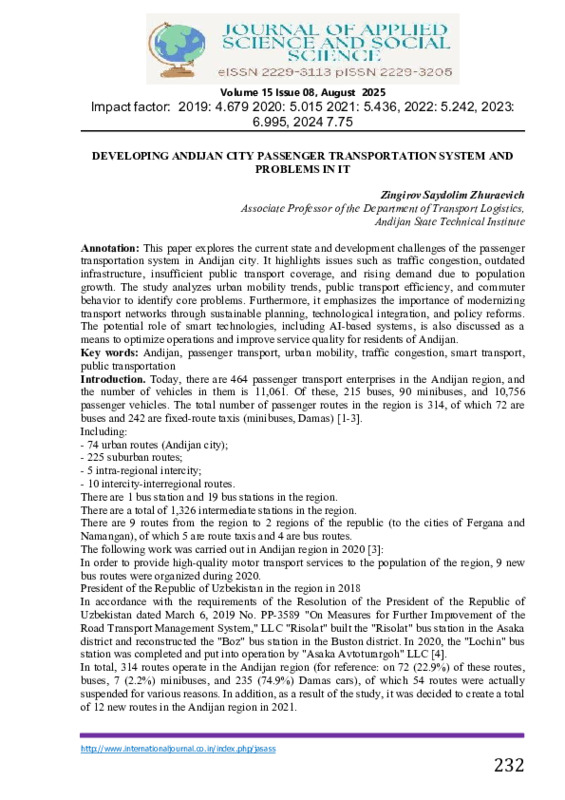
DEVELOPING ANDIJAN CITY PASSENGER TRANSPORTATION SYSTEM AND PROBLEMS IN IT
This paper explores the current state and development challenges of the passenger transportation system in Andijan city. It highlights issues such as traffic congestion, outdated infrastructure, insufficient public transport coverage, and rising demand due to population growth. The study analyzes urban mobility trends, public transport efficiency, and commuter behavior to identify core problems. Furthermore, it emphasizes the importance of modernizing transport networks through sustainable planning, technological integration, and policy reforms. The potential role of smart technologies, including AI-based systems, is also discussed as a means to optimize operations and improve service quality for residents of Andijan.

235-238
57
28
EQUIPMENT FOR EFFECTIVE AND SAFE MICROWAVE GRAIN DISINFECTION
This paper examines the main components and design requirements of equipment used for ultra-high-frequency (microwave) grain disinfection. It analyzes different types of microwave radiation sources, waveguide systems, grain treatment chambers, loading and unloading mechanisms, control and monitoring systems, and safety features. Key parameters affecting process efficiency and operator safety are discussed, along with engineering solutions to ensure uniform heating and prevent microwave leakage. The paper also considers the importance of proper system integration for energy efficiency, reliability, and long-term operational stability.

239-242
50
11
IMPROVING THE QUALITY OF GLANCING THE FRICTION SURFACES OF AUTOMOTOR ENGINE PARTS: PARAMETERS, METHODS, AND OPTIMAL CONDITIONS
The quality of smoothing the friction surfaces of engine parts is important for its long-term and efficient operation. In the current literature, the methods of grinding are insufficiently covered, and a unified system of indicators has not been developed. The quality of grinding is influenced by the physical and mechanical properties of the materials, the quality of processing, the lubricating material, and the conditions of friction. Taking these factors into account, optimizing the grinding process extends the service life of engine parts and increases operational efficiency.

243-246
58
11
INTEGRATION OF DAMAS AND BUS TRAFFIC AND INCREASING TRANSPORT EFFICIENCY IN THE CITY OF ANDIJAN
The lack of compatibility between the public transport system in the city of Andijan, in particular, Damas cars, and the main bus routes, reduces transport efficiency. Despite the fact that Damas trucks are maneuverable on narrow streets, problems with traffic congestion and road safety arise due to the fact that they are not closely connected with the main highways. The chaotic traffic on Boburshoh Street leads to obstacles on road transport and creates inconvenience for passengers. This article analyzes ways to increase the efficiency of the transport system and improve road safety through the coordination of Damas and bus routes.


253-255
70
18
PROBLEMS AND SOLUTIONS IN THE OPERATION OF A LIGHT VEHICLE'S BRAKE SYSTEM
The car's braking system is of great importance from a safety perspective. This article analyzes the main problems arising during the operation of the brake system, their causes and consequences, as well as effective solutions. The main goal of the work is to increase the reliability and safety of the braking system, and proposals have been developed aimed at ensuring the effectiveness of the braking system in modern cars.

256-260
84
21
THE IMPORTANCE OF FAMILY COMMUNICATION IN THE DEVELOPMENT OF MORAL QUALITIES IN CHILDREN OF PRIMARY SCHOOL AGE
This article examines the role of family communication in shaping moral qualities in primary school-aged children. It analyzes how parent-child interactions influence the development of values such as honesty, empathy, responsibility, and respect. The study highlights the importance of open, consistent, and supportive communication in fostering ethical behavior and social competence. Practical recommendations for parents and educators are provided to enhance moral development through everyday family interactions.

261-263
47
13
WHAT IS MEDIA LITERACY AND ITS IMPORTANCE?
Ush article media literacy person and his/her modern in society importance illuminates . Media literacy of people public information from the movement place messages right about , analysis to do and they conscious raving send is the subject . In the article media literacy lie information and to manipulation against defense , democratic in processes active participation to grow and personal thing and prosperity in provision place is emphasized . Media literacy society to live and reliable information diseases for necessity based on given


268-271
40
11
THE STRENGTH OF THE ASPHALT CONCRETE COATING BY ADDING MINERAL POWDER TO THE COMPOSITION OF BITUMEN ENHANCEMENT TECHNOLOGY
In the article, to increase the strength of the asphalt concrete coating, bitumen the enrichment of the composition and the physical and mechanical indicators of asphalt concrete were analyzed. In the process, additives applied to increase the tolerance of asphalt concrete Coating Laboratory the conditions are checked for strength indicators, which are now many in our country it was compared with the strength indicators of the asphalt concrete coatings used.
As a result, the strength indicators of asphalt concrete, the composition of which was applied enriched bitumen, are simple the type was found to have improved slightly from that of asphalt concrete coatings.
As a result, the strength indicators of asphalt concrete, the composition of which was applied enriched bitumen, are simple the type was found to have improved slightly from that of asphalt concrete coatings.

272-275
44
18
ENVIRONMENTAL IMPACT OF VEHICLES BEING USED WITHIN THE CITY
Air pollution is a serious problem, since it is not only increases Environmental, but also economic and health risks. Environmental air pollution is a global problem, especially a local one. Released in one country pollutants can travel in the atmosphere of other countries and thus contributes to the deterioration of air quality. A lot of motor vehicles within the city its use leads to an increase in fuel consumption and a negative impact on the environment. This the process is associated with several factors, it is necessary to dig deeper into them.

276-278
39
19
ADVANTAGES OF CAR FUEL DEVELOPMENT THROUGH HYDROGEN ENERGY
This article examines the advantages of developing the fuel system through the use of hydrogen energy for automobiles. Hydrogen fuel is environmentally friendly, renewable, and highly energy-efficient, offering a sustainable alternative to traditional fuels. The study highlights the integration of hydrogen technologies into the automotive industry, their impact on the environment, economic efficiency, and role in ensuring energy security. Global experience and prospects of this technology are also analyzed. The article shows the possibilities of solving fuel problems and forming a sustainable transport system through the introduction of hydrogen energy.

279-284
76
9
USE OF BEACONS AND PROBES IN TRANSPORT MANAGEMENT
This paper examines the application of beacons and probes in modern transport management systems to enhance traffic monitoring, vehicle tracking, and infrastructure efficiency. Beacons, using Bluetooth or RFID technology, enable real-time communication with nearby vehicles and devices, facilitating data collection on movement patterns and congestion. Probes, typically installed in vehicles or smartphones, provide continuous location and speed data that help analyze traffic flow and optimize route planning. The study highlights how integrating these technologies supports intelligent transport systems (ITS), improves traffic signal coordination, and enhances overall urban mobility. Real-world case studies demonstrate their effectiveness in reducing delays and improving safety.

285-288
61
19
METHODOLOGY FOR IMPROVING THE QUALITY INDICATORS OF PASSENGER TRANSPORT SERVICES ON CITY BUS ROUTES
This article analyzes the quality of transport services for passengers on city bus routes and the criteria for its assessment. First of all, such factors as the level of efficiency of the existing bus route system, the traffic schedule, the infrastructure of bus stops, the professional training of drivers, and passenger safety will be studied. To improve quality indicators, proposals have been developed for optimizing the service process, monitoring passenger traffic in real time, regular monitoring of the technical condition of vehicles, and the introduction of modern information and communication technologies. The proposed method serves to improve the quality of service in the city's internal transport system, increase the level of passenger satisfaction, and improve the overall transport efficiency.

289-291
54
17
ENVIRONMENTAL PROTECTION AND THE GREEN ECONOMY: PATHWAYS TO SUSTAINABLE DEVELOPMENT
Environmental protection and the green economy are interdependent pillars of sustainable development. This paper explores the relationship between environmental conservation and economic growth through green practices, examining global trends alongside Uzbekistan’s initiatives. Using a qualitative literature review and comparative case study method, the research highlights policy, technology, and innovation as key drivers of a successful transition to a sustainable economy. The results reveal that integrating strong environmental measures into economic systems can simultaneously preserve ecosystems, reduce climate risks, and generate inclusive growth. Recommendations focus on policy integration, technological adoption, and public engagement to strengthen the green economy at both national and international levels.

292-296
300
16
THE USE OF ANTONOMASIA IN ENGLISH LITERATURE
This article explores the semantic and stylistic functions of meaningful proper names in English literature, with a particular focus on the phenomenon of antonomasia. Drawing on a wide range of literary and linguistic sources, the study examines the ways in which character names, imbued with internal form and symbolic value, contribute to the construction of meaning, characterization, and narrative tone across various historical periods.

297-302
45
17
THE EMERGENCE AND DEVELOPMENT OF THE AUTOMATIC GEAR.
In this work, the emergence of the automatic transmission (AUQ), its design structure, and technological production components were studied. The historical development of additional mechanical transmission systems in automobiles is analyzed, and the evolutionary processes up to modern electronically controlled automatic transmissions are highlighted. In the work, consider the power, creation of an automatic transmission, the operating principle, and technological achievements of different generations. The industry will reveal the importance of innovative solutions in the automotive industry in this area and will also take a look at the trends in the production of automatic transmissions.

303-304
59
17
ISSUES OF USING NEW PEDAGOGICAL TECHNOLOGIES IN FORMING ECOLOGICAL KNOWLEDGE AND CULTURE IN STUDENTS STUDENTS IN AUTOMOTIVE SPECIALTIES
This article explores the issues related to the use of new pedagogical technologies in forming ecological knowledge and culture among students in automotive specialties. It discusses the integration of innovative teaching methods and digital tools in environmental education, emphasizing the importance of ecological awareness in technical fields. The study highlights challenges faced by educators, the effectiveness of interactive learning, and the role of ecological culture in professional training. Recommendations are provided to improve teaching strategies that foster sustainable thinking and responsible behavior among future automotive specialists.

305-309
49
16
METHOD OF INCREASING THE WEAR RESISTANCE OF WORKING SURFACES
Parts used in production are subject to various mechanical loads. If the properties of the part are not commensurate with this load, the service life of the part will not meet the level of demand or economic performance. A number of research institutions and research laboratories around the world are carrying out a number of research activities aimed at reducing the cost of parts and increasing the service life of parts. In particular, Uzbek researchers are conducting research to increase the corrosion resistance of abrasive surfaces.

310-313
43
11
METHODOLOGY FOR IMPROVING THE QUALITY INDICATORS OF PASSENGER TRANSPORT SERVICES ON CITY BUS ROUTES
This article analyzes the quality of transport services for passengers on city bus routes and the criteria for its assessment. First of all, such factors as the level of efficiency of the existing bus route system, the traffic schedule, the infrastructure of bus stops, the professional training of drivers, and passenger safety will be studied. To improve quality indicators, proposals have been developed for optimizing the service process, monitoring passenger traffic in real time, regular monitoring of the technical condition of vehicles, and the introduction of modern information and communication technologies. The proposed method serves to improve the quality of service in the city's internal transport system, increase the level of passenger satisfaction, and improve the overall transport efficiency.

314-317
60
28
INFLUENCE OF RAILWAY TRANSPORT AND AIT TRANSPORT ON THE DEVELOPMENT OF ANDIJAN REGION
This study examines the influence of railway transport on the socio-economic development of the Andijan region. It highlights how the expansion of railway infrastructure has enhanced trade, mobility, and industrial growth, fostering stronger regional and national connectivity. The railway system plays a pivotal role in facilitating the efficient movement of goods and people, contributing to urbanization, employment, and investment in the region. Historical perspectives are considered alongside current trends to understand the long-term impact of railway development. The paper concludes that railway transport remains a vital driver of economic progress and regional integration in Andijan and across Uzbekistan.

318-322
52
20
BASIC PRINCIPLES OF URBAN DEVELOPMENT
This article analyzes the basic principles of urban development. It will consider ways of sustainable development of cities based on such factors as modern urbanization processes, infrastructure, ecology, social environment, and economic efficiency. Planning, the transport system, the quality of the living environment, and taking into account the needs of the population are presented as important conditions for urban development. The article also highlights advanced principles that can be applied in the cities of Uzbekistan based on foreign experience.

323-325
50
21
DETERMINING THE INFLUENCE OF FUEL QUALITY ON THE ENVIRONMENTAL SAFETY OF AUTOMOBILE ENGINES.
The results of the conducted work on a comparative assessment of the toxicity of emissions from motor vehicles under different climatic conditions and the influence of fuel quality on the reliability of the vehicle are presented.

326-328
81
6
COMPLIANCE OF THE QUALITY OF VEHICLES AND FUEL WITH ENVIRONMENTAL NORMS IN UZBEKISTAN
This article analyzes the level of air pollution in Uzbekistan, its main sources, as well as the reforms being implemented by the state to ensure environmental safety, strategic documents, and priority goals.

329-330
55
12
THE SIGNIFICANCE OF ROAD SAFETY SYSTEM EFFECTIVENESS FOR THE STATE AND SOCIETY
The effectiveness of the road safety system has significant economic, social, and cultural significance for the state and society. This system plays a significant role in protecting human life and health, reducing economic costs, increasing the efficiency of the transport system, and ensuring social stability.

331-334
51
15
MAGNETIC ELECTRIC PROCESSING OF HYDROCARBON FUEL
This article analyzes the technology of magnetoelectric processing of hydrocarbon fuel, its influence on physicochemical properties, and its role in increasing combustion efficiency. Factors that positively affect the engine's operating mode and energy-saving possibilities will also be considered.

335-338
53
18
DEPENDENCE OF THE FLOW RATE INDICATOR OF THE POLYMER COMPOUND MILL ON THE FILLING CONTENT
In this work, the physical properties of the composite of the polymer mixture from the kaolin content were studied. The polymer composite was made by mixing a polymer mixture of filler powder to obtain the desired properties.

339-341
39
13
THE IMPORTANCE OF FORMING DUAL EDUCATION FOR STUDENTS IN PRODUCTION ENTERPRISES
In this article, the organization of the dual education process for students of engineering universities at production enterprises and the ways of forming its main elements are analyzed.

342-344
56
19
PEDAGOGICAL AND PSYCHOLOGICAL CHARACTERISTICS OF PREPARING PRESCHOOL EDUCATION PROFESSIONALS FOR INNOVATIVE PROFESSIONAL ACTIVITIES
This article discusses the unique pedagogical and psychological features of the process of preparing future preschool education specialists for innovative professional activities. Pedagogical practices, best practices and cooperation with parents were also described in preparing them for innovative professional activities.

345-348
55
25
INFLUENCER MARKETING: THE MODERN WORD-OF-MOUTH THAT SELLS
Social media has radically changed the process by which consumers discover, evaluate and choose hospitality and tourism brands. This research explores influencer marketing as a strategic tool that serves to build sincere engagement and trust. By analyzing examples of Hilton Hotels, Marriott Bonvoy, VisitScotland, the Maine Tourism Authority, and Pigeon Forge Tourism, the study shows that influencer collaborations increase brand visibility, reach a specific audience, and increase conversions. Influencer types such as Nano, Micro, Macro, and Mega are also explored, as are best practices such as experience-based stay, event coverage, local address promotion, and the right to use content. The results show that collaborations that match brand identity and audience orientation provide a higher level of engagement and positive attitude towards traditional advertising. Key indicators such as level of engagement, coverage, conversions and audience feedback are offered to measure efficiency. The study concludes that influencer marketing is an extensible form of word-to-word advertising adapted to the 21st century, a powerful tool to inspire travel desire for hospitality and tourism brands and build long-term commitment in a competitive digital market setting.

349-354
115
18
THE ROLE OF THE THIRD RENAISSANCE IN THE FORMATION OF A MODERN WORLDVIEW AMONG YOUNG PEOPLE AND THE DEVELOPMENT OF A NEW UZBEKISTAN
The reforms being implemented in our country are primarily focused on the education of the younger generation, the formation of their modern worldview and ensuring sustainable socio-economic development in the face of global threats. Increasing the intellectual and spiritual potential of young people, instilling in them a new way of thinking based on national and universal values - these are the main criteria for today's development. From this point of view, the idea of \u200b\u200bthe "Third Renaissance" is of great scientific, theoretical and practical importance in the development of New Uzbekistan. Because through this process, the harmony of science, innovation and spirituality is ensured, and the necessary foundation is created for young people to mature as fully developed individuals. The article analyzes modern directions in the formation of a modern worldview in young people, the importance of innovative approaches in the educational process, and the role of the idea of the Third Renaissance in the development of New Uzbekistan.

355-358
60
11
ORGANIZATIONAL AND ECONOMIC MECHANISMS FOR IMPROVING WATER CONSUMPTION MANAGEMENT IN ECONOMIC SECTORS BASED ON INNOVATIVE TECHNOLOGIES
This article substantiates the necessity of introducing innovative technologies to improve the efficiency of water resource use in economic sectors. At the same time, the shortcomings of the existing management system are analyzed, and organizational and economic mechanisms for their elimination are proposed. Ways to optimize water consumption based on modern technologies such as digitalization, IoT, and artificial intelligence are presented.

359-366
48
38
TECHNOLOGY FOR OBTAINING EARLY, HIGH-QUALITY AND HIGH-YIELD AGRICULTURAL CROPS IN THE CONDITIONS OF UZBEKISTAN
In the conditions of meadow-serozem soils of the Jizzakh region, pre-sowing treatment of cotton seeds, winter wheat, sugar beet, soybeans and beans and spraying during the growing season with humic-based stimulants and bio-organic fertilizers in optimal timing and rates improves germination, growth and development, physiological processes, as well as increases the yield of raw cotton by 3.4-7.3 c/ha, winter wheat by 2.3-7.7 c/ha, sugar beet by 55.4-112 c/ha, soybean by 3.4-6.5 c/ha and beans by 2.5-5.3 c/ha.

367-372
43
34
A PHILOLOGICAL APPROACH TO TEACHING ENGLISH IN THE DIGITAL AGE: DEVELOPING MEDIA AND LINGUISTIC COMPETENCE
This study explores a technology-based approach to English language teaching with a particular focus on developing students’ media competence. As technology continues to shape contemporary educational landscapes, it becomes important to evaluate how digital tools can support language learning and enhance students’ ability to critically evaluate media. The aim of the study was to examine how technology-based teaching methods can support the development of media competence in English language learners. Using a mixed-methods approach, the study included qualitative and quantitative data, including surveys, classroom observations, and student performance assessments. The results indicate that the integration of digital platforms and multimedia content into English language teaching significantly improved students’ ability to engage with and analyze media. Moreover, students demonstrated improved critical thinking skills when navigating information in a variety of formats.

373-376
95
19
METHODS OF STUDYING THE MYTHOPOETIC LAYER OF A LITERARY TEXT
This article analyzes the methods of studying the mythopoetic layer of a literary text. The mythopoetic dimension reflects ancient worldviews, archetypes, and symbolic codes preserved in literature. The research applies structural, comparative, semiotic, and reconstructive approaches to identify the functions of mythological motifs in literary works. The study shows that mythopoetic analysis contributes to a deeper understanding of cultural semantics, reveals the continuity between folklore and written texts, and uncovers the symbolic mechanisms through which literature reflects human experience.


387-392
72
24
PEDAGOGICAL ASPECTS OF DEVELOPING COMMUNICATIVE COMPETENCE OF THE HEAD OF A PRESCHOOL EDUCATIONAL ORGANIZATION
The article analyzes the necessity and pedagogical foundations of developing the communicative competence of the head of a preschool educational organization. The ability of the head to communicate effectively is considered as a decisive factor in ensuring the effectiveness of the educational process management, the formation of a healthy psychological climate in the team and interaction with the family community.

393-396
104
38
PRESENTATION OF THE CULTURAL HERITAGE OF UZBEKISTAN AT INTERNATIONAL EXHIBITIONS: OPPORTUNITIES, INFLUENCE AND CULTURAL DIPLOMACY
This article explores the presentation of Uzbekistan’s cultural heritage at international exhibitions and its role in shaping global perceptions, strengthening national identity, and promoting cultural diplomacy. Uzbekistan, situated on the Great Silk Road, possesses a unique historical and artistic legacy reflected in its architectural monuments, crafts, music, and intangible heritage. Showcasing this cultural wealth at international platforms not only increases global awareness of Uzbekistan but also contributes to tourism development, international cooperation, and the country’s soft power strategy. The study highlights the opportunities created by cultural promotion, its influence on international relations, and the importance of exhibitions as tools of cultural diplomacy in a globalized world

397-401
58
34
PSYCHOLOGICAL PREPARATION OF AVIATION RESCUE TECHNICIANS
The activities of aviation rescuers take place in complex and highly dangerous situations. Therefore, their psychological preparation is an important factor in effective action in emergency situations, quick decision-making and coordinated work in a team. During psychological preparation, special attention is paid to the development of stress tolerance, emotional stability, concentration and willpower. The psychological stability of aviation rescuers increases the chances of saving human lives in emergency situations, and also ensures their professional efficiency. Psychological preparation is formed using training, simulation exercises, psychodiagnostic methods and special exercises. The relevance of this topic is that in the modern aviation security system, not only technical means, but also the readiness of the human factor, in particular the mental state of rescuers, is of decisive importance. Studies show that highly trained aviation rescuers are able to maintain composure in emergency situations and develop effective solutions.

402-409
63
43
AI-BASED DECISION-MAKING MODELS FOR AUTONOMOUS DRIVING IN URBAN ENVIRONMENTS
Autonomous driving in urban environments presents a uniquely complex challenge due to dynamic traffic patterns, dense infrastructure, and the unpredictability of human agents such as pedestrians and cyclists. This review explores the growing role of artificial intelligence (AI) in addressing the decision-making demands of urban autonomous vehicles (AVs). We categorize key AI-based approaches—deep learning, reinforcement learning, imitation learning, multi-agent models, and hybrid systems—and analyse their applications, strengths, and limitations in real-world scenarios. The paper also examines foundational tools, including simulation platforms (CARLA, SUMO, AirSim), benchmark datasets (KITTI, nuScenes, Waymo), and insights from industry leaders like Waymo, Baidu Apollo, and Tesla. Core challenges such as safety validation, data scarcity for rare events, interpretability, and ethical considerations are critically discussed. Finally, we outline future directions involving 5G/6G integration, digital twins, and human-centered AI to support scalable, reliable, and transparent decision-making in urban autonomy. This review serves as a comprehensive foundation for researchers and practitioners aiming to advance the next generation of intelligent urban mobility systems.

410-414
65
10
“ENHANCING FLAXSEED OIL QUALITY AND STABILITY USING PULSED ELECTRIC FIELDS”
Flaxseed (Linum usitatissimum L.) oil is a valuable source of α-linolenic acid (ALA), sterols, tocopherols, carotenoids, and phenolic compounds. However, its high degree of unsaturation makes it extremely susceptible to oxidative deterioration during storage, leading to decreased nutritional quality and shortened shelf life. In this study, quality and oxidative stability of commercial cold-pressed flaxseed oils were evaluated at the beginning and end of storage and compared with expected outcomes for pulsed electric field (PEF) treated flaxseed oil. Literature data showed that conventional oils underwent significant increases in peroxide (16–37%), anisidine (13–41%), and acid values (18–40%) with a reduction in induction time by 9–26% after three months of storage. By contrast, PEF-treated oil is expected to exhibit negligible changes (<5%) in these parameters, while preserving bioactive compounds and fatty acid composition. These findings demonstrate that PEF pretreatment can substantially extend the shelf life, reduce oxidative deterioration, and maintain the nutritional value of flaxseed oil.

415-418
58
30
PREPOSITIONS IN ARABIC
This article analyzes the structure, grammatical aspects, types and usage of prepositions in the Arabic language. In addition to expressing syntactic relations, prepositions in the Arabic language play an important role in expressing the meaning of a sentence semantically. Of course, this article will be useful for those interested in the Arabic language and students studying it.

419-422
69
22
DEVELOPMENT OF COMMUNICATION SKILLS AFTER COCHLEAR IMPLANTATION: THE CASE OF EARLY CHILDHOOD CHILDREN
This article examines the development of communication skills in early childhood children following cochlear implantation (CI). It investigates the trajectory of language acquisition, speech production, and auditory comprehension in young children who received CIs before the age of five, focusing on factors that influence their communicative outcomes. The study explores the impact of age at implantation, pre-implantation communication skills, family involvement, and rehabilitation strategies on language development. It also considers the challenges and potential delays faced by early CI users compared to their typically developing peers. By synthesizing existing research and presenting empirical findings, this paper aims to provide a comprehensive overview of communication development after CI in early childhood and to inform best practices for intervention and support.

423-426
56
15
"PROBLEMS AND SOLUTIONS OF INCLUSIVE EDUCATION FOR CHILDREN LIVING WITH COCHLEAR IMPLANTS"
This article explores the challenges and opportunities presented by inclusive education for children with cochlear implants (CIs). It examines the specific obstacles these children face in mainstream educational settings, including auditory processing difficulties, speech intelligibility issues, language delays, social integration challenges, and the need for specialized support. The article then analyzes effective strategies and interventions that promote successful inclusion, such as assistive technology, individualized education programs (IEPs), teacher training, peer support programs, and modifications to the learning environment. It emphasizes the importance of collaboration between educators, audiologists, speech-language pathologists, and families to ensure that children with CIs receive the necessary support to thrive academically, socially, and emotionally in inclusive classrooms. The study draws upon current research, best practices, and case studies to provide practical recommendations for creating truly inclusive educational experiences for children with CIs.

427-431
728
33
GRAVITATIONAL FORCES: DIFFERENCES IN GRAVITY BETWEEN EARTH AND OTHER PLANETS
This article examines the nature of gravitational forces and explores the differences in gravitational acceleration between Earth and other planets in the solar system. It highlights how variations in mass, radius, and composition affect gravitational strength, influencing planetary environments and conditions. Understanding these differences is essential for space exploration, planetary science, and the study of how gravity shapes celestial bodies.

432-435
58
14
EFFECTIVENESS OF THE GRAPHICAL METHOD IN TEACHING LINEAR MOVEMENT
This article explores the effectiveness of the graphical method in teaching linear movement in physics education. It analyzes how graphs can enhance students' conceptual understanding of motion, support problem-solving skills, and contribute to deeper engagement with real-world phenomena. The study highlights the role of visual learning tools in promoting scientific thinking among secondary school students.

436-439
64
23
EQUATION IS A DIALOGUE: ANALYSIS OF ALGEBRAIC EXPRESSION AS A FORM OF COMMUNICATION
This article explores the concept of equations as a form of dialogue, illustrating how algebraic expressions facilitate communication between mathematical ideas. By analyzing the structure and components of algebraic expressions, we emphasize their role in conveying information and relationships. The intersection of language and math is examined, showcasing how equations can be interpreted as a conversation among variables, constants, and operations. This perspective not only enhances our understanding of mathematical concepts but also fosters better communication skills in both education and real-world applications. The article argues for a more expressive approach to algebra that recognizes the communicative power of equations, serving as a foundation for problem-solving and critical thinking in mathematics.

440-444
47
16
SMALL CHANGES, BIG RESULTS: A MODEL OF DECISION-MAKING THROUGH LIMITS
This article presents a comprehensive model of decision-making centered around the concept of limits. By exploring how small changes can lead to significant outcomes, it emphasizes the importance of incremental adjustments in various decision-making processes. Through a systematic analysis, the article examines how setting boundaries and recognizing limits can enhance clarity and focus in decision-making. It highlights case studies across different fields, demonstrating how adopting a limits-based approach not only streamlines choices but also fosters long-term success. The discussion concludes with practical strategies for utilizing this model in personal and professional contexts, encouraging readers to embrace the power of small, deliberate changes to achieve bigger results.

445-449
73
13
MULTIDISCIPLINARY REHABILITATION SYSTEM FOR CHILDREN WITH SEVERE DEVELOPMENTAL DISORDERS
Children with severe developmental disorders face a wide range of challenges that affect multiple areas of their functioning. Effective rehabilitation requires a multidisciplinary approach, integrating medical, therapeutic, educational, psychological, and social support to address the complex needs of these children. This article discusses the importance of such a coordinated system, highlights the roles of various specialists, emphasizes early intervention and family involvement, and addresses current challenges and future directions in multidisciplinary rehabilitation.

450-453
67
19
APPLICATION OF INFORMATION AND COMMUNICATION TECHNOLOGIES IN DEFECTOLOGY: CHALLENGES AND PROSPECTS
The integration of information and communication technologies (ICT) in defectology has transformed approaches to assessment, diagnosis, and rehabilitation of individuals with developmental disabilities. This article explores the current state of ICT application in defectology, addressing both the opportunities it offers for enhancing educational and therapeutic processes, and the challenges faced in implementation. Prospects for future developments are also discussed, emphasizing the need for specialized training and infrastructure to optimize ICT benefits.

454-457
63
17
KOREAN EXPRESSIONS FOR UZBEK "HAVE/NOT"
This article investigates the various Korean expressions used to translate the Uzbek concepts of "have" and "not have," analyzing the semantic and grammatical nuances that differentiate them. It examines the core Korean verbs for possession, 있다 (itta) and 없다 (eopda), and explores alternative constructions using auxiliary verbs, adjectival predicates, and idiomatic expressions that convey similar meanings. The study focuses on how these Korean expressions map onto the diverse range of possessive relationships expressed in Uzbek, considering factors such as alienable vs. inalienable possession, location, and abstract possession. Furthermore, it analyzes the pragmatic considerations that influence the choice of specific Korean expressions in different communicative contexts. By providing a detailed comparison of Korean and Uzbek possessive constructions, this paper aims to offer valuable insights for language learners, translators, and linguists interested in cross-linguistic semantic variation.

458-461
75
19
SEMANTIC INTERPRETATION OF THE CONSTRUCTIONS “이다/아니다” AND TRANSLATION METHODS IN UZBEK
This article examines the semantic interpretation of the Korean copula constructions "이다 (ida)" (to be) and "아니다 (anida)" (to not be), analyzing their diverse functions beyond simple identification and predication. It explores how these constructions contribute to expressing properties, categories, definitions, and equivalence relations. The study further investigates the various translation methods used to convey the nuances of "이다/아니다" in Uzbek, considering the challenges posed by the differing grammatical structures and semantic ranges of the two languages. It examines the use of copular verbs, demonstrative pronouns, adverbial phrases, and alternative syntactic structures in Uzbek to accurately capture the intended meaning of the Korean source. Finally, the paper analyzes the pragmatic factors that influence the choice of translation strategies, considering context, register, and speaker intention. This comparative study offers valuable insights for translators and linguists seeking to effectively bridge the semantic gap between Korean and Uzbek copular constructions.

462-465
105
41
IDIOMATIC EXPRESSIONS AND CULTURAL VALUES IN MULTILINGUAL CONTEXT
This article explores the intricate relationship between idiomatic expressions and cultural values within a multilingual context. It examines how idioms serve as reflections of the beliefs, traditions, and social norms of a culture, and how they can vary across different languages. The study focuses on the ways in which idiomatic expressions convey meaning beyond their literal interpretations, encapsulating the shared experiences and values of speakers. By analyzing examples from various languages, the article highlights the challenges and opportunities that arise in translation and cross-cultural communication. It also discusses the role of idiomatic expressions in identity formation and cultural preservation, particularly within multilingual communities. Ultimately, the article aims to demonstrate how understanding idioms can enhance intercultural competence and facilitate more meaningful interactions in diverse linguistic environments.

466-469
203
22
CASE SYSTEMS IN RUSSIAN,ENGLISH AND UZBEK: A CONTRASTIVE STUDY
This article presents a contrastive analysis of case systems in Russian, English, and Uzbek. Russian is a synthetic language with a rich morphological case system, while English has largely lost its inflectional case marking, relying heavily on word order and prepositions. Uzbek, belonging to the Turkic language family, employs an agglutinative case system. The study compares and contrasts the number of cases, the functions of each case, the morphological marking of case, and the semantic roles encoded by case in each language. It examines the historical development of case systems in these languages, tracing the erosion of case marking in English and the evolution of case morphology in Russian and Uzbek. Furthermore, the article investigates the implications of these typological differences for language acquisition, translation, and cross-linguistic influence. It explores how the absence or presence of a robust case system affects sentence structure, information structure, and the expression of grammatical relations. Data is drawn from descriptive grammars, linguistic analyses, and comparative studies. The goal is to provide a comprehensive overview of the case systems in these three languages and to highlight the challenges and opportunities they present for learners and linguists alike.

470-472
59
12
INCLUSIVE STRATEGIES IN TEACHING STUDENTS WITH INTELLECTUAL DISABILITIES
This article examines effective inclusive strategies for teaching students with intellectual disabilities in mainstream educational settings. It discusses the importance of individualized instruction, collaborative teaching, and adaptive learning environments. Emphasis is placed on fostering social integration, communication skills, and independence, supported by current research and practical examples. The article concludes with recommendations for educators and policymakers to promote inclusive education successfully.

473-476
115
21
THE ROLE OF EARLY INTERVENTION IN SPEECH AND LANGUAGE DISORDERS
Early intervention plays a critical role in addressing speech and language disorders in children. Timely diagnosis and appropriate therapeutic strategies can significantly improve communication skills, social development, and academic performance. This article explores the importance of early identification, intervention methods, and the impact on overall child development.

477-480
301
181
COMPARING KOREAN WITH OTHER EAST ASIAN LANGUAGES
This article examines the similarities and differences between Korean and other major East Asian languages, including Chinese and Japanese. It explores linguistic features such as phonetics, grammar, vocabulary, writing systems, and cultural contexts. The discussion highlights the unique characteristics of Korean while acknowledging shared historical influences. The article aims to provide a comprehensive understanding of how Korean fits within the East Asian linguistic landscape.

481-482
314
40
HOW K-DRAMAS HELP IN LEARNING KOREAN VOCABULARY
This article explores the role of Korean dramas (K-Dramas) in enhancing vocabulary acquisition for Korean language learners. It highlights the immersive and contextual learning environment that K-Dramas provide, which helps learners understand colloquial expressions, improve listening skills, and acquire culturally relevant vocabulary. The article also discusses strategies to maximize the benefits of watching K-Dramas for language learning.

483-486
249
12
CHALLENGES FACED BY FOREIGNERS WHEN LEARNING KOREAN
This article explores the common challenges faced by foreign learners of the Korean language. It discusses linguistic difficulties such as complex grammar, honorific systems, pronunciation, and vocabulary acquisition. Additionally, it considers cultural and psychological factors that impact language learning. The article aims to provide a comprehensive understanding of these challenges and suggests strategies to overcome them.

487-490
207
35
THE IMPORTANCE OF HONORIFICS IN KOREAN COMMUNICATION
This article examines the vital role of honorifics in Korean communication, emphasizing their significance in expressing respect, social hierarchy, and cultural values. It explores the linguistic features of honorifics, their usage in daily interactions, and their impact on effective communication within Korean society. The article also discusses challenges learners face in mastering honorifics and the importance of understanding them for successful language acquisition.

491-494
74
21
THE WORKING PRINCIPLES AND BENEFITS OF ELECTRIC LOCOMOTIVES
This article discusses the fundamental working principles of electric locomotives and their numerous advantages over traditional diesel and steam-powered engines. It highlights how electric locomotives contribute to efficient, sustainable, and environmentally friendly rail transportation.

495-498
120
14
MICROPROCESSORS: THE HEART OF MODERN TECHNOLOGY
This article discusses the fundamental role of microprocessors in modern technology. It covers their history, architecture, functions, and applications across various industries. The paper highlights the evolution of microprocessors and their impact on computing, automation, and everyday life.

499-501
40
13
E-COMMERCE INFRASTRUCTURE: CHALLENGES AND OPPORTUNITIES IN THE DIGITAL AGE
In the digital economy, e-commerce infrastructure serves as the foundation for online business operations, supporting everything from data security to last-mile logistics. This article examines the evolving nature of e-commerce infrastructure in the face of technological advancement and globalization. It explores the main challenges such as scalability, integration, security, and infrastructure gaps in developing regions, while highlighting emerging opportunities through innovations like AI, cloud computing, and mobile financial tools. The article provides a forward-looking analysis of how digital transformation is shaping the service delivery ecosystem and outlines best practices for building resilient, inclusive, and sustainable e-commerce platforms.

502-504
45
12
SMART ECONOMY: INTEGRATING AI AND ICT IN SERVICE DELIVERY
The smart economy represents an evolution of traditional economic systems through the integration of Artificial Intelligence (AI) and Information and Communication Technologies (ICT) in service delivery. This integration enhances efficiency, personalization, and accessibility while fostering innovation and sustainable development. The article examines how AI and ICT reshape service industries by automating processes, enabling real-time analytics, and improving customer experiences. Challenges such as data privacy, ethical concerns, and digital divides are discussed alongside future prospects. Strategic implementation of AI and ICT is vital to harness the benefits of the smart economy and drive inclusive growth.

505-508
85
13
MODERN APPROACHES TO SELECTION AND PLACEMENT OF EMPLOYEES
This article analyzes modern approaches to employee selection and placement processes. It shows the importance of effective workforce selection and appropriate placement based on contemporary management methods in achieving company goals. The article highlights new technologies, innovative methods, and psychological approaches in HR selection and placement stages.

509-511
40
11
EFFECTIVENESS OF THE SYSTEM OF IMPROVING AND RETRAINING WORKERS' QUALIFICATIONS
The system of improving and retraining workers' qualifications plays an important role in increasing efficiency and strengthening competitiveness in modern enterprises. This article analyzes the main directions of skill enhancement, modern approaches, and methods to improve effectiveness.

512-514
72
17
UNEMPLOYMENT AND PRESSURE ON YOUNG PEOPLE IN SOUTH KOREA
youth unemployment in the country has been increasing sharply in recent years, which threatens social and economic stability. The study primarily examines the main causes of unemployment, including the slowdown in economic growth, limited job opportunities, and competition in the labor market. It also analyzes the negative psychological impact of unemployment among young people, causing problems such as stress, depression, and social isolation.

515-517
61
31
LOW BIRTH RATE IN SOUTH KOREA
South Korea, despite being an economically developed country known for its technological innovations, is facing a low birth rate. The reasons for this phenomenon are related to a number of social, economic and cultural factors. Social pressures, family relationships and the changing importance of marriage also play an important role. Many young people prefer to avoid or delay marriage, which leads to a decrease in the birth rate.

518-520
55
16
ENHANCING SOCIAL PARTICIPATION IN CHILDREN UNDER THREE THROUGH CORRECTIVE PLAY METHODOLOGIES
Early childhood is a critical period for social and emotional development. This article explores the effectiveness of corrective play methodologies in enhancing social participation among children under three years old. Drawing on recent research and clinical practices, it discusses how targeted play interventions can improve communication, social skills, and emotional regulation in young children, particularly those at risk of developmental delays or disorders. The article highlights practical approaches, contemporary findings, and implications for early childhood education and therapy.

521-524
93
12
EPIGENETIC MECHANISMS INVOLVED IN PRENATAL STRESS-INDUCED AUTISM RISK
Maternal stress during pregnancy has emerged as a critical environmental factor influencing fetal brain development and potentially contributing to the onset of autism spectrum disorder. This article explores the epigenetic mechanisms through which prenatal stress alters neurodevelopmental outcomes in offspring. By focusing on DNA methylation, histone modifications, and non-coding RNAs, the review highlights how stress-related hormonal changes in the intrauterine environment can affect gene expression patterns associated with neurodevelopment. Understanding these pathways offers new insight into preventive strategies and early interventions for autism spectrum disorder.

525-527
59
15
PRESCHOOL EDUCATION IS THE FOUNDATION OF FUTURE SUCCESS
during the preschool period, children develop social skills, emotional intelligence, and problem-solving abilities. Preschool education is crucial for creating a quality learning environment and fostering independence, creativity, and teamwork skills.

528-530
64
14
PRINCIPLES OF MANAGEMENT IN MODERN PRESCHOOL EDUCATIONAL INSTITUTIONS
preschool education is an important stage in the initial development of children, and its effective management directly impacts the quality of education. Additionally, information will be provided about the goals, functions, and methods of preschool educational institutions.

531-533
59
12
THE ROLE AND EFFICIENCY OF COPPER-BASED CATALYSTS IN ETHYLENE OXYCHLORINATION
This article explores the role and efficiency of copper-based catalysts in the ethylene oxychlorination process, a crucial industrial reaction for producing vinyl chloride monomer. The catalytic properties of copper compounds significantly influence reaction rates, selectivity, and product yield. Recent advancements in catalyst design and mechanistic understanding are reviewed to highlight improvements in performance and environmental sustainability.

534-536
93
14
GREEN CHEMISTRY AND ITS ROLE IN ENVIRONMENTAL PROTECTION
Green chemistry, also known as sustainable chemistry, aims to design chemical products and processes that reduce or eliminate the use and generation of hazardous substances. This approach plays a crucial role in environmental protection by minimizing pollution, conserving resources, and promoting safer manufacturing practices. The article explores the principles of green chemistry, recent advancements, and its significant impact on reducing ecological footprints across various industries.

537-540
55
17
Considerations on the classification of numbers
In this thesis, the literature on number series presents the type of "fractional number" as a meaningful type of number, and we have tried to explain this situation with some considerations, calling it a type of number according to its use .

541-547
78
21
LINGUISTIC ANALYSIS OF SEMANTIC EQUIVALENCE AND STYLISTIC CHALLENGES IN THE TRANSLATION OF PROVERBS RELATED TO KNOWLEDGE AND IGNORANCE
This study explores the semantic equivalence, stylistic features, and pragmatic functions of proverbs related to knowledge and ignorance in Uzbek and English, focusing on the challenges encountered in their translation. Using a qualitative linguo-pragmatic framework, a corpus of thirty proverbs from each language was analyzed to identify patterns of semantic shifts, stylistic adaptations, and pragmatic modifications. The findings reveal that while some proverbs maintain close semantic alignment, a majority require adaptive translation strategies due to culture-specific idiomatic expressions and differing cultural conceptions of knowledge. Stylistic elements such as metaphorical imagery, rhythm, and tone often undergo alteration or loss, impacting the proverb’s aesthetic and mnemonic qualities. Pragmatic analysis highlights the necessity of cultural sensitivity to preserve the communicative intent and moral functions of proverbs across languages. This study underscores the importance of an integrated linguo-pragmatic approach in proverb translation, emphasizing the balance between linguistic fidelity and cultural adaptation. The results contribute valuable insights for translators and educators engaged in cross-cultural communication and translation practice.

548-551
48
12
METAPHOR AS A MEANS OF SPEECH DEVELOPMENT
This article explores metaphor not merely as an ornament of speech, but as a universal unity of language and thought that stimulates the development of individual speech. The linguistic potential of metaphor in enriching children’s speech, as well as its role and significance in innovative pedagogy, are thoroughly analyzed. Due to the multifunctionality of human cognition, from the perspective of linguistic methodology, metaphor is presented as a key component of speech expressiveness and as an effective tool for speech development.

552-555
47
30
PEDAGOGICAL POTENTIAL AND THE ROLE OF CLUBS IN DEVELOPING STUDENTS’ PROFESSIONAL COMPETENCIES
This article analyzes the role and importance of extracurricular activities in the formation of students’ professional competencies from a pedagogical perspective. Extracurricular activities are regarded as an effective tool in training specialists who meet the requirements of the modern labor market, capable of independent thinking and creative approach. The article highlights the components of professional competence, particularly theoretical knowledge, practical skills, professional values, and communicative abilities, as well as the ways of their development. Furthermore, the effectiveness of extracurricular activities organized on the basis of interactive methods, project-based tasks, and problem situations is analyzed through practical experience. Factors that positively influence students’ professional development — such as motivation, responsibility, and initiative towards their chosen profession — are revealed. In conclusion, it is emphasized that a systematic and purposeful organization of extracurricular activities can deepen students’ professional competencies. The article has practical significance for university teachers, methodologists, and specialists engaged in pedagogical activity.

556-559
99
14
PEDAGOGICAL AND PSYCHOLOGICAL FEATURES OF DEVELOPING PEDAGOGICAL SKILLS OF FUTURE PRIMARY SCHOOL TEACHERS BASED ON NATIONAL EDUCATION
The article highlights the pedagogical and psychological features of developing the pedagogical skills of future primary school teachers based on national education. The role of social environment, national values, and educational factors in the formation of personality is analyzed on a scientific basis. Relying on E. G. G’oziyev’s views on personality psychology and self-awareness, the relevance of methodological approaches based on national values in the development of teachers’ professional skills is substantiated. The article also emphasizes the specific influence of family, school, mahalla, and the social environment in educating a well-rounded generation.

560-562
59
10
INNOVATIVE PROTECTION MEANS ENSURING THE SAFETY OF YOUNG CHILDREN IN CARS
This project is dedicated to the development of an innovative solution aimed at ensuring the safety of children moving in a car. It is known that due to insufficient protection of children from inertia forces during road accidents, serious bodily injuries and even life-threatening consequences often occur. In order to eliminate this problem, a special 3D-modeled protective device based on shock-absorbing materials with an ergonomic shape was created within the framework of the project. The main advantages of the device are: low cost, simple installation, and adaptability to local conditions. In this respect, it is recognized not only as a technological innovation, but also as a practical tool for solving a pressing security problem for the general public.

563-568
54
16
CATEGORIZATION AND MAKEUP OF ECONOMIC ENTITIES' EXPENDITURES
The examination of economic entities' costs is the focus of this essay. The article examines in detail the composition, classification, different types of expenses and their impact on the activities of economic entities. Numerous cost classification techniques, such as functional and economic ones, are examined. Also, methods of cost management, keeping them at an optimal level and increasing efficiency are discussed. The article also shows the practical aspects of analyzing the costs of economic entities, planning and controlling them.

569-579
106
14
PROBLEMS AND ANALYSIS OF CAR BRAKES
This article will focus on improving the efficiency of the braking systems used in passenger cars, the processes of comparing the effective mechanisms of the braking system, methods of improvement, as well as highlighting the advantages and disadvantages. The analysis of the problems of applying brakes in cars is given. The main theoretical parts of the article fully cover the solution to each problem. The main defects found in brake systems are technical and technological defects, malfunctions during operation, and recommendations for the prevention of malfunctions are given.

580-583
58
13
IMPROVING THE BRAKE SYSTEM
This article provides instructions on how to improve brake systems. It partially covers methods and causes of brake system problems. It also provides recommendations for keeping your car's brake systems working properly.

584-587
64
25
PSYCHOLOGICAL AND PEDAGOGICAL GUIDANCE OF GIFTED STUDENTS WITH DISABILITIES IN UZBEKISTAN'S UNIVERSITIES
The article examines the following issues: the definition of gifted students with disabilities, types of giftedness, the problem of diagnostics, and conditions for the development of abilities and talents in students with disabilities.

588-590
76
8
PREPOSITIONS IN THE ARABIC LANGUAGE
This article analyzes the structure, grammatical aspects, types and usage of prepositions in the Arabic language. In addition to expressing syntactic relations, prepositions in the Arabic language play an important role in expressing the meaning of a sentence semantically. Of course, this article will be useful for those interested in the Arabic language and students studying it.

591-593
75
14
STRATEGIC COOPERATION AND PROSPECTS BETWEEN CENTRAL ASIA AND THE GLOBAL SOUTH
This article analyzes the key areas of strategic cooperation between Central Asian countries and the states of the Global South. It explores political, economic, environmental, security, and technological collaborations, highlighting their importance and future prospects. The discussion emphasizes opportunities for sustainable development and enhancement of international standing through mutually beneficial partnerships.

594-599
52
25
FAUNISTIC COMPLEX OF PHYTONEMATOD OF POMEGRANATE AGROCENOSES OF SOUTH UZBEKISTAN
The article provides data on the faunistic complex of phytonematodes of pomegranate agrocenoses in southern Uzbekistan. The study revealed 128 species of plant nematodes belonging to 54 genera, 30 families, 7 orders and 3 subclasses. It has been established that the species Eudorylaimus pratensis, Cephalobus persegnis, Eucephalobus oxyuroides, Chiloplacus sclerovaginatus, Ch. propinquus, Panagrolaimus rigidus, Rhabditis brevispina, Aphelenchus avenae, Aphelenchoides parietinus, A. bicaudatus, A. blasthophthorus, A. composticola, A. graminis, A. limberi, Filenchus filiformis, Tylenchorhynchus cylindricus, Quinisulcius cylindricus, T.claytoni Helicotylenchus erythrinae, Pratylenchus pratensis, P. crenatus, Meloidogyne incognita, M. javanica, and Ditylenchus dipsaci.

600-602
73
21
PHYTONEMATODES OF SOME FRUIT TREES IN THE SURKHANDARYA REGION OF UZBEKISTAN
The article provides data on the fauna, taxonomic composition and distribution of plant nematodes of fruit trees in the conditions of the Surkhandarya region of Uzbekistan. As a result of the study, 35 species of plant nematodes belonging to 24 genera, 15 families, 4 orders and 2 subclasses were registered in the root system and rhizosphere of some fruit trees (apricot, peach).

603-605
63
13
DIGITALIZATION AND AUTOMATION OF CERTIFICATION PROCESSES
This article examines the main purpose of certification - the requirements for certification of products and services and their quality management, the content, nature and history of development of the regulatory and legal framework of certification, international standards and national legislation.

606-615
271
17
EMIR SAID ALIMKHAN’S LIFE IN AFGHANISTAN AND HIS ATTITUDE TOWARD THE INDEPENDENCE MOVEMENT IN BUKHARA
This article examines the life of Bukhara’s last Emir, Said Alimkhan, during his years in Afghanistan and his attitude toward the independence movement in Bukhara. Particular attention is given to his material and moral support for the activities of the qorboshis (local resistance leaders).

616-620
93
17
THE USE OF ARTISTIC LANGUAGE TOOLS IN THE TRANSLATION OF GOETHE'S WORKS INTO UZBEK
This article explores the use of artistic language tools in the translation of Johann Wolfgang von Goethe’s works into Uzbek. Special attention is given to the role of metaphors, epithets, similes, symbols, and other stylistic devices in preserving the philosophical depth and poetic spirit of Goethe’s writings. By comparing original texts such as Faust, The Sorrows of Young Werther, and West–Eastern Divan with their Uzbek translations, the study highlights the challenges faced by translators, including cultural differences, the balance between form and meaning, and the rendering of complex philosophical imagery. The discussion emphasizes the strategies used by Uzbek translators to adapt Goethe’s works while retaining their artistic essence, thereby creating a productive dialogue between European and Uzbek literary traditions.

621-626
58
18
DEVELOPMENT OF PRACTICAL COMPETENCIES AIMED AT ENSURING THE BALANCE OF EDUCATION, WORK, AND PERSONAL LIFE IN STUDENTS
This article explores the development of practical competencies essential for students to maintain a healthy balance between education, work, and personal life. It highlights key skills such as time management, stress management, effective communication, self-advocacy, and goal setting. The piece also discusses strategies for fostering these competencies through curriculum integration, mentorship, technology use, and experiential learning. Additionally, it emphasizes the critical role of educational institutions in creating supportive environments that accommodate students’ diverse responsibilities, ultimately promoting their academic success and overall well-being.

627-629
128
16
IMPROVING THE METHODOLOGY OF DEVELOPING ENGLISH VOCABULARY IN PRIMARY STUDENTS
This article discusses the issues of improving the methodology of developing English vocabulary in primary school students. Vocabulary is considered as a key factor in language learning, and the effectiveness of traditional and modern methods is analyzed. In particular, the advantages of interactive games, visual materials, multimedia tools, and the CLIL approach are substantiated with examples. The results of the experiment show that modern methods significantly increase the effectiveness of vocabulary acquisition. The author gives recommendations on taking into account psychological and pedagogical characteristics and using innovative technologies in the process of forming vocabulary in students.

630-632
70
12
PRACTICAL APPLICATION OF INTERACTIVE GAMES IN DEVELOPING ENGLISH SPEAKING SKILLS IN PRIMARY GRADES
This article highlights the importance of using interactive games in developing English speaking skills in primary school students. The types of interactive games, the methodology of their use, and the role of the teacher are analyzed in detail. Also, the effectiveness of interactive methods is proven based on practical experience and observations. The results of the study show that game technologies increase students' speech activity, enhance motivation, and help form speaking skills in real communicative situations.

633-636
74
12
THE IMPORTANCE OF FORENSIC ANTHROPOLOGY IN LEGAL INVESTIGATIONS
Forensic anthropology is a subfield of forensic medicine and physical anthropology that applies the study of human skeletal remains to legal contexts. By analyzing bones, forensic anthropologists can determine biological profiles such as age, sex, stature, and ancestry, as well as identify trauma and pathological changes. This article explores the historical development of forensic anthropology, its methodologies, and its role in criminal justice, mass disaster victim identification, and human rights investigations. Challenges such as skeletal preservation, ethical considerations, and the integration of advanced technologies are also discussed, with emphasis on the growing importance of interdisciplinary collaboration.

637-641
62
34
DYNAMICS AND DEVELOPMENT FACTORS OF AGRICULTURAL PRODUCTION IN THE REPUBLIC OF KARAKALPAKSTAN
This paper analyzes the dynamics of agricultural production in the Republic of Karakalpakstan between 2019 and 2024. Using official statistical data, the study evaluates changes in gross agricultural output, crop yields, and livestock development. The findings reveal a significant increase in agricultural production, from 2.5 million tons in 2019 to 8.6 million tons in 2024, highlighting the impact of state reforms, investment flows, and technological modernization. However, persistent challenges such as water scarcity, soil salinization, and limited financial resources remain crucial constraints. Comparative insights from neighboring countries demonstrate the potential of adopting modern irrigation and farm management systems. Based on the analysis, practical recommendations are proposed to ensure sustainable agricultural growth in Karakalpakstan.

119-123
67
16
SUN’IY INTELLEKT ASOSIDA YARATILGAN RENDER VA PROFESSIONAL VIZUALIZATSIYA O‘RTASIDAGI QIYOSIY TAHLIL
Ushbu maqolada konseptual arxitektura dizayni bosqichida sun’iy intellekt asosida yaratilgan vizual renderlar va an’anaviy grafik dastur – Lumion yordamida tayyorlangan professional vizualizatsiya o‘rtasidagi farqlar qiyosiy tahlil qilinadi. Tadqiqotda bir xil 3D-geometriyali model asosida ikkita yo‘nalishda vizualizatsiya bajarildi: birinchi holatda ChatGPT asosida AI-renderlar, ikkinchisida esa Lumion dasturida foydalanuvchi nazoratida yuqori sifatli tasvirlar yaratildi. Tahlil natijalari AI vositalarining render tezligi, avtomatik kontent generatsiyasi va ko‘p variantlilikda ustun ekanini, Lumion esa detal aniqligi, barqarorlik va foydalanuvchi nazorati borasida afzal ekanini ko‘rsatdi. Maqolada ushbu ikki yondashuvning afzallik va cheklovlari texnik, vizual va amaliy mezonlar asosida baholandi. Natijalar AI vositalarining konseptual dizayn bosqichidagi samaradorligini, Lumionning esa yakuniy vizualizatsiya sifatidagi ustunligini isbotladi.

226-242
75
93
CHATGPT YORDAMIDA BIR XONALI KVARTIRANING REJASINI VIZUAL TAHLIL QILISH VA OPTIMALLASHTIRISH TAJRIBASI
Mazkur tadqiqotda bir xonali kvartiralar (studio va bir xonali uylar) rejalari zonallik, mebel joylashuvi, yoritish, ergonomika va funksionallik nuqtai nazaridan tahlil qilindi. 86 ta real turar-joy majmuasi (TJM) loyihalari asosida kvartiralar to‘rt toifaga ajratildi: Studio (0–33 m²), Standart (33–36 m²), Large (36–45 m²) va Katta (46+ m²). Har bir toifa bo‘yicha mavjud rejalarning xususiyatlari va kamchiliklari aniqlanib, ChatGPT sun’iy intellekt modeli yordamida optimallashtirish bo‘yicha tavsiyalar ishlab chiqildi. Tahlil natijalari shuni ko‘rsatadiki, kichik maydonli kvartiralarda ko‘p funksiyali mebel va zonalash orqali funksional qulaylikni oshirish mumkin, kattaroq maydonli kvartiralarda esa maydondan samarali foydalanish va norma talablariga muvofiq qismlarga ajratish masalalari dolzarbdir. SHNQ 2.08.01-24 kabi qurilish normalari talablari (masalan, minimal maydon, xonalarning yoritilishi va ergonomik o‘lchamlari) inobatga olingan holda, ChatGPT tavsiyalari amaldagi me’yorlarga mos takliflarni bera olishi kuzatildi. Ushbu ish bir xonali uy-joylarni loyihalash va optimallashtirishda sun’iy intellekt vositalaridan foydalanish imkoniyatlarini namoyish etadi.

334-347
56
27
DESIGN GENERATION BASED ON ARTIFICIAL INTELLIGENCE: A COMPARATIVE ANALYSIS OF METHODOLOGICAL APPROACHES
This article explores four methods of generating architectural and interior design using artificial intelligence — zero-shot, one-shot, few-shot, and prompt chaining — from both theoretical and experimental perspectives. Practical experiments were conducted based on real design tasks to compare output quality, user control, technical complexity, and generation speed. Particular focus is given to the prompt chaining approach, which was used to develop a step-by-step landscape design concept for the Shorkul reservoir area in Bukhara. The article outlines the advantages and limitations of each method and offers recommendations for effective integration of AI tools into the design process.

348-355
68
23
EVOLUTION OF ARTIFICIAL INTELLIGENCE AND ITS INTEGRATION IN ARCHITECTURAL DESIGN
This article analyzes the conceptual formation and historical development stages of artificial intelligence (AI) within the context of architectural design. The study examines the evolution of AI technologies, from early rule-based systems to advanced approaches such as deep learning and generative models. The paper evaluates the emergence of AI tools in architectural design, their functional capabilities, and their role in optimizing design decisions. It highlights how AI is being integrated into contemporary architectural practice through approaches such as shape grammar, parametric design, generative adversarial networks (GANs), and large language models (LLMs). The article aims to provide a systematic analysis of the interrelation between AI and architecture.

210-221
72
18
SPATIAL ANALYSIS OF CONTEMPORARY ONE-ROOM APARTMENT LAYOUTS IN TASHKENT’S NEW RESIDENTIAL BUILDINGS
This paper presents an in-depth analysis of over eighty “one-room” apartment floor plans from newly built residential buildings in Tashkent, Uzbekistan. The study identifies common spatial patterns in these compact dwellings, examining how rooms are arranged, how circulation flows, and how effectively the limited space is utilized. We evaluate the ergonomics and usability of typical layouts, highlighting frequent design issues such as overly tight kitchens, constrained bathroom areas, single-sided natural lighting, and inefficient use of hallways. These observed patterns are then compared against Uzbek residential building norms and standards – for example, minimum room sizes and daylight requirements – to assess compliance and areas for improvement. Based on best practices in micro-apartment design and Uzbekistan’s building codes, the paper proposes design improvements to enhance compact unit livability, such as more open-plan configurations, multi-functional furniture integration, and better access to natural light. We further explore how generative design tools and AI-based approaches can optimize layouts for space efficiency and ergonomics, even beyond the solutions seen in current plans. The use of AI is illustrated through examples of floor plan generation and layout optimization, demonstrating potential innovative configurations that meet or exceed human design outcomes. The findings aim to inform architects, developers, and policymakers on creating more functional and comfortable one-room apartments in the context of Tashkent’s rapid urban development.

12-15
58
16
COMPARISON OF STRATEGIC AND OPERATIONAL MARKETING FEATURES
Strategic and operational marketing are two main directions of marketing activity. Strategic marketing is aimed at analyzing long-term goals and market conditions, while operational marketing is aimed at managing daily activities and achieving short-term results.

16-19
66
17
TRAGIC AMERICA IN THE NOVELS OF JOYCE CAROL OATES
This article examines the tragic dimension of American life as represented in the novels of Joyce Carol Oates. Her fiction reveals how systemic violence, cultural myths, and historical trauma shape the individual and collective destinies of American society. Oates democratizes tragedy by focusing not on heroic figures but on ordinary men and women whose lives reflect the contradictions of the American Dream. Through her portrayals of gender oppression, social inequality, racial conflict, and cultural mythologies, Oates presents a vision of “tragic America” where hope and despair are inseparable. Her works highlight the cyclical nature of violence and trauma, suggesting that tragedy is not an exception but a persistent feature of the American experience.

20-22
126
21
TRANSLATION CHALLENGES: STRATEGIES FOR TRANSLATING HUMOROUS DIALOGUES IN DIFFERENT LANGUAGE SYSTEMS
Humor is one of the most captivating yet most delicate and difficult-to-translate aspects of any culture. It is inextricably linked not only to language but also to deep cultural, historical, and social contexts. "Transferring" a humorous dialogue from a film, book, or series into another language is not just about replacing words but transforming an entire emotion, intention, and laughter into a new cultural code. This process poses an extremely complex task for the translator: to preserve the text or its effect? This article explores the main strategies used in translating humorous material from different language systems (e.g., English, Uzbek, Russian), their applications, and their effectiveness.

23-25
74
24
REFERRAL PUBLICATIONS ON NAMANGAN
This article provides information on the content and form, types and varieties of local history documents, including the publication of reference publications, their importance and the fact that reference publications serve not only as a primary source for readers, but also as a primary source for librarians-bibliographers in carrying out factual inquiries about the region, as well as the importance and content of reference publications published about the Namangan region, and the fact that these publications serve as a primary source for carrying out bibliographic inquiries.

26-31
65
40
LITERARY REFERENCE PUBLICATIONS ABOUT NAMANGAN: THEIR ROLE IN THE SERVICE OF INFORMATION AND BIBLIOGRAPHY
This article discusses the creation of literary reference publications about Namangan. It highlights how these publications contain concise and precise information about the life and work of poets and writers from Namangan, along with samples from their works. It also mentions sources about writers who were born in other regions but later moved to Namangan, settled there, and contributed significantly to the development of its literary environment. The article emphasizes the role of Namangan and its people in the growth of Uzbek literature,culture,and science.

32-35
67
19
IDENTIFYING GENDER INEQUALITY ELEMENTS IN CURSES AND METHODOLOGY FOR DISCUSSING THEM IN EDUCATION
This article examines the presence of gender inequality elements in curses as part of oral folklore and proposes a methodological framework for integrating their critical discussion into the educational process. Curses, while functioning as expressive speech acts, reflect social attitudes, stereotypes, and cultural perceptions of gender roles. In many contexts, curses directed toward women are linked to their domestic responsibilities, appearance, or motherhood, whereas curses toward men emphasize authority, strength, and social dominance. This imbalance reproduces gender inequality embedded in cultural heritage. The article argues that discussing these linguistic elements in education not only enhances cultural literacy but also promotes critical thinking and gender sensitivity among students.

36-39
73
17
PEDAGOGICAL CONDITIONS FOR DEVELOPING INDEPENDENT LEARNING AND COGNITIVE ACTIVITY IN PRIMARY SCHOOL STUDENTS
This article examines the pedagogical conditions necessary for developing independent learning and cognitive activity in primary school students. It highlights the importance of fostering motivation, creativity, and problem-solving skills from the early stages of education. The study analyzes theoretical foundations such as Vygotsky’s concept of the zone of proximal development and constructivist approaches, emphasizing the teacher’s role as a facilitator rather than a knowledge transmitter. Practical strategies including the creation of a motivational environment, the use of active learning methods, individualization of the learning process, application of educational technologies, and self-assessment are discussed. The findings suggest that a comprehensive approach combining pedagogical, psychological, and technological aspects is essential for nurturing independence and preparing students for lifelong learning.

40-43
47
13
STUDY OF INTERNATIONAL EXPERIENCE AND INNOVATIVE APPROACHES TO THE EFFECTIVE ORGANIZATION OF SCIENTIFIC CIRCLES IN HIGHER EDUCATIONAL INSTITUTIONS
The effective organization of scientific circles in higher educational institutions plays a crucial role in improving students’ research skills, creativity, and professional development. This article explores international practices and innovative approaches in managing the activities of scientific circles. Special attention is given to the integration of modern pedagogical methods, digital technologies, and interdisciplinary collaboration, which significantly enhance the efficiency of students’ academic and scientific engagement. The study emphasizes the importance of adapting best practices from global experience to local conditions, thereby fostering competitiveness, innovation, and quality in higher education.

44-47
62
14
BANKING MARKETING AND PROMOTION STRATEGIES
The article discusses the issues of banking marketing and strategies for promoting banking services. The authors analyze the main elements of banking marketing, as well as current trends in the development of strategies for promoting banking services. The article notes that banking marketing is an important tool for improving the efficiency of banks. It allows banks to adapt their activities to the needs of customers, as well as effectively compete in the banking services market.

48-54
125
13
INCLUSIVE PROJECT-BASED LEARNING WITH DIFFERENTIATED INSTRUCTION AND AI-SUPPORTED DIGITAL TECHNOLOGIES FOR 9TH GRADE ENGLISH LANGUAGE LEARNERS IN UZBEKISTAN
This study examines how project-based learning (PBL), when combined with differentiated instruction and supported by artificial intelligence (AI) and digital tools, can create an inclusive learning environment for 9th grade English classes in Uzbekistan. The research was carried out in a public school in Namangan, where students demonstrated highly diverse language abilities and learning needs. Within the framework of national reforms, including the Law on Education (2020) and the Resolution of the Cabinet of Ministers No. 187 on the development of inclusive education (2021), the project sought to integrate innovative methods aligned with state priorities. The practical component involved organizing group projects in which learners of different proficiency levels contributed through roles tailored to their skills, while AI applications such as ChatGPT, Quizlet, and Canva assisted teachers in generating adaptive materials and feedback. The findings indicate that PBL enriched by digital support not only motivated students but also encouraged collaboration and participation among learners with varying abilities. The study argues that combining PBL, differentiation, and AI tools can significantly enhance inclusivity in English language education, while also reducing teacher workload. The article provides recommendations for teachers and policymakers on how to extend such practices to secondary schools nationwide.

55-58
63
16
ANALYSIS OF FOREIGN AND LOCAL EXPERIENCES ON FORMING RESEARCH SKILLS IN PHYSICS IN STUDENTS
This article analyzes foreign and local experiences on the formation of research skills in physics in students. It is emphasized that the use of experimental approaches, laboratory exercises, project methods and problem-based educational technologies in physics education motivates students to research and develops their scientific thinking. The experience of foreign countries shows that the integration of physics with other disciplines based on "STEM" and "STEAM" programs has yielded effective results in involving students in scientific research. In the local experience, the work carried out in the Uzbek education system to develop students' research skills based on laboratory work, scientific circles, science olympiads, and practical projects in teaching physics was analyzed. At the same time, the relevance of forming students' skills in connecting physical phenomena with practice, applying them in everyday life, and scientifically approaching problem situations was substantiated. Research shows that by adapting foreign advanced experiences to the national education system, students' research skills in physics can be developed more effectively.

59-64
53
15
FROM INFORMATION TO CONSCIOUSNESS: THE HISTORY OF MEDIA, HUMANITY'S SELF-UNDERSTANDING IN THE INTERPRETATION OF JOHN NERON, AND THE PHILOSOPHICAL PANORAMA OF TODAY'S MEDIA WORLD
This article examines journalism in both historical and theoretical dimensions through the lens of contemporary philosophy. It discusses the development of Western and US press, its historical stages, and the philosophical as well as social foundations of the concept of "norm." The study also explores the rise of the internet and social networks, the impact of artificial intelligence on the information space, ethical and normative challenges, and the role of journalism in today's media environment. The analysis is situated at the intersection of journalism theory, philosophy of communication, and information technology.
The findings suggest that the concepts of media space and information are deeply intertwined with human cognition and technological progress, which necessitates continuous philosophical reflection. Media space is interpreted as a dynamic and multi-layered phenomenon, evolving simultaneously in philosophical and technological dimensions. From a phenomenological and synergetic perspective, it mirrors the interactions between society and technology, offering insights not only into information and communication technologies but also into broader social and cultural processes.
The article also draws upon the ideas of John Nerone, whose research on the history of American journalism highlights its role in shaping democratic institutions, thereby enriching the philosophical and historical analysis of media as a phenomenon.
The findings suggest that the concepts of media space and information are deeply intertwined with human cognition and technological progress, which necessitates continuous philosophical reflection. Media space is interpreted as a dynamic and multi-layered phenomenon, evolving simultaneously in philosophical and technological dimensions. From a phenomenological and synergetic perspective, it mirrors the interactions between society and technology, offering insights not only into information and communication technologies but also into broader social and cultural processes.
The article also draws upon the ideas of John Nerone, whose research on the history of American journalism highlights its role in shaping democratic institutions, thereby enriching the philosophical and historical analysis of media as a phenomenon.

65-71
54
12
THE CULTURE OF NEIGHBORLINESS IN THE SOCIAL AND POETIC CONTEXT OF UZBEK LITERATURE
This article explores the culture of neighborliness within Uzbek society, emphasizing its significance both as a social practice and a recurring theme in Uzbek literature. It examines how neighborliness, rooted in historical and communal traditions, functions as a moral and ethical value that fosters social cohesion. The study highlights the reflection of these values in classical and modern Uzbek poetry and prose, with special attention to figures like Alisher Navoi and the rich oral folklore. The article illustrates how Uzbek literature not only preserves but also reinterprets the ideals of mutual respect, empathy, and solidarity, revealing their continued relevance in contemporary social contexts.

72-76
91
13
THE ROLE OF CINEMATIC IDIOMS IN COMEDIC FILMS: CULTURAL AND LINGUISTIC PERSPECTIVES
This article examines the linguocultural aspects of translating cine-idioms and idiomatic expressions from Russian into Uzbek. The research material is based on classical film comedies in which idiomatic expressions and cultural references play a significant role in creating humor. The author focuses on the problem of adequately conveying national and cultural elements embedded in cine-idioms and highlights the difficulties of translating language units that lack direct equivalents in Uzbek. Different translation strategies are analyzed, including calque, adaptation, descriptive translation, and functional substitution.

77-81
49
11
DIGITAL ECONOMY IN BRICS COUNTRIES: OPPORTUNITIES, OBSTACLES AND EXPERIENCE SHARING
This article examines the development of the digital economy in BRICS countries, focusing on the opportunities, challenges, and the importance of experience sharing among member states. It highlights the role of digital technologies—such as artificial intelligence, big data, fintech, and e-commerce—in driving economic modernization and competitiveness. The study also analyzes the structural barriers faced by BRICS nations, including digital inequality, infrastructure gaps, and regulatory issues. Furthermore, the article emphasizes the significance of mutual cooperation and knowledge exchange in accelerating digital transformation and shaping a more inclusive global digital order.

82-87
76
44
DEVELOPMENT TRENDS IN APPLIED ARTS AND CRAFTS
This article explores the current development trends in applied arts and crafts, highlighting the dynamic interplay between tradition and innovation. Key trends include the revival of traditional craftsmanship, the integration of modern technologies such as digital design and 3D printing, and a growing emphasis on sustainability and eco-friendly practices. Additionally, personalization and customization have become increasingly important in meeting consumer demands for unique, meaningful objects. Cross-cultural influences and community engagement further enrich the field, fostering creativity and cultural exchange. By examining these trends, the article provides insight into how applied arts continue to evolve, balancing cultural heritage with contemporary artistic and social needs.

88-91
96
25
LINGUOCULTURAL ANALYSIS OF UZBEK AND ENGLISH HEORTONYMS
This article examines the linguocultural aspects of phraseological units associated with Uzbek and English holiday names. It explains the factors that are dominant in the phraseology of these holiday names through the use of proverbs and idioms.

92-96
106
38
ADVANTAGES AND DISADVANTAGES OF DISTANCE LEARNING
This paper explores the advantages and disadvantages of distance learning, which has become one of the most common educational practices in the 21st century. The purpose of the study is to analyze how online education benefits students in terms of flexibility, accessibility, and self-paced learning, while also considering challenges such as lack of social interaction, technical problems, and decreased motivation. The paper is based on previous research and real examples from global education systems. Findings suggest that distance learning creates new opportunities for learners, especially those who cannot attend traditional classes, but it also requires strong self-discipline and reliable technology. The study concludes that distance learning should be seen as a complement rather than a complete replacement of face-to-face education.

97-100
98
17
MENTAL HEALTH ISSUES AMONG UNIVERSITY STUDENTS AND THEIR CAUSES AND SOLUTIONS
Mental health challenges among university students have become a growing concern worldwide, particularly in the 21st century when academic pressure, financial difficulties, and social transitions intersect with personal development. This paper aims to explore the causes of mental health problems such as anxiety, depression, and stress among university students, as well as to examine possible solutions that educational institutions, families, and policymakers can implement. The study relies on existing research, global reports, and recent surveys to highlight the extent of the issue. Findings indicate that the most common factors contributing to mental health problems include heavy workloads, financial insecurity, social isolation, and lack of institutional support. The consequences of untreated mental health problems range from poor academic performance and low self-esteem to dropout rates and long-term health complications. Proposed solutions include the establishment of campus counseling centers, integration of mental health education into curricula, peer support programs, and stronger collaboration between universities and healthcare providers. This research underscores the urgent need for a holistic approach that combines preventive measures with accessible treatment, aiming to improve the academic experience and overall well-being of students.

101-104
60
20
RESULTS OF DETERMINING MILK PRODUCTIVITY INDICATORS OF HOLSTEIN COWS
In this article, milk yield, milk fat, milk protein yield and 4% milk yield per 100 kg of live weight of Holstein cows of Dutch, German and Danish selection were compared and studied depending on the type of constitution. information was provided.

105-108
59
14
WORKING WITH MATHEMATICAL FUNCTIONS IN MS EXCEL
This article explores the use of mathematical functions in MS Excel. It demonstrates how built-in formulas enable users to solve a wide range of problems, from basic arithmetic operations to advanced statistical analysis. Examples of addition, rounding, trigonometric, and logical functions are discussed. The significance of Excel in education, business, and research is highlighted, along with its role in automating calculations and improving the accuracy of data analysis.

109-113
140
12
THE INFLUENCE OF YOUTH SLANG ON MODERN COMMUNICATION: TRENDS AND IMPACTS
Youth slang has become a powerful tool of expression among younger generations, especially in the digital age. It influences both online and offline communication, reflecting cultural values, identity, and social belonging. This paper explores how youth slang affects modern communication patterns and examines its linguistic, cultural, and social implications. The study combines literature review and qualitative data from digital media to analyze current slang trends.

114-118
84
16
INTERPRETATION OF THE FAMILY AND THE POSITION OF INDIVIDUALS IN IT BY UZBEK PSYCHOLOGISTS
This article analyzes how Uzbek psychologists interpret the family and the position of individuals within it. It highlights the role of spousal responsibility in ensuring family stability, the legal status of children, and the educational role of parents. International legal documents (such as the Convention on the Rights of the Child) and Uzbekistan’s family legislation are examined in relation to the protection of children’s rights. Furthermore, the historical, cultural, and psychological evolution of the father’s role is discussed, with particular emphasis on strengthening paternal responsibility in contemporary society.

119-124
47
6
EXPRESSION OF GENDER CHARACTERISTICS IN ZEBO MIRZO'S POETRY
This article explores the expression of gender characteristics in the poetry of Zebo Mirzo, a prominent contemporary Uzbek poet. Mirzo’s work intricately weaves themes of femininity, identity, and social roles, presenting a nuanced portrayal of women’s experiences within the cultural and historical context of Uzbekistan. Through an analysis of her poetic language, imagery, and thematic concerns, the study reveals how Mirzo challenges traditional gender norms and articulates a complex, multifaceted understanding of gender. The article highlights the balance between vulnerability and strength in her depiction of femininity and considers the broader implications of her work for gender discourse in Uzbek literature. By situating Mirzo’s poetry within both personal and collective frameworks, the study underscores her contribution to expanding the boundaries of gender expression in contemporary poetry.

125-127
92
25
GRAMMATICAL DIFFICULTIES OF THE RUSSIAN LANGUAGE FOR FOREIGN STUDENTS
Studying the grammatical structures of the Russian language is a significant challenge for speakers of other languages. This article examines the main grammatical difficulties encountered by learners of Russian as a foreign language. Key aspects include the case system, verb aspect, word agreement, and the use of prepositions.
Typical errors made by foreign students are analyzed, and methods to overcome these difficulties are proposed. Emphasis is placed on individualized teaching approaches and the use of diverse materials and methods to help students effectively master Russian.
Typical errors made by foreign students are analyzed, and methods to overcome these difficulties are proposed. Emphasis is placed on individualized teaching approaches and the use of diverse materials and methods to help students effectively master Russian.

128-133
62
13
TEACHING NATURAL SCIENCE IN PRIMARY GRADES THROUGH DIGITAL TECHNOLOGIES: MODERN APPROACHES AND THE 5E MODEL
This article examines the integration of digital technologies in teaching natural science to primary grade students through the lens of the 5E instructional model. It highlights how modern digital tools—such as interactive simulations, augmented reality, and educational apps—can enhance student engagement, understanding, and inquiry skills. The 5E model’s structured phases (Engage, Explore, Explain, Elaborate, Evaluate) provide a pedagogical framework that supports meaningful technology integration. The article discusses the benefits and challenges of this approach and emphasizes its importance in fostering early scientific literacy and digital competence in young learners.

134-137
50
13
THE ROLE OF CONTEXT IN INTERPRETING INDIVIDUALISTIC AND COLLECTIVISTIC PROVERBS: A CROSS-CULTURAL STUDY ANNOTATION
This article explores the influence of context on the interpretation of proverbs through the lens of cultural dimensions such as individualism and collectivism. Proverbs are concise, memorable aphorisms that have encapsulated folk wisdom and moral codes for centuries. However, their meaning can shift significantly depending on the context and the cultural background of the individual. This study uses a cross-cultural approach to identify differences in the interpretation of proverbs originating from individualistic (Western) and collectivistic (Eastern) cultures. The results suggest that context plays a crucial role in understanding the meaning of proverbs and leads to people from different cultures interpreting them in distinct ways.

