All articles - Cultural Studies
-
 АНАЛИЗ И РЕКОМЕНДАЦИИ РАЗВИТИЯВНУТРЕННЕГО ТУРИЗМА С УЧЁТОМ СОВРЕМЕННЫХ ТЕНДЕНЦИЙ ТУРИЗМА В РЕСПУБЛИКИ УЗБЕКИСТАНВ этой статье затронут вопрос туристического потенциала внутреннего туризма, историяего развития, достопримечательности используемые в качестве объектов показа и возможности приоритетных направлений развития данного направления. Изучены и приведены статистические данные в сфере внутреннего туризма. Описаны основные проблемы развития внутреннего туризма. Разработаны предложения по решению этих проблем путем использования современных методов и технологий обслуживания в сфере туризма и сервиса.
Modern Science and Research -
 ОСОБЕННОСТИ РАССЛЕДОВАНИЯ ПРЕСТУПЛЕНИЙ, СВЯЗАННЫХ С НЕЗАКОННЫМ ОБРАЩЕНИЕМ С НАРКОТИЧЕСКИМИ СРЕДСТВАМИ И ПСИХОТРОПНЫМИ ВЕЩЕСТВАМИклассификация общественно опасных деяний, относящихся к незаконному обращению запрещенных уголовным законодательством Республики Узбекистан наркотических средств. В данной статье подробно освещаются наркомания среди несовершеннолетних, ее негативные последствия, деятельность по борьбе с наркобизнесом и профилактике преступлений, связанных с незаконным обращением, и прочные правовые основы, разработанные в нашей стране.
Modern Science and Research -
Bul maqlada este saqlaw processiniń psixologiyalıq ádebiyatlarda úyrenilgenligi, psixolog hám alımlardıń bul boyınsha miynetleri haqqında sóz etilgen.
-
 PEDAGOGIK FAOLIYATDA O‘QITUVCHILIK KASBIY SIFATIGA QO‘YILADIGAN TALABLARPedagogik faoliyatda o‘qituvchining kasbiy sifati ta’lim-tarbiya jarayonida axloqiy, yo‘l-yo‘riqlarni va kasbiy burchlarni qanday bajarayotganliklarini nazorat qiluvchi ma’naviy kuchdir. Bu ma’naviy kuch, o‘qituvchi uchun o‘quvchilarga o‘z kasbini o‘rgatish, ularning insonparvarlik, etik, adabiyot, hamjamiyatga foydali aks etish va kasbiy rivojlanishiga erishishida muhim rol oynaydi.
Modern Science and Research -
 BO‘LAJAK MAKTABGACHA TA’LIM TASHKILOTI TARBIYACHILARINING IJTIMOIY FAOLLIGINI RIVOJLANTIRISHDA YUZAGA KELADIGAN MUAMMOLAR VA ULARNING YECHIMLARIMaqolada maktabgacha yoshdagi bolalarning turli faoliyat turlarida mustaqilligini shakllantirish uchun o‘qituvchilarni tayyorlashning zamonaviy jihatlari ko‘rib chiqiladi. Normativ-huquqiy hujjatlarni tahlil qilish asosida maktabgacha tarbiya o‘qituvchilari uchun tegishli treningni tashkil etish muammosi aniqlandi. Bolalarning mustaqilligini rivojlantirish uchun maktabgacha tarbiyachilarni tayyorlash texnologiyasini ishlab chiqish va joriy etish orqali muammoni hal qilish bo‘yicha takliflar keltirilgan.
Modern Science and Research -
 Ushbu maqolada mamlakatimizning siyosiy hayotida, davlat va jamiyat boshqaruvida, iqtisodiyotimizning barcha tarmoqlarida, madaniyat, ilmu - fan, maktabgacha va maktab ta’limi, sog‘liqni saqlash, sport kabi ijtimoiy sohalarda ayollarimizning o‘rni va roli yoritib berilgan.
 -
 TERGOVGA QADAR TEKSHIRUV BOSQICHIDA AMALGA OSHIRILADIGAN PROTSESSUAL VA TERGOV HARAKATLARINING TAVSIFIMazkur maqolamizda O‘zbekiston Respublikasi jinoyat-protsessual qonunchiligiga muvofiq tergovga qadar tekshiruv davrida o‘tkaziladigan protsessual va tergov harakatlarining tavsifi, ularni qanday holatlarda o‘tkazish zarurligi haqida so‘z yuritilgan.
Modern Science and Research -
 VOCATIONAL GUIDANCE OF PRIMARY SCHOOL STUDENTS IS AN IMPORTANT PEDAGOGICAL PROCESSThe following article analyzes the initial pedagogical processes in the professional orientation of students of primary education, reflecting on the content of the pedagogical skills of the teacher, knowledge and skills of choosing a profession, tasks, as well as personality traits in choosing a profession, student psychology, criteria indicating the readiness of students to choose a profession, age stages of preparing students for
Modern Science and Research -
 MAHALLIY BYUDJETLAR TOMONIDAN IJTIMOIY SOHA XARAJATLARINI MOLIYALASHTIRISH TIZIMINI TAKOMILLASHTIRISHMaqolada O‘zbekistonda ijtimoiy sohani moliyalashtirishdagi islohotlar hamda ulardan kutilayotgan moliyaviy natijalar tahlil qilingan. Mamlakatimizda izchillik bilan amalga oshirilayotgan ta’lim sohasidagi islohotlarning moliyaviy jihatlari tadqiq qilingan va xulosalar berilgan.
Modern Science and Research -
 Публичные услуги в Казахстане, Кыргызстане и Узбекистане: сравнительный анализ и пути развитияВ данной работе проводится сравнительный анализ института публичных услуг в странах Центральной Азии (Казахстан, Кыргызстан, Узбекистан). Особое внимание уделяется изучению законодательной базы, принципов и механизмов предоставления публичных услуг, а также выявлению проблем и перспектив развития данной сферы. В исследовании используются методы сравнительного правового анализа и анализа нормативно-правовых актов, регулирующих деятельность государственных органов и учреждений, предоставляющих публичные услуги.
Modern trends in the development of science: prospects and practice -
 In recent years, the world's need for water has increased and there is a water shortage. The need for water depends on the number of people it is created through the increase and the careless attitude of man to nature.
 -
 The significant role of the service sector in increasing the standard of living of the population and ensuring employmentIn the article, the shortcomings and indicators in ensuring the employment of the population, which is one of the current topics, are widely covered.
in Library -
Subjects of inquiry: large foreign museums were epochs of historical and cultural heritage of temurids and the main of characters.
Aim of the inquiry: In the XIV-XV centuries the exponents historical and explained the fate in it.
Methods of inquiry: scintest, history ncarthy of formation the comparative analysis, the problem of tenses mark gathering in formations.
The achieved results and their novelty: at the first of different problems were used. Keeping to foreign museums, the century of temurids for historical and cultural places. In Usbekistan and foreign museums were in XIV-XV centuries cksponants arc made lists and science for the conversation.
Practical value: dissertation Materials will help in studying of museum, problems and possibilities of development of the international cultural contact, in enrichment of museum marketing by new sources.
Degree of embed and economic effectively: main contents of the dissertation reflected in 5 scientific articles and 2 theses of reports at scientific conferences.
Sphere of usage: results of research can be used in the higher and middle special educational institutions, in activity of the Ministry of Foreign Affairs of the Republic of Usbekistan and The triad cultural and sport compations of the Republic of Usbekistan, official bodies, the state and not state organizations and the structural branches which arc engaged in the international relations. -
 Activity of the Tatar-Bashkirian enlighteners in socio-political and cultural life of Turkestan (the end 19th - the beginning of 20th centuries)
Catalog of abstractsSubjects of the inquiry: role and activity of the Tatar-Bashkirian educators in sociopolitical and cultural life of Turkistan on the end 19th and the beginnings of 20th centuries.
Aim of the inquiry: investigating the activity of the Tatar-Bashkirian enlighteners on the basis of primary sources, accepting their participations in movements of jadididism (reformation), cultural processes and in struggles against explotation.
Methods of the inquiry: historical-retrospective, problem-chronological and contrastive-comparative methods have been used.
The results achieved and their novelty: the dissertation for the first time in native historical studies has developed scientific generalization of Tatar-Bashkirian educators’ activity in Turkistan during the period of the end 19*-the beginning of 20th centuries. The activity of tatar-bashkirian Tolmachs (oral translators) and translators in conditions of colonial regime is investigated. The objective analysis of jadid (new method) schools based by the Tatar-Bashkirian educators is presented in this work, and also is enshrined the negative attitudes to them submitted from colonial administration. Activity of the sociopolitical organizations organized by them is analyzed, and the role of Tatar-Bashkirian educators in the organization of periodical press, publishing business and the art of theatre is opened also. On the basis of primary sources the role of educators in struggle for the Turkistan Autonomy is covered.
Practical value: received results, scientific conclusions and theories will promote perfection of reflection of the period of independence in a history of Uzbekistan. At the same time they represent significant interest, for formation knowledge of people of the international consent and religious tolerance.
Degree of embed and economic effectivity: main ideas, conclusions and theories of the research arc stated in published articles and statements of the researcher.
Sphere of usage: results of the research can serve as an important theoretical sources for experts on a history of Uzbekistan. -
Subjects of the inquiry: to investigate mutual beneficial cooperation of the Republic of Uzbekistan with Tajikistan in 1991-2007 years.
Aim of the inquiry: on the basis of studying new sources to lead the complex analysis of key tendencies of development of cultural cooperation of Republic Uzbekistan with Tajikistan, its forms, methods and the basic directions of activity.
Methods of the inquiry: scientific method, historical approach, cooperative analysis, impartial assessment of the collected information.
The results achieved and their novelty: the present work is the first attempt of special studying of cultural cooperation of the Republic of Uzbekistan with Tajikistan in 1991-2007. Scientific novelty of the research consists also that the significant part of the sources used in the dissertation for the first time is entered into a scientific turn.
Practical value: it is caused by that the material systematized in it, the made generalizations will help to fill existing blanks in cultural cooperation of the Republic of Uzbekistan with Tajikistan and the international cooperation in sections of newest history.
Degree of embed and economic effectivity: the main content of the dissertation reflected 5 scientific articles and 8 theses of reports at scientific conferences.
Sphere of usage: may be used in prepared texts-books and academic textbooks in the subject history of Uzbekistan, also in conducting special courses in higher educational schools the republic. -
 Impact of belt and road initiative (BRI) on Central and South Asian regional integrationAnnotation: Belt and Road Initiative (BRI) is one of the noteworthy initiatives of the Chinese government. It has been intended to interface neighboring 65 nations to enhance inter-regional international trade. This research focused on impact of initiative on Central and South Asian regional integration under BRI framework. Central and South Asia, characterized by diverse geopolitical interests and historical complexities, have emerged as focal points of the BRI’s implementation. The article explores how the BRI has influenced the dynamics of regional integration in these regions, considering factors such as infrastructure investments, economic interdependence, and geopolitical alignments. By examining case studies and analyzing data, the article provides insights into the opportunities and challenges presented by the BRI for Central and South Asian countries. It discusses how infrastructure projects under the BRI have the potential to bridge connectivity gaps, stimulate economic growth, and foster greater regional cooperation. However, it also addresses concerns regarding debt sustainability, sovereignty issues, and geopolitical tensions that have arisen in the context of BRI investments. Furthermore, the article evaluates the role of key stakeholders such as China, Russia, India, and the countries of Central and South Asia in shaping the trajectory of regional integration within the framework of the BRI. It considers the evolving geopolitical landscape and the implications for regional security, trade dynamics, and diplomatic relations. Overall, this article provides a comprehensive analysis of the Impact of Belt and Road Initiative (BRI) on Central and South Asian Regional Integration, offering valuable insights for policymakers, researchers, and stakeholders interested in the geopolitics and economics of the Eurasian region. For data analysis, several databases have been utilized likewise, UN-Comtrade, World Bank, World Integrated Trade Solution (WITS), etc. Data analysis part has done with the application of Stata.
Научный саммит молодых исследователей -
 Strengthening organizational mechanism of strategic planning at tourism destinations (on the example of Samarqand city)
Catalog of abstractsSubject of research: Samarqand city touristic destination of Samarqand city as the destination providing stable development of tourism.
Purpose of work: working out scientifically grounded organizational mechanism of strategic planning at touristic destinations in conditions of modernized economy.
Methods of research: the following ways of researching economic and administrative processes were used, comparative, systematic approach, logical statistic analysis, SWOT-analysis, economy-mathematic modeling, sociological research, and expert evaluation.
The results obtained and their novelty: the essence and the role of the following notions in the system of tourism were identified “touristic destination” and “strategic planning the development of tourism”; the model of interrelations within the framework of touristic destination was suggested; complex evaluating exterior and interior environment of strategic planning in Samarqand city according to SWOT analysis has been done and strategic matrix was suggested; Organizational mechanism of forming strategic planning system in Samarqand city was worked out and appropriate recommendations on how to provide its effective work were prepared; recommendations were given on the members of the Strategic Committee on Tourism at Samarqand regional municipality in order to work out strategies and programmers of developing the sphere of tourism in the city; the forecast of the indicators of the development of tourism in Samarqand region strategic plan.
Practical value: most of theoretical researches, conclusions and recommendations were reduced to clear methodological recommendations; and organs of administrating tourism as well as the authority of the city can use them in order to organize the process of planning in their regions to develop tourism. The conclusion and recommendations of the dissertation can be the basis for further researches in the theory and practice of forming touristic complexes of cities and touristic planning. The results of the research can be used in preparing economists, managers, marketologists, tour operators in the system of higher, vocational education, and in the sphere of services.
Degree of embed and economic effectivity: recommendation on organizational structure of the strategic plan of developing tourism in Samarqand city were accepted by the regional municipality of the city and the main results of the research work were implemented into the practical activity of touristic enterprises. Besides, the results of the work were accepted by Samarqand state university and the institute of economy and service for the implementation into the educational process.
Field of application: can be widely used in; subjects in the sphere of tourism; organizations dealing with participants of relations connected with the processes of touristic services and their monitoring; sphere of education; sphere of services, service, organizing and development of the activity of subjects of small business and entrepreneurship. -
 Loyihalarning ko‘lami, tuzulma, resurslari, qiymati va boshqalarga qarab ularni boshqarishning maxsus usullariga ehtiyoj ortib boradi. Ushbu tezisda loyihani samarali amalga oshirish tendensiyalari xususida so’z boradi.
 -
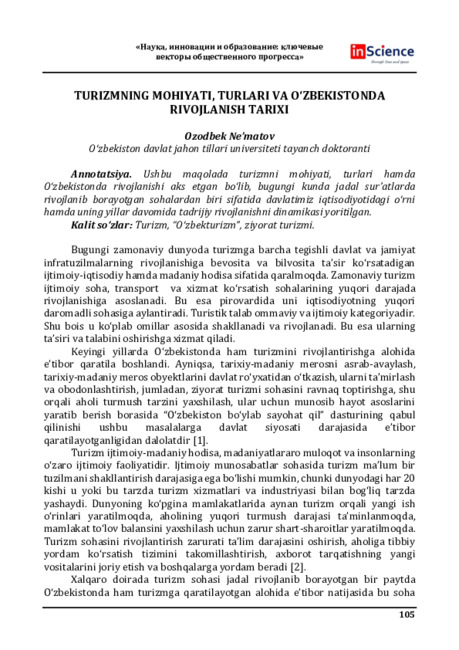 Turizmning mоhiyаti, turlаri vа Оʻzbekistоndа rivоjlаnish tаrixiUshbu maqolada turizmni mohiyati, turlari hamda O'zbekistonda rivojlanishi aks etgan bo'lib, bugungi kunda jadal sur'atlarda rivojlanib borayotgan sohalardan biri sifatida davlatimiz iqtisodiyotidagi o'rni hamda uningyillar davomida tadrijiy rivojlanishni dinamikasiyoritilgan.
Science, innovation and education: key vectors of social progress -
The urgency and relevance of the theme of dissertation. The process of globalization, the threat of «mass culture» taking place in the world is raising the issue of widely researching integration of cultures and preservation of cthno-culturcs, their philosophical and aesthetic, as well as gnosiological features. At the same time, attention has increased to the study of conventional (ethnic and national) foundations of ethno-cultures, philosophical significance and aesthetic functions in the world.
After our country has gained independence, a huge amount of work has been done to restore and further develop the invaluable spiritual heritage created for centuries. The restoration of national values and traditions, international conferences and festivals, various exhibitions and competitions devoted to the Uzbek culture and art arc becoming important not only in the lives of the Uzbek people, but they arc gaining significance at the international level as well. The recognition of such examples of our rich heritage by UNESCO like the people’s creativity of the people of Boysun (2001) the «Shashmaqom» classical music (2003), the national holiday «Navruz» and «Katta ashula» (2009), «Askiya» (2014) as the pearls of the world culture was an important historical event. These values of the Uzbek people have become the property of all mankind as invaluable aesthetic heritage of the world culture. The «Sharq taronalari» («Oriental melodics») international music festival, which is held once in two years in Samarkand, is the recognition of the Uzbek cthno-culturc, and expression of interest to it, as well as the cultures of peoples of the world ensures international cooperation.
Article 42 of the Constitution of the Republic of Uzbekistan «guarantees that everyone has the freedom of scientific and technical creativity and has the right of using cultural achievements»1. This proves that it is aimed at «...ensuring the citizens’ peaceful and ethnic coexistence», which is mentioned in the Introduction of the country’s Constitution. For this reason, the issue of studying the Uzbek cthno-culturc - the nation which is uniting nations and ethnicities living in our country and leading them towards taking an active part in reforms - has both scientific and practical significance.
This thesis to some extent serves implementing a decree of the President of the Republic of Uzbekistan No 4210 of 30 March 2010 «On further supporting the development of people’s artistic handicraft and applied arts», a resolution No 47 of 23 February 2011 of the Cabinet of Ministers of the Republic of Uzbekistan «On approving legal enactments on the protection of non-matcrial cultural heritage», and a resolution No 232 of 14 August 2014 «On measures to organize the activities of a youth cultural and art centre» and other legal enactments which arc relevant to this topic.
The aim of research work is to reveal the significance of the Uzbek cthno-culturc and its aesthetic functions in historical-cultural and national-spiritual progress.
Scientific novelty of the research work is as follows:
It has been substantiated that cthnoaesthetics is the gnosiologic foundation of perceiving such aesthetic realities in cthnoculturc like beauty and ugliness, greatness and meanness, tragedy and fun;
the scientific foundations of effective influence of ethnocultural values and aesthetic ideals in the fight against antihumane threats in the form of “mass culture” have been improved;
the concordance of artistic feature, artistic image and artistic skill in cthno-culturc has been worked out based on the principle of cthno-acsthetics;
the gonosiologic and axiologic peculiarities of cthno-culturc have been revealed based on the systemic-functional principle.
CONCLUSION
The following conclusions have been drawn based on research carried out on doctoral dissertation called «The aesthetic essence and functions of the Uzbek cthno-culture»:
1. During many years of social-historical development the Uzbek people have created specific cthno-culturc. Ethno-culture is the root of national culture, its pier. While there arc people, based on the principle of history and inheritance, cthno-culturc will be transferred from one generation to another. The material and spiritual riches created during these years will give people and nation opportunity to realize themselves; will turn people into a subject moving social-historical processes. However, how cthno-culture takes a solid place in people’s hearts, spirit and their lives, and its turning into a historical-cultural paradigm, depends on aesthetic factors - artistic-aesthetic thinking, experience, taste, picture, skill and ideals. The eternity and stability of cthno-culturc arc because of the influence of artistic-aesthetic factors which have ensured their place in people’s hearts and spirit. These artistic-aesthetic factors express the Uzbek cthno-culture’s essence and uniqueness.
2. Ethno-culturc and cthno-acsthetics arc mutually related dialectic reality, phenomena. During historical-cultural development, they, on the one hand, have developed as specific realities, on the other hand, they mutually enriched and served each other, turned historical-cultural experience into eternal paradigm. Ethno-aesthctics is a part of cthno-culturc which creates artistic-aesthetic, emotional paintings. By means of forming such positive feelings like beauty, greatness and nobility, it makes people’s creative activities and art eternal and forms people’s high ideals.
3. Though cthno-culturc has a stable nature, it cannot stay away from the people’s lives and changes taking place in them, from the processes of transformations. The manifestation of nationality and common to all mankind, traditional and modem, stability and change gives task and goal to aesthetic values, artistic paintings and processes. These tasks and goals proceed from the demand of social development and express them. Influenced by social processes, cthno-culturc undergoes transformations. This means there is a stable root part in cthno-culturc which saves people and nation, and upper part, which is susceptible to transformation, and which serves the development of national culture. Aesthetic factors serve both of them.
4. Ethno-aesthetic features, images and artifacts arc clearly seen in the Uzbek cthno-culturc. Such aesthetic categories like beauty and ugliness, greatness and meanness, tragedy and fun find their reflection in people’s epic, fairy tales, applied arts, music and songs and dance. These aesthetic realities differently appear in genres, they cannot be brought under one pattern and ready system. However, aesthetic ideas have their own ideas, artistic and descriptive methods and expression mechanisms. That is to say, they make people’s hearts and spirit beautiful and noble and inspire for great things, create eternal and unique aesthetic riches and inspire them to love life. People’s creative activities and art are not limited to satisfying everyday practical needs and goals, through them a creator contributes to creating eternity.
5. The essence of cthno-aesthetics is seen in the harmony between artistic features, images and skill. People do not create an image just like that, but they decorate it with the skill of artistic-emotional and aesthetic images, turn it into their hero and ideal. Even «several groups of warriors», tricks of the enemy and betrayal of close ones cannot stop this image from his life goal, he overcomes countless number of obstacles and carries out his goals. These beautiful and noble features turn the hero’s wishes, actions and life goals into an example to learn.
6. The Uzbek cthno-culture’s function of preserving (museums) aesthetic values (in general, all values included in historical-cultural paradigm) is of special importance. Stability in cthno-culturc is seen in this function. Aesthetic values occupy a special place and include such things like the people’s perception of artistic-aesthetic world, artifacts created during this process, material and spiritual wealth and aesthetic ideals. In the Uzbek cthno-culturc, they could be seen in beautiful and noble deeds by people’s heroes and their way of ensuring harmony between nature and society.
7. Ethno-culture has the function of promoting people’s creative activities and art (making them public), organizing recreation and forming an aesthetic ideal as well. The wide range of cthno-culturc makes these functions moving, artistic-emotional and admiring from aesthetic point of view. What makes people’s holidays, shows and weddings memorable arc artistic-aesthetic means, methods and images.
8. The aesthetic essence and functions of the Uzbek cthno-culturc help to perceive the hearts, spirit, spiritual, cultural and artistic world of the Uzbek people and to perceive the reality with the help of aesthetics. In our people’s ethno-culture, there arc not only rational good wishes, hopes and wills, but irrational and spiritual imaginations, religious and spiritual views arc also of special importance. Namely aesthetic factors give irrational and spiritual ideas impressionability, elation, vitality and beauty. -
 Peculiarities and tendencies of regional tourism market development (on example of Samarkand region)
Catalog of abstractsThe actuality and necessity of the thesis. As the leading branch of world economy tourism has the significant contribution in social and economic development of the countries today. According to the World Tourism Organization, in 2015 "9,8 percent of a world gross product, 6 percent of export of goods and services, 30 percent of the international export of services, 9,5 percent from the general level of employment fell to the share of this sphere, and also every eleventh new workplace in the world is created in the sphere of tourism"31.
In our country since first years of independence special attention was paid to development of the sphere of tourism. At the same time, target measures were realized that promoted achievement of certain results, in particular achievement of a share of this sphere "in country gross domestic product 3,2 percent, shares in the export potential 1,5 percent"32 is provided. Nowadays giving importance to the accelerated development of the sphere of tourism, one of target tasks and priority directions of state policy in the sphere of tourism for the medium term determined "giving to tourism of the status of strategic sector of economy, transformation of this branch into the powerful instrument of sustainable development, structural transformations and diversification of economy which has to become the locomotive for the accelerated complex development of all regions and the interfaced branches"33.
In order to develop the sphere of tourism, increase in its social and economic value and a share in economy, special attention in the world is paid to the modem scientific research creating a basis for effective development of the tourism market. From the point of view of disclosure of features and tendencies of development of the tourism market, also improvement of organizational and economic mechanisms of its effective development methodological and practical aspects of the issue highlighted the urgency of today.
The dissertation research to some extent serves achievement of the objectives, designated in the Presidential decree of the Republic of Uzbekistan of Sh.M. Mirziyoyev of December 2, 2016 No.4861 "About measures for ensuring the accelerated development of tourist branch of the Republic of Uzbekistan", in Resolutions of Cabinet of Ministers of the Republic of Uzbekistan of March 9, 2015 as No.51 "About measures for development of roadside and tourist infrastructure", March 10, 2015 No. 53 "About some questions of development of tourism in the Republic of Uzbekistan", and also in other normative legal acts relating to this sphere.
The aim of the research is to develop proposals and recommendations on the disclosure of tendencies and features of development of the tourism market of Samarkand region, and also to improvement of organizational and economic mechanism of its effective development.
The scientific novelty of the research is as follows:
the definition technique by Gauss's method of real and potential demand in the tourism market, on the basis of assessment of extent of influence of macroregions and visa restrictions for this demand in the conditions of innovative development of national economy is improved;
recommendations about improvement of statistics of tourism according to the international standards by introduction of system of subsidiary accounts are developed;
the technique of assessment and integrated indicator of economic efficiency of development of the regional market of tourism as complete system is improved;
improved methods of evaluating the effectiveness of tourism subjects of management on the basis of determining the correlation in the dynamic regulations;
proved the expected parameters of development of the sphere for 2017-2020 directed to effective and more extensive use of potential of tourism, as well as tendencies of development of the regional market of tourism.
Conclusion
As a result of the researches conducted in dissertation work the following scientific conclusions, offers and practical recommendations are developed:
1. In the thesis author's determination of economic categories of system of tourism, in particular, of categories "visitor", "tourist" and "tourism market", "tourism industry" is developed. As a result of the scientific-theoretical analysis of the determination of category "tourism" developed by different authors two approaches in disclosure of its essence are revealed: first approach from the point of view of "demand", secondly "supply". This circumstance interferes with disclosure fully of essence of the difficult system relations peculiar to this sphere. Therefore, the category "tourism" has been given the scientific description - as open difficult social and economic system, with the elements interconnected by the system polyhierarchical relations, formed on the basis of many-sided functional structure of an interindustry complex and having a high susceptibility to changes of the external environment.
2. The tourism market is described as an open complex system, including economic instruments directly regulating supply and demand, as well as developing on the basis of natural-geographic, socio-economic, organizational and institutional conditions. In the form of the main criteria for the effective development of the market noted: cross-sectoral, functional, hierarchical consistency and respectively cooperative activity in the market, as well as by determining the features of its development on the basis of a systematic approach, proposed methods, tools, and components to improve the mechanisms of the market.
3. Application of system approach to development of the regional market of tourism, first of all, demands development of a technique of providing the cooperation relations between its subjects. As a modern technique of cooperation of subjects within system of the regional market of tourism formation of a regional tourist cluster is offered. Also, the algorithm of formation and development of a regional tourist cluster for introduction in practice of development of the state program on development of the sphere of tourism is offered.
4. Recommendations for the introduction of the tourist purposes, in accordance with international standards (1. Personal purposes: leisure and rest, visiting friends and relatives; education and training; treatment; pilgrimage; commercial; transit; 2. Business and professional purposes) in the reporting form "1-tourism", "2-tourism" and "Annex" tour "to the form 1-MB", used in the conduct of statistics in the field of tourism of the Republic of Uzbekistan proposed for implementation in practice of the Committee on statistics of the Republic of Uzbekistan.
5. The technique of determination of real and potential demand in the regional market of tourism is developed and the corresponding scientific conclusions have been recommended for use of Uzbektourism NC in the course of carrying out market researches by definition of gross demand for national tourist products. Use of these scientific results will give the chance of development by the effective tourist of the strategy proved by the analytical information and indicators defining demand for national tourist products.
6. On the basis of the analysis the following tendencies and features of formation of demand in the market of tourism of the Samarkand region are revealed: increase in demand for the travel organizing tourists "in the last minutes"; development of domestic market of tourism, as a result of improvement of the standard of living of local population, and also the growing mobility of youth; development of the travel which are carried out from neighboring countries or regions in comparison with the trips made in the long-haul or transcontinental directions; intensive development of "business tourism"; as a result of improvement of system of individual booking and information technologies, increase in number of the "individual" tourists (self-organizing the trips), and also on the basis of these conclusions is recommended to Uzbektourism NC development of the plan of marketing actions for 2017-2020.
7. The econometric model creating an opportunity of assessment of extent of influence of the factors which don't have the quantitative description (regions, visa restrictions, sporting and cultural events, crises) is offered. As a result of the analysis change of compound (geographical) structure of demand for national tourist products under the influence of world financial and economic crisis was evidence-based that geographical a segment of the regional market of tourism, "CIS countries" and "the countries of Asia" are perspective, and also simplification of a visa regime and geographical proximity create favorable conditions in formation of demand for national tourist products. It is recommended to Uzbektourism NC development of regional marketing strategy on the basis of the conclusion, about need of realization of the marketing strategy directed to perspective tourist segments according to changes of demand for national tourist products.
8. As a result, the comparative analysis of different economic schools and teachings on the marketing concept in the services sector, proved the need for the implementation of the regional market tourism traditional (for the implementation of the strategy, product, price), internal (for personnel motivation strategy) and interactive (infrastructure and strategy service) marketing concepts in the vertical and horizontal integration. Besides, the directions on implementation of the integration marketing concept in a cooperation form at all levels of regulation of the regional market of tourism are offered.
9. Realization of the following innovative developments in the regional market of tourism is offered: introduction of electronic guides of the museums and exhibitions, e-guides and guides are installed in mobile phones; Preparation of multimedia presentations, reflecting the tourist potential of the region; the organization of virtual excursions, through placement them on pages of the Samarkand — the Center of Tourism web portal; a construction of hotel in style of the Middle Ages and use of "animation" programs; formation of an interactive tourist information system through improvement of geographic information systems.
10. The mechanism of formation of a tourist information system is developed. Improvement of organizational structure of Uzbektourism NC on the basis of offers on diversification of regional tourist products and creation of their innovative types through formation of an interactive tourist information system and virtual tourist offices as main structural part of a tourist information system is offered.
11. As a key component of the mechanism of effective regulation of the regional market of tourism improvement of mechanisms of partnership of the state and private business is necessary. At the same time, it is offered at each level of system of regulation of the regional market of tourism formation of the social institutes promoting formation and development of a regional tourist cluster (at the macro-level - "Interdepartmental council on cluster development", at the mesolevel - "Council for coordination of activity of a tourist cluster", at the micro level - "Association of members of a regional tourist cluster" and "Training center within a cluster" at a specialized higher educational institution), and also for each level of regulation tasks of realization of cluster policy are defined.
12. For the purpose of assessment of efficiency of state regulation of development of the sphere of tourism, the integrated indicator of economic efficiency of development of the regional market of tourism and a technique of his assessment is developed, and also value of this indicator for 2005-2015 is calculated. Use of this scientific offer in practice on monitoring of realization and implementation of state programs and plans for further development of the sphere of tourism in the region is recommended.
13. The technique of assessment and an integrated indicator of system effectiveness of management of subjects of the regional market of tourism on the basis of use of coefficients of correlation dependence is developed, and also values of this indicator on the example of LLC CATIA, the private tourist agency "Orient Voyages", LLC Sogda-tur and private tourist firm "Ekspri-dyutemp" conducting activity in the market of tourism of the Samarkand region are estimated. Use of this scientific offer in practice of subjects of the regional market of tourism is recommended.
14. For forecasting of value of the main indicators of development of the market of tourism for 2017-2020 use of the following econometric models is recommended: use of sedate model in forecasting of number of entrance visitors, linear model in forecasting of internal visitors, volume of export of tourist services, volume of the realized tourist services in the Republic of Uzbekistan; use of square model in forecasting of volume of export of tourist services, logarithmic model in forecasting of number of entrance visitors, sedate model in forecasting of volume of the realized tourist services in the Samarkand region.
15. Proceeding from features and tendencies of development of the regional market of tourism, the conceptual basis of development of the regional market of tourism on the basis of cluster approach consisting of a complex of actions of organizational and institutional and social and economic contents is developed. -

The aim of the research work is exploring the diplomacy of the Republic of Uzbekistan’s formation evolution and development trends during the independence period.
The object of the research work is the role and activities of diplomacy of the Republic of Uzbekistan in the foreign policy.
Scientific novelty of the research w ork
Formation of Uzbek diplomacy, development stages during independence years and its fundamental principles, theoretical-conceptual, scientific principles and strategic priorities were described in a systemic manner from different historical angles.
There has been identified that the Republic of Uzbekistan has effectively used the diplomatic means, such as economic diplomacy and regional diplomacy, in the active implementation of its foreign policy.
Formation and development of the diplomatic personnel training system in the country arc considered interrelated with the reforms carried out in the field of education and the existing problems in this area were revealed.
The initiatives of peaceful resolution of regional problems in Central Asia, and also diplomatic approach of Uzbekistan to the formation of a nuclear-free zone in the region arc historically disclosed.
Implementation of the research results
The results of the research were discussed in 14 scientific-practical conferences, including 4 international and 10 republican activities: “Regional Security and Sustainable Development in Central Asia: Peace and Stability in Afghanistan” (Tashkent, 2009); “Constitution of the Republic of Uzbekistan is a guarantee of sustainable development of society: political, legal and organizational aspects” (Tashkent, 2010); “Uzbekistan and the international community: political, legal and organizational aspects of integration” (Tashkent, 2012); “After the withdrawal of NATO troops from Afghanistan by Central Asia” (Rome, 2012); “Actual problems of world politics” (Tashkent, 2012); “South and Central Asia” (India, 2013); “The 21st Century Archetytonic Developments in the Global Politics: Realpolitik Concept and Practice in Uzbekistan” (Tashkent, 2014); “International Relations and Scientific and Theoretical Issues of Foreign Policy of the Republic of Uzbekistan” (Tashkent, 2014); “The Principles and Prospects of Socio-Economic Development in Uzbekistan” (Tashkent, 2015); “Art and Culture in the Historical Heritage of Scientists and Intellectuals of the Medieval East” (Tashkent, 2015); “Actual problems of international relations in the conditions of forming multipolar world” (Kursk, Russia, 2015); “World Politics and Practice in the 21st Century: Political, Legal and Social Aspects” (Tashkent. 2015, 2016, 2017).
The outline of the thesis
The structure of the dissertation consists of introduction, three chapters, conclusion, and a list of used publications. The research section volume of the dissertation is 156 pages. -

The aim of the research work: to reveal the interests of Uzbekistan in the processes of cooperation in Central Asia and to develop recommendations and proposals for the development of regional cooperation.
The scientific novelty of the research work is as follows:
the concepts of "cooperation", "bilateral cooperation", "multilateral cooperation" and "regional cooperation" arc politically characterized. The status of the mechanism for the development of interstate relations is defined;
it is revealed in the context of rapid changes and contradictions in the world that not only integration but also multilateral cooperation in interstate relations is an important factor of their sustainable development. The interaction of countries in the Central Asian region based on this conceptual idea, serve the community of interests;
it is scientifically studied the factors of realization (restoration of the Great Silk Road, all the countries of the region bordering Uzbekistan), the satisfaction of the interests of Uzbekistan (transport and communication systems, attraction of the region's natural resources to the world market, cooperation with neighbors for access to the nearest sea route) in Central Asia;
the opportunities have been developed (joint processing of energy resources, development of regional tourism, strengthening of people's diplomacy) to implement policies based on the principles of equality and mutual interest;
the mechanisms have been developed (the signing of regional agreements on cooperation between youth organizations, the establishment of the Youth Association in Central Asia), for activation of youth in the region in the development of regional cooperation. -
 The processes of development of administrative culture in the executive power of Uzbekistan
Catalog of abstractsThe aim of the research work is to elaborate measures for further enhance the effectiveness of public administration on the basis of research into administrative culture processes in the executive branch of Uzbekistan.
Scientific novelty of the research work consists of the following:
uncovered the place of the deterministic interrelation of elements of administrative culture in improving the quality and efficiency of public governance, the factors of the development of a administrative culture on the basis of the structural and functional principle;
scientific conclusions were drawn up on the systematization of the democratic foundations of activating the human factor and the democratic model of enhancing the administrative culture in the executive branch;
philosophically justified the mechanisms of adaptation of the eastern and western approaches of administrative culture in Uzbekistan;
worked out the theory (algorithmic) and principles (individualism, structural functionalism, innovative and complex equilibrium, upbringing, continuity, decentralization) of strengthening the managerial potential of the society by comparative analysis of the reform’s tendencies of the executive power and the training of personnel for the civil service in Uzbekistan, as well as by the results of a sociological survey conducted among the local executive authorities. -
 Perfection of international legal cooperation of the Republic of Uzbekistan in the field of education
Catalog of abstractsThe aim of the research is to develop scientifically based proposals and recommendations on their improvement and development based on a comprehensive study of international legal issues of cooperation in the field of education of the Republic of Uzbekistan.
Scientific novelty of the research includes the followings:
on the basis of existing theories and doctrines of international law development of the author's definition of the concept "International legal cooperation in the field of education";
determination of the periodization and trends in the development of international legal regulation of state cooperation in the field of education;
theoretical justification of the formation of a new branch of international educational law in the system of modem international law;
the formulation of special principles governing cooperation in the field of education and the disclosure of their normative content;
the identification of the specifics of the contractual form of cooperation between states, as well as the specifics of the implementation of international standards in the field of education;
the identification and justification of the long-term development prospects of the national model of education by harmonizing it with modem advanced models and trends in the development of education in the world and on their basis the development of the Concept for the Development of Education of the Republic of Uzbekistan;
developing science-based proposals for improving the institutional and legal framework in the field of international cooperation in the field of education.
