All articles - Arts and Humanities Other Topics
-
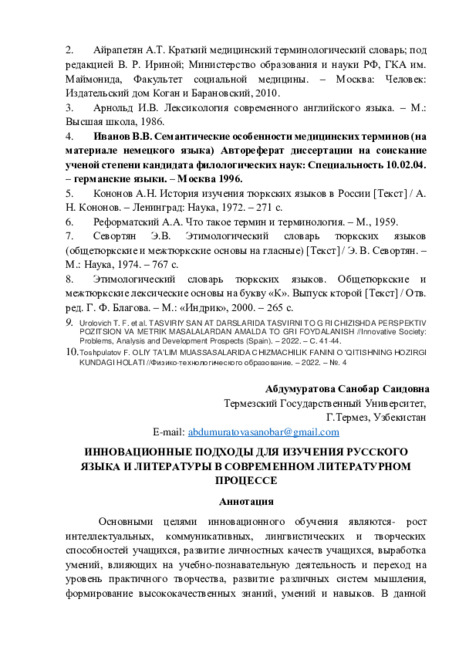 Innovative approaches for the study of languages and literature in the modern literary process
Traditions and innovations in language research and teachingThe main objectives of innovative learning are: the growth of intellectual, communicative, linguistic and creative abilities of students, the development of personal qualities of students, the development of skills that affect educational and cognitive activity and the transition to the level of practical creativity, the development of various systems of thinking, the formation of high-quality knowledge,
skills and abilities. This article discusses problems and innovative approaches in the study of Russian language and literature. -
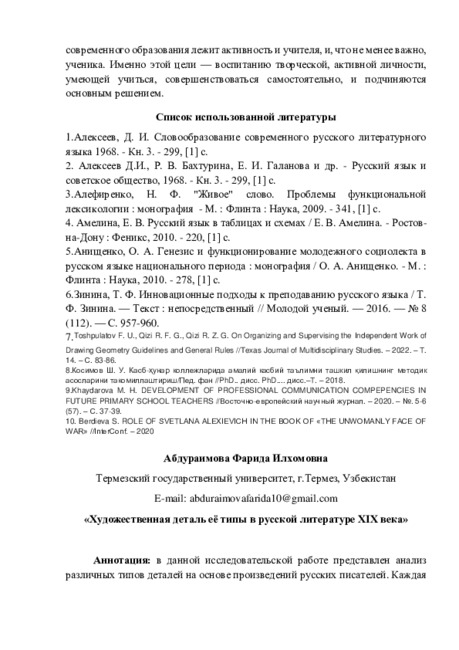 “Artistic detail and its types in Russian literature of the 19th century”
Traditions and innovations in language research and teachingThis research work presents an analysis of various types of details based on the works of Russian writers. Every detail plays an important role in the reader’s holistic perception of a work of art.
-
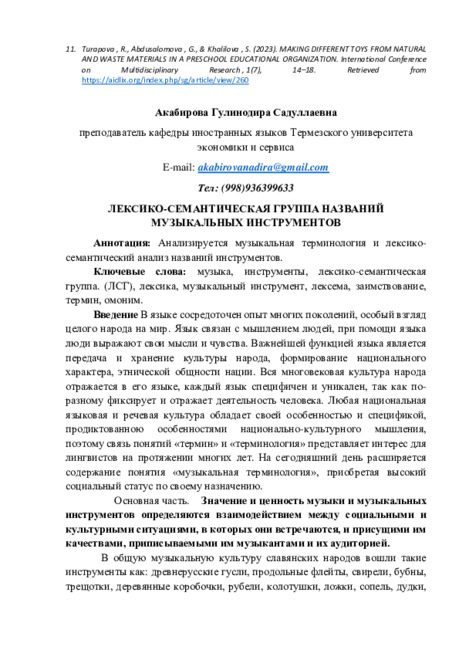 Lexico-semantic group of names of musical instruments
Traditions and innovations in language research and teachingАнализируется музыкальная терминология и лексико-семантический анализ названий инструментов.
-
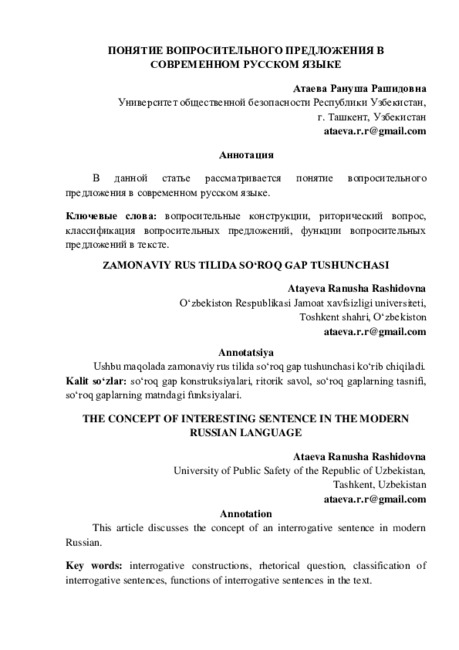 The concept of interesting sentence in the modern russian language
Traditions and innovations in language research and teachingThis article discusses the concept of an interrogative sentence in modern Russian.
-
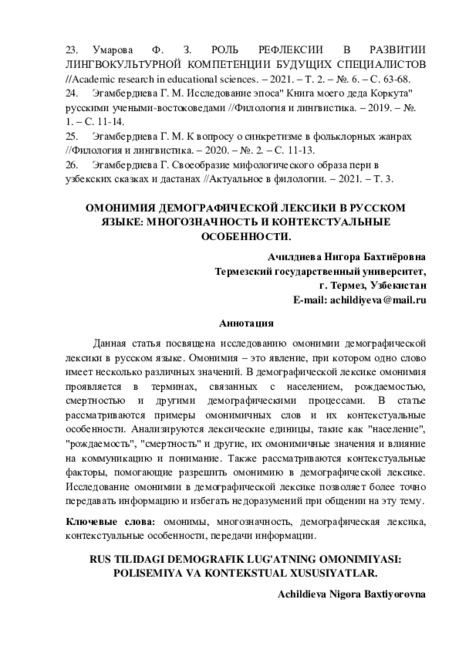 Homonymy of demographic vocabulary in the russian language: polysemy and contextual features
Traditions and innovations in language research and teachingThis article is devoted to the study of homonymy of demographic vocabulary in the Russian language. Homonymy is a phenomenon in which one word has several different meanings. In demographic vocabulary, homonymy manifests itself in terms related to population, fertility, mortality and other demographic processes. The article discusses examples of homonymous words and their contextual features. Lexical units such as “population”, “fertility”, “mortality” and others, their homonymous meanings and influence on communication and understanding are analyzed. Contextual factors that help resolve homonymy in demographic vocabulary are also considered. The study of homonymy in demographic vocabulary allows us to more accurately convey information and avoid misunderstandings when communicating on this topic.
-
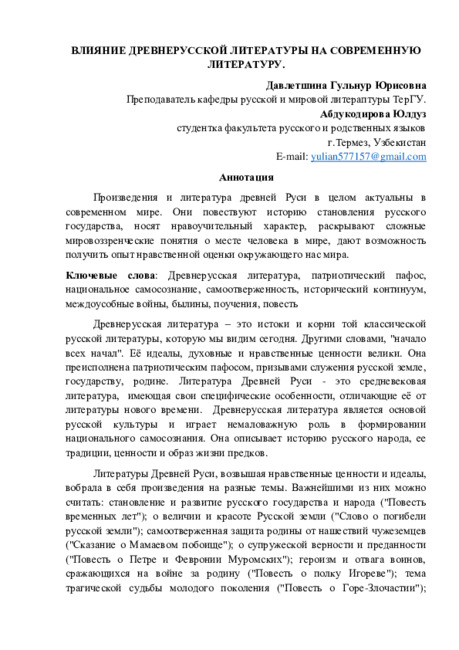 The influence of ancient Russian literature on modern literature
Traditions and innovations in language research and teachingПроизведения и литература древней Руси в целом актуальны в современном мире. Они повествуют историю становления русского государства, носят нравоучительный характер, раскрывают сложные мировоззренческие понятия о месте человека в мире, дают возможность получить опыт нравственной оценки окружающего нас мира.
-
 Functional-semantic feature of gender-polite vocabulary of Russian and Uzbek languages
Traditions and innovations in language research and teachingВ данной статье рассмотрены вопросы, отвечающие ведущим тенденциям современной сопоставительной лингвистики и лингвокультурологии, где приоритетным является функционально-семантический подход к анализу национально-культурных особенностей гендерной лексики в процессе эвфемизаци речи, как проявления вежливости в речевом поведении носителей русского и узбекского языков.
-
 Comparative and comparative typology of gender-polite euphemization of taboo vocabulary in the russian and uzbek languages
Traditions and innovations in language research and teachingThis article discusses issues that meet the leading trends of modern comparative linguistics and linguoculturology, where the priority is the functional-semantic approach to the analysis of the national and cultural characteristics of euphemism as a manifestation of politeness in the speech behavior of speakers of the Russian and Uzbek languages. A euphemism is a direct word or expression used for a number of reasons instead of taboo words or expressions that seem prohibited, indecent, or rude to the speaker.
-
 Modalation in russian and uzbek languages as a result of transitional phenomena in the system of part of speech
Traditions and innovations in language research and teachingThis article examines one of the types of transposition: modalation in the Russian and Uzbek languages. The transition of significant and auxiliary parts of speech to the category of modal words is analyzed. Modalation is the transition of other parts of speech into modal words. When modalating parts of speech, a change occurs not only in semantics, but also in the grammatical properties of the original word, which leads to its transition to a different lexical and grammatical class. This article may be useful for linguists studying comparative linguistics.
-
 Linguistic and pragmatic theory of speech genres
Traditions and innovations in language research and teachingIn this article, taking into account the unflagging interest of researchers in the problem of speech genres, special attention is paid to speech, which is the main means of ensuring the liveliness, vitality and content of language. The concept of speech genres is a special linguistic object for those who study language as a unit of speech and speech communication. Speech communication provides communication between the speaker and the listener and forms the center of speech activity.
-
 Digital educational resource and its content
Traditions and innovations in language research and teachingThe work examines the use of digital educational resources in the educational
process as one of the forms of modernization of education, which constitutes the
content of a digital educational resource. -
 The relationship of slavic languages in the field of vocabulary
Traditions and innovations in language research and teachingthe article examines the kinship relations of the lexical composition of Slavic languages. It is based on the description of semantic relations between lexical units of the thematic group «Clothing» in Slavic languages. A comparative historical analysis of clothing names is carried out in order to identify the signs that formed the basis of their designation. Examples of the discrepancy in the use of words similar in meaning or form in Russian and Slavic languages are given.
-
Causes of discrepancies in linguistic pictures of the world
Traditions and innovations in language research and teachingThe article deals with the three main factors or causes of linguistic differences:
nature, culture and cognition. Any peculiarity of the cultural sphere is fixed in
language. Language differences can be conditioned by national rites, customs,
rituals, folklore and mythological representations, symbolism. Cultural models
conceptualised in certain names spread throughout the world and become known
even to those who are not familiar with the culture of this or that nation. -
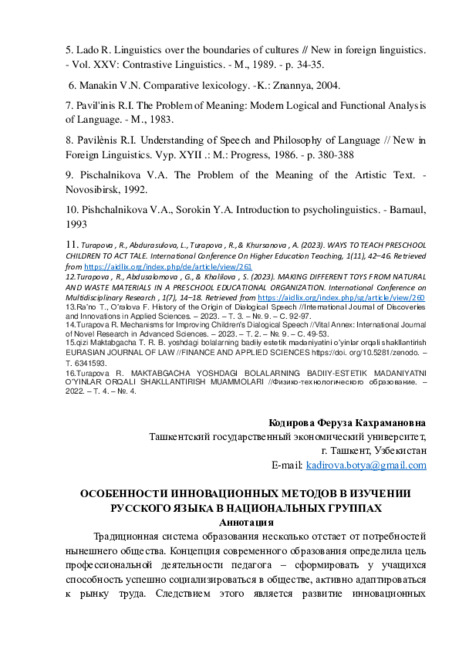 Features of innovative methods in the study of the russian language in national groups
Traditions and innovations in language research and teachingThe traditional education system lags somewhat behind the needs of today's society. The concept of modern education has defined the goal of the teacher's professional activity - to form students' ability to successfully socialize in society, actively adapt to the labor market. The consequence of this is the development of innovative technologies in teaching. Innovative methods are characterized by a new style of organization of educational and cognitive activity of students. This article
will attempt to characterize the features of innovative methods in teaching Russian in national groups. -
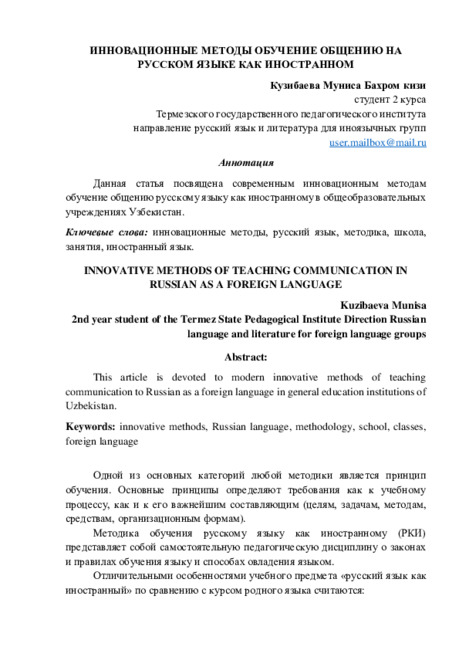 Innovative methods of teaching communication in russian as a foreign language
Traditions and innovations in language research and teachingThis article is devoted to modern innovative methods of teaching communication to Russian as a foreign language in general education institutions of Uzbekistan.
-
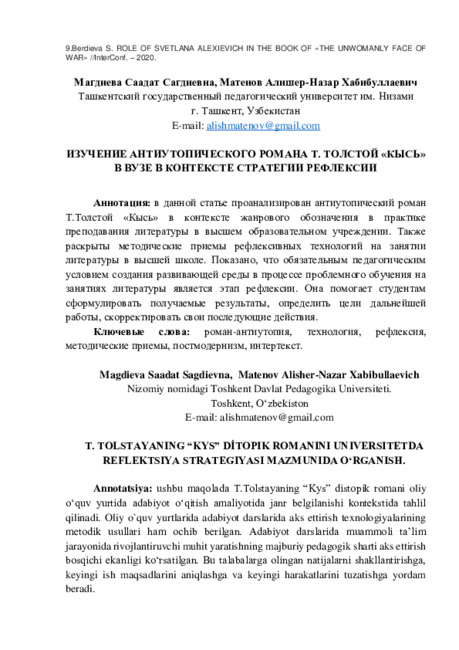 Studying T. Tolstaya's dytopic novel "Kys" at the university in the context of reflection strategy
Traditions and innovations in language research and teachingThis article analyzes T. Tolstaya’s dystopian novel “Kys” in the context of genre designation in the practice of teaching literature in a higher educational institution. Methodological techniques of reflective technologies in literature classes in higher education are also revealed. It is shown that a mandatory pedagogical condition for creating a developmental environment in the process of problem-based learning in literature classes is the stage of reflection. It helps students formulate the results obtained, determine the goals of further work, and
adjust their subsequent actions. -
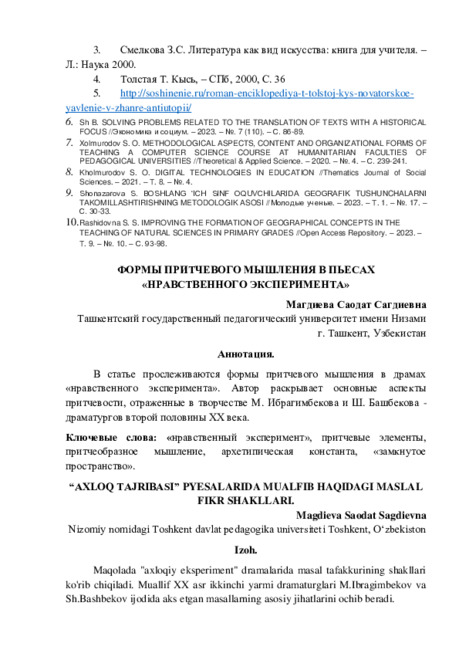 Forms of parable thinking of the author in the plays of the “moral experiment”
Traditions and innovations in language research and teachingThe article traces the forms of parable thinking in the dramas of the “moral experiment”. The author reveals the main aspects of parables reflected in the works of M. Ibragimbekov and Sh. Bashbekov, playwrights of the second half of the twentieth century.
-
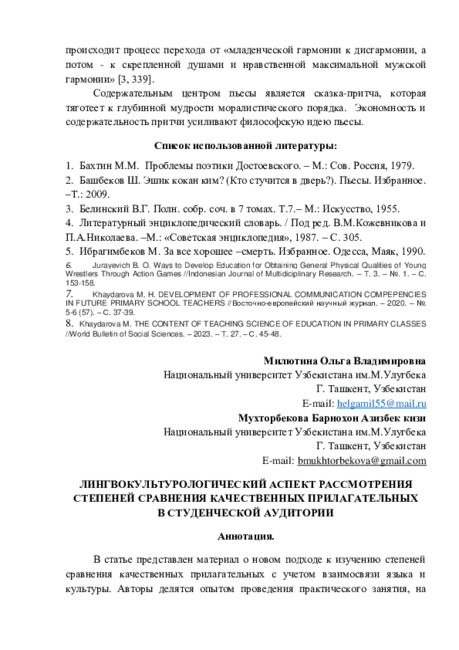 Linguoculturological aspect of consideration of degrees of comparison of qualitative adjectives in the student audience
Traditions and innovations in language research and teachingThe article presents material on a new approach to the study of degrees of
comparison of qualitative adjectives, taking into account the relationship between
language and culture. The authors share their experience of conducting a practical
lesson, in which grammatical material was considered based on the use of degrees
of comparison of qualitative adjectives in S. Yesenin’s poems as a reflection of the
poet’s worldview and his linguistic picture of the world. -
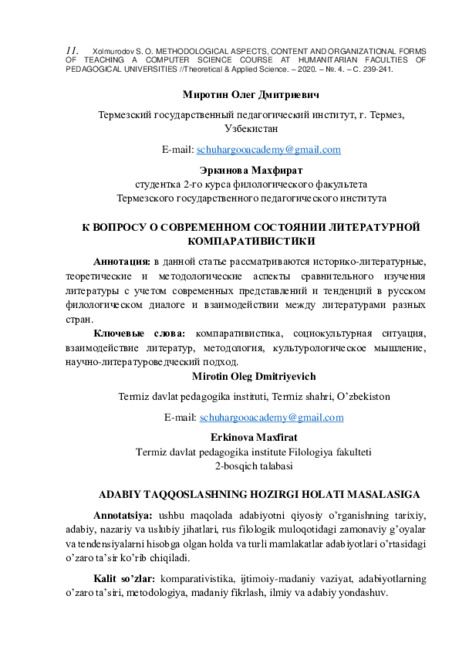 On the question of the current state of literary comparative studies
Traditions and innovations in language research and teachingThis article examines the historical, literary, theoretical and methodological aspects of comparative study of literature, taking into account modern ideas and trends in the Russian philological dialogue and interaction between the literatures of different countries.
-
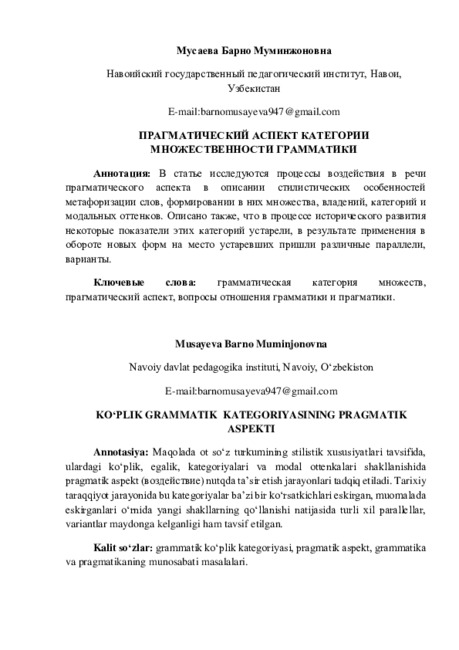 Pragmatic aspect of grammar multiplicity category
Traditions and innovations in language research and teachingThe article explores the processes of influence in speech of a
pragmatic aspect in describing the stylistic features of metaphorization of words, the
formation of a set, possessions, categories and modal shades in them. In the process
of historical development, it is described that as a result of the use of new forms in
place of outdated, outdated words in the circulation of these categories appeared
various parallels, options in speech. -
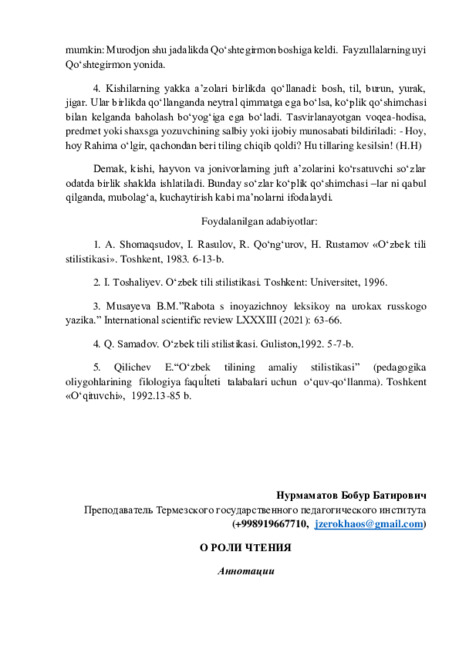
В данной статье рассматривается роль художественной литературы в современном информационном обществе. Несмотря на преобладание доступа к информации, человеческие чувства и эмоции не утрачивают своего значения. Художественная литература, согласно статье, способна воздействовать на человеческое сознание и эмоциональную сферу несравненным образом, внося глубокие изменения в мировоззрение и мышление читателя. Анализируются утверждения писателей о том, что чтение расширяет кругозор, развивает мышление, а также предоставляет ответы на вопросы жизни и помогает в поиске цели и интереса в жизни. Автор выделяет важность литературного воздействия на человеческую душу и обосновывает, что книга остается мощным инструментом формирования личности и обогащения внутреннего мира, способствуя не только интеллектуальному, но и духовному развитию человека в информационной эпохе.
-
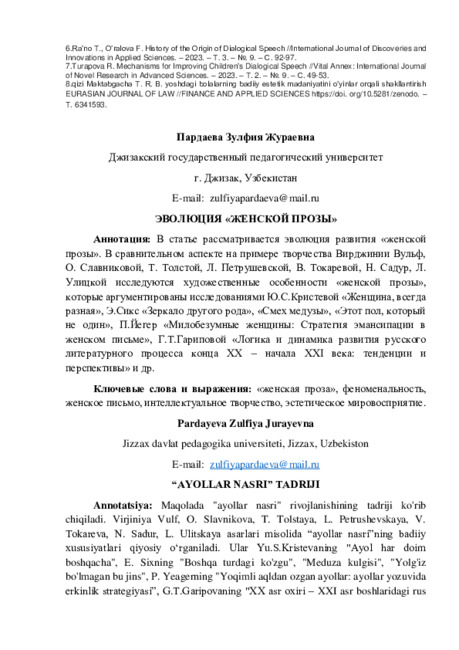
The article examines the evolution of the development of “women's prose”. In a comparative aspect, using the example of the works of Virginia Woolf, O. Slavnikova, T. Tolstaya, L. Petrushevskaya, V. Tokareva, N. Sadur, L. Ulitskaya, the artistic features of “women’s prose” are explored, which are supported by the research of Yu.S. Kristeva “Woman , always different”, E. Six “Mirror of a different kind”, “The laughter of a jellyfish”, “This sex, which is not alone”, P. Yeager “Cutely crazy women: The strategy of emancipation in women’s writing”, G.T. Garipova “Logic and dynamics of the development of the Russian literary process of the late 20th – early 21st centuries: trends and prospects”, etc.
-
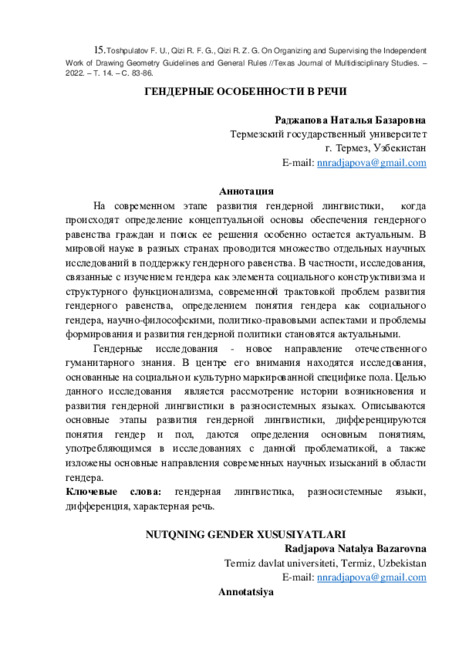
At the present stage of the development of gender linguistics, when the conceptual framework for ensuring gender equality of citizens is being defined and the search for its solution remains especially relevant. In the world of science, many separate scientific studies are conducted in different countries in support of gender equality. In particular, research related to the study of gender as an element of social constructivism and structural functionalism, the modern interpretation of the problems of gender equality development, the definition of gender as a social gender, scientific and philosophical, political and legal aspects and the problems of the formation and development of gender policy are becoming relevant. Gender studies are a new direction of domestic humanitarian knowledge. His focus is on research based on socially and culturally marked gender specifics. The purpose of this study is to examine the history of the emergence and development of gender linguistics in multi-system languages. The main stages of the development of gender linguistics are described, the concepts of gender and gender are differentiated, definitions of the basic concepts used in research with this problem are given, as well as the main directions of modern scientific research in the field of gender are outlined.
-
 Specific features of teaching russian language in uzbek school
Traditions and innovations in language research and teachingThe article examines the problem of teaching Russian in an Uzbek school. The author focuses on the specific difficulties of teaching Russian to Uzbek students, especially in the process of understanding the functions of prepositions and prefixes.
-
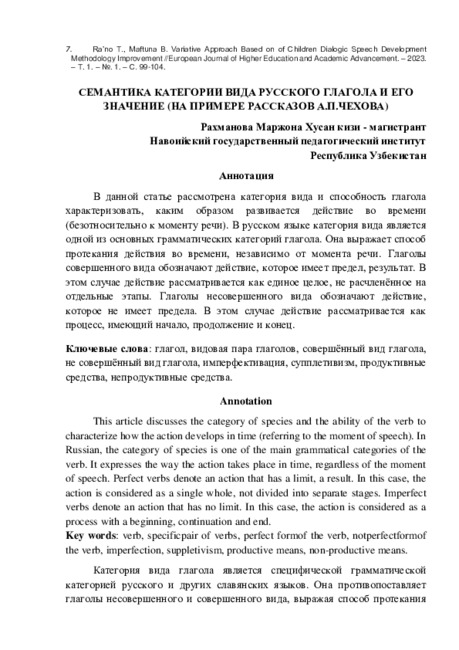 Semantics of the Russian verb aspect category and its meaning (using the example of the stories of A.P. Chekhov)
Traditions and innovations in language research and teachingThis article discusses the category of species and the ability of the verb to characterize how the action develops in time (referring to the moment of speech). In Russian, the category of species is one of the main grammatical categories of the verb. It expresses the way the action takes place in time, regardless of the moment of speech. Perfect verbs denote an action that has a limit, a result. In this case, the action is considered as a single whole, not divided into separate stages. Imperfect verbs denote an action that has no limit. In this case, the action is considered as a process with a beginning, continuation and end.
