• Journals
    • Conferences
    • Library
    • Catalog of abstracts
    • Catalog of dissertations
    • Catalog of monographs
    • Catalog of textbooks
  • Organizations
  • The authors
    • Public Offer
    • Personal data processing
    • Open Access Statement
    • Public license
    • Copyright
    • Contacts
  • Login
  • en
  • ru
  • uz
  • en
  • ru
  • uz
Journals Conferences Library Catalog of abstracts Catalog of dissertations Catalog of monographs Catalog of textbooks
Organizations The authors
Public Offer Personal data processing Open Access Statement Public license Copyright Contacts
Login
16-01-2024 1-8 118 28

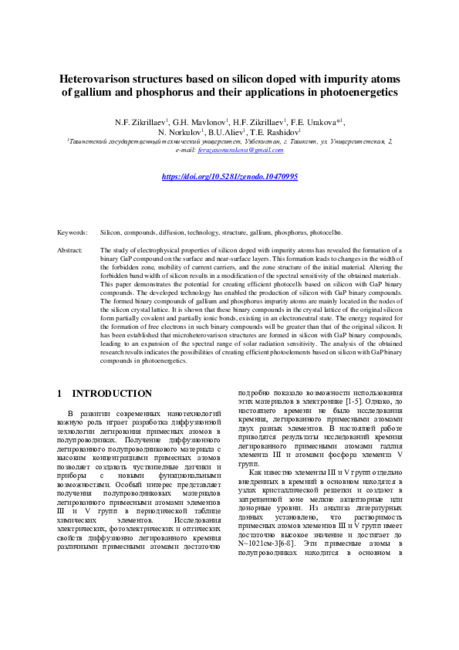
Heterovarison structures based on silicon doped with impurity atoms of gallium and phosphorus and their applications in photoenergetics

The study of electrophysical properties of silicon doped with impurity atoms has revealed the formation of a binary GaP compound on the surface and near-surface layers. This formation leads to changes in the width of the forbidden zone, mobility of current carriers, and the zone structure of the initial material. Altering the forbidden band width of silicon results in a modification of the spectral sensitivity of the obtained materials. This paper demonstrates the potential for creating efficient photocells based on silicon with GaP binary compounds. The developed technology has enabled the production of silicon with GaP binary compounds. The formed binary compounds of gallium and phosphorus impurity atoms are mainly located in the nodes of the silicon crystal lattice. It is shown that these binary compounds in the crystal lattice of the original silicon form partially covalent and partially ionic bonds, existing in an electroneutral state. The energy required for the formation of free electrons in such binary compounds will be greater than that of the original silicon. It has been established that microheterovarison structures are formed in silicon with GaP binary compounds, leading to an expansion of the spectral range of solar radiation sensitivity. The analysis of the obtained research results indicates the possibilities of creating efficient photoelements based on silicon with GaP binary compounds in photoenergetics.
  • PDF (Uzbek)
  • Current
  • Archives
    • About the Journal
    • Submissions
    • Privacy Statement
    • Contact
Current Archives
About the Journal Submissions Privacy Statement Contact
  1. Home
  2. Articles

Categories

    • Arts and Humanities
    • Medicine
    • Natural Sciences
    • Social sciences
    • Technics
    • Biological sciences

Information

  • For Readers
  • For Authors
  • For Librarians

Issue

Vol. 3 No. 1 (2024): Modern science and research

Section

Articles

Categories

  • Education and Educational Research

Downloads

Download data is not yet available.

How to Cite

Heterovarison structures based on silicon doped with impurity atoms of gallium and phosphorus and their applications in photoenergetics. (2024). Modern Science and Research, 3(1), 1-8. https://doi.org/10.71337/inlibrary.uz.science-research.28168
  • APA
  • MLA
Crossref
Scopus
Google Scholar
Europe PMC

License

Creative Commons License

This work is licensed under a Creative Commons Attribution 4.0 International License.

Article on Google Scholar
Совершенствование правовых основ обеспечения общественной безопасности
inLibrary

inLibrary — is a scientific electronic library built on the paradigm of open science (Open Science), the main tasks of which are the popularization of science and scientific activities, public quality control of scientific publications, the development of interdisciplinary research, a modern institute of scientific review, increasing the citation of Uzbek science and building a knowledge infrastructure.

CONTACTS:

 
100164, Republic of Uzbekistan, Tashkent, 4 Tepamasjid Street

 
(+998) 99-006-61-10

 
info@inscience.uz
       

НАВИГАЦИЯ:

Journals
Conferences
Organizations
Authors
Blog
Contact
© Copyright 2026 Modern Science and Research All Rights Reserved | Developed by in Science | Site create by in Designer
Login
inLibrary Logo


