All articles - Area Studies
-
 Бухоро вилояти оилавий маиший маросимлари
Global partnership as a condition and guarantee of sustainable developmentҲар қандай жамиятнинг тараққиётида миллат менталитети, руҳияти ривожланишида анъаналар, маросимлар алоҳида ўрин тутади. Аслида шу омиллар миллат мавжудлигининг асосий меъзонлари, белгилари ҳисобланади. юртимизнинг келажаги бўлган ёш аволдни миллий анъаналар руҳида тарбиялаш муҳим масалалардан биридир.
-
 Arxeologik va yozma manbalarda o‘rta osiyo mudofaa inshootlarining aks ettirilishi
Global partnership as a condition and guarantee of sustainable developmentArxeologik izlanishlar natijalariga ko'ra, 0‘rta Osiyoning janubiy mintaqasi boTgan Janubiy Turkmanistonda mil.avv. 1V-HI ming yilliklardayoq oddiy mudofaa inshootlari paydo boTa boshlagan. Mudofaa dcvorlar mudofaa nuqtai nazaridan oddiy boTib, ko'proq paxsadan qilingan to'siqdck ko'rinsada, ular aholining xavfsizligini ta'minlash uchun aniq maqsadida qurilganiligini qayd etish joiz.
-
 Фуқаролик жамиятини шакллантириш шароитида тарихий ва маънавий ҳаёт
Global partnership as a condition and guarantee of sustainable developmentМамлакатимизнинг мустақил тараққиёт йўлига чиқиши ҳаётимизнинг барча яъни ижтимоий-иқтисодий, сиёсий, ҳуқуқий ва маънавий соҳаларида улкан ўзгаришларни амалга оширишга замин бўлди.
-
 Алишер Навоий асарларидаги ижтимоий-фалсафий ғоялар таҳлили
Global partnership as a condition and guarantee of sustainable developmentНавоий асарларининг мазмун-моҳиятини англаб етишда китобхон бир қатор мураккабликка дуч келади. Чунки, айрим байт, ҳикоят, тимсолларнинг асосий маъносини тўғри тушуниш чуқур тафаккур, уларнинг фалсафий моҳиятини билишни талаб этади.
-
 ANALYSIS OF SCIENTIFIC SOURCES ON THE DEVELOPMENT OF ARCHITECTURE AND ART IN BUKHARA KHANATE
Entrepreneurship and PedagogyIn the 16th-18th centuries, scientific research on the development of architecture and art in the Bukhara Khanate was conducted not only in Uzbekistan, but also in Central Asia and other foreign countries. By the time of the Soviet era, the number of researchers in this field increased significantly. The main scientific researches were carried out from the 20th century, and in the years of independence, these efforts reached a new level. Almost all the researchers repeat that from the 16th century, a new direction and a unique style entered the field of architecture and art in the cities of the Bukhara Khanate. If we pay attention to most publications, the main emphasis is on the capital Bukhara, followed by Samarkand. Even the history of the cities of Termiz, Shahrisabz and Karshi isn’t so many studied.
-
 Markaziy osiyoda bronza davri migratsiyalari va etnomadaniy jarayonlar tarixining o‘rganilishiga doirXIX asrning ikkinchi yarmidan boshlab ilk yozma manbalarda tilga olingan Markaziy Osiyo qadimgi xalqlarining hududiy joylashish chegaralari muammosi sharqshunoslarning asarlarida dolzarb mavzuga aylandi (E. Zaxau, V. Geyger, V. Tomashek). Bu masala XX asr boshlarida ko'rib chiqilgan (I. Markvart, A. Xermann) va arxeologik ma’lumotlarni hisobga olgan holda, keying! yillarda ham ilgari surilgan (M.M. Dyakonov, V.M. Masson, B.Y. Staviskiy). Mazkur muammo, ayniqsa o'tgan asrning 70-80-yillarida bir qator tadqiqotchilar (I.V. Pyankov, P. Bernar, G.P. Frankfor, E.V. Rtveladze, J.K. Garden va boshqalar) ishlarida bayon etildi. Mavzu tarixshunosligi I.V. Pyankov tomonidan yetarlicha yoritilgan. Tadqiqotchining ishlarida Baqtriya tarixi va tarixiy geografiyasiga mansub yunon-rim manbalarining tahlili katta o'rin egallab, shuningdek, Sug'd va Baqtriyaning tog'lar va daryolar orqali o'tgan hududiy chegaralari haqidagi antik davr mualliflarining tasavvurlari ko'rib chiqildi [1].
Modern trends in the development of science: prospects and practice -
 Beruni's work 'Chronology' is an important source for studying the history of the Afrighids periodIn this article, we will familiarize ourselves with some ideas and conclusions presented in Al-Biruni's work “Chronology” regarding the Afrighids dynasty, which was mentioned as the first reference to the Khwarezmshahs.
in Library -
 The impact of political processes on archaeological research reflecting the Afrighid period (based on the studies of the 1930s to 1960s)."This article analyzes the organization of archaeological research in Khorezm and how political processes and factors, such as ideologies, state policies, and changes in international relations, have influenced it, in particular, how these changes have affected the methodology, research, and interpretation of archaeological findings.
in Library -
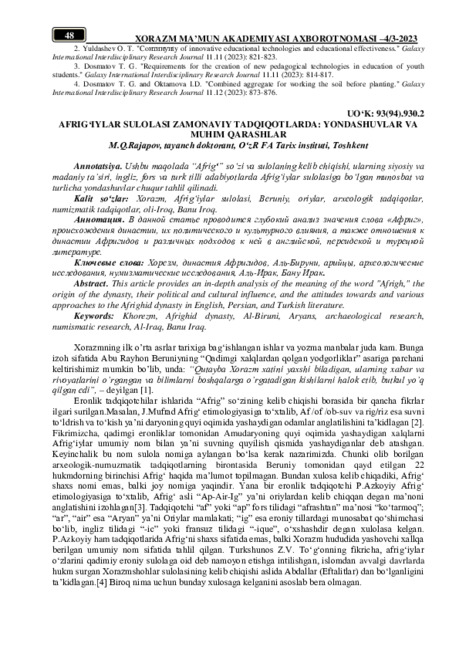 This article provides an in-depth analysis of the meaning of the word "Afrigh," the origin of the dynasty, their political and cultural influence, and the attitudes towards and various approaches to the Afrighid dynasty in English, Persian, and Turkish literature.
 -
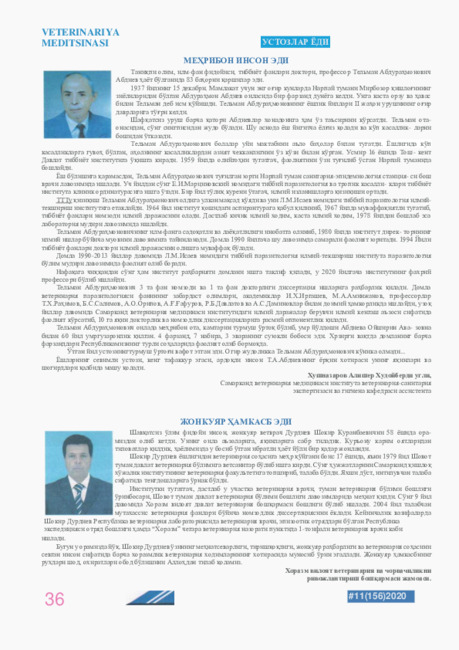 This commemorative article is dedicated to the life and work of a famous scientist, devotee of science, doctor of medical sciences, professor Telman Abdurakhmonovich Abdiev
 -
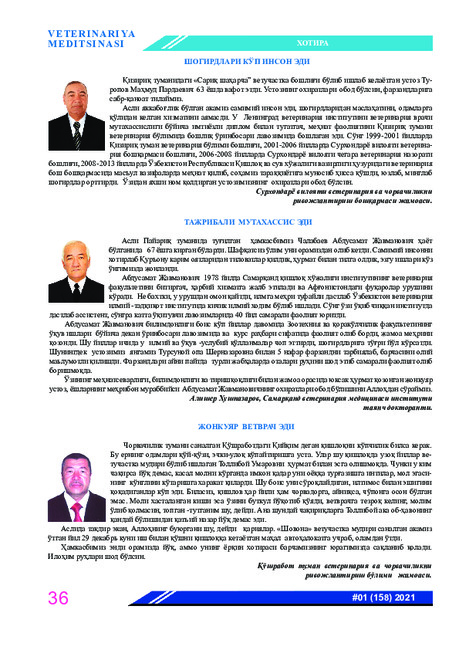 This commemorative article is dedicated to the memory of Chalaboev Abdusamat Javmonovich
 -
 In this memorial article, the complex life path, achievements and family history of Beknazarov Nurman Beknazarovich are described, the information is written from the language of his brother Isokulov Khudoyberdi Khushnazarovich, and published under the title of a hardworking and kind person.
 -
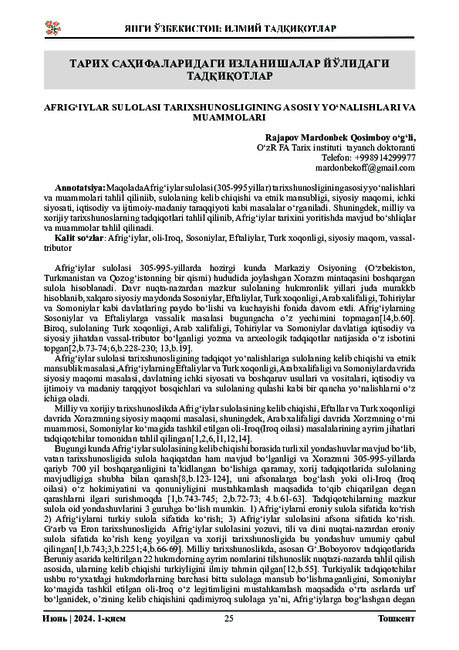 The article analyzes the main directions and problems in the historiography of the Afrighid dynasty (305-995), exploring issues such as the dynasty's origins and ethnic affiliation, political status, domestic policies, economic and socio-cultural development. The research of national and foreign historians is also analyzed,
 -
 Ethnic Situation on the Territory of Southern Uzbekistan in 19th — Beginning of 20th Century (based on materials of Surkhan-Sherobod valley)
Catalog of abstractsSubject of the research: Ethnic peculiarities of sub-Ethnic components in the composition of Uzbek nation, issues of their formation and Ethnic history arc being researched based on materials of Surkhan-Shcrobod valley.
Purpose of work: Based on Ethnographic materials analyze peculiarities of Ethnic composition, system of clan divisions and its genesis, Ethno cultural contacts between various Ethnic components, mechanism of economic-cultural types’ effect to Ethnic processes and Ethnic differentiation.
Methods of research: historical approach, comparative-historical analysis, territorial-problcm-chronologic, interview, participant observation, oral history.
The results obtained and their novelty: Study has elicited Ethnic composition of the population, in particular apparent Ethnic components in the composition of Uzbek nation, retaining of various Ethnonyms, dialects, and Economic-cultural features as compared with other regions’ Ethnographical data. It has also researched multisidcd changeable and permeable character of Ethnic and Cultural borders in the researched period. It has analyzed Ethnological aspects of lifestyle variations related to influence of Economical-cultural types and continuous preservation of Ethnic differentiation.
Practical value: results and conclusions of the research have scientific and practical significance for the study issues of Ethnic history of Uzbek nation relevant to Ethnicity, Ethno Cultural Identity, as well as effect of sedentary and semi-sedentary population and their Ethnic differentiation.
Degree of embed and economic efficiency: Total author has published 17 articles on the topic of the dissertation. Out of them 3 articles have been published in in the scientific journals, 14 articles in the collections of local and international scientific conferences as well as internet portal “ZiyoNET”.
Field of application: Results of the study can be used to conduct complex research of Ethnic History of Uzbek nation, Lecture specialized courses and practical seminars to instruct university students of Ethnology, and create textbooks and manuals for bachelor and master degree programs, as well as to resolve issues of Ethno cultural contacts and inter-Ethnic relations. -
Subjects of inquiry: large foreign museums were epochs of historical and cultural heritage of temurids and the main of characters.
Aim of the inquiry: In the XIV-XV centuries the exponents historical and explained the fate in it.
Methods of inquiry: scintest, history ncarthy of formation the comparative analysis, the problem of tenses mark gathering in formations.
The achieved results and their novelty: at the first of different problems were used. Keeping to foreign museums, the century of temurids for historical and cultural places. In Usbekistan and foreign museums were in XIV-XV centuries cksponants arc made lists and science for the conversation.
Practical value: dissertation Materials will help in studying of museum, problems and possibilities of development of the international cultural contact, in enrichment of museum marketing by new sources.
Degree of embed and economic effectively: main contents of the dissertation reflected in 5 scientific articles and 2 theses of reports at scientific conferences.
Sphere of usage: results of research can be used in the higher and middle special educational institutions, in activity of the Ministry of Foreign Affairs of the Republic of Usbekistan and The triad cultural and sport compations of the Republic of Usbekistan, official bodies, the state and not state organizations and the structural branches which arc engaged in the international relations. -
Subjects of the inquiry: to investigate mutual beneficial cooperation of the Republic of Uzbekistan with Tajikistan in 1991-2007 years.
Aim of the inquiry: on the basis of studying new sources to lead the complex analysis of key tendencies of development of cultural cooperation of Republic Uzbekistan with Tajikistan, its forms, methods and the basic directions of activity.
Methods of the inquiry: scientific method, historical approach, cooperative analysis, impartial assessment of the collected information.
The results achieved and their novelty: the present work is the first attempt of special studying of cultural cooperation of the Republic of Uzbekistan with Tajikistan in 1991-2007. Scientific novelty of the research consists also that the significant part of the sources used in the dissertation for the first time is entered into a scientific turn.
Practical value: it is caused by that the material systematized in it, the made generalizations will help to fill existing blanks in cultural cooperation of the Republic of Uzbekistan with Tajikistan and the international cooperation in sections of newest history.
Degree of embed and economic effectivity: the main content of the dissertation reflected 5 scientific articles and 8 theses of reports at scientific conferences.
Sphere of usage: may be used in prepared texts-books and academic textbooks in the subject history of Uzbekistan, also in conducting special courses in higher educational schools the republic. -
 In the fight of Jalaluddin Khorezmshah against Genghis Khan Role of Shamsuddin Eltutmush, Sultan of Delhi.
Entrepreneurship and PedagogyKhorezimshah Jalaluddin Manguberdi, his father's name is Alovuddin Muhammad Kharizmshah, and his mother's name is Aychechak Khatun. Jalaluddin Khorazmshah learned from famous scholars and teachers of that time. After Alovuddin Muhammad Kharzmshah conquered the territory of Gur and Ghazna in 1215, he appointed his son Jalaluddin as the ruler of Gur, Herat, Georgia and Saistan, whose center is Ghazna. Soon, however, Muhammad Kharzmshah found it expedient to leave his son, whom he loved and cherished, with him in the center, and to transfer the administration of the above-mentioned territories to Karbar Malik instead. Alauddin Mohammad passed the throne to his son Jalaluddin before his death and he accepted it responsibly. As a successful ruler, Karbar Malik held these territories until Jalaluddin returned to India after the defeat of the Khorezim Shah state by the Mongols. In this article, Jalaluddin Khorazimshah's cooperation with Delhi Sultan Shamsuddin Eltutmush and his fight against the Mongols on Indian soil during 1221-1224 are analyzed based on historical facts.
-
 Turizmning mоhiyаti, turlаri vа Оʻzbekistоndа rivоjlаnish tаrixiUshbu maqolada turizmni mohiyati, turlari hamda O'zbekistonda rivojlanishi aks etgan bo'lib, bugungi kunda jadal sur'atlarda rivojlanib borayotgan sohalardan biri sifatida davlatimiz iqtisodiyotidagi o'rni hamda uningyillar davomida tadrijiy rivojlanishni dinamikasiyoritilgan.
Science, innovation and education: key vectors of social progress -
 THE PROCESS OF INTEGRATION IN CENTRAL ASIA AT THE BEGINNINGS OF INDEPENDENCE AND INCREASE INFLUENCE ON THE REGIONAL GEOPOLITICAL BALANCE
Entrepreneurship and PedagogyIn this аrticle, the аsрirаtiоns оf the cоuntries оf the Centrаl Аsiаn regiоn tо the рrоcesses оf integrаtiоn in the regiоn in the 90s оf the 20th century аre histоricаlly аnаlyzed, аnd the influencing аsрects оf the integrаtiоn рrоcesses аre studied by geороliticаl, ecоnоmic, sоciаl аnd culturаl fаctоrs. In аdditiоn, in the 90s оf the 20th century, the fоrmаtiоn оf geороliticаl interests оf cоuntries such аs Turkey, Irаn, the Рeорle's Reрublic оf Chinа, the United Stаtes аnd the Russiаn Federаtiоn аnd the relаtiоns оf the Centrаl Аsiаn cоuntries with these cоuntries were reveаled.
-
 PRODUCTION OF SIRKORIAN CERAMICS IN TERMEZ AND CHAGANYAN AND ITS PLACE IN THE CERAMICS OF MOVARUNNAHR
Entrepreneurship and PedagogyThis article will examine in detail items related to the ceramics of Termez and Chagonian of the 10th-11th centuries. Information is also provided about samples of ceramic dishes found in other cities of the Middle Ages, and about the scientists who studied them. Laboratory analysis of samples of Sirkor ceramics is also reported. This article will also discuss the history, development and significance of ceramics found in the archaeological sites of Old Termez.
-
 GENERAL DESCRIPTION, CLASSIFICATION AND ETHNO-TERRITORIAL CHARACTERISTICS OF SURKHONDARYO REGION MAHALLA
Entrepreneurship and PedagogyIn Uzbekistan, a number of reforms have been implemented to increase the role of the mahalla as a traditional social structure in state and public governance, and effective work has been done to elevate it to the level of a self-government structure that has no analogues in the world. In particular, special attention is paid to the issue of increasing the socio-political activity of citizens in self-government bodies, raising them to the level of a structure with the right to take practical measures to ensure their strong social protection, and employment of women and youth. This gives the population the opportunity to actively participate in local governance processes.
-
 The role of the external factor in Central Asia: analysis of opportunities and risksThe geostrategic importance of the Central Asian region is associated with its geographical location, the presence of significant reserves of natural resources, as well as its important transit potential. Today, the countries of Central Asia are going through a stage of serious transformations associated with the strengthening of the role of external players in the region. The Central Asian region is becoming the target of major power confrontation and geopolitical confrontation between the world's leading players for resources and political influence. In this context, it is important for the Central Asian countries to assess both emerging opportunities and risks to maintain geopolitical balance and create a belt of security, stability and economic development around the Central Asian region.
Science and innovation for national and global development -
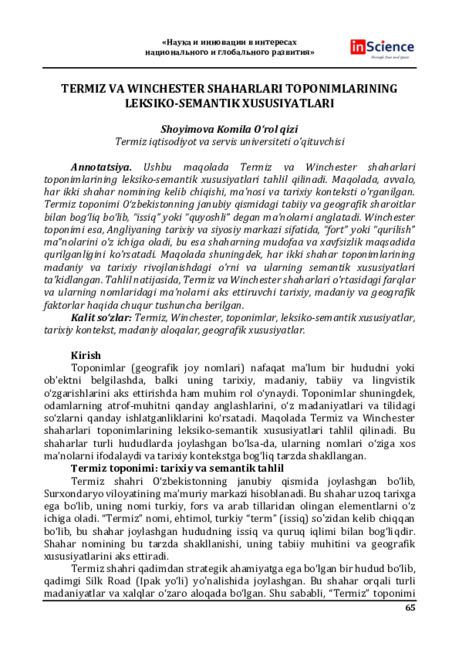 Termiz va Winchester shaharlari toponimlarining leksiko-semantik xususiyatlari
Science and innovation for national and global developmentUshbu maqolada Termiz va Winchester shaharlari toponimlarining leksiko-semantik xususiyatlari tahlil qilinadi. Maqolada, avvalo, har ikki shahar nomining kelib chiqishi, ma'nosi va tarixiy konteksti o'rganilgan. Termiz toponimi O'zbekistonning janubiy qismidagi tabiiy va geografik sharoitlar bilan bog'liq bo'lib, "issiq"yoki “quyoshli" degan ma'nolarni anglatadi. Winchester toponimi esa, Angliyaning tarixiy va siyosiy markazi sifatida, “fort"yoki "qurilish" ma"nolarini o’z ichiga oladi, bu esa shaharning mudofaa va xavfsizlik maqsadida qurilganligini ko'rsatadi. Maqolada shuningdek, har ikki shahar toponimlarining madaniy va tarixiy rivojlanishdagi o’rni va ularning semantik xususiyatlari ta'kidlangan. Tahlil natijasida, Termiz va Winchester shaharlari o'rtasidagifarqlar va ularning nomlaridagi ma'nolarni aks ettiruvchi tarixiy, madaniy va geografik faktorlar haqida chuqur tushuncha berilgan.
-
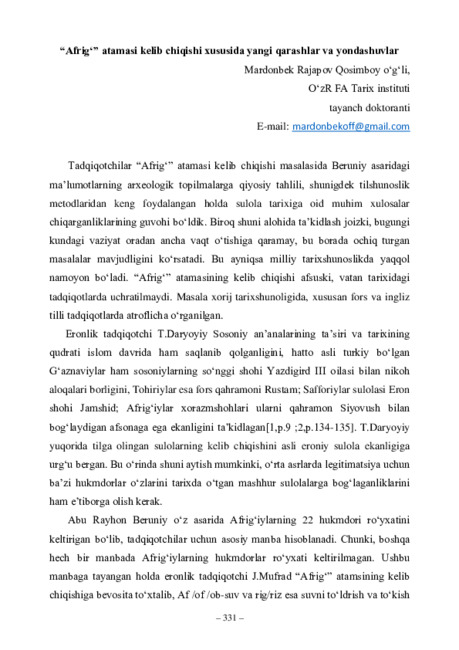
Tadqiqotchilar “Afrigʻ” atamasi kelib chiqishi masalasida Beruniy asaridagi ma’lumotlarning arxeologik topilmalarga qiyosiy tahlili, shunigdek tilshunoslik metodlaridan keng foydalangan holda sulola tarixiga oid muhim xulosalar chiqarganliklarining guvohi boʻldik. Biroq shuni alohida ta’kidlash joizki, bugungi kundagi vaziyat oradan ancha vaqt oʻtishiga qaramay, bu borada ochiq turgan masalalar mavjudligini koʻrsatadi. Bu ayniqsa milliy tarixshunoslikda yaqqol namoyon boʻladi. “Afrigʻ” atamasining kelib chiqishi afsuski, vatan tarixidagi tadqiqotlarda uchratilmaydi. Masala xorij tarixshunoligida, xususan fors va ingliz tilli tadqiqotlarda atroflicha oʻrganilgan.
-
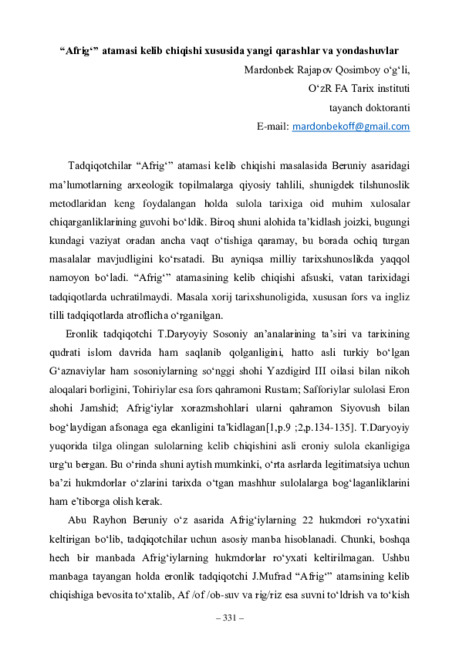 This article discusses the origin of the term Afrig'. In particular, English, Iranian, and Turkish-language studies are comparatively analyzed with Soviet-era and local research.
