All articles - Social Sciences Other Topics
-
Динамичное развитие информационной сферы и информационных технологий, либерализация средств массовой информации служат важными факторами углубления демократических преобразований в нашей стране.
-
 Иккинчи жаҳон урушининг ғалабасига Ўзбекистоннинг қўшган ҳиссаси
Prospects for the development of medicineИккинчи жаҳон урушининг қозонилган ғалабасига 76 йил бўлди. Бугунга келиб урушда қатнашган фаҳрийлар камайиб бормоқда. Биз ёшлар бу даврни ўрганишимиз, ундан тўғри сабоқ чиқаришимиз учун , бугунги глобал даврда бундай урушларга йўл бермасдан, ёшларимизни бундан ўзига тўғри хулосалар қилишлари ва соғлом турмуш тарзини танлаб ҳаёт кечиришлари учун ҳам бу мавзу долзарбдир.
-
 Opportunities to reduce the negative impact of the seasonality factor in the development of tourism
in LibraryThere are many factors which have impact whether positive or negative on the development of tourism. One clear illustration of the factors is seasonality. This factor can be recognized as the primary reason for the uneven distribution of tourists in a certain period (a year, half a year). From an economic point of view, it represents recurring fluctuations in demand with alternating peaks and valleys. Lower seasonal demand unevenness is also characteristic of medical and business tourism; different tourist regions have specific forms of seasonal demand unevenness. Therefore, we can talk about the specifics of tourist demand in a particular locality, region, country, on a global scale. The seasonality of demand is also influenced by psychological factors (traditions, imitation, fashion). Peaks and declines in tourist activity can be largely explained by the conservatism of most tourists such as the ingrained opinion that summer is the most favorable time for holidays. Seasonal fluctuations in tourist demand can lead to forced downtime of the material and technical base, give rise to social problems. Furthermore, this factor heavily influences when it comes to major tourist centers. The main aim of this paper is to research the possibilities of alleviating the negative impact of the seasonality factor in the development of tourism in Samarkand.
-
This article is devoted to assessing the impact of the processes of decentralization of powers and responsibilities from the central government level to elected authorities at the subnational level, and also calculates the various degrees of accountability upwards and downwards, and various ranges of control from the central government.
-
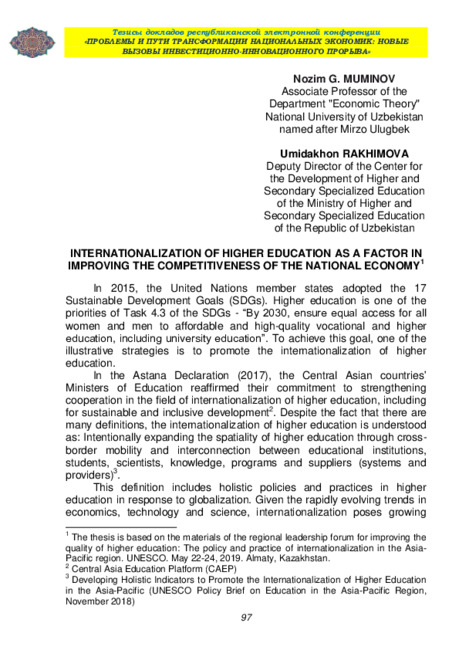 Internationalization of higher education as a factor in improving the competitiveness of the national economy
in LibraryIn 2015, the United Nations member states adopted the 17 Sustainable Development Goals (SDGs). Higher education is one of the priorities of Task 4.3 of the SDGs - ―By 2030, ensure equal access for all women and men to affordable and high-quality vocational and higher education, including university education‖. To achieve this goal, one of the illustrative strategies is to promote the internationalization of higher education. In the Astana Declaration (2017), the Central Asian countries’
Ministers of Education reaffirmed their commitment to strengthening cooperation in the field of internationalization of higher education, including for sustainable and inclusive development 2. Despite the fact that there are many definitions, the internationalization of higher education is understood
as: Intentionally expanding the spatiality of higher education through cross-border mobility and interconnection between educational institutions, students, scientists, knowledge, programs and suppliers (systems and providers)3. -
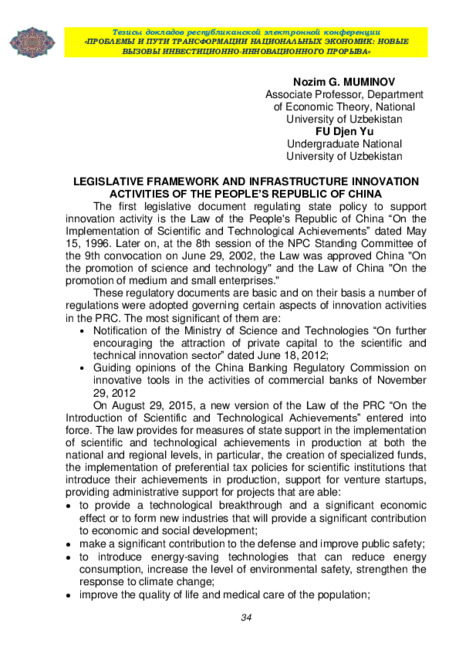 Legislative framework and infrastructure innovation activities of the people’s republic of China
in LibraryThe first legislative document regulating state policy to support innovation activity is the Law of the People's Republic of China ―On the Implementation of Scientific and Technological Achievements‖ dated May 15, 1996. Later on, at the 8th session of the NPC Standing Committee of the 9th convocation on June 29, 2002, the Law was approved China "On the promotion of science and technology" and the Law of China "On the promotion of medium and small enterprises."
-
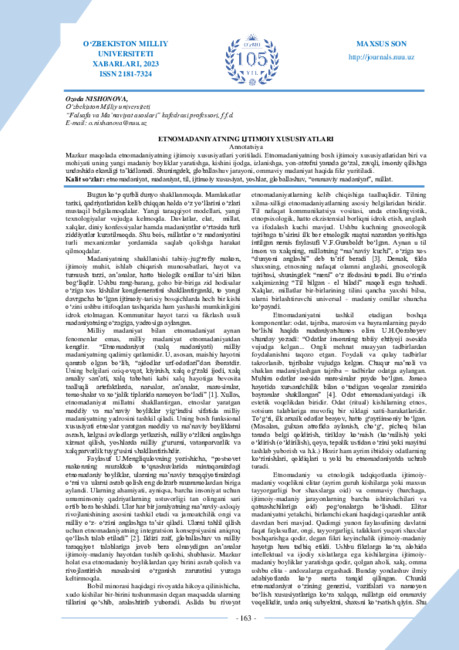
This article describes the social features of ethnoculture. It is emphasized that one of the main social characteristics and essence of ethnoculture is that it encourages people to create new cultural assets, to create, to search, to make the environment more beautiful, pleasant, and humane. The process of globalization and popular culture are also discussed.
-
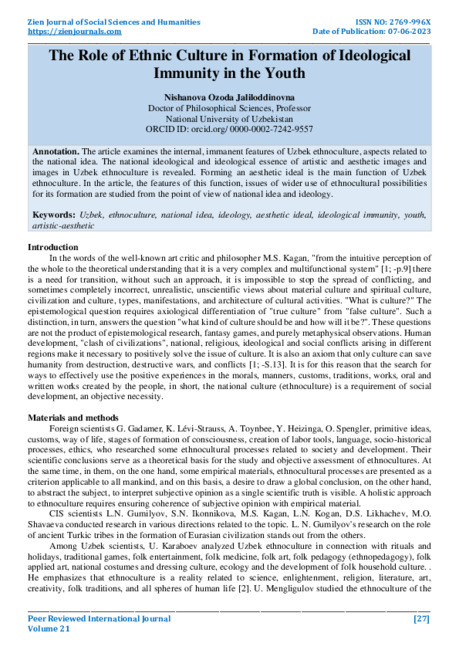
The article examines the internal, immanent features of Uzbek ethnoculture, aspects related to the national idea. The national ideological and ideological essence of artistic and aesthetic images and images in Uzbek ethnoculture is revealed. Forming an aesthetic ideal is the main function of Uzbek ethnoculture. In the article, the features of this function, issues of wider use of ethnocultural possibilities for its formation are studied from the point of view of national idea and ideology.
-
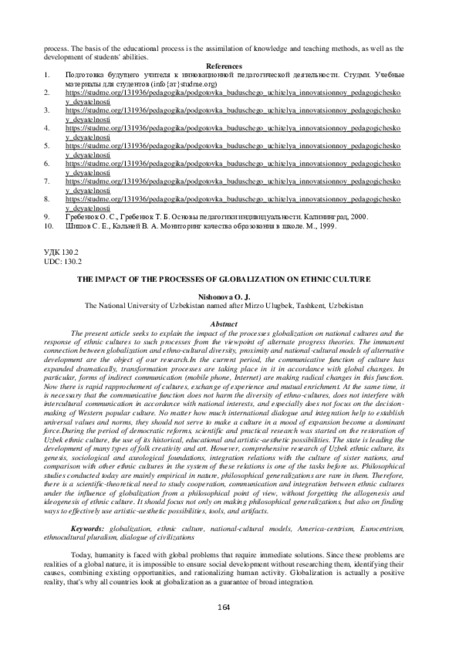
The present article seeks to explain the impact of the processes globalization on national cultures and the response of ethnic cultures to such processes from the viewpoint of alternate progress theories. The immanent connection between globalization and ethno-cultural diversity, proximity and national-cultural models of alternative development are the object of our research.In the current period, the communicative function of culture has expanded dramatically, transformation processes are taking place in it in accordance with global changes. In particular, forms of indirect communication (mobile phone, Internet) are making radical changes in this function. Now there is rapid rapprochement of cultures, exchange of experience and mutual enrichment. At the same time, it is necessary that the communicative function does not harm the diversity of ethno-cultures, does not interfere with intercultural communication in accordance with national interests, and especially does not focus on the decision-making of Western popular culture. No matter how much international dialogue and integration help to establish universal values and norms, they should not serve to make a culture in a mood of expansion become a dominant force.During the period of democratic reforms, scientific and practical research was started on the restoration of Uzbek ethnic culture, the use of its historical, educational and artistic-aesthetic possibilities. The state is leading the development of many types of folk creativity and art. However, comprehensive research of Uzbek ethnic culture, its genesis, sociological and axeological foundations, integration relations with the culture of sister nations, and comparison with other ethnic cultures in the system of these relations is one of the tasks before us. Philosophical studies conducted today are mainly empirical in nature, philosophical generalizations are rare in them. Therefore, there is a scientific-theoretical need to study cooperation, communication and integration between ethnic cultures under the influence of globalization from a philosophical point of view, without forgetting the allogenesis and ideogenesis of ethnic culture. It should focus not only on making philosophical generalizations, but also on finding ways to effectively use artistic-aesthetic possibilities, tools, and artifacts.
-
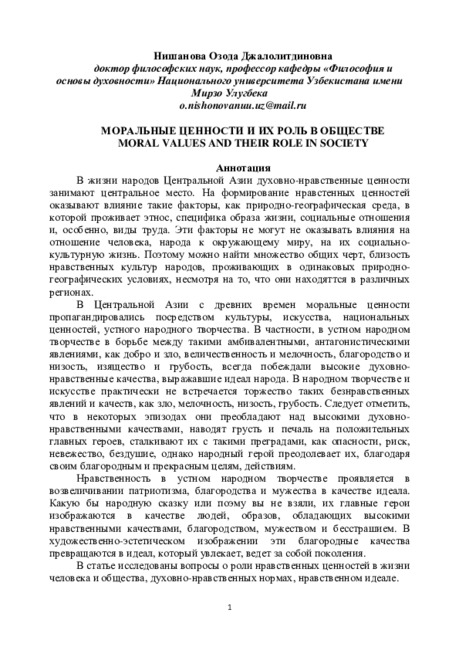
The moral-spiritual values play a central role in the life of the Central Asian Peoples. The formation of moral values is influenced by factors such as the natural and geographical environment in which the ethnos lived, the uniqueness of the lifestyle, social relations, especially the types of work. These factors cannot fail to affect the world, environment and socio-cultural life of a person, people. Therefore, there are many similarities and similarities in the moral culture of peoples who live in different regions and have the same natural and geographical environment. From the earliest times, the moral values are disseminated through culture, arts, national traditions and folklore. For instance, in the fight between goodness and evil, nobility and inferiority, nobility and inferiority, elegance and rudeness, high moral and spiritual qualities expressing the ideal of the people always prevail. It is almost rare to celebrate such immoral events and traits as evil, baseness, meanness, and rudeness in folk creativity and art. It should be noted that in some episodes they are superior to high moral and spiritual qualities, positive, they make the protagonists sad, they are exposed to danger, ignorance, arrogance, but the hero of the people overcomes them through noble and beautiful goals and actions. We can see the moral values in folklore by noticing the elevation and appraisal of patriotism, nobleness and courage in folklore. No matter which folk tale or folk epic, the main characters in them are depicted as a person with high moral qualities, noble qualities, bravery. In the artistic-aesthetic image, these noble
qualities become a social ideal that generations envy and follow. The article seeks to explore the role of ethical and moral values in individual and social life, the issues of ethical-spiritual norms and the problem of ethical ideal. -
The article examines the historical-archaeological approach to the study of ethnocultural, the mythological-religious approach, the sociolinguistic approach, the economic-formational approach, the folkloristic approach, the geographical-ethnographic approach, the socio-pedagogical approach, the artistic-aesthetic approach, the civilization approach, the sociological (sociodynamic) approach, the philosophical-cultural approaches. Also, ethnic signs, signs, components of the process of formation of Ethnos are illuminated. Subetnik-ethnic-superetnik systems of the Uzbek ethnoculture are studied.
-
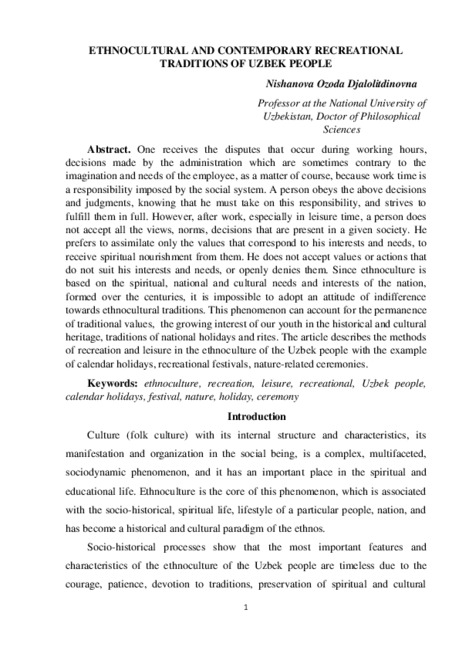
One receives the disputes that occur during working hours,
decisions made by the administration which are sometimes contrary to the imagination and needs of the employee, as a matter of course, because work time is a responsibility imposed by the social system. A person obeys the above decisions and judgments, knowing that he must take on this responsibility, and strives to
fulfill them in full. However, after work, especially in leisure time, a person does not accept all the views, norms, decisions that are present in a given society. He prefers to assimilate only the values that correspond to his interests and needs, to receive spiritual nourishment from them. He does not accept values or actions that
do not suit his interests and needs, or openly denies them. Since ethnoculture is based on the spiritual, national and cultural needs and interests of the nation, formed over the centuries, it is impossible to adopt an attitude of indifference towards ethnocultural traditions. This phenomenon can account for the permanence of traditional values, the growing interest of our youth in the historical and cultural heritage, traditions of national holidays and rites. The article describes the methods of recreation and leisure in the ethnoculture of the Uzbek people with the example of calendar holidays, recreational festivals, nature-related ceremonies. -
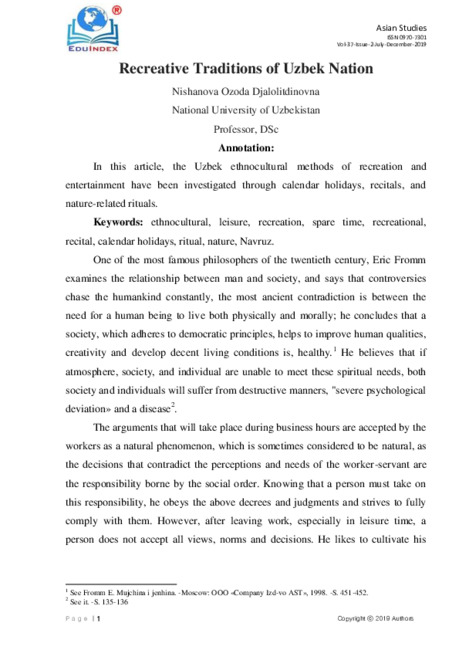
In this article, the Uzbek ethnocultural methods of recreation and entertainment have been investigated through calendar holidays, recitals, and nature-related rituals.
-
It is known that Uzbekistan is a multi-ethnic country. Today, representatives of 136 nationalities and peoples live in our country. There are also 16 religious denominations. Representatives of each nation, each denomination have their own values. Harmonizing and protecting the interests of all of them is a rather complicated task.
-
 Наука и религия: возможна ли их комплементарность?
Global partnership as a condition and guarantee of sustainable developmentМногие нынешние исследователи соотношение науки и религии рассматривают как формы общественного сознания, не имеющие общие позиции, находящиеся в контрарном состоянии, полагая, что они радикально несовместимы. А взаимосвязь их считают невозможной, ибо современное развитие науки, технологий, глобализационные процессы нс дают оснований для их совместимости. Они рассматриваются как контрарные, несовместимые формы общественного сознания, а в целом и феномены культуры.
-
 Issues of taking season and climate factors into account in the development of the tourism sector
in LibraryRapid development of the tourism sector and increasing its importance in the economy is considered one of the important tasks of the Development Strategy of the Republic of Uzbekistan. In recent years, tourism has become one of the "points of growth" of the national economy, it stimulates the growth of incomes by becoming a driver for the development of interconnected networks and has a high multiplier effect.
-
 Improving criminal law and criminological measures to combat crimes in the field of information technology and security
Catalog of dissertations and abstractsThe aim of the research consists in development of offers and recommendations about further improvement of criminal-legal and criminological measures of fight against crimes in the sphere of information technologies and safety.
The object of the research work is the system of the public relations regulating criminal-legal, criminological and organizational measures for counteraction to crimes in the sphere of information technologies and safety.
The scientific novelty of the research consists of the following:
the expediency of establishment of administrative responsibility for violation of personal privacy at compliance with the law about protection of private life, ensuring protection of the rights of citizens and also completion of legal gaps is proved;
need of establishment of responsibility for infringement of personal privacy in article 1411 Criminal Code of the Republic of Uzbekistan when ensuring criminal legal protection of personal privacy and inevitability of responsibility is proved;
for ensuring the principles of justice and humanity in the criminal legislation the expediency of awarding punishment in the form of restriction of freedom on the persons who have committed crimes in the sphere of information technologies is proved;
high degree of public danger of some crimes (illegal activities for attraction of money and (or) other property (article 1881 of CK), production, storage, distribution or demonstration of the materials containing threat of public safety and to public order (article 2441 of CK)) committed with use of networks of telecommunications and the Internet is explained;
establishment of responsibility for bringing to suicide and inducement to suicide with use of networks of telecommunications and the Internet is proved;
need of introduction of responsibility of the blogger for placement of public negative information of a certain look for the Internet is proved;
inadmissibility of use of personal data of the participants at implementation of electronic commerce for who aren't provided by the contract, need of nondisclosure of the specified data are proved;
establishment of the ban on distribution among children of the information justifying illegal behavior and promoting commission of offense, calling for promotion of the destructive ideas in society and also responsibility for the specified acts is offered;
expediency of application of a method of «confidential dialogue» concerning the persons who have committed information crimes, need of implementation of inquiry, the investigation and preventive measures proceeding from their psychological state are specified;
need of recognition of the actions exerting negative impact to life, health and morality of the personality, made with use of means of information technologies as socially dangerous act is offered.
Implementation of research results. The results of the study are used:
the proposal on establishment of administrative responsibility for violation of personal privacy has found the reflection in article 461 of the Code of the Republic of Uzbekistan about the administrative liability entered by the Law of the Republic of Uzbekistan of September 23, 2016 No. ZRU-411 (the act of Committee on the legislation and the judicial-legal matters of the Legislative Chamber of the Oliy Majlis of the Republic of Uzbekistan from September 28, 2016, No. 06/1-05/1148-vkh). This change provides compliance with the law about personal privacy, protection of the rights of citizens and also completion of a legal gap in the legislation;
the proposal on establishment of criminal liability for violation of personal privacy has found the reflection in article 1411 of the Criminal code of the Republic of Uzbekistan entered by the Law of the Republic of Uzbekistan of September 23, 2016 No. ZRU-411 (the act of Committee on the legislation and the judicial-legal matters of the Legislative Chamber of the Oliy Majlis of the Republic of Uzbekistan from September 28, 2016, No. 06/1-05/1148-vkh). Establishment of criminal liability for commission of the act breaking personal privacy provides criminal legal protection of private life of the person and inevitability of responsibility;
offers on expediency of awarding punishments in the form of restriction of freedom concerning the persons who have committed crimes in the sphere of information technologies, have found the reflection in articles 2781-2786 Criminal Code of the Republic of Uzbekistan according to the Law of the Republic of Uzbekistan from August 10, 2015 No. ZRU-389 (the act of Committee on the legislation and the judicial-legal matters of the Legislative Chamber of the Oliy Majlis of the Republic of Uzbekistan from July 2, 2018, No. 06/1-05). This offer serves purpose of alternative punishment for crimes in the sphere of information technologies;
high degree of public danger of commission of some types of crimes with use of networks of telecommunications and the Internet has found reflection in article 1881, the «g» point of third part of article 2441 Criminal Code of the Republic of Uzbekistan according to the Law of the Republic of Uzbekistan of April 25, 2016 No. ZRU-405 (the act of Committee on the legislation and the judicial-legal matters of the Legislative Chamber of the Oliy Majlis of the Republic of Uzbekistan from July 2, 2018, No. 06/1-05). According to this offer criminal liability for use of information technologies in criminal intents has been established;
responsibility for bringing to suicide, the inducement to suicide made with use of networks of telecommunications and the Internet have been established in article 103 and 1031 Criminal Code of the Republic of Uzbekistan according to the Law of the Republic of Uzbekistan of June 13, 2017 No. ZRU-436 (the act of Committee on the legislation and the judicial-legal matters of the Legislative Chamber of the Oliy Majlis of the Republic of Uzbekistan from July 2, 2018, No. 06/1-05). This offer has served establishment of criminal liability for the information attacks encroaching on human life;
regulations on responsibility of the blogger for dissemination of public negative information of some look on the Internet are introduced in articles 3 and 121 of the Law of the Republic of Uzbekistan from December 11, 2003 No. 560-II «About informatization» (the act of Committee on questions of innovative development, information policy and information technologies of the Legislative Chamber of the Oliy Majlis of the Republic of Uzbekistan from July 2, 2018, No. 05/2-01-71). This offer serves prevention of various crimes committed with use of the Internet;
offers on inadmissibility of use of personal data of the participants at implementation of electronic commerce for who aren't provided by the contract need of nondisclosure of the specified data have found the reflection in article 18 of the Law of the Republic of Uzbekistan of May 22, 2018 No. ZRU-385 «About electronic commerce» (the act of Committee on questions of innovative development, information policy and information technologies of the Legislative Chamber of the Oliy Majlis of the Republic of Uzbekistan from July 2, 2018, No. 05/2-01-71). This offer became a basis for the ban illegal use of personal data from participants of electronic commerce;
offers on establishment of the ban on distribution among children of the information justifying illegal behavior and promoting commission of offense, calling for promotion of the destructive ideas in society and also responsibility for the specified acts are introduced in article 16 of the Law of the Republic of Uzbekistan of September 8, 2017 No. ZRU-444 «About protection of children from information doing harm to their health» (the act of Committee on questions of innovative development, information policy and information technologies of the Legislative Chamber of the Oliy Majlis of the Republic of Uzbekistan from July 2, 2018, No. 05/2-01-71). This offer has served recognition of dissemination of information among children of information doing harm to their health as illegal behavior;
offers on improvement of criminal liability for crimes in the sphere of information technologies and safety have been used by preparation of analytical notes within the Concept of improvement of the criminal and criminal procedure legislation approved by the resolution of the President of the Republic of Uzbekistan of May 14, 2018 No. PP-3723 (the act of Committee on questions of innovative development, information policy and information technologies of the Legislative Chamber of the Oliy Majlis of the Republic of Uzbekistan from July 2, 2018, No. 05/2-01-71). This offer serves a proving of inevitability of responsibility for crimes in the sphere of information technologies and information security;
offers on expediency of application of a method of «confidential dialogue» concerning the persons who have committed information crimes, need of implementation of inquiry, the investigation and preventive measures proceeding from their psychological state have been introduced in activity of the relevant structural divisions of the Ministry of Internal Affairs of the Republic of Uzbekistan (the act of the Ministry of Internal Affairs of the Republic of Uzbekistan from July 2, 2018 No. 33/1985). This offer has served increase in efficiency of prevention of crimes in the sphere of information technologies and information security;
offers on need of definition of external influence, level of competence and practical skills of employees, motives of offense when studying the reasons of crimes in the sphere of information technologies and information security and also conducting monitoring of social networks have been introduced in activity of the relevant structural divisions of the Ministry of Internal Affairs of the Republic of Uzbekistan (the act of the Ministry of Internal Affairs of the Republic of Uzbekistan from July 2, 2018 No. 33/1985). This offer has served definition of the reasons and early warning of crimes in the sphere of information technologies and information security;
offers that the information security is object of criminal legal protection taking into account its direct connection with the state interests have found the reflection in the Law of the Republic of Uzbekistan «About modification and additions in the Law of the Republic of Uzbekistan «About the principles and guarantees of freedom of information» (the act of the Center of information security and assistance in ensuring public order at the Ministry of information technology development and communications of the Republic of Uzbekistan from November 13, 2017 No. 03-07-02/124). This offer has served protection of information security as object of criminal legal protection;
offers on need of implementation of complex measures from law enforcement agencies for ensuring information security at information security have found the reflection in the Law of the Republic of Uzbekistan «About modification and additions in the Law of the Republic of Uzbekistan «About the principles and guarantees of freedom of information» (the act of the Center of information security and assistance in ensuring public order at the Ministry of information technology development and communications of the Republic of Uzbekistan from November 13, 2017 No. 03-07-02/124). This offer has provided orientation of activity of law enforcement agencies on information security;
offer that threats of information security exert essential harm to the interests of the personality, society and state information have found the reflection in the Law of the Republic of Uzbekistan «About modification and additions in the Law of the Republic of Uzbekistan «About the principles and guarantees of freedom of information» (the act of the Center of information security and assistance in ensuring public order at the Ministry of information technology development and communications of the Republic of Uzbekistan from November 13, 2017 No. 03- 07-02/124). This offer has allowed to estimate high degree of public danger of information threats as a factor of commission of information crimes;
the rule about protection of the personality against illegal information influence taking into account that impact on consciousness of the personality with use of means of information technologies exerts negative impact on life, health and morality of the personality, has found the reflection in the Law of the Republic of Uzbekistan «About modification and additions in the Law of the Republic of Uzbekistan «About the principles and guarantees of freedom of information» (the act of the Center of information security and assistance in ensuring public order at the Ministry of information technology development and communications of the Republic of Uzbekistan from November 13, 2017 No. 03-07-02/124). This offer has served recognition of the specified actions as socially dangerous act.
Structure and volume of the dissertation. The thesis consists of an introduction, four chapters, a conclusion, a list of used literature and applications. The volume of the thesis is 260 pages.
-
 Талаба-ёшларнинг инновацион тафаккурини юксалтиришда таълим тизимининг ўрни ва аҳамияти
Global partnership as a condition and guarantee of sustainable developmentЖаҳон миқёсидаги глобаллашув тизимида иқтисодий ресурсларнинг энг муҳим манбалари сифатида билим ва инновациялардан фойдаланиш асосида ижтимоий ишлаб чиқариш самарадорлиги ўсиши янги парадигмаси шаклланмоқда. Узбекистон ҳам жаҳон иқтисодий тизимига кирган ҳолда, давом этаётган жараёнлардан четда қолиши мумкин эмас, шунинг учун тегишли иқтисодиётни яратиш бўйича инновацион стратегияни ишлаб чиқиш XXI асрнинг биринчи ярмида унинг ривожланишининг асосий йўналиши ҳисобланади. Бундай шароитда мамлакатнинг инновацион ривожланиш стратегиясини шакллантиришнинг фалсафий асосига айланадиган яхлит қарашлар тизимини ишлаб чиқишни тақозо этади. Бундай яхлит тизим, бизнинг фикримизча, дунёқараш позициясига асосланиши керак, унинг ичида инсон ҳар қандай ривожланишнинг асосий манбаи сифатида тан олинади ва шу билан бирга ҳар доим эришилган ижтимоий муносабатларнинг натижаси ҳисобланади.
-
 Ёшларнинг миллий ғурур руҳида тарбиялашда оиланинг ўрни
Global partnership as a condition and guarantee of sustainable developmentУзбек халқи ўзининг неча минг йиллик тарихига эга. Ҳар қандай миллат ўз тарихи давомида ўзининг аждодлари қандай инсон бўлганини, уларнинг яшаш тарзини билмоги ва шу билан бирга тарихий меросини ҳам авайлаб асрамоги керак.
-
The article discusses the impact of the environmental situation in the Aral Sea region on the health of the population. The data of the analysis of environmental factors are presented.
-
 Baudrillard’s views on consumer society and its present implications
Global partnership as a condition and guarantee of sustainable developmentThe contemporary culture and society is marked by plurality, diversion, intense fragmentation, and indirection. It can be discovered that it is mass media that create demands and seduction of objects and ultimately make the contemporary society a powerful consumer society. Media have shaken the very foundation of postmodern culture, giving a new direction to reality. The relationship between the real and simulacra has undergone a sea change in the contemporary society. Now the very concept of a true copy is thrown into the wind. Models and simulacra have become reality. In the postmodern media and consumer society, everything becomes an image, a sign, a spectacle, a trans aesthetic, and trans-political. The present paper makes an investigation on the four points — (1) postmodern society is the society of communication established by mass media (2) postmodern society is a consumer society and (3) the culture of postmodern society is based on simulation, simulacra, or hyper-reality, and (4) postmodern society is nearing the fractal order. It also seeks to describe various postmodern trends in present Uzbekistan, the efficacy of the reforms in the social sphere and the need to be more conscious of the various side effects of the formation of westerntype consumer society.
-
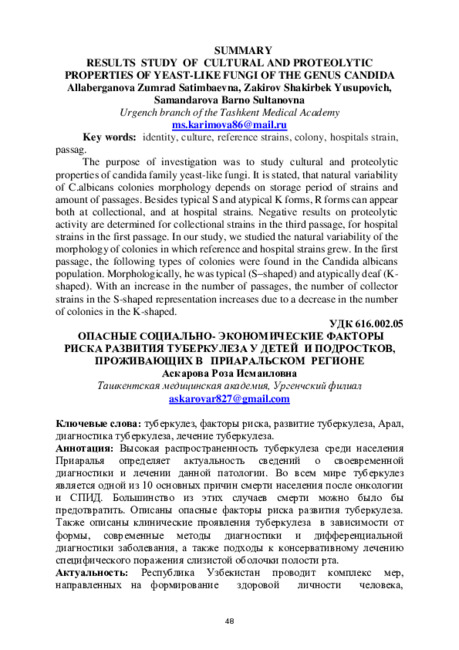 Dangerous socio-economic risk factors for the development of tuberculosis in children and adolescents living in the Aral Sea region
in LibraryHigh prevalence of tuberculosis among the population The Aral Sea region determines the relevance of information about the timely diagnosis and treatment of this pathology. Tuberculosis is one of the top 10 causes of death worldwide after oncology and AIDS. Most of these deaths could have been prevented. Dangerous risk factors for the development of tuberculosis are described. It also describes the clinical manifestations of tuberculosis depending on the form, modern methods of diagnosis and differential diagnosis of the disease, as well as approaches to the conservative treatment of a specific lesion of the oral mucosa.
-
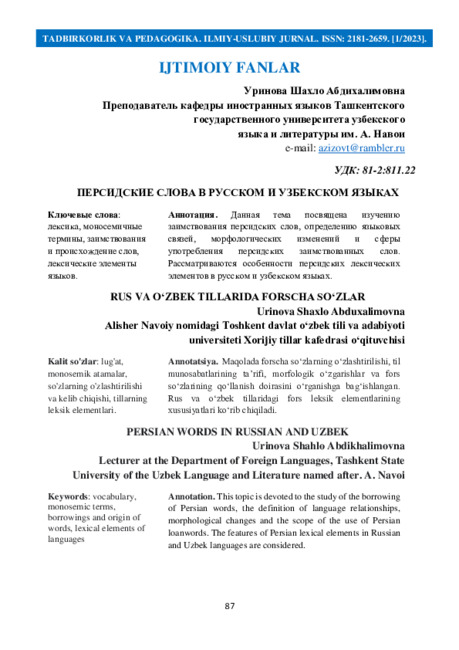
This topic is devoted to the study of the borrowing of Persian words, the definition of language relationships, morphological changes and the scope of the use of Persian loanwords. The features of Persian lexical elements in Russian and Uzbek languages are considered.
-
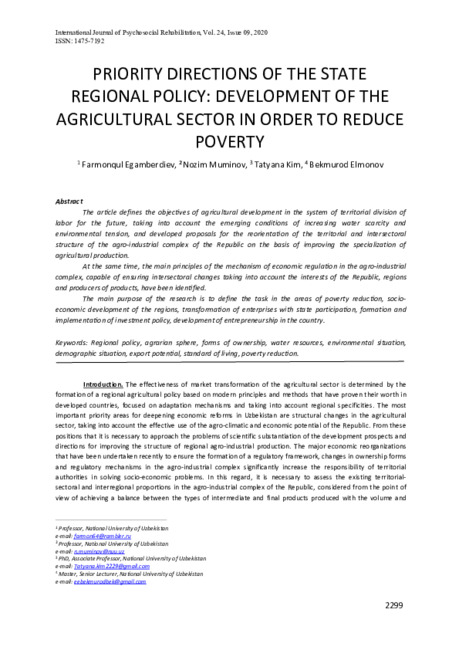 Priority directions of the stateregional policy: development of the agricultural sector in order to reduce poverty
in LibraryThe article defines the objectives of agricultural development in the system of territorial division of labor for the future, taking into account the emerging conditions of increasing water scarcity and
environmental tension, and developed proposals for the reorientation of the territorial and intersectoral structure of the agro-industrial complex of the Republic on the basis of improving the specialization of agricultural production.
At the same time, the main principles of the mechanism of economic regulation in the agro-industrial complex, capable of ensuring intersectoral changes taking into account the interests of the Republic, regions and producers of products, have been identified.
The main purpose of the research is to define the task in the areas of poverty reduction, socio-economic development of the regions, transformation of enterprises with state participation, formation and
implementation of investment policy, development of entrepreneurship in the country. -
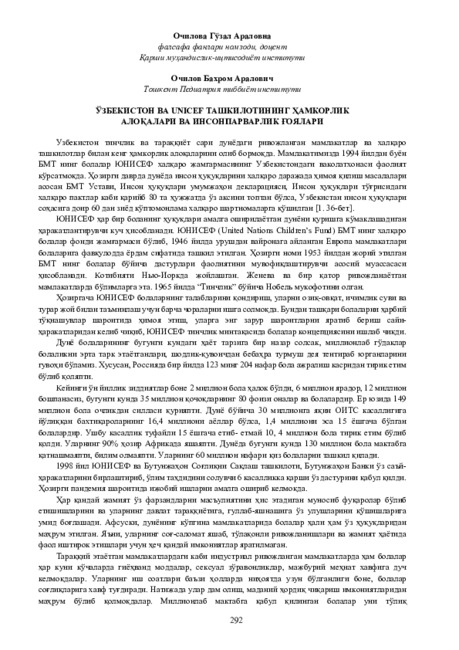 Ўзбекистон вa UNICEF ташкилотининг ҳамкорлик алоқалари ва инсонпарварлик ғоялари
Global partnership as a condition and guarantee of sustainable developmentУзбекистон тинчлик ва тараққиёт сари дунёдаги ривожланган мамлакатлар ва халқаро ташкилотлар билан кенг ҳамкорлик алоқаларини олиб бормоқда. Мамлакатимизда 1994 йилдан буён БМТ нинг болалар ЮНИСЕФ халқаро жамгармасининг Узбекистондаги ваколатхонаси фаолият кўрсатмоқда. Ҳозирги даврда дунёда инсон ҳуқуқларини халқаро даражада ҳимоя қилиш масалалари асосан БМТ Устави, Инсон ҳуқуқлари умумжаҳон декларацияси, Инсон ҳуқуқлари тўғрисидаги халқаро пактлар каби қарийб 80 та ҳужжатда ўз аксини топтан бўлса, Узбекистан инсон ҳуқуқлари соҳасига доир 60 дан зиёд кўптомонлама халқаро шартномаларга қўшилган [1. 36-бет].
